Gartner surveyed 360 organizations in Q2 2025 and found that those running a dedicated AI governance platform were 3.4 times more likely to achieve high effectiveness in AI governance than those that weren’t. That same year, IBM’s breach study found that 63% of breached organizations either had no AI governance policy or were still developing one.
Whether to buy is settled. What to buy isn’t. Gartner’s first Magic Quadrant for AI Governance Platforms (June 16, 2026) evaluated 13 vendors, and they solve noticeably different problems. This guide compares the best tools for enterprise AI governance on the four jobs a platform has to do.

Get the short answer
- Need policy enforced on every agent and model call, inside your own cloud? Pick Lyzr Opencontroller. It refuses a call before the action happens and keeps the record.
- Running a large, regulated estate across cloud and on-premises? Pick IBM watsonx.governance, with accelerators that include SR 11-7 and the EU AI Act.
- Already run IT, risk and security on ServiceNow? Pick ServiceNow AI Control Tower.
- Governance is owned by risk and compliance, not engineering? Pick Credo AI for its policy packs.
- Your privacy program already lives in OneTrust? Pick OneTrust AI Governance.
- Want governance built into how models and agents ship? Pick ModelOp.
- Need red teaming and bias testing next to compliance evidence? Pick Holistic AI.
Four jobs of an AI governance platform
Most buying mistakes come from assuming a tool does all four of these.
- Know: Keep a live inventory of every model, GenAI app, vendor AI feature and agent, with an owner and a risk tier. That includes the shadow AI nobody registered.
- Map: Turn frameworks such as the EU AI Act, NIST AI RMF and ISO/IEC 42001 into controls that apply to specific systems.
- Prove: Produce evidence on demand: risk assessments, approvals, test results and a usable audit trail.
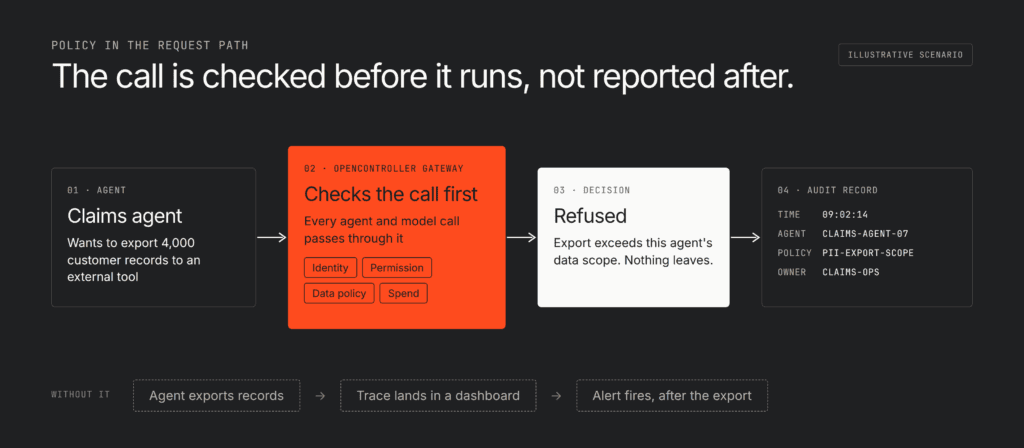
- Enforce: Stop a system that breaks policy, in the moment, by refusing a call, restricting a permission or capping spend.
Most platforms here grew up doing the first three for predictive models, where a quarterly review was a fine pace. Agents broke that pace: one that calls tools can break policy in seconds, and next quarter’s finding doesn’t undo it. Our view is blunt. A registry with no enforcement is a well-organized spreadsheet, and that stops being enough once agents touch customers or money.

Why 2026 turned AI governance into a buying decision
The regulatory calendar firmed up: The EU’s Digital Omnibus on AI, published in the Official Journal on July 24, 2026, pushed obligations for standalone high-risk systems to December 2, 2027 and for AI embedded in regulated products to August 2, 2028. The delay is real, but the Article 50 transparency duties kept their August 2, 2026 start. Use the extra time to build evidence; nobody assembles an AI Act file in the final quarter.
Analysts made it a category: Gartner expects spending on AI governance to reach $492 million in 2026 and pass $1 billion by 2030, as AI regulation extends to 75% of the world’s economies. It also expects large enterprises to run an average of 10 GRC technology solutions by 2028, up from 8 in 2025. So pick a platform that replaces work, not one more console.
The cost of skipping it got a number: In IBM’s 2025 Cost of a Data Breach Report, 13% of organizations reported breaches of AI models or applications, and 97% of those had no AI access controls in place. Organizations with high levels of shadow AI saw breach costs $670,000 higher on average.
See how we scored enterprise AI Governance tools
We assessed each tool from public documentation and announcements as of October 2026. Lyzr publishes this guide and is listed first; where another tool is the better call, we say so.
| Dimension | What we checked |
|---|---|
| Inventory and discovery | Registry of models, apps, vendors and agents, plus shadow AI detection |
| Regulatory mapping | Pre-built policy packs for the EU AI Act, NIST AI RMF, ISO/IEC 42001 |
| Evidence and audit | Risk assessments, approvals, audit trails an examiner will accept |
| Spend controls | Per-agent limits on model and tool spend |
| Agent governance | Agent registry, identity and permissions |
| Runtime enforcement | Whether a policy can refuse or restrict a live call |
| Deployment | SaaS, own cloud or on-premises |

Seven tools for enterprise AI governance
1. Lyzr Opencontroller: governance that acts on the live call
Opencontroller was built for the fourth job. It discovers agents, models, tools, data and workflows across your estate, including unregistered agents running in clusters, the three major clouds and employee devices. Then it sits in the path. Two gateways, one for agent invocations and one for model calls, check every call, so identity, permissions and spend limits apply before an action happens rather than after. Lyzr measures the added latency at about 11 ms.
It runs in your own cloud account (AWS, GCP or Azure) or on-premises, air-gapped if needed, with no traffic to the vendor. It governs agents already built on LangGraph, CrewAI, Google ADK, the OpenAI Agents SDK or hand-written code, with no proprietary SDK. Ordered promotion, separation of duties on production and EU AI Act mapping cover the evidence side.
Pick it if you are
- Running agents that move money, change records or talk to customers.
- Required to keep governance data and traffic inside your own cloud.
Skip it if you are
- Mainly building a compliance program for predictive models and vendor AI. IBM, Credo AI or OneTrust cover intake, policy packs and vendor risk more fully.
- Looking for a tool that Gartner has placed in its 2026 Magic Quadrant. Lyzr wasn’t evaluated.
Not sure how many agents are already running without an owner? The free AI Agent Sprawl Audit gives you a starting count.
2. IBM watsonx.governance: the safe pick for regulated, hybrid estates
A Leader in Gartner’s 2026 Magic Quadrant, watsonx.governance is built for regulated industries. A governance graph links AI systems to their risks, controls and policies, and shadow AI detection finds unapproved use. Its compliance accelerators, an add-on, cover 12 frameworks including the EU AI Act, ISO/IEC 42001, NIST AI RMF and the Federal Reserve’s SR 11-7 model risk guidance. Integration with Guardium AI Security brings the security team into the same workflow.
Deployment: SaaS or on-premises; also sold through AWS Marketplace, with Azure integration.
Best for: regulated enterprises with model risk teams and hybrid infrastructure.
Not ideal if: you want a lightweight tool for a small team.
3. ServiceNow AI Control Tower: governance where the tickets already live
Also a Gartner Leader, ServiceNow moved Control Tower well past inventory in May 2026. The update added 30 integrations across AWS, Google Cloud, Azure, SAP, Oracle and Workday, five risk frameworks aligned to NIST and the EU AI Act, agent observability from its Traceloop acquisition, and identity governance through Veza. ServiceNow says Control Tower can detect an agent operating beyond its permissions and “shut it down in real time.” ServiceNow slated those enhancements for general availability in August 2026, so ask for production references.

Deployment: part of the ServiceNow AI Platform.
Best for: companies that already run IT, risk and security workflows on ServiceNow.
Not ideal if: ServiceNow isn’t already your system of record.
4. Credo AI: policy-first governance for risk teams
Credo AI, a Visionary in Gartner’s 2026 Magic Quadrant and a Leader in Forrester’s Q3 2025 AI governance Wave, is built for people who write policy rather than code. Policy packs cover the EU AI Act, NIST AI RMF, ISO/IEC 42001, Colorado’s AI rules and NAIC guidance. Its registry includes agent cards and shadow AI detection, and a vendor portal handles third-party AI assessments. Agent Governor, its agent-specific layer, is still a research preview.
Deployment: available through AWS Marketplace and Microsoft Marketplace.
Best for: governance led by risk, legal and compliance teams.
Not ideal if: you need policy enforced on live agent traffic today.
5. OneTrust AI Governance: an extension of the privacy program
OneTrust’s March 2026 release added continuous detection and inventory of agents, models and datasets, a policy library with standards-aligned templates, and guardrail enforcement that checks configurations and flags violations in real time. Gartner named it a Visionary. The real advantage is context: it sits on the same platform as OneTrust’s privacy and third-party risk products, so AI reviews can start from records your teams already keep.
Deployment: OneTrust platform.
Best for: privacy-led organizations that want AI governance next to data governance.
Not ideal if: engineering, not privacy, owns your AI risk.
6. ModelOp: governance built into delivery
ModelOp, a Gartner Visionary, embeds governance into the end-to-end AI lifecycle, across ML, GenAI, agentic AI and embedded vendor AI. MADE, launched in June 2026, lets enterprises plug their own agents into governed delivery workflows. AI FinOps tracks token usage through LLM provider integrations and alerts on material spend increases.
Deployment: confirm hosting options with ModelOp.
Best for: enterprises managing hundreds of AI use cases through a formal release process.
Not ideal if: you mainly need a register and a policy library.
7. Holistic AI: testing and compliance in one place
Holistic AI, the only Challenger in Gartner’s 2026 Magic Quadrant, combines discovery and inventory with technical testing most governance tools leave to others: automated bias, privacy and transparency testing, agentic red teaming for jailbreaks and hallucination, and an Agent Graph that maps agents, tools and data flows. Its Operative Agents step in inline to govern which tools an AI calls, what it can access and how much it can spend, which puts it closer to runtime than most of its peers.
Integrations: AWS, Azure, Google Cloud, Databricks, MLflow, LangGraph, CrewAI and more; confirm hosting options with Holistic AI.
Best for: teams that want test results and compliance evidence in the same record.
Not ideal if: you want a lightweight intake-and-register tool.
Compare all tools side by side
| Capability | Lyzr | IBM | ServiceNow | Credo AI | OneTrust | ModelOp | Holistic AI |
|---|---|---|---|---|---|---|---|
| AI inventory and shadow AI discovery | ✅ | ✅ | ✅ | ✅ | ✅ | ◐ | ✅ |
| Regulatory framework mapping | ◐ | ✅ | ✅ | ✅ | ✅ | ◐ | ✅ |
| Evidence and audit trail | ✅ | ✅ | ✅ | ✅ | ✅ | ✅ | ✅ |
| Agent identity and permissions | ✅ | ❗ | ✅ | ◐ | ◐ | ❗ | ◐ |
| Refuses a policy-breaking call before it executes | ✅ | ❗ | ◐ | ❗ | ◐ | ❗ | ◐ |
| Per-agent spend controls | ✅ | ❗ | ◐ | ❗ | ❗ | ◐ | ✅ |
| Runs in your own cloud account, air-gapped option | ✅ | ◐ | ❗ | ❗ | ❗ | ❗ | ❗ |
Key: ✅ full support · ◐ partial support · ❗not documented publicly or not the focus. Editorial assessment, October 2026, based on public documentation. ServiceNow shuts an agent down once detected beyond its permissions; ModelOp alerts on spend rather than capping it.
The Magic Quadrant vendors are strongest at knowing, mapping and proving, and differ mostly in whose workflows they fit. Enforcement on the live call is where coverage thins. Expect to run two layers: a program platform for policy and evidence, and a control plane for agents in production. If your concern is agents specifically, our guide to AI agent governance tools goes deeper.
Ask these four questions in every demo
- “Show me something you found that we didn’t register.” Intake forms never catch shadow AI.
- “Take one EU AI Act article and show me the control, the system it applies to and the evidence.” Policy packs vary a lot in depth.
- “An agent tries to do something it shouldn’t. What happens in the next second?” If the answer is an alert, write that down.
- “Where does our governance data live?” For many regulated buyers, the hosting answer ends the evaluation early.
For a fuller evaluation plan, The CIO Guide to AI Agent Governance sets out the owners and controls to have in place before you sign.
See Opencontroller enforce your policies
If you need a register and a policy library, any Magic Quadrant vendor above is a sound choice. Once agents act on customers, money or records, a policy also needs a consequence. Opencontroller adds it, inside your own cloud, for agents built on Lyzr or any other framework.
Book a demo of Opencontroller →
FAQ
AI governance covers every AI system, including predictive models, GenAI apps and vendor AI, mostly through inventory, policy and evidence. Agent governance focuses on systems that take actions, so identity, permissions and runtime enforcement matter more.
No. It’s a voluntary management-system standard. Certification can show customers and regulators that your program runs in practice, and most tools above map controls to it.
It can. It covers AI placed on the EU market or whose output is used in the EU, wherever the provider sits. A US lender scoring EU applicants can be in scope.
No, it’s voluntary. It organizes AI risk work into four functions: Govern, Map, Measure and Manage, and most tools above ship it as a policy pack.
Book A Demo: Click Here
Join our Slack: Click Here
Link to our GitHub: Click Here