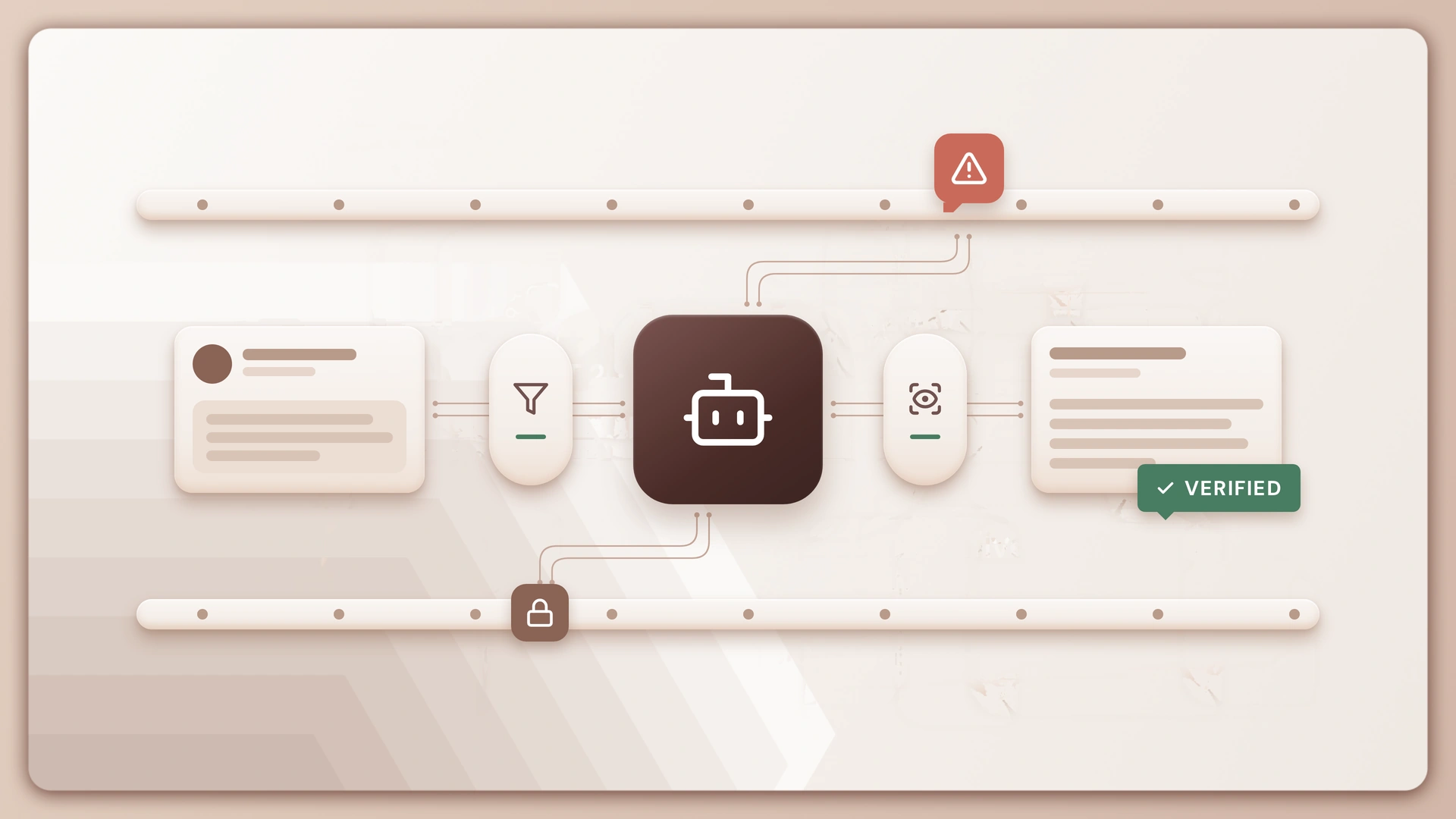
AI agent guardrails are relatively straightforward to evaluate when an agent only generates text. The decision gets more complicated as soon as the agent can retrieve documents, read customer records, call APIs, update business systems, send emails, approve transactions, or trigger another agent.
At that point, prompt-injection detection is only one part of the problem.
The more useful question is: What can this guardrail actually see, and can it stop the action that matters before that action executes?
That question gives you a much better way to compare AI agent guardrail tools. Instead of counting features, you can look at where a control runs, what information it can inspect, what it can block, and how close it sits to the action that could cause damage.
This guide compares eight AI agent guardrail tools across those dimensions. It also shows how the right shortlist changes for chatbots, RAG agents, tool-using agents, and multi-agent enterprise environments.
Quick answer: which guardrail tools should you evaluate?
There is no single guardrail layer that covers every failure mode. The right shortlist depends on where your highest-impact risk occurs.
| If your primary requirement is… | Tools to evaluate | Why they belong on the shortlist |
| Prompt injection and jailbreak detection | Lakera Guard | Focused protection for adversarial prompts and jailbreak attempts |
| Programmable controls across an LLM application | NVIDIA NeMo Guardrails | Supports input, retrieval, dialog, execution, and output rails |
| Python-native validation | Guardrails AI | Application-level validators and structured-output controls |
| Broad input, output, and agentic checks | Future AGI | Broad guardrail coverage across several safety and quality checks |
| Multi-provider AI gateway | Bifrost by Maxim AI | Central gateway with integrations across model and guardrail providers |
| AWS-native applications | Amazon Bedrock Guardrails | Managed controls that can be associated with Bedrock inference, agents, and knowledge bases |
| Azure-native applications | Azure AI Content Safety | Content filtering plus Prompt Shields for user and document attacks |
| Runtime governance and action control | Lyzr Open Controller | Focuses on agent identity, ownership, permissions, policy, spend, and consequential actions |
The key distinction is between screening a request and controlling an agent.
A gateway can detect a malicious prompt before the model sees it. A runtime control layer can decide whether an agent should be allowed to execute a particular tool call. Those are different control points, and production agents can need both.
1. Start with the failure you need to prevent
Before comparing vendors, define what could actually go wrong with the agent you are buying or building.
Finish this sentence:
“The agent could cause real damage if it ______.”
The answer should point you toward the control you need.
| Failure mode | Control to evaluate |
| The agent accepts a malicious user prompt | Input protection |
| The agent follows instructions hidden inside a document | Retrieval and content protection |
| The agent returns sensitive customer information | Output and PII controls |
| The agent calls an approved tool with unsafe arguments | Tool-call controls |
| The agent keeps taking actions across multiple steps | Runtime and trajectory controls |
| The agent consumes excessive model or tool spend | Budgets and runtime limits |
| Nobody can clearly identify who owns an agent | Identity, ownership, and governance |
This distinction matters because the same agent can have several risks at once.
For example, a customer-service agent might receive a malicious prompt, retrieve a poisoned knowledge-base article, generate an apparently safe response, and then call a refund API with the wrong amount. A single input classifier would only see part of that sequence.
A 30-second guardrail check
Before looking at vendors, answer these five questions for the agent you are actually evaluating:
| Question | Your answer |
| What is the highest-impact action this agent can take? | __________________ |
| Which tools and APIs can it call? | __________________ |
| Can untrusted content enter its context? | __________________ |
| Where should a risky action be blocked? | __________________ |
| Who owns the agent when something goes wrong? | __________________ |
If the last two answers are unclear, the problem is probably larger than content safety. You are evaluating runtime governance and control, not just prompt filtering.
Placement comes before the vendor shortlist
Once you know the failure mode, the next question is where the guardrail needs to sit.
A useful production architecture has three broad control points: the gateway, application middleware, and the agent runtime.
| Layer | What it can see | What it can protect | What it can miss |
| Gateway | Model requests and responses | Prompt injection, jailbreaks, harmful content, PII, policy violations | Agent reasoning, tool selection, action arguments |
| Application middleware | Application state and business logic | Conversation rules, structured outputs, application-specific policies | Traffic or actions that bypass the application layer |
| Agent runtime | Agent trajectory, tool choice, arguments, permissions, and actions | Tool authorization, action limits, identity, approvals, spend, runtime policy | Controls that live completely outside the runtime |
The placement changes what the control can actually enforce.
Consider a simple request:
“Refund this customer.”
A gateway may correctly determine that the language is harmless. But the agent could still select the wrong customer or generate a dangerous amount:
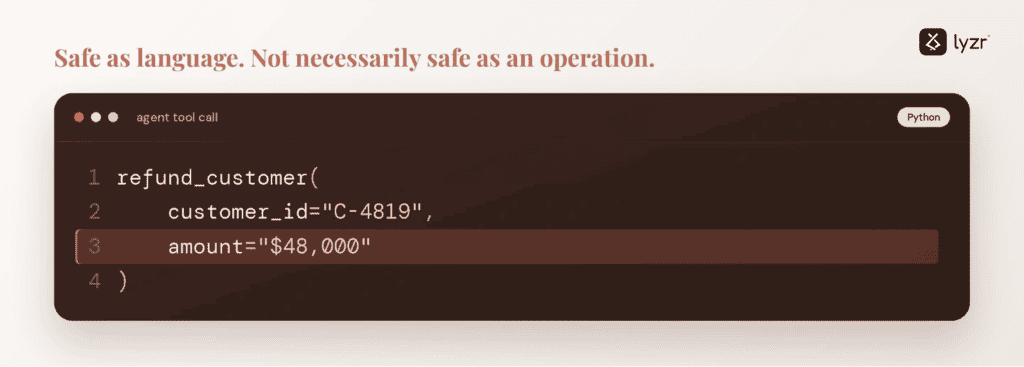
The request is safe as language. The action is not necessarily safe as an operation.
That is why tool authorization and argument validation need to happen close enough to the action to inspect what the agent is actually trying to execute.
NVIDIA’s current NeMo Guardrails documentation illustrates this layered model directly. Its rail types cover input, retrieval, dialog, execution, and output stages, with execution rails specifically controlling tool and action calls. NVIDIA NeMo Guardrails documentation
Eight AI agent guardrail tools to evaluate
The tools below are easier to compare once the control points are clear. Each section focuses on the same questions: where the tool fits, what it controls, where it has a boundary, and what kind of deployment it makes sense for.
1. Lyzr Open Controller: runtime control for agents
Lyzr Open Controller sits at the agent control and governance layer rather than trying to replace every content-safety classifier.

Its focus is on giving enterprises visibility and control over agents across frameworks, clouds, models, and runtimes, with controls around identity, ownership, permissions, policy, spend, and agent actions.
Where it fits
| Capability | Lyzr Open Controller |
| Agent discovery | Yes |
| Agent identity and ownership | Yes |
| Runtime policy | Yes |
| Tool and action control | Yes |
| Spend and cost controls | Yes |
| Multi-framework | Yes |
| Multi-cloud | Yes |
| On-premises or customer environment | Supported |
| Gateway prompt classification | Not its primary role |
| Developer tracing | Complementary to dedicated observability tools |
The distinction is important. The primary use case is not simply filtering every unsafe sentence. It is establishing boundaries around what an agent is allowed to do and enforcing those boundaries while the agent operates.
That becomes more relevant when an agent can call tools such as:

The key evaluation question is
Can the control layer stop the call based on the agent identity, permissions, arguments, and policy before execution?
If the answer is no, a separate runtime control layer may be necessary even when the existing input and output guardrails are strong.
2. Lakera Guard: focused prompt injection and jailbreak defense
Lakera Guard addresses a narrower part of the problem: detecting adversarial inputs such as prompt injection and jailbreak attempts.
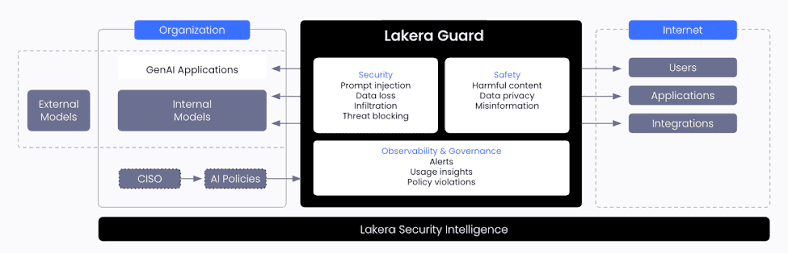
That makes it useful when the immediate gap is malicious input reaching the model rather than controlling everything an agent can do after the model responds.
| Best fit | What to check |
| Prompt injection detection | Does it cover the attack patterns relevant to your application? |
| Jailbreak detection | How does detection behave on your own attack set? |
| Customer-facing applications | What latency does screening add at expected traffic levels? |
| High-volume input screening | What downstream controls are still required for actions? |
The important boundary is that prompt-defense coverage does not automatically become tool authorization.
Use it when: malicious input is one of your primary risks.
Do not treat it as: a complete runtime governance layer for an agent that can change business systems.
3. NVIDIA NeMo Guardrails: programmable controls across the application flow
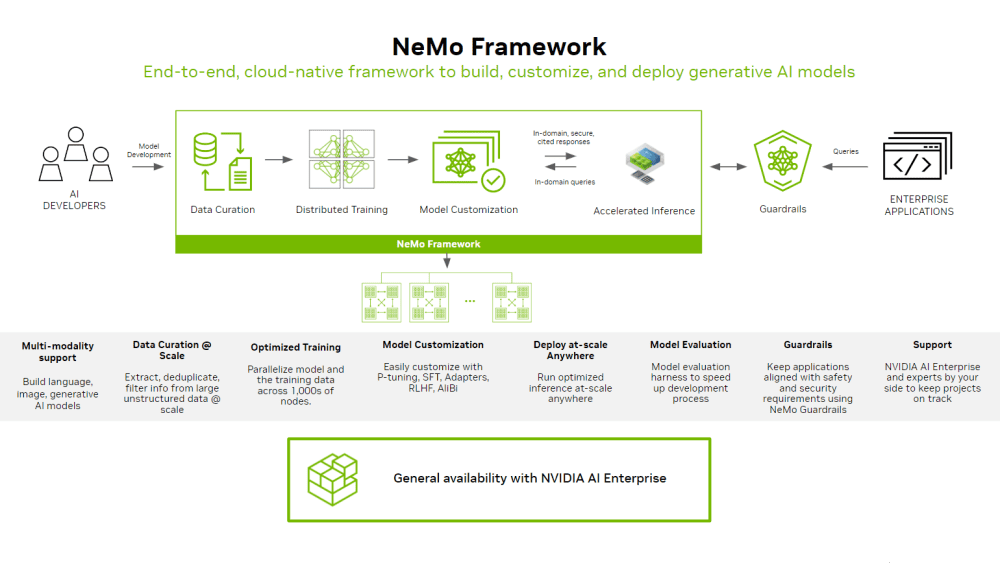
NVIDIA NeMo Guardrails takes a broader application-level approach. Its current documentation defines five major rail types:
- Input rails
- Retrieval rails
- Dialog rails
- Execution rails
- Output rails
That means a team can place controls at multiple stages rather than limiting protection to the initial user prompt.
For example, retrieval rails can process retrieved chunks before they enter the model context, while execution rails can control tool and action calls. NVIDIA documents execution rails as a mechanism for controlling and validating tool inputs and outputs. NVIDIA NeMo Guardrails rail types
Where it fits
| Best fit | What to consider |
| Python engineering teams | Guardrails become part of application engineering |
| Stateful conversation controls | More implementation work than a managed API |
| RAG and tool workflows | Configuration and Colang add a learning curve |
| Self-managed deployments | Your team owns deployment and operations |
NeMo Guardrails is especially relevant when the engineering team wants to define the policy logic itself and keep that logic close to the application.
Its current documentation also supports both a Python package and a microservice deployment model, with YAML and Colang configurations used across the two approaches. NVIDIA NeMo Guardrails overview
4. Guardrails AI: Python validators and structured outputs
Guardrails AI is an open-source framework for building validation and guard logic around LLM applications.

Its mental model is straightforward:
Define what valid model behavior or output looks like, then validate it.
That makes it particularly relevant when the application already has clear schemas or business rules that need to be enforced in code.
| Best fit | What to consider |
| Python applications | Enforcement lives inside application code |
| Structured outputs | Validation logic needs to match the actual schema |
| Custom validators | Validators require ongoing testing and maintenance |
| Self-hosted teams | Engineering integration remains part of the deployment |
The important question is therefore not just whether Guardrails AI can validate a response. It is whether application-level validation is the right enforcement point for your particular failure mode.
For a structured response, that may be exactly what you need. For an agent with broad runtime permissions, you may need controls closer to the action itself.
5. Future AGI: broader guardrail coverage

Future AGI takes a broader approach to guardrails, with controls covering areas such as prompt injection, jailbreaks, PII, toxicity, hallucination, faithfulness, groundedness, task adherence, schema validation, and tool-call validation.
That breadth changes the evaluation question.
Instead of asking whether it handles one specific failure mode, ask:
How much of the guardrail surface do you want to consolidate into one platform, and which controls still need independent enforcement?
A broader platform can reduce the number of separate components you have to integrate. At the same time, concentrating more of the safety stack in one vendor makes it important to test the controls independently against your own policies and failure scenarios.
Use it when: you want a broader guardrail layer rather than assembling several specialized components.
6. Bifrost by Maxim AI: gateway and guardrail integration layer
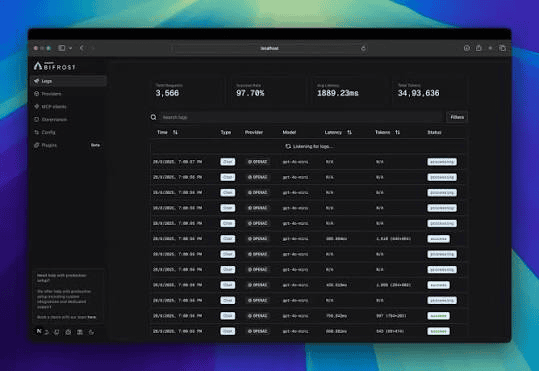
Bifrost is an open-source AI gateway designed to centralize traffic across model providers.
Its relevance to guardrail evaluation comes from its gateway position and its ability to integrate with multiple guardrail providers.
| Best fit | What to consider |
| Multi-model environments | Gateway placement still limits visibility into agent actions |
| Centralized AI traffic | Determine which controls are enforced before and after model calls |
| Multiple guardrail providers | Evaluate how each provider’s controls behave in the combined architecture |
| High-throughput infrastructure | Runtime agent authorization remains a separate concern |
A gateway can be valuable when an organization wants one place to manage model traffic. But the gateway should not automatically be treated as the complete control plane for an agent.
The question is where the gateway ends and where agent-specific authorization begins.
7. Amazon Bedrock Guardrails: managed controls for AWS-native AI stacks

Amazon Bedrock Guardrails provides configurable safeguards for model inputs and outputs, including content filters, denied topics, sensitive-information handling, and prompt-attack detection.
AWS also documents applying guardrails to model inference, Bedrock agents, knowledge bases, and flows. Amazon Bedrock Guardrails use cases
This makes it a natural option for teams that already standardize their AI workloads around Bedrock.
The more useful buying question is not:
“Does AWS have guardrails?”
It does.
The question is:
Are the AWS-native controls sufficient for the agent actions you need to govern across your environment?
If the agents, models, retrieval layer, and actions all remain within the Bedrock ecosystem, native controls may cover a substantial part of the architecture.
If the estate spans multiple clouds, frameworks, or runtimes, you need to evaluate where the control boundary stops.
8. Azure AI Content Safety: content and prompt-attack protection for Azure stacks

Azure AI Content Safety includes content filtering and Prompt Shields for adversarial inputs.
Microsoft documents Prompt Shields for both user prompt attacks and document attacks. That distinction matters for RAG systems because untrusted instructions can enter through retrieved documents rather than through the user’s original message. Microsoft Prompt Shields documentation
| Best fit | What to consider |
| Azure-native AI applications | Strongest fit when Azure is already central to the stack |
| Prompt attack detection | Test user-prompt attacks against your own threat set |
| Document attack detection | Test indirect instructions embedded in retrieved content |
| Content safety | Runtime authorization still needs separate evaluation |
Microsoft’s documentation explicitly describes document attacks as malicious instructions embedded in third-party content. That makes document-level testing particularly important for RAG and agent workflows. Microsoft Prompt Shields concepts
Use it when: Azure is already the center of your AI stack and you need managed content and prompt-attack controls.
Compare the tools by control point, not feature count
Once the individual tools are understood, bring them back into the same framework.
The table below is intentionally focused on where a tool can enforce controls, rather than trying to count every feature a vendor offers.
| Tool | Primary layer | Input / injection | Retrieval | Tool-call control | Runtime governance | Deployment / fit |
| Lyzr Open Controller | Agent runtime | Complementary | Complementary | Strong | Strong | Enterprise agent control |
| Lakera Guard | Gateway | Strong | Limited | No | No | Prompt injection and jailbreak defense |
| NVIDIA NeMo Guardrails | Application / middleware | Yes | Yes | Yes | Partial | Programmable application guardrails |
| Guardrails AI | Application / middleware | Via validators | Via application | Limited | No | Python-native validation |
| Future AGI | Multi-layer | Yes | Yes | Yes | Yes | Broad agentic guardrails |
| Bifrost | Gateway | Yes | Limited | Partial | Partial | Multi-provider gateway |
| Amazon Bedrock Guardrails | Bedrock / gateway | Yes | Yes | Limited | Limited | AWS-native stacks |
| Azure AI Content Safety | Azure / gateway | Yes | Document attacks | Limited | Limited | Azure-native stacks |
Important: “Yes” does not mean “solves every version of the problem.” A tool may support a control at one point in the request path while lacking visibility into a later agent action.
That is why the next step should be to evaluate the tools against the actual workflow your agent will run.
Match the shortlist to your agent architecture
The vendor shortlist becomes much easier once you test it against concrete scenarios.
Scenario A: Customer-facing chatbot
A chatbot that only answers questions has a different risk profile from an agent that can update a CRM.
Your immediate risks may include:
- Jailbreaks
- Harmful content
- PII leakage
- Prompt injection
For this architecture, gateway or application-level controls may cover much of the immediate requirement.
Tools to evaluate: Lakera Guard, Amazon Bedrock Guardrails, Azure AI Content Safety, NVIDIA NeMo Guardrails, and Guardrails AI.
The key question is whether your chatbot only generates responses or whether it can also perform actions. If it can perform actions, move to the tool-call and runtime tests below.
Scenario B: RAG agent reading external documents
The architecture changes when the agent reads documents, webpages, emails, or knowledge-base content.
Now ask:
Can the guardrail inspect retrieved content before it becomes instructions for the agent?
This is an important distinction because the malicious instruction may never appear in the user’s original prompt.

A control that only inspects the user’s message does not necessarily see the problem at the retrieval stage.
Tools to evaluate: NVIDIA NeMo Guardrails, Azure AI Content Safety, Amazon Bedrock Guardrails, and broader multi-layer platforms.
Scenario C: Agent that can change business data
This is where the buying decision becomes more focused on action enforcement.
Suppose the agent can:
- Update CRM records
- Issue refunds
- Create purchase orders
- Modify support tickets
- Send customer emails
Now ask:
Can the control layer inspect the actual tool call and its arguments before execution?
A safe user prompt and a safe-looking model response do not prove that the final action is safe.
For example:

The relevant control is the one that can see the generated arguments before the API executes.
Tools to evaluate: Lyzr Open Controller and tools with explicit execution or tool-call controls, potentially combined with gateway-level protection.
Scenario D: Multi-agent enterprise environment
With multiple agents, the problem expands beyond individual requests.
You need to know:
- Which agents exist?
- Who owns each agent?
- What can each agent access?
- Which frameworks are they built on?
- Which tools can they call?
- What do they cost?
- Which policies apply?
- Which agents can call other agents?
At this point, you are evaluating an agent governance and control-plane problem.
A prompt classifier can still be part of the stack, but it does not answer questions about ownership, permissions, spend, or runtime authority.
The 5-minute buyer exercise
Once you have identified the highest-risk action, test your current architecture against five checkpoints.
| Checkpoint | Yes | No |
| Can you identify the agent and its owner? | ☐ | ☐ |
| Can you identify every tool or API it can call? | ☐ | ☐ |
| Can you validate tool arguments before execution? | ☐ | ☐ |
| Can you stop or restrict the agent at runtime? | ☐ | ☐ |
| Can you reconstruct what happened after an incident? | ☐ | ☐ |
Do not treat this as a vendor score.
It is an architecture check. The purpose is to identify which control layer you already have and which layer is still missing.
For example, a team may have excellent prompt-injection detection but no mechanism for stopping an agent after it exceeds a spending limit. Another team may have runtime permissions but no retrieval protection for untrusted documents.
Those are different gaps, and they lead to different shortlists.
What most guardrail comparisons leave out
A feature table can make guardrail tools look interchangeable. The actual failure paths show why they are not.
A safe prompt can still produce an unsafe action
Consider:
“Help me update the customer account.”
There is nothing inherently suspicious about that request.
The agent can still select the wrong customer, generate an unauthorized operation, or pass an invalid argument to an approved tool.
The relevant control therefore needs visibility into the action, not only the language.
Retrieval can introduce instructions
An agent may read:
- A PDF
- A webpage
- An email
- A support ticket
- A knowledge-base entry
The malicious instruction may never appear in the original user prompt.
For that reason, retrieval filtering deserves its own row in an enterprise guardrail evaluation. Azure’s Prompt Shields documentation, for example, explicitly distinguishes user prompt attacks from document attacks. Microsoft Prompt Shields
One safe turn does not mean a safe trajectory
An agent does not necessarily follow:

Guardrails are not the same as evaluation
A guardrail asks:
“Should this request or action be allowed right now?”
Evaluation asks:
“How did this agent behave across many runs?”
Those are different jobs.
| Need | Guardrail | Evaluation / observability |
| Block prompt injection | ✓ | |
| Prevent PII leakage | ✓ | |
| Stop unauthorized tool calls | ✓ | |
| Enforce action policy | ✓ | |
| Detect behavioral drift | ✓ | |
| Compare model versions | ✓ | |
| Analyze thousands of runs | ✓ | |
| Run regression tests | ✓ |
A production AI stack may therefore need both enforcement and evaluation rather than treating one as a replacement for the other.
Test vendors with the failure, not the feature list
A vendor demo can show a clean dashboard and a successful detection result without proving that the system can stop the action you care about.
Instead of asking:
“Does your platform support agent guardrails?”
ask the vendor to demonstrate a controlled failure.
Test 1: The malicious-document test
Give the agent a document containing an instruction that conflicts with the system policy.
Then ask:
Can you show exactly where that instruction is detected, and before which step is it blocked?
You want to see the enforcement point, not only the final alert.
This test is particularly useful for RAG agents because it checks whether the platform sees untrusted content before that content can influence the agent.
Test 2: The wrong-argument test
Give the agent permission to call an approved tool. Then make the generated arguments unsafe.
For example:
Tool: refund_customer
Allowed maximum: $500
Generated amount: $5,000
Ask:
Does the guardrail inspect the actual tool arguments before the API executes?
This test separates response filtering from actual action enforcement.
Test 3: The unauthorized-tool test
Give the agent access to:
search_customer
update_customer
delete_customer
Allow the first two tools but not the third.
Then ask the agent to delete a record.
The question is:
Show me the exact point where the call is rejected.
Do not settle for a dashboard notification or an after-the-fact alert. You want to see the rejection before execution.
Test 4: The runaway-agent test
Allow the agent to make multiple calls and define hard limits for:
- Number of steps
- Token spend
- Tool calls
- Execution time
Then deliberately trigger one of those limits.
Ask:
Does the system stop the run, or only report that the limit was exceeded?
That distinction matters whenever the cost or consequence of continued execution is material.
Test 5: The ownership test
Pick a production agent and ask:
Who owns this agent, what can it access, which policies apply to it, and when was its current version deployed?
If answering that question requires multiple disconnected dashboards and a spreadsheet, the issue is no longer only model safety. It is an operational governance gap.
Final checklist before you select a tool
Before selecting an AI agent guardrail platform, make sure you can answer the following for your environment:
- We know the highest-impact action each production agent can take.
- We know where untrusted instructions can enter the agent.
- We can inspect retrieved content when required.
- We can inspect tool calls and arguments before execution.
- We can enforce permissions at runtime.
- We can stop or restrict a misbehaving agent.
- We can attribute every agent to an owner.
- We can reconstruct policy decisions after an incident.
- We have tested latency on our own traffic.
- We have tested what happens when the guardrail fails or becomes unavailable.
- We know which controls require a second layer.
- We have run real attack scenarios, not only vendor demos.
The most useful guardrail is not necessarily the one with the longest feature list. The more important question is whether the control is positioned where your highest-impact failure can actually be detected and stopped.
Start with that failure. Then choose the layer that can see it. Only after that should you compare vendors.
Frequently asked questions
- What are AI agent guardrails?
AI agent guardrails are controls that evaluate inputs, retrieved content, tool calls, outputs, or runtime behavior against defined policies. Depending on where they run, they can allow, block, modify, or restrict an interaction or action.
- What is the difference between AI guardrails and AI agent governance?
Guardrails typically enforce specific safety or policy checks during execution. Agent governance is broader and can include discovery, identity, ownership, permissions, lifecycle management, auditability, and organizational policy.
- Can guardrails stop prompt injection?
They can detect and block many prompt-injection attempts, but prompt injection remains an active security problem. A vendor’s detection capability should therefore be tested against your own attack scenarios rather than treated as complete elimination of the risk.
- Do AI agent guardrails need to inspect tool calls?
For agents that can take consequential actions, this is an important capability to evaluate. Input and output filtering alone may not reveal whether the agent selected the correct tool or generated safe arguments.
- Can I use more than one guardrail tool?
Yes. A layered architecture can combine gateway-level screening with application controls, runtime authorization, and observability or evaluation. The important part is knowing which layer owns each control and whether any action path can bypass it.
- Are open-source AI guardrails available?
Yes. NVIDIA NeMo Guardrails and Guardrails AI are open-source options. Bifrost’s gateway is also open source, while some guardrail and governance capabilities across the broader ecosystem are available through enterprise offerings.
Book A Demo: Click Here
Join our Slack: Click Here
Link to our GitHub: Click Here