A model passes every offline eval in CI. You ship. Production breaks within a week, because a class of prompts your eval dataset never exercised got scored by a judge model that quietly drifted last Tuesday.
LLM failures don’t throw exceptions: the output gets silently worse, and the first person to find the regression is a user. The fix is a cascade: deterministic checks as the cheap floor catching 30-60% of failures for free, LLM-as-a-judge as the expensive ceiling for subjective rubric breaks. This guide compares the 10 tools that handle that evaluation cascade in 2026.
TL;DR
- Lyzr OpenController – auto-scoped deterministic + LLM-judge evaluation as a promotion gate
- DeepEval – 60+ metrics, GEval (LLM-judge) + DAGMetric (deterministic), pytest-native
- Braintrust – full-lifecycle SaaS: datasets, assertions, LLM judges, CI gates
- Promptfoo – declarative YAML eval + 500+ red-team vectors
- Galileo AI – distilled Luna-2 judge models (3B-8B) for cost-optimized scoring
- Langfuse – open-source tracing + evaluation scoring over production traces
- Arize Phoenix – open-core observability + eval in one self-hosted deployment
- RAGAS – canonical RAG evaluation (context precision, faithfulness, relevancy)
- Patronus AI – hallucination, copyright, and factual accuracy specialization
- W&B Weave – LLM eval inside the W&B experiment-tracking platform
Deterministic vs. LLM-Judge: When to Use Each
Understanding the two paradigms is the prerequisite for choosing a tool. Neither replaces the other.
Deterministic Evaluation
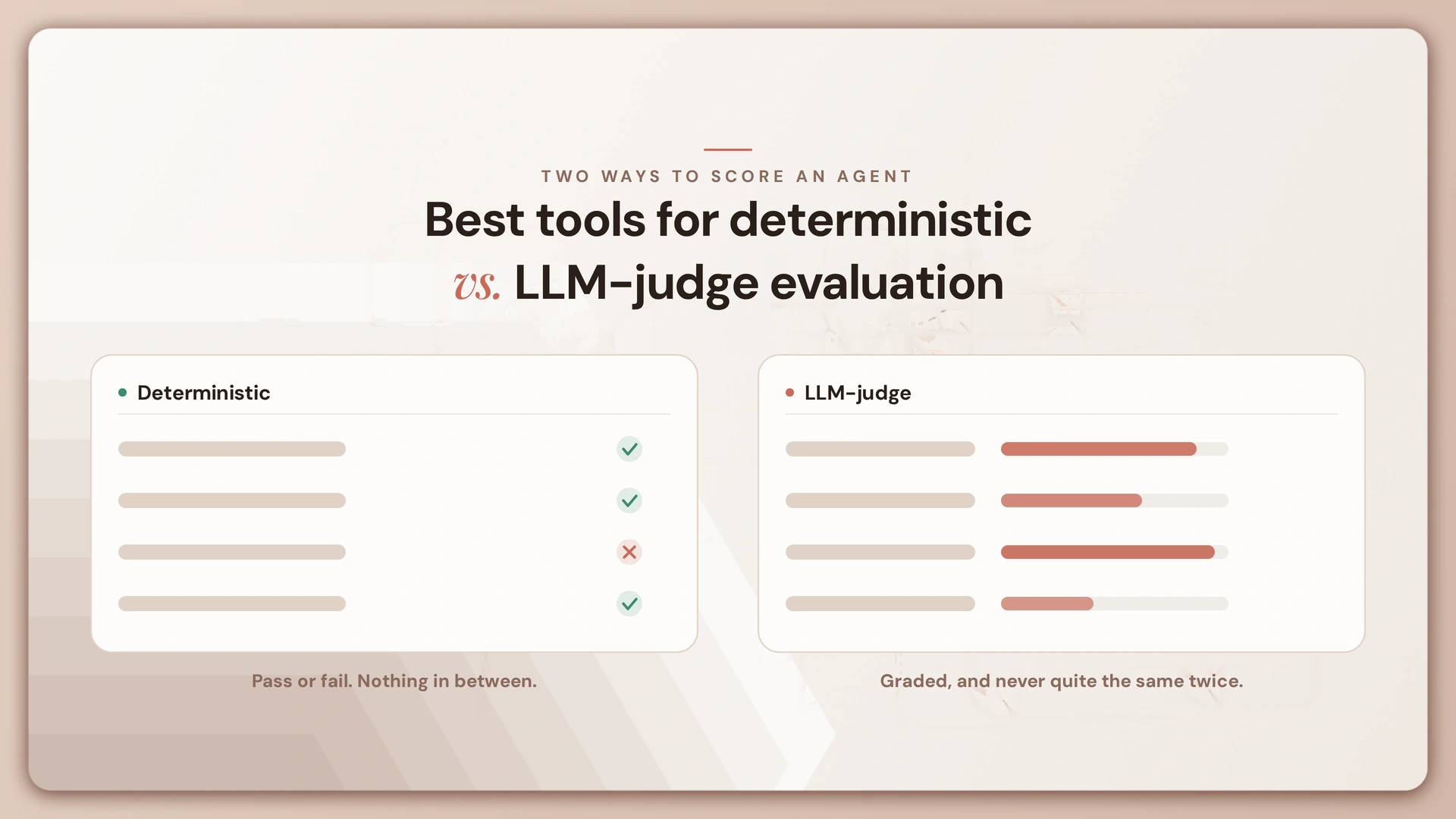
A deterministic metric returns the same score for the same input, every time, with no LLM in the loop. It never drifts, never has a bad day, and runs without an API call.
What it covers:
- JSON schema and structural validation (catches malformed tool-call arguments, broken structured outputs)
- Regex, exact-match, and contains checks
- Lexical overlap (BLEU, ROUGE) against reference answers
- Function-call validators (did the agent call the right tool with correct arguments?)
- Citation-presence checks
- Latency and cost thresholds
- Code syntax validation (AST parsers, SQL parsers)
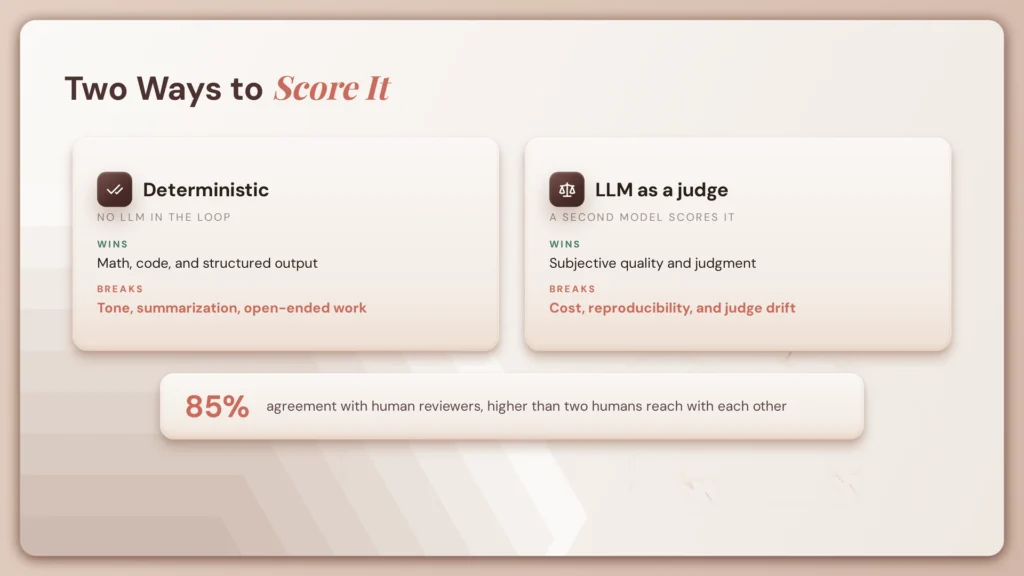
Where it wins: math, classification, code generation, structured output, any task with a verifiable right answer. Fast, free, reproducible.
Where it breaks: open-ended generation, summarization, conversational quality, tone, helpfulness, anything where many surface forms are correct.
LLM-as-a-Judge Evaluation
LLM-as-a-judge uses a second model (often a frontier model like GPT-5 or Claude, or a purpose-built distilled judge) to score the output against a rubric defined in natural language.
What it covers:
- Context relevancy, answer relevancy, and faithfulness
- Helpfulness, tone, and safety
- Groundedness against retrieved sources
- Hallucination detection via self-consistency or semantic entropy
- Agent trajectory evaluation (plan quality, step efficiency, task completion)
Where it wins: subjective quality dimensions, open-ended generation, summarization, conversational agents, anything where “correct” depends on judgment. An LLM judge agrees with human reviewers about 85% of the time, higher than two humans agree with each other on the same task.
Where it breaks: cost at scale (cents per eval, multiplied across production traffic), reproducibility (non-deterministic by definition, even at temperature zero), and judge drift (the underlying model changes across vendor versions, so scores shift silently).
The Cascade: Layer, Don’t Choose
The production answer is a layered stack, cheapest first:
- Deterministic checks first (free, sub-millisecond, catches 30-60% of failures)
- Reference metrics or embedding similarity where applicable (still no LLM)
- Distilled evaluators for semantic scoring at volume (Galileo Luna-2, DeepEval metrics)
- LLM-as-judge for cases the cheaper layers can’t handle
- Human review on sampled subsets for ambiguous, high-stakes cases
Most production traffic should never touch the expensive judge. The cascade is the lever that drops eval cost 95% while maintaining coverage.
Best Tools for Deterministic vs. LLM-Judge Evaluation: Comparison
| Tool | License / Model | Deterministic Support | LLM-Judge Support | Best For |
|---|---|---|---|---|
| Lyzr OpenController | Commercial | Task completion, tool correctness, argument correctness | Contextual relevancy, answer relevancy, knowledge retention, groundedness (LLM-as-judge) | Agent evaluation as a promotion gate |
| DeepEval | Apache 2.0 | DAGMetric (decision trees), custom logic | 60+ metrics, GEval for custom rubrics | pytest-driven eval in CI |
| Braintrust | SaaS | Custom programmatic assertions | Built-in automated scorers, LLM judges | Full-lifecycle SaaS eval platform |
| Promptfoo | MIT | Regex, JSON schema, latency, cost | LLM-graded rubrics, model comparison | Declarative YAML eval + red-teaming |
| Galileo AI | Commercial | Data logging, telemetry triggers | Luna-2 distilled judge models (3B-8B) | Cost-optimized judge at scale |
| Langfuse | MIT (core) | Custom metric ingestion via SDK | Evaluation scoring templates over traces | Self-hosted tracing + eval |
| Arize Phoenix | Open source | Deterministic retrieval-quality checks | Embedding analysis, LLM-judge evals | Open-core observability + eval |
| RAGAS | Apache 2.0 | Context precision, context recall | Faithfulness, answer relevancy (LLM-judge-backed) | RAG-specific evaluation |
| Patronus AI | Commercial | Factual extraction checks | Hallucination, copyright, accuracy scoring | Output-quality eval for regulated use |
| W&B Weave | Commercial | Experiment-tracking metric comparison | LLM-judge evaluation integrated with ML tracking | Teams already on W&B for ML |
The 10 Best Tools for Deterministic vs. LLM-Judge Evaluation
1. Lyzr OpenController
OpenController’s evaluation and improvement domain (described in our AI agent governance guide) runs both deterministic and LLM-as-judge scoring, not as a standalone eval framework but as a promotion gate wired into the agent release pipeline: a version that regresses on any scored metric against the currently-live version is refused at the gate, not flagged in a dashboard.
Deterministic metrics: task completion (did the agent complete what it was authorized to do) and tool correctness with argument correctness (did the agent call the right tool with the right arguments). These switch on automatically when the agent has tools, no configuration required.
LLM-as-judge metrics: contextual relevancy, answer relevancy, knowledge retention, and groundedness/hallucination scoring (reflection cycles, groundedness against retrieved sources, LLM-as-judge). These switch on automatically when the agent has a knowledge base.
What separates it: seven metrics auto-scoped to each agent’s configuration, scored 0.00 to 1.00 with critical, medium, and low severity. Auto-scoping matters because it means nobody has to configure evaluations per agent, which is the reason evaluation coverage stalls in most enterprises. The simulation engine auto-generates multi-turn and adversarial test suites from the agent’s own definition. The improvement engine grades production traces, clusters failures into named patterns, proposes prompt rewrites as a reviewable diff, and every resolved issue becomes a permanent test case that can’t silently return.
Strengths: evaluation is a promotion condition, not an optional report. The regression gate compares against the live version rather than an absolute threshold, so quality can only go up. Every resolved issue becomes a permanent regression test.
Weaknesses: the evaluation domain is part of a broader governance platform (identity, budgets, deployment), so teams that only want a standalone eval library are adopting more surface area than the job requires.
Best for: enterprise teams that want evaluation wired into agent governance and release management, not separate from it.
2. DeepEval (Confident AI)

DeepEval is the strongest Apache 2.0 framework for pytest-driven LLM evaluation, with 60+ metrics spanning RAG, agent trajectory, chatbot, and safety testing. Its dual evaluation paradigm is the most explicit in the category: GEval for custom LLM-judge rubrics written in natural language, and DAGMetric for deterministic decision-tree evaluation where scoring logic needs hard branches and gates rather than LLM reasoning.
Deterministic: DAGMetric lets teams define scoring as a directed acyclic graph of deterministic branches, custom logic, and conditional gates. This is unique: no other tool on this list offers a native graph-based deterministic evaluation primitive.
LLM-judge: GEval supports custom subjective criteria in natural language. QAG-style metrics break evaluation into closed-ended checks. Built-in metrics cover faithfulness, contextual relevancy, answer relevancy, hallucination, toxicity, bias, and agent trajectory (TaskCompletionMetric, StepEfficiencyMetric, PlanAdherenceMetric).
Strengths: runs locally with no infrastructure; integrates directly into pytest/CI so every PR is evaluated. The metric breadth (60+) is the widest of any open-source framework here.
Weaknesses: the commercial Confident AI layer adds a managed platform for non-technical teams, but the open-source core requires Python engineering to configure and run.
Best for: engineering teams that want evaluation as unit tests in their CI pipeline, with the flexibility to define both deterministic DAG logic and custom LLM-judge rubrics in code.
3. Braintrust

Braintrust is the polished SaaS platform for teams that want dataset management, scoring, production monitoring, and CI-based release enforcement inside a single system. It connects all stages of the evaluation lifecycle rather than serving one layer.
Deterministic: custom programmatic assertions written in code, covering format checks, latency thresholds, JSON schema validation, and any business logic expressible as a function.
LLM-judge: built-in automated scorers and LLM judges with a visual judge editor, plus support for human-annotation workflows alongside automated scoring.
Strengths: the full-lifecycle integration (datasets, offline eval, judge editor, CI gates, production monitoring, human annotation) in a single platform is the differentiator. Most other tools on this list serve one or two of those layers.
Weaknesses: SaaS-only for the full feature set, which doesn’t fit data-sovereignty constraints in regulated industries.
Best for: teams that want one platform from dataset curation through production monitoring, with unlimited users on Starter/Pro plans.
4. Promptfoo

Promptfoo is an MIT-licensed evaluation framework built around declarative YAML configuration, making it the fastest tool here to set up a multi-model comparison or a security validation sweep without writing code.
Deterministic: extensive assertion types out of the box: regex, JSON schema validation, contains/not-contains, latency thresholds, cost thresholds, and custom function assertions.
LLM-judge: native LLM-graded rubrics defined in the same YAML configuration as deterministic checks, plus a red-teaming suite with 500+ adversarial attack vectors.
Strengths: the declarative approach means a non-engineer can read and modify an eval config. The red-teaming depth (500+ vectors) is the strongest in the open-source category for security testing specifically.
Weaknesses: less emphasis on production monitoring and continuous evaluation than Braintrust or Arize Phoenix; strongest as a pre-deployment testing tool rather than a runtime quality layer.
Best for: teams that want fast, config-driven model comparison and red-teaming without a heavy framework commitment, especially for prompt and model selection decisions.
5. Galileo AI

Galileo’s differentiation is cost-optimized LLM-judge evaluation through Luna-2, a family of purpose-built 3B-8B distilled judge models that deliver LLM-judge-quality scoring at a fraction of frontier model cost per evaluation.
Deterministic: data logging and telemetry triggers that feed into evaluation pipelines, rather than a library of deterministic assertions.
LLM-judge: Luna-2 distilled evaluators calibrated against frontier judge models. The 2026 pattern Galileo pioneered: pre-production evaluations automatically convert into production guardrails, so evaluation scores control agent actions, tool access, and escalation paths at runtime.
Strengths: the unit cost advantage of a distilled 3B-8B judge over a frontier model per evaluation is substantial at production scale. The eval-to-guardrail conversion closes the loop between evaluation and enforcement.
Weaknesses: the distilled judge inherits the biases of the frontier model it was trained on, and smaller models score less reliably on edge cases than their frontier teachers.
Best for: teams running high-volume evaluation at scale where the cost of a frontier judge per eval is prohibitive, and where evaluation needs to feed directly into runtime protection.
6. Langfuse

Langfuse is the most widely adopted open-source (MIT core) LLM observability platform, with evaluation capabilities built on top of its tracing foundation rather than as a standalone eval framework.
Deterministic: custom metric ingestion via SDK, allowing any deterministic scorer to push results into Langfuse’s trace-level evaluation store.
LLM-judge: evaluation scoring templates that run LLM-judge rubrics over traced production runs, with human annotation workflows for calibration.
Strengths: self-hosted with no data leaving infrastructure; evaluation is attached directly to production traces rather than run against synthetic datasets, which means the eval reflects what actually happened, not what a test suite simulated.
Weaknesses: teams build the orchestration layer (CI gating, regression testing, cascade logic) themselves. Langfuse provides the scoring primitives, not the full evaluation workflow.
Best for: teams that already use Langfuse for tracing and want to add evaluation as a layer on top of production data without adopting a separate eval platform.
7. Arize Phoenix

Arize Phoenix is the strongest open-core option covering both observability and evaluation in a single self-hostable deployment, with OpenTelemetry-native tracing and research-backed evaluation methods.
Deterministic: retrieval-quality checks (context precision, context recall) using deterministic methods against reference data.
LLM-judge: embedding analysis, faithfulness scoring, and LLM-judge evaluations with dataset curation for regression testing.
Strengths: the combination of deep tracing, evaluation, and dataset curation in one open-source tool is unique. Most tools offer one or two of those; Phoenix offers all three.
Weaknesses: heavier to deploy and operate than a lightweight eval-only library like DeepEval or Promptfoo.
Best for: teams that want production monitoring and evaluation in one self-hosted platform, especially for RAG applications where retrieval quality needs to be measured alongside generation quality.
8. RAGAS

RAGAS is the canonical open-source (Apache 2.0) evaluation framework for RAG applications, with structured metrics purpose-built for measuring retrieval quality and generation accuracy.
Deterministic: context precision and context recall use deterministic methods to measure retrieval relevance against ground-truth labels.
LLM-judge: faithfulness and answer relevancy scores use LLM-backed evaluation to measure whether the generated answer is grounded in the retrieved context and relevant to the query.
Strengths: the RAG-triad framework (context relevance, groundedness, answer relevance) is the most widely adopted standard for RAG evaluation and is referenced by multiple other tools on this list.
Weaknesses: purpose-built for RAG. Teams evaluating general chat, agent trajectory, or non-retrieval tasks need a complementary framework alongside it.
Best for: teams building RAG applications who need a dedicated, research-backed evaluation framework for retrieval and generation quality.
9. Patronus AI

Patronus AI provides rigorous output-quality evaluation specializing in hallucination detection, copyright violation detection, and factual accuracy scoring, positioned as an evaluator rather than a guardrail or a monitoring platform.
Deterministic: factual extraction checks where structured facts can be verified against a reference source.
LLM-judge: judge models calibrated specifically for hallucination, factual accuracy, and copyright, rather than general-purpose scoring.
Strengths: the specialization in hallucination and copyright makes it stronger in those specific dimensions than general-purpose eval frameworks that cover them as two metrics among fifty.
Weaknesses: narrower scope than a full-lifecycle eval platform. Teams needing agent trajectory evaluation, multi-turn testing, or CI gating need complementary tooling.
Best for: teams where hallucination and factual accuracy in high-stakes content (legal, medical, financial) are the primary risk and the evaluation budget should focus there.
10. Weights & Biases Weave

W&B Weave extends the established Weights & Biases ML experiment-tracking platform into LLM evaluation, adding tracing, evaluation, and prompt versioning to a platform many ML teams already run.
Deterministic: experiment-tracking metric comparison using the same dashboard and comparison tools ML teams already use for classical model evaluation.
LLM-judge: LLM-judge evaluation integrated into the experiment-tracking workflow, with prompt versioning and trace-level scoring.
Strengths: for teams already standardized on W&B for classical ML, adding LLM eval extends a familiar workflow rather than introducing a new platform.
Weaknesses: the LLM evaluation layer is newer than W&B’s core ML tracking product; teams without an existing W&B footprint will find LLM-native tools like DeepEval or Braintrust faster to adopt.
Best for: ML engineering teams already running W&B who want LLM evaluation inside the same experiment-tracking platform.
How to Choose
- Want evaluation as a governed promotion gate, not a standalone tool? OpenController wires evaluation into the agent release pipeline so a regression refuses the promotion, with auto-scoped metrics that require no per-agent configuration.
- Want the most flexible open-source eval framework for CI? DeepEval for pytest-native evaluation with both DAGMetric and GEval. Promptfoo for declarative YAML if you prefer config over code.
- Want one SaaS platform from datasets through production monitoring? Braintrust.
- Need to run high-volume LLM-judge evaluations without frontier-model cost? Galileo Luna-2 distilled judges.
- Already running Langfuse for tracing and want to add eval? Langfuse’s evaluation scoring templates attach directly to production traces.
- Evaluating RAG specifically? RAGAS for the canonical metrics. Arize Phoenix for RAG eval plus tracing in one deployment.
- Hallucination and factual accuracy are the primary concern in a regulated domain? Patronus AI.
- Already standardized on W&B for ML experiment tracking? Weave extends that platform into LLM eval.
FAQ
What is deterministic LLM evaluation?
Deterministic evaluation uses fixed algorithms (JSON schema validation, regex, exact match, lexical overlap, function-call validators) that return the same score for the same input every time, with no LLM in the loop. Scores are reproducible, sub-millisecond cheap, and immune to judge drift, but blind to semantic quality.
What is LLM-as-a-judge evaluation?
LLM-as-a-judge uses a second language model to score the output of the model under test, against a rubric defined in natural language. It handles subjective quality dimensions (tone, helpfulness, faithfulness) that deterministic checks can’t measure, but is non-deterministic by definition and costs cents per evaluation.
Should I use deterministic or LLM-judge evaluation?
Both, in a cascade. Deterministic checks run first as a cheap floor catching 30-60% of failures for free. LLM-as-judge runs only on the traffic that passes the deterministic layer, handling the subjective and semantic checks the deterministic layer is blind to. This cascade structure drops evaluation cost by up to 95% compared to running a judge on every output.
How accurate are LLM judges compared to human reviewers?
Published research shows LLM judges agree with human reviewers about 85% of the time, which is higher than two humans agree with each other on the same task. That said, LLM judges have measurable biases: position bias, verbosity bias, and self-enhancement bias (favoring their own output style). Design around these rather than trusting blindly.
What is judge drift and how do I prevent it?
Judge drift occurs when the judge model changes across vendor versions, silently shifting evaluation scores even though nothing about the agent under test changed. Prevention: pin the judge model version, run a calibration set alongside every eval batch, and maintain an audit trace per scored output so you can detect when scores shifted and which model version caused it.
Can I use evaluation scores as runtime guardrails?
Yes, and this is the 2026 pattern: pre-production evaluation criteria automatically convert into production guardrails that control agent behavior at runtime. Galileo pioneered this pattern; OpenController implements it as a regression gate that refuses a promotion when quality drops against the live version. The key is that the evaluator and the enforcer share the same rubric, not two different systems with different definitions of “good.”
What are the best open-source LLM evaluation frameworks?
DeepEval (Apache 2.0, 60+ metrics, pytest-native), Promptfoo (MIT, YAML-driven, 500+ red-team vectors), RAGAS (Apache 2.0, RAG-specific), and Langfuse (MIT core, tracing + eval). Most production stacks combine two: a testing framework for blocking bad deploys plus a platform for ongoing monitoring.
How do I evaluate AI agents, not just single LLM calls?
Agent evaluation adds dimensions beyond single-call scoring: task completion (did the agent finish the job), tool correctness (did it call the right tool), argument correctness (did it pass valid arguments), step efficiency (did it take the shortest path), and plan adherence (did it follow its own plan). DeepEval, Braintrust, and OpenController all support these agent-specific metrics; pure LLM eval tools that only score input/output pairs can’t address them.
What is the cost difference between deterministic and LLM-judge evaluation?
Deterministic evaluation costs effectively nothing (CPU cycles, sub-millisecond). LLM-as-judge evaluation costs cents per call with a frontier model, or significantly less with distilled judges (Galileo Luna-2, 3B-8B parameter range). At production volume (millions of evals), the cost difference between running a frontier judge on everything vs. a deterministic-first cascade is the difference between thousands of dollars and single digits.
How do I wire evaluation into CI/CD for LLM applications?
The standard pattern: define a golden dataset of representative inputs with expected outputs, run both deterministic and LLM-judge scorers against every PR or prompt change, set tolerance bands (not exact thresholds) to handle LLM non-determinism, pin the judge model, and fail the build if any metric drops below the band. DeepEval, Promptfoo, Braintrust, and OpenController all support this flow natively. OpenController adds a production regression gate that compares against the live version specifically, so the threshold is relative rather than absolute.
Book A Demo: Click Here
Join our Slack: Click Here
Link to our GitHub: Click Here