TL;DR
- Agent evaluation splits into three jobs that different tools do well: offline experimentation against datasets, production tracing and scoring, and simulation of multi-turn user behaviour.
- Braintrust is the strongest all-rounder.
- DeepEval suits developer-first unit-test workflows.
- Langfuse and Phoenix are the open-source picks.
- Maxim AI leads on agent simulation.
- Most teams end up using two, because no single platform covers offline evaluation, production observability, and simulation equally well.
- The harder problem is not picking a tool. It is building an evaluation set worth running.
Traditional testing does not work on agents
Conventional software testing, such as through open-source automation tools, assumes determinism. Same input, same output, assertion passes or fails.
AI agents are not deterministic. The same workflow produces different behaviour depending on the prompt, retrieval quality, memory state, tool availability, model version, and how a user happened to phrase the request. Run the identical test twice and you may get two different paths through the same logic.
The harder property is that failures are not loud. Nothing throws. The response is fluent, well-structured, and confidently wrong. A test suite built on exceptions and status codes sees a green pipeline.
This is why agent evaluation became its own discipline rather than a chapter in the testing handbook.
| What teams now test for | What usually breaks |
|---|---|
| Multi-turn conversations | Agents lose context over several turns |
| Hallucination | Confident but unsupported answers |
| Tool usage | Wrong tool selected, or right tool with wrong arguments |
| Retrieval quality | Weak context produces weak answers |
| Prompt regressions | A small edit changes behaviour elsewhere |
| Persona handling | Different user types trigger different failure modes |
| Trajectory | The agent reaches the right answer by the wrong route |
That last row is the one most teams add late. An agent that produces a correct answer after six unnecessary tool calls is working and expensive, and only trajectory evaluation catches it.
The three jobs evaluation tools do
Before comparing platforms it is worth separating what they are for, because most of the confusion in this category comes from treating one category as three.
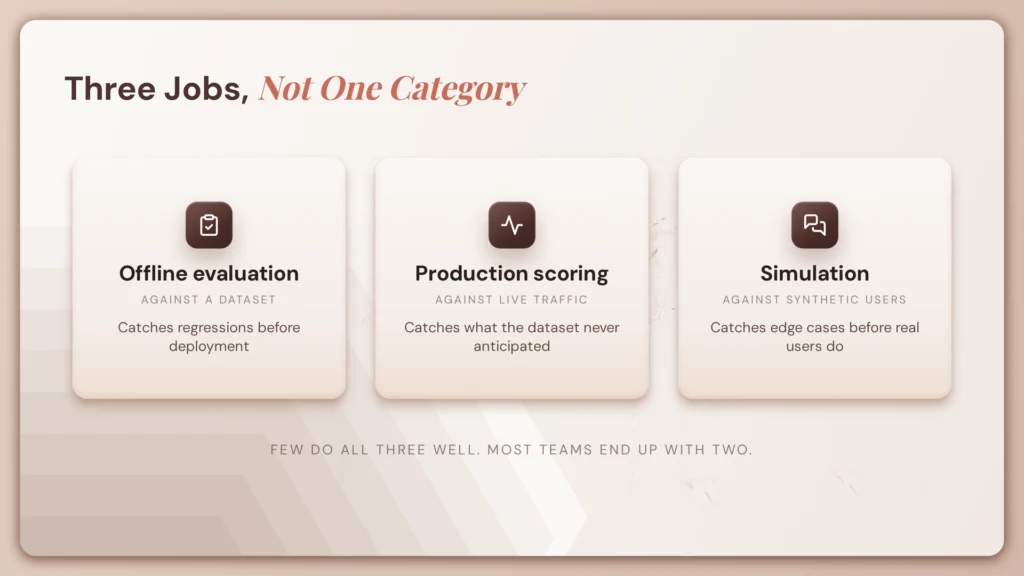
Offline evaluation. Running a dataset of inputs against your agent and scoring the outputs. This is where you catch regressions before deployment, and it is the closest analogue to a conventional test suite.
Production observability and scoring. Tracing what actually happened in live traffic, across every agent orchestration step, and scoring a sample of it. This catches the failure modes your dataset did not anticipate, which is most of them. Our comparison of AI agent observability platforms covers this half in more depth.
Simulation. Generating synthetic multi-turn conversations to test how the agent handles unpredictable user behaviour, interruptions, and edge cases before real users find them.
Very few platforms do all three well. Most do one properly and the others adequately, which is why the realistic answer for a production team is usually two tools rather than one.
The three scoring methods
Cutting across all of it, three ways to actually produce a score:
LLM-as-a-judge. A model scores the output against a rubric: relevance, faithfulness to retrieved context, tone, task completion. Flexible and the only practical option for open-ended output. The caveat is that your judge is a model with its own failure modes, and judge prompts need their own validation.
Code-based assertions. Deterministic checks: valid JSON, required fields present, regex match, expected tool called, latency under threshold. Cheap, fast, completely reliable, and only applicable to the subset of behaviour you can express as a rule. Useful for validating tool and API calls in particular. Use these wherever possible before reaching for a judge.
Human review. Slow, expensive, and the only ground truth you have. Its real job is calibrating the other two rather than scaling, which is why QA teams often argue AI evaluation cannot fully replace human judgement.
Link this to how you think about agent evaluation generally, and to model evaluation for the underlying concepts.
The Best AI Agent Evaluation Platforms Right Now
Verify current capabilities against each vendor’s documentation before committing. This category moves fast and several of these products shipped major changes recently.
| Platform | Strongest at | Open source | Self-host | Offline eval | Production tracing | Simulation |
|---|---|---|---|---|---|---|
| Braintrust | End-to-end eval and production scoring | No | No | Deep | Deep | Limited |
| Maxim AI | Multi-step agent simulation | No | No | Yes | Deep | Deep |
| DeepEval | Developer-first, pytest-style | Yes | Yes | Deep | Via Confident AI | Limited |
| Arize Phoenix | Open-source tracing, OTel-native | Yes | Yes | Yes | Deep | No |
| Galileo | Hallucination detection and quality monitoring | No | No | Yes | Deep | Limited |
| LangSmith | LangChain and LangGraph ecosystem | No | Enterprise tier | Yes | Deep | Limited |
| Langfuse | Open-source observability with eval tracking | Yes | Yes | Yes | Deep | No |
| Promptfoo | CI regression and adversarial testing | Yes | Yes | Deep | No | Limited |
| Confident AI | Managed layer over DeepEval | Partial | Partial | Deep | Yes | Yes |
The platforms in depth
Braintrust

Combines offline experimentation, structured evaluation pipelines, CI integration, and real-time production scoring in one product. If you want one tool that covers the most ground, this is usually it.
Strongest at: dataset-driven experimentation with clean version comparison, and carrying the same scorers from development into production so your offline and online metrics are actually comparable.
Honest limitation: simulation of multi-turn user behaviour is not its focus. If testing unpredictable conversational paths is your primary need, pair it with something else.
Pick it if: you want one platform for the evaluation lifecycle and you are not primarily testing conversational agents.
Maxim AI
The strongest option specifically for agent simulation. Runs synthetic multi-turn scenarios across personas to test autonomous tool selection and recursive decision paths, with end-to-end trace observability alongside.
Strongest at: simulating how an agent behaves when the user does something nobody scripted, which is the failure mode that dataset-driven evaluation structurally cannot reach.
Honest limitation: newer than several alternatives, and the no-code collaboration surface that makes it accessible to non-engineers also means less low-level control than a code-first framework.
Pick it if: you are shipping multi-agent systems or conversational agents where the interaction path is genuinely open-ended.
DeepEval

Open-source, developer-first, built to feel like pytest. Define metrics as assertions, run them in CI, inspect failures locally.
Strongest at: component-level metrics with a workflow that a Python engineer already understands. No context switch, no separate UI to learn, and it drops into an existing test suite.
Honest limitation: local-first by design. Production observability comes through Confident AI, the managed layer, rather than from DeepEval itself.
Pick it if: your team is Python-native, you want evaluation in CI, and you would rather write assertions than configure a dashboard.
Arize Phoenix

Open-source and OpenTelemetry-native, which matters more than it sounds. If your organisation already standardises observability on OTel, agent traces land in the same pipeline as everything else.
Strongest at: tracing and debugging, particularly retrieval inspection. If you are running RAG and need to see which chunks were retrieved and how they influenced the answer, Phoenix is built for that. Our guide to building a RAG engine covers where retrieval quality typically degrades.
Honest limitation: evaluation is present but lighter than in eval-first platforms, and simulation is not part of the product.
Pick it if: you want open-source tracing with OTel compatibility and RAG debugging depth.
Galileo
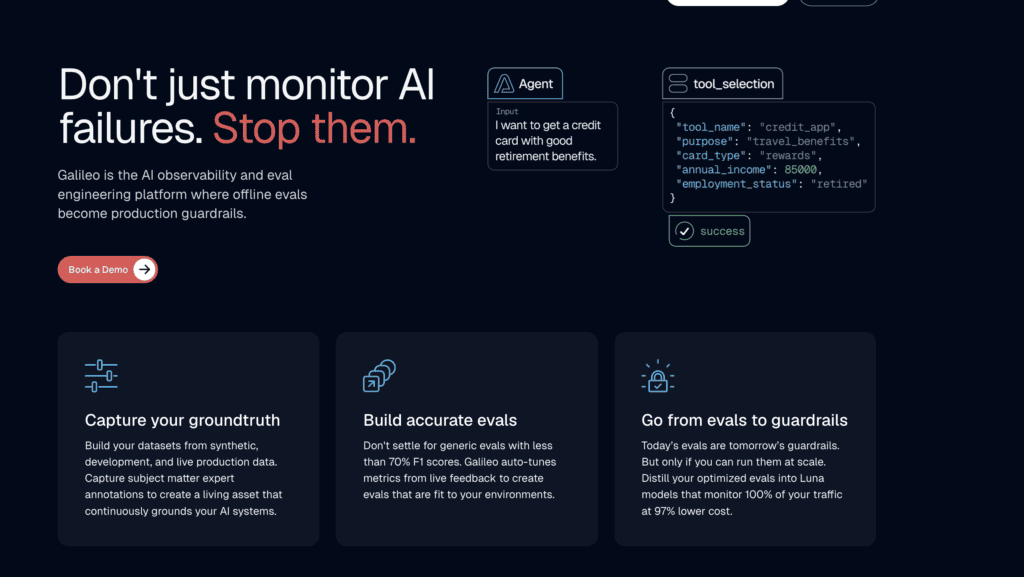
Specialised in automated hallucination detection and response quality monitoring, including model-consensus approaches that score an output by comparing across models.
Strongest at: catching unsupported claims at scale without a human reading every output. This is the most common production failure in agent systems and the hardest to detect cheaply.
Honest limitation: narrower than the all-rounders. Strong on quality monitoring, less complete on experimentation workflow.
Pick it if: hallucination is your specific problem and you need it monitored continuously rather than sampled. Pair with hallucination management controls at the runtime layer.
LangSmith
The native debugging and evaluation suite for the LangChain ecosystem. Deep integration, commit-hash versioning, environment promotion, clean rollbacks.
Strongest at: visibility into what a LangChain or LangGraph agent is actually doing, step by step. If you built on that stack, nothing else sees inside it as well.
Honest limitation: the integration depth is also the coupling. Teams evaluating whether to stay in that ecosystem should read it as a factor. Our guide to LangChain alternatives covers the wider trade-off.
Pick it if: you are LangChain-native and expect to stay there.
Langfuse
Open-source, self-hostable, and the most complete free option for observability with evaluation tracking attached.
Strongest at: production tracing with prompt versioning and eval scores in one place, self-hosted, at no licence cost. For teams with data residency requirements this is frequently the only viable option, and it sits alongside the wider open-source agent tooling ecosystem.
Honest limitation: self-hosting is real operational work, and evaluation depth is lighter than in eval-first tools.
Pick it if: you need self-hosted, open-source, and reasonably complete.
Promptfoo

A testing tool rather than a platform, and the distinction matters. Declarative test configs, run in CI, fail the build.
Strongest at: regression testing and adversarial evaluation including jailbreak and injection testing. If you care about prompt injection resistance, this is the tool that tests for it systematically.
Honest limitation: no production observability. It answers whether a change broke something, not what is happening in live traffic.
Pick it if: you want evaluation gated in CI. Many teams run Promptfoo alongside a tracing platform rather than instead of one.
Confident AI
The managed platform layer over DeepEval, adding dataset management, production monitoring, and simulation to the open-source framework.
Strongest at: giving a DeepEval-based workflow a hosted home without abandoning the code-first approach.
Honest limitation: most valuable if you have already adopted DeepEval.
Pick it if: DeepEval is working and you need the managed layer around it.
What most teams get wrong
The tool is not the hard part. Four failures that no platform fixes for you.
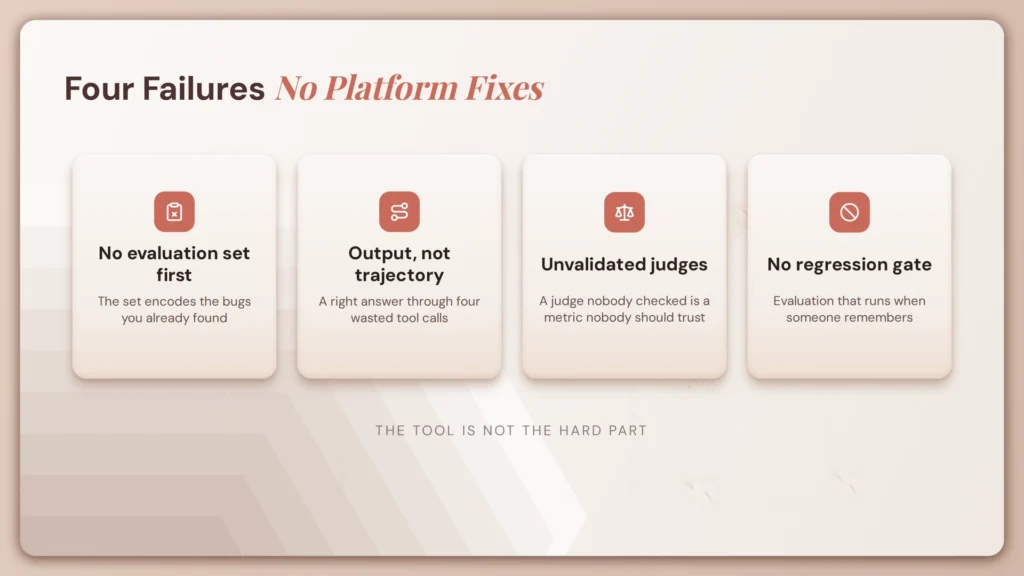
No evaluation set before the agent. The highest-value thing an evaluating team can do is build fifty to a hundred real user inputs with known-good outcomes, before writing the agent. Almost nobody does. Teams build the agent, ship it, then assemble an evaluation set from the failures, which means the set encodes the bugs they already found rather than the ones they have not.
Evaluating the output and not the trajectory. A correct answer reached through four unnecessary tool calls is a cost problem and a latency problem and, eventually, a reliability problem. Evaluate the path, not just the destination.
Unvalidated judges. LLM-as-a-judge is only as good as the judge prompt, and judge prompts drift like any other prompt. Sample your judge against human labels periodically. A judge nobody has checked is a metric nobody should trust.
No regression gate. Evaluation that runs when someone remembers is not evaluation. It belongs in CI, blocking merges, the same way tests do. This is the same discipline platform teams already apply to conventional services. This is where Promptfoo or DeepEval earn their place regardless of what else you run.
If you are taking agents from prototype to production, our playbook on taking agents to production covers where evaluation sits in the wider sequence, and enterprise AI agent challenges covers the organisational side.
So, How Should You Actually Choose An AI Agent Evaluation Platform?
Our overview of enterprise agent evaluation covers how these decisions play out at scale.
- Python team, want eval in CI, budget constrained. DeepEval, optionally with Confident AI later.
- Need open source and self-hosted. Langfuse for observability breadth, Phoenix if OTel compatibility matters.
- Want one platform for the whole lifecycle. Braintrust.
- Conversational or multi-agent systems with open-ended paths. Maxim AI.
- LangChain-native. LangSmith.
- Hallucination is the specific problem. Galileo.
- Regression gating is the immediate need. Promptfoo, alongside something else.
Most production teams run two: a tracing platform and a CI testing tool. That is a normal end state, not a failure to decide.
Where evaluation meets governance
Evaluation tells you whether the agent is behaving correctly. It does not tell you which agents exist, who owns them, what they are permitted to do, or whether a given action was approved.
Those are governance questions, and they matter for the same reason evaluation does. An agent that scores well on your eval set and holds credentials nobody scoped is still a production risk. An agent nobody registered cannot be evaluated at all, because nobody knows to evaluate it.
The two disciplines meet at the same requirement: attribution. You cannot evaluate what you have not inventoried, and you cannot govern what you cannot trace.
Lyzr operates at the governance layer rather than as an evaluation platform. The OpenController provides agent registration and ownership, per-agent permission scoping, approval gates on consequential actions, and decision traces that record what an agent retrieved, reasoned, and invoked.
Agents built on existing frameworks can be registered without a rewrite, and Responsible AI controls apply at the behavioural layer alongside whichever evaluation tooling you choose.
Lyzr also ships an agent simulation engine and multi-turn evaluation for agents built on the platform, which covers the simulation job for that subset. It is not a replacement for a dedicated evaluation platform if your agents live elsewhere.
Where to go next: if you are choosing a tool, start with the comparison above. If the harder question is which agents you should be evaluating in the first place, start with AI agent governance. If you want to see how registration and permission scoping work, read the Lyzr documentation or book a demo.
Frequently asked questions
What are the best AI agent evaluation tools?
Braintrust for end-to-end coverage, DeepEval for developer-first CI workflows, Langfuse and Phoenix for open source, Maxim AI for simulation, and Galileo for hallucination monitoring.
How can an AI agent be evaluated?
Through offline evaluation against a dataset, production tracing and scoring of live traffic, and simulation of multi-turn scenarios. Scores come from LLM-as-a-judge, code-based assertions, or human review.
What are the top LLM evaluation tools?
The same platforms largely serve both. Agent evaluation adds trajectory and tool-use assessment on top of output-quality metrics, which is what separates it from LLM evaluation.
Are there free AI agent evaluation tools?
Yes. DeepEval, Langfuse, Phoenix, and Promptfoo are open source and self-hostable at no licence cost. Model inference for LLM-as-a-judge scoring is billed separately.
What is LLM-as-a-judge?
Using a model to score another model’s output against a rubric. Flexible enough for open-ended output, and it requires periodic validation against human labels because the judge has its own failure modes.
How do you evaluate agent tool use?
Assert on the trajectory: was the correct tool selected, with correct arguments, in a reasonable number of steps. Deterministic assertions handle most of this without a judge.
What is agent simulation testing?
Generating synthetic multi-turn conversations across personas to test how an agent handles unscripted user behaviour, interruptions, and edge cases before real users encounter them.
How many test cases do I need?
Fifty to a hundred real user inputs with known-good outcomes is enough to start and more useful than a thousand synthetic ones. Build it before the agent if you can.
What is the difference between evaluation and observability?
Observability traces what happened. Evaluation scores whether it was right. Most platforms now do both, which is why the categories are converging.
Do I need an evaluation platform, or is CI enough?
If you have a handful of agents and a Python team, assertions in CI may be sufficient. A platform earns its place when you need production scoring, non-engineer access, or dataset management at scale.
Book A Demo: Click Here
Join our Slack: Click Here
Link to our GitHub: Click Here