TL;DR
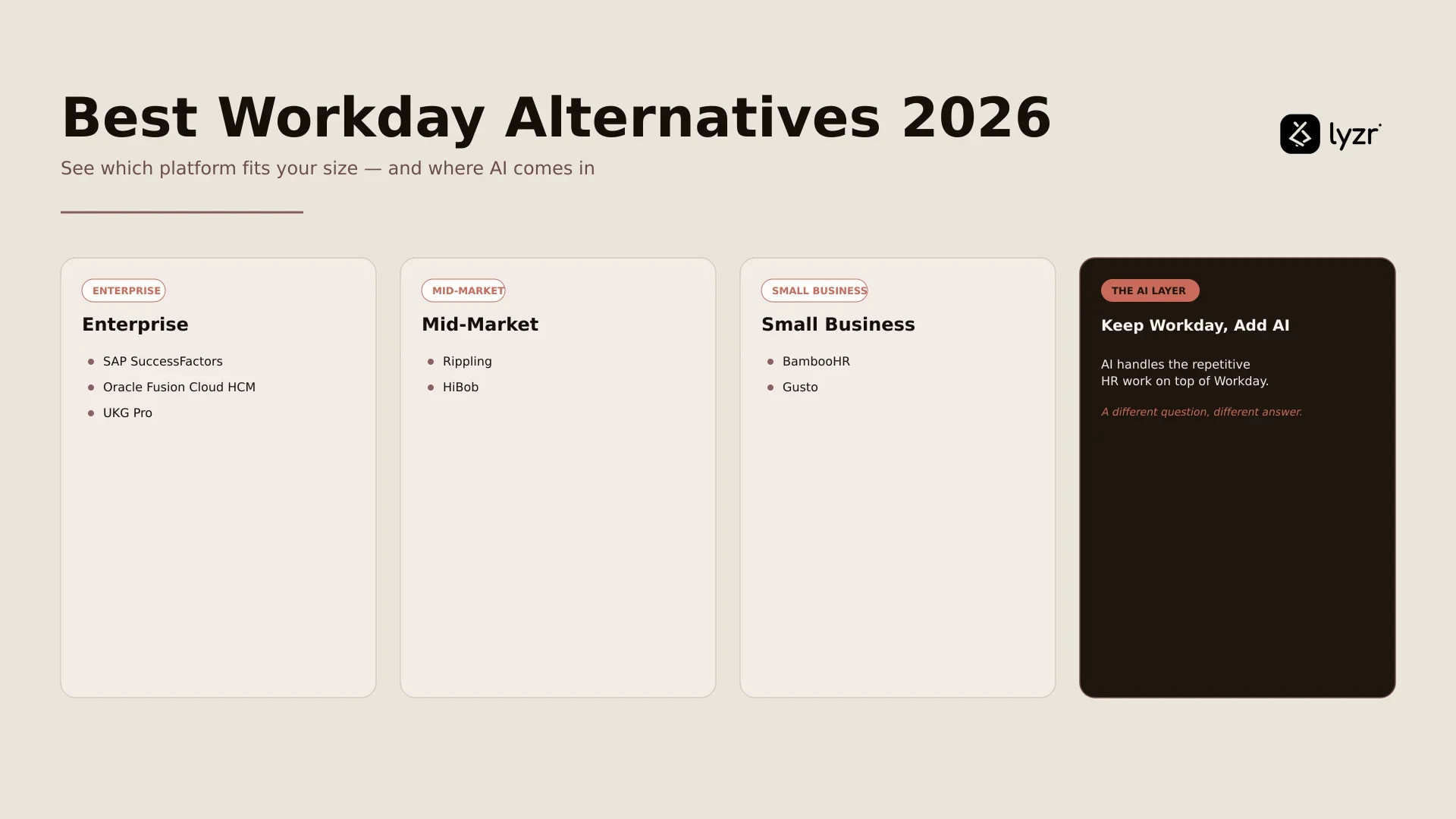
- SAP SuccessFactors, Oracle HCM, and UKG Pro lead the enterprise workday alternative field. Rippling and HiBob own mid-market. BambooHR and Gusto lead SMB.
- OrangeHRM and Kredily are the strongest free and open-source Workday alternatives.
- AI HR agents like Diane don’t replace your HRMS. They sit on top of Workday or whichever alternative you choose.
The best workday alternative depends on your company size and budget. Enterprises usually land on SAP SuccessFactors, Oracle Fusion Cloud HCM, or UKG Pro. Mid-market teams gravitate to Rippling or HiBob. Small businesses do well with BambooHR or Gusto. And if you’re keeping Workday but want AI handling the repetitive HR work on top of it, that’s a different question with a different answer.
This guide covers all four buying scenarios, plus the AI layer nobody else is naming yet.
Why companies look for Workday alternatives
Five reasons drive most workday alternative searches, and they rarely show up alone.
Cost. Workday’s core HCM (Human Capital Management) module typically runs $20 to $42 per employee per month at scale, with full-suite deployments climbing well beyond that. Implementation fees commonly equal 100 percent or more of the first year’s subscription, which means a mid-market buyer can face a first-year bill well into six figures before anyone logs in.
Implementation complexity. Enterprise HCM rollouts routinely take six months to a year and a half, depending on modules and data migration scope, and often require outside implementation partners.
User experience. Employees expect a mobile-first experience for leave requests, payslips, and time tracking. Interface friction on the employee-facing side is one of the most cited reasons HR teams start evaluating alternatives.
Feature fit. Workday is engineered for large, multi-entity, global organizations. A 200-person, single-country company pays for capabilities it will never touch.
AI capability differences. Workday has invested in its own AI features, but several alternatives now ship native AI as a core part of the platform rather than a bolt-on, which changes the buying calculus for AI-forward teams.
According to AppsRunTheWorld’s HCM software vendor and market forecast, Workday leads the HCM applications market with a 9.8 percent share, ahead of Microsoft, UKG, SAP, and ADP. That scale is exactly why the platform fits some buyers and overshoots others.
Best Workday alternatives in 2026 by category
The right workday alternative depends on headcount, geography, and what you’re actually trying to fix.
Enterprise (500+ employees, multi-country operations)
- SAP SuccessFactors. Workday’s closest enterprise competitor. Best for global organizations already running SAP for finance or ERP, with deep talent management and multinational compliance handling.
- Oracle Fusion Cloud HCM. Fits organizations tied to the Oracle ecosystem. Strong in AI-driven workforce planning and people analytics.
- UKG Pro. A strong fit for large North American and multinational workforces, particularly in shift-based industries like retail, healthcare, and manufacturing.
- ADP Workforce Now. Built for companies with intricate, multi-state payroll and compliance needs. Payroll depth is its core strength.
- Ceridian Dayforce. Runs on a continuous payroll calculation engine and a single data model, which suits retail and hospitality operations with high shift volume.
Mid-market (100 to 1,000 employees)
- Rippling. Unifies HR, IT, and device management in one system, with a fast-moving AI roadmap that appeals to tech-forward companies.
- HiBob. Built around employee experience and culture, with strong engagement and performance tools.
- Paylocity. A payroll-first platform that has expanded into full HR, with growing AI features layered into recruiting and engagement.
Small business
- BambooHR. The default choice for small teams moving off spreadsheets, with straightforward core HR, onboarding, and time tracking.
- Gusto. Payroll-first, with expanding HR features. The strongest fit for US-based small businesses where payroll simplicity matters most.
- Keka HR. A leading choice for growing businesses in India, unifying attendance, payroll, and statutory compliance in one platform.

Workday vs top alternatives: feature comparison
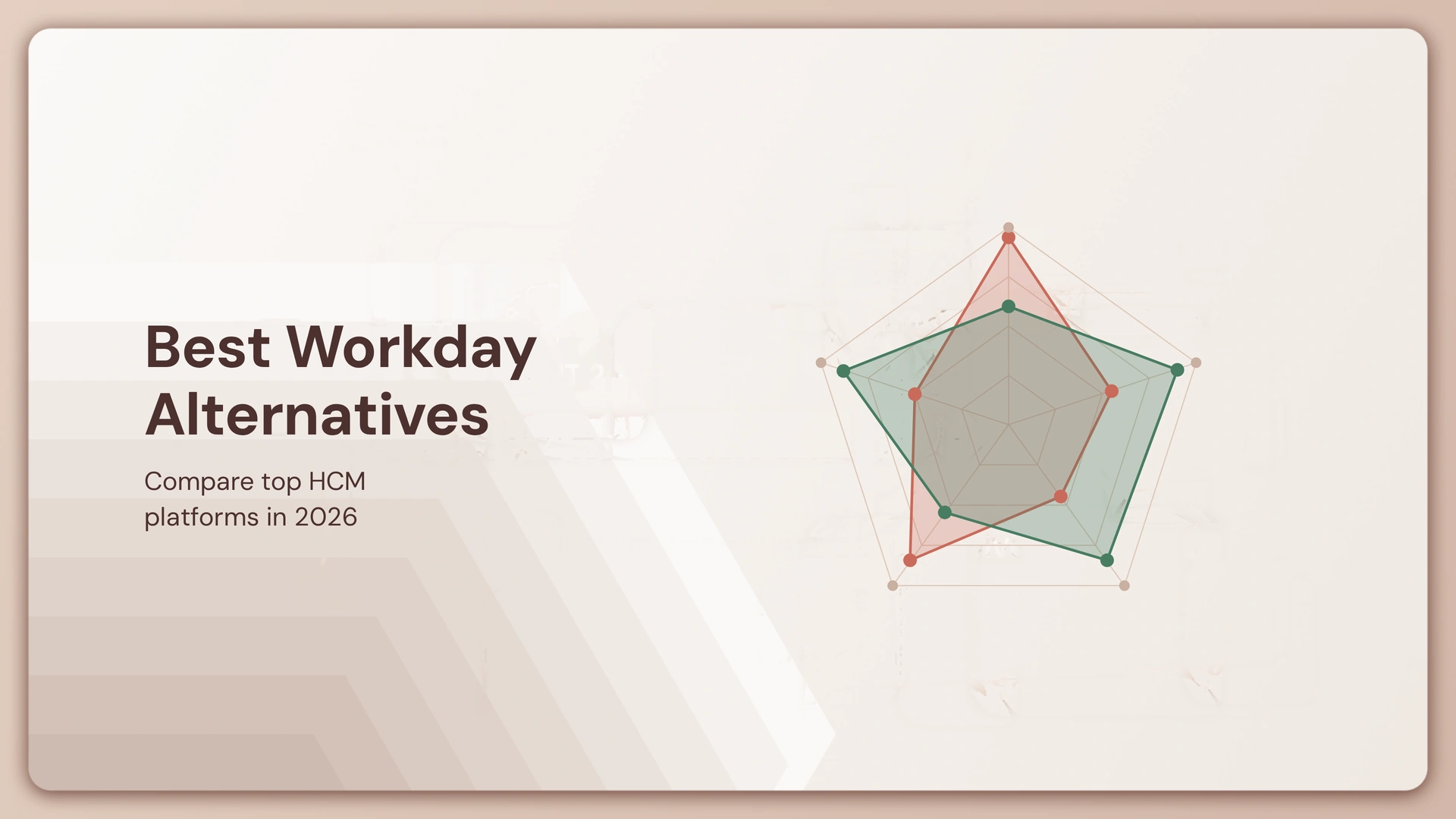
Workday HCM compared against SAP, Oracle, Rippling, and BambooHR
| Feature | Workday HCM | SAP SuccessFactors | Oracle HCM | Rippling | BambooHR |
|---|---|---|---|---|---|
| Target company size | Enterprise | Enterprise | Enterprise | Mid-market | SMB |
| Core HR and payroll | ✓ | ✓ | ✓ | ✓ | ✓ |
| Applicant tracking | ✓ | ✓ | ✓ | ✓ | ✓ |
| Performance management | ✓ | ✓ | ✓ | ✓ | ✓ |
| Learning management (LMS) | ✓ | ✓ | ✓ | ✓ | ✕ |
| Native AI features | ✓ | ✓ | ✓ | ✓ | Limited |
| Deployment | Cloud | Cloud | Cloud | Cloud | Cloud |
| Typical pricing tier | Enterprise | Enterprise | Enterprise | Mid-market | SMB |
Each of these platforms handles core HCM functions. What separates them is depth of global payroll coverage, how much configuration a rollout demands, and how native the AI layer actually is versus how bolted-on it feels.

Read the broader HRMS software buyer’s guide
Free and open-source Workday alternatives
Free and open-source platforms serve very small teams and organizations with in-house technical capacity.
OrangeHRM is the most established open-source HRMS, with a free, self-hosted community edition covering recruitment, leave management, time tracking, and performance, plus paid cloud and enterprise tiers.
Sentrifugo is a free, open-source HRMS covering attendance, leave, and recruitment. It does not include payroll, so you’ll need a separate system for that function.
Kredily is a free cloud HRMS built for Indian teams under 100 employees. It isn’t open source, but its core HR and payroll modules are genuinely free to use.
IceHrm runs a freemium, open-source model with both cloud and self-hosted deployment options.
Free tiers trade off support, analytics depth, and integration breadth. Time tracking is a common shortfall: most free HRMS platforms handle basic clock-in and clock-out, but dedicated tools like Unrubble’s time tracking product go further on shift accuracy and compliance reporting, which is worth knowing before you assume your free HRMS covers it end to end.
The AI-native HR shift: augmenting your HRMS with AI HR agents
The newest category in this market isn’t another HRMS. It’s an AI layer that sits on top of whichever HRMS you already have, Workday included.
HRMS vendors are shipping their own AI features, and it’s worth naming them: Workday AI, Rippling AI, Darwinbox AI, HONO Generative AI, SAP Joule for HR, and Oracle AI for HCM. Each is useful, and each is locked to its own vendor’s ecosystem and roadmap.
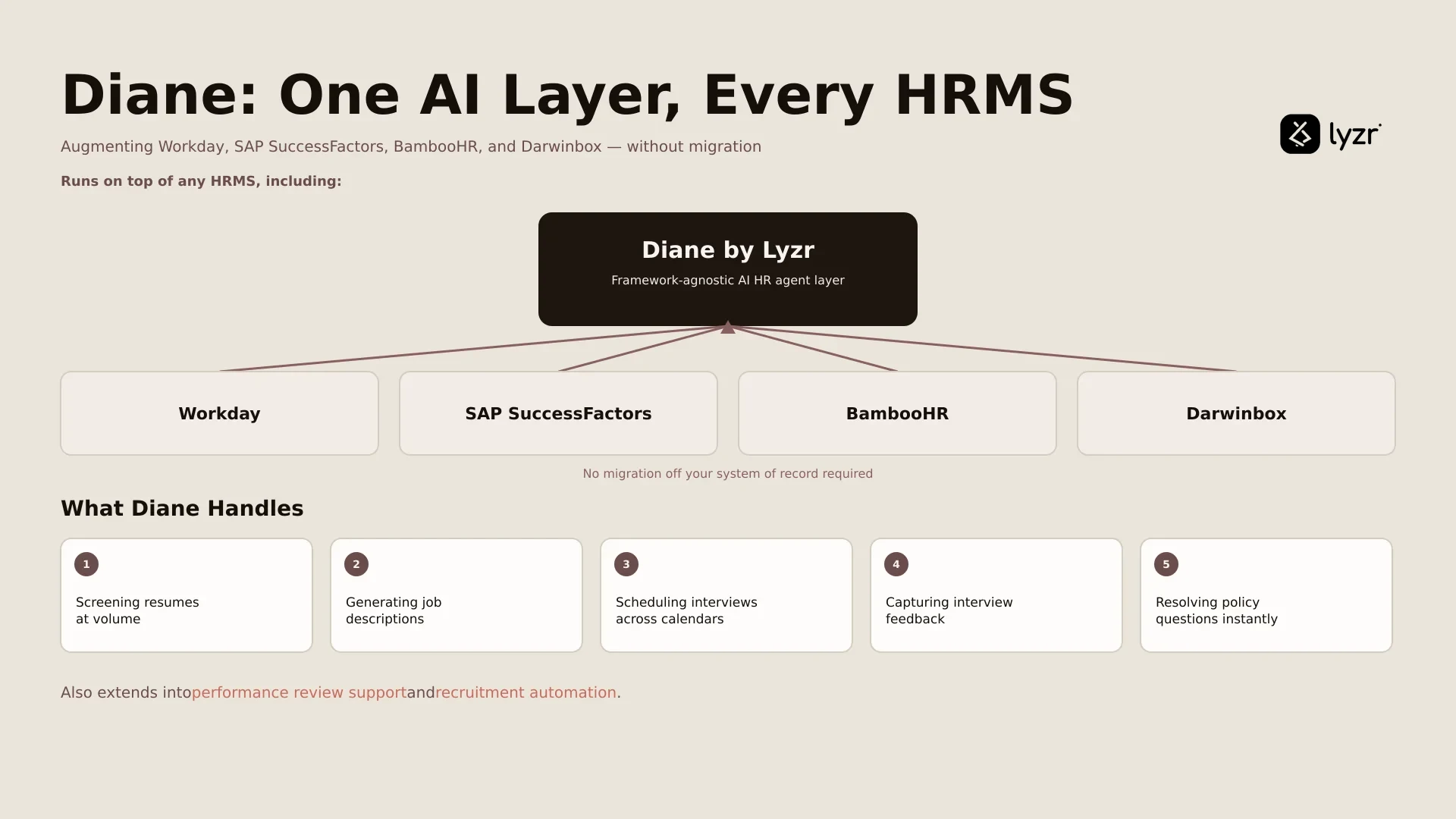
A separate category of framework-agnostic AI HR agents works differently. Diane by Lyzr runs on top of any HRMS, whether that’s Workday, SAP SuccessFactors, BambooHR, or Darwinbox, and handles the unstructured, judgment-heavy work those systems were never built for: screening resumes at volume, generating job descriptions, scheduling interviews across calendars, capturing interview feedback, and resolving employee policy questions instantly. It extends into functions like AI-driven performance review support and recruitment automation without asking you to migrate off your system of record.
A tier-1 HR technology firm runs AI agents on top of its existing HRMS specifically for high-volume resume screening and employee query resolution, keeping its core HR system untouched while the agent layer absorbs the repetitive work. That pattern, HRMS as system of record plus a governed AI layer on top, is showing up across the customer base and in detailed case studies.
It also mirrors a trend playing out in adjacent, high-stakes fields. Lumeto’s work applying AI to healthcare training shows the same principle: augment the system people already trust with judgment on top, rather than replacing the system itself.
This only works if the agent layer is governed, not scattered. Enterprises running multiple agents across HR, finance, and operations need a unified agent Control Plane and a framework-agnostic approach so the AI layer doesn’t become its own management problem. The fuller list of what this looks like in practice runs to more than 15 named use cases across the HR function.
Explore Diane, the AI HR agent that sits on top of any HRMS
How to choose the right Workday alternative: 7 questions
What is your company size and geographic footprint? Global enterprises usually need SAP or Oracle. Mid-market companies with international operations lean toward Rippling or HiBob. Small teams do fine with BambooHR or Kredily.
What compliance requirements matter? US-only operations need FLSA (Fair Labor Standards Act) and FMLA (Family and Medical Leave Act) support at minimum. EU operations add GDPR (General Data Protection Regulation). India-based entities need PF, ESI, PT, and TDS handling.
Which features are non-negotiable? Core HR, attendance, and employee self-service are table stakes everywhere. Recruitment, an ATS (Applicant Tracking System), performance management, and an LMS (Learning Management System) matter more for growing teams. Deep talent management and compensation planning matter most at enterprise scale.
What integrations do you need? Native connectors to your existing finance, ERP, and identity systems matter more than the presence of a generic API.
What is your total cost of ownership tolerance? Factor in implementation, customization, and ongoing administrative overhead, not just the per-employee-per-month rate.
How important is mobile and employee experience? Test the actual mobile app before you sign, not the sales deck screenshots.
Do you need AI-native augmentation? If resume screening, query automation, or policy drafting on top of your HRMS matters, that’s a separate evaluation from the HRMS itself. Diane is built for exactly that layer, whether you’re deployed on Workday or evaluating cloud versus on-premise deployment for the agents themselves.
Frequently asked questions
Who is Workday’s biggest competitor?
SAP SuccessFactors is Workday’s biggest enterprise competitor, followed by Oracle Fusion Cloud HCM and UKG Pro. In mid-market, Rippling and HiBob are the strongest alternatives. The right choice depends on your company size and existing tech stack.
What are the top 5 HR systems?
For enterprise, the top systems in 2026 are Workday, SAP SuccessFactors, Oracle HCM, ADP Workforce Now, and UKG Pro. For mid-market and SMB, BambooHR, Rippling, HiBob, Paylocity, and Ceridian Dayforce are the most widely deployed.
What system is better than Workday?
It depends on your priorities. Enterprises already on SAP or Oracle usually get better integration from SuccessFactors or Oracle HCM. Mid-market buyers often prefer Rippling or HiBob for user experience. Small businesses find BambooHR more accessible.
Is Workday an ATS or CRM?
Neither. Workday is a Human Capital Management (HCM) suite spanning payroll, HR, and workforce planning. It includes ATS-like recruiting features but isn’t a CRM, which is software built to manage customer relationships, not employees.
What is the best Workday alternative for small business?
BambooHR is the most common choice for US small businesses. Gusto suits payroll-heavy SMBs. Keka HR and Zoho People are strong, affordable options for Indian SMBs, and Kredily offers a genuinely free tier.
What are free Workday alternatives?
Kredily offers a free cloud HRMS for Indian teams under 100 employees. OrangeHRM has a free, open-source edition. Free options work for very small teams but usually lack the support and depth of paid plans.
Is there an open-source Workday alternative?
Yes. OrangeHRM is the leading open-source option, with the largest community and the deepest feature set. Sentrifugo and IceHrm are also viable, though self-hosting requires internal IT capability.
What are Workday alternatives for mid-market companies?
Rippling unifies HR and IT for tech-forward companies. HiBob focuses on employee experience. Paylocity delivers strong US mid-market payroll. Ceridian Dayforce fits shift-based operations, and Keka or Darwinbox lead for mid-market companies in India.
Can AI HR agents replace Workday?
No. AI HR agents like Diane augment an HRMS, automating tasks like resume screening, query resolution, and policy drafting. They don’t replace core HRMS functions like payroll, benefits administration, or workforce planning. Enterprises run both together.
How much does Workday cost compared to alternatives?
Workday’s core HCM typically runs $20 to $42 per employee per month at scale, with full-suite deployments running higher once implementation is included. SAP and Oracle sit in a comparable enterprise price band. Rippling and HiBob cost less at mid-market scale, and BambooHR and Gusto are priced for SMB budgets.
Where to go from here
Your next step depends on where you are in the decision.
If you want to see what AI agents actually automate in HR, download the AI HR agent use cases template or the broader 101 AI use cases template. If you’re building the internal business case, the HR automation playbook and the production playbook for taking agents live cover the ground your CFO and IT team will ask about.
If you’re ready to see whether an AI layer fits your specific HRMS, run the agent diagnostic assessment, explore Lyzr’s HR agent solutions, or book a demo to walk through Diane against your current setup.
The question worth sitting with: are you evaluating Workday alternatives because your HRMS is wrong for your size, or because the manual work sitting on top of a perfectly good HRMS is what’s actually costing you time? Those are two different projects, and they have two different answers.
Book A Demo: Click Here
Join our Slack: Click Here
Link to our GitHub: Click Here