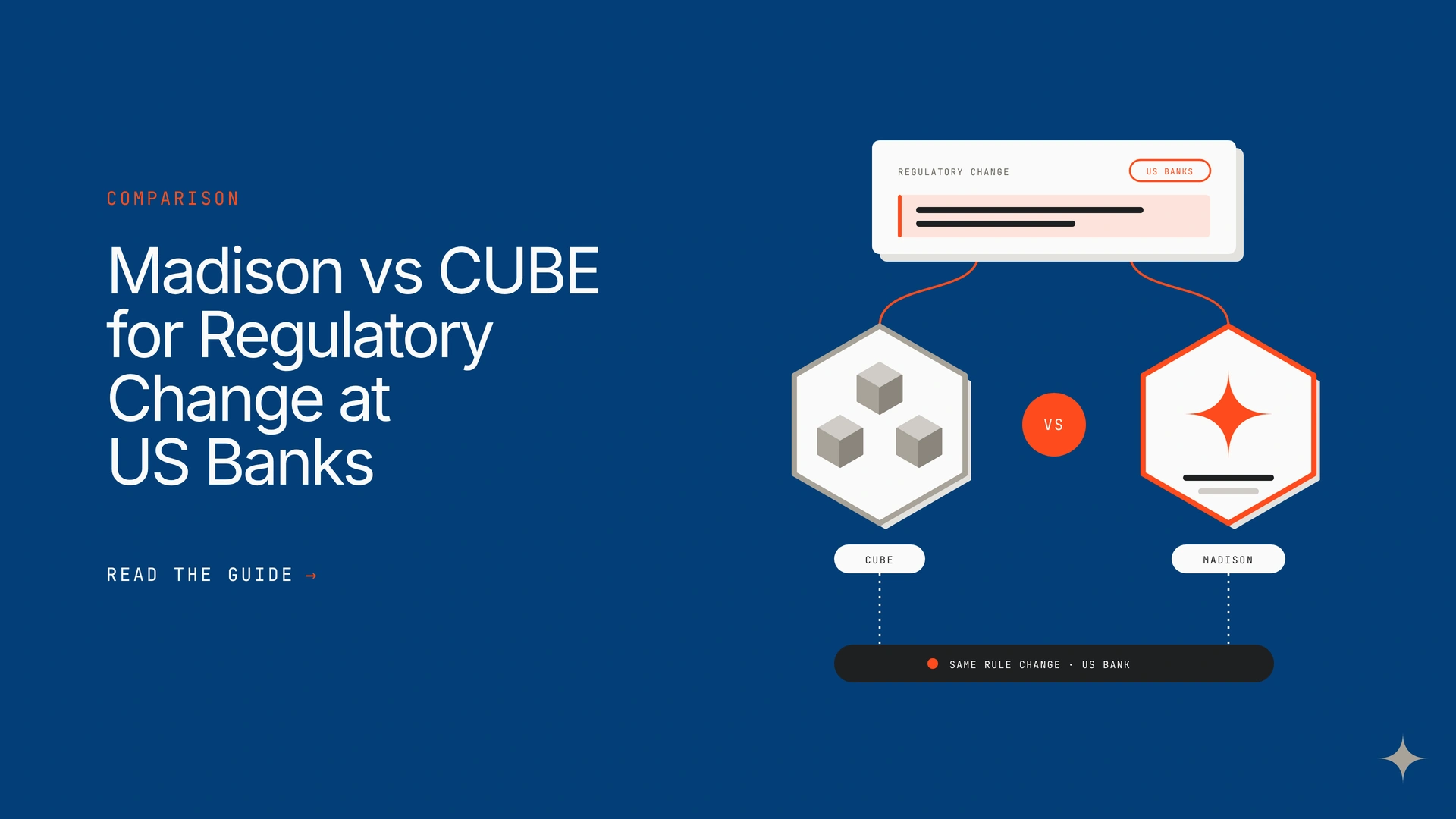
Madison and CUBE both help banks keep up with regulatory change, but they are built around different ideas. CUBE is an AI-native regulatory intelligence and change management platform with global source coverage, relevance scoring, obligation mapping and a peer network. Madison, Lyzr’s agentic GRC product for US banks and credit unions, uses agents to trace each rule through your own obligations, policies, procedures and controls, and on to tests, findings and examiner requests, with a named person approving every decision. This page compares the two on what a US bank actually needs, using CUBE’s own public materials, and says where each fits.
TL;DR
- Different starting points: CUBE starts from global regulatory intelligence and filters it down to what is relevant. Madison starts from your bank’s own library and traces each rule through it.
- CUBE: says it monitors 1,000+ sources across 250 countries and territories, classifies applicability, maps changes to obligations and controls, and adds agentic “coworkers” for priorities, analysis and enforcement.
- Madison: one connected model from regulation to obligation, policy, procedure, control, test, finding, evidence and examiner request. Live now in regulatory change, examinations and issues, and third-party and AI oversight.
- For a US bank: what matters is proposed versus final rules, federal and state change, and the link to your own policies. Test each tool on those.
- Human control: in Madison agents propose, a named person decides, and the decision is signed against the exact version. Madison writes nothing back to your core banking system.
- Fair warning: this is written by Madison’s maker. CUBE claims are quoted from CUBE’s own pages and should be confirmed with CUBE.
What are Madison and CUBE?
CUBE
A regulatory intelligence and regulatory change management company. Its platform, RegPlatform, is described as a connected enterprise compliance and risk platform “enabled by agentic AI”. CUBE’s AI engine is called RegBrain, and in 2025 it acquired Acin, an operational risk provider, to bring regulatory tracking and operational risk and controls together. It sells to banks, financial services firms, insurers and corporates, and has a mid-market product, RegPlatform Intel, aimed at regional and community banks among others.
Madison by Lyzr
A workforce of AI agents for compliance and risk in US banks and credit unions. It reads the rules, your policy and procedure library and your examination history, builds a live map of how they connect, and hands finished, sourced work to a named person who decides. Regulatory change and coverage, examinations and issues, and third-party and AI oversight are live now.
Both answer the question every compliance team asks each week: what changed, does it apply, and what do we have to do about it? They differ in how much of the answer comes from a global content and peer network, and how much comes from tracing the change through your own documents.
How do Madison and CUBE compare at a glance?
| Dimension | CUBE | Madison by Lyzr |
|---|---|---|
| Core idea | AI-native regulatory intelligence, filtered to what is relevant to a firm, then mapped to obligations and controls. | An agent workforce working on one connected model of rules, policies, procedures, controls and evidence. |
| Starting point | Global regulatory data and a peer-validated network, filtered by firm profile. | The bank’s own library of policies, procedures and controls, mapped to the rules that apply. |
| Geography | Global. CUBE says it covers 1,000+ sources across 250 countries and territories. | US banks and credit unions. |
| What the AI does | Ingests and classifies change, scores relevance, answers questions in natural language and consolidates enforcement actions. | Traces a rule to the duties, policies, procedures and controls it touches, shows coverage gaps and drafts the response. |
| Human role | Decisions are “subject to your own configuration and review process”, with 250 in-house experts behind the content. | Agents propose, a named owner accepts, amends or rejects, and the decision is signed. |
| Reach beyond change and obligations | Maps obligations to controls and, through Acin, operational risk and controls. | Continues to tests, findings, remediation, evidence, examiner requests and third-party and AI oversight. |
| Writes to core systems? | Delivers intelligence inside existing platforms such as ServiceNow and Azure. Write behavior is not stated. | No. Madison reads from your systems and writes nothing back to your core banking system. |
What does regulatory change look like for a US bank?
A US bank does not track one rulebook. It tracks federal rules, agency bulletins, interagency guidance, state banking department changes and enforcement actions, and it has to know which are proposals and which are final. Three recent examples show why the distinction matters.
| Example | Status | Why a tool must get it right |
|---|---|---|
| FinCEN AML/CFT program proposed rule (April 7, 2026) | Proposed. Comments closed June 9, 2026. | A proposal is not an obligation. A tool that surfaces it as binding creates false work. |
| SR 26-2 model risk guidance (April 17, 2026; OCC Bulletin 2026-13; FDIC FIL-15-2026) | Issued. Places generative and agentic AI outside its scope. | Applicability depends on the bank’s size and use. A scope carve-out changes what you must do. |
| Interagency third-party risk guidance (June 2023) | Final, non-binding. | Guidance shapes examination, so it still belongs in your obligation map, labelled as guidance. |
Dates as reported in the sources listed in our earlier articles. Verify against the primary Federal Register, Federal Reserve, OCC and FDIC texts.
For a US bank, a good regulatory change tool therefore separates status, applies your charter and size, and connects the result to your own policies and controls. Our guide on how to evaluate a regulatory change agent turns these into tests.
How far does each one reach along the compliance chain?
A rule change is the start of the work, not the end. To hold up in an examination, a bank connects it to an obligation, then to the policy that carries it, the procedure beneath and the control that proves it, and then to the tests, findings and evidence that follow.

Global intelligence or connected bank model: how does each one work?
The deeper difference is where the intelligence sits. CUBE’s pitch is that scale, data and experts come first: it ingests change from a very large set of sources, enriches and classifies it, and delivers what is relevant to each firm. Madison’s pitch is that a bank’s own documents are the other half of the answer, so agents trace each rule through your obligations, policies, procedures and controls and bring finished work to a named person.

| Question | Global intelligence model | Connected bank model |
|---|---|---|
| Where does the answer come from? | A large content and expert base, plus peer-validated network data, filtered by firm profile. | Rule text traced through your own policies, procedures and controls. |
| Strength | Breadth across regulators and jurisdictions, and a view of how peers read the same change. | A direct line from a US rule to the exact clause, procedure and control it affects. |
| What to test | How well relevance scoring and mapping fit your charter, states and products. | How accurate the agents’ mappings are on your documents, and how the review gate works. |
If you want the method for testing either one on your own history, see how to map policies to controls with an agent, and check the mapping it proposes.
Capability by capability: what does each one do?
The table follows the order of a compliance team’s work. The CUBE column reflects its public pages and product news as we read them in October 2026, so confirm current scope with CUBE.
| Capability | CUBE | Madison |
|---|---|---|
| Sources | Continuous ingestion from 1,000+ sources across 250 countries and territories, from “primary legislation to supervisory guidance”. | Reads published rules and amendments that apply to the bank. Rule intake and horizon scanning are part of the regulatory change area. |
| Applicability | AI-driven classification of which changes likely apply, by jurisdiction, entity type and business activity. | Applicability is a link in the connected model, between the obligation and the policy that carries it. |
| Relevance and priority | Priorities Coworker scores incoming change for relevance and filters out the rest. | Shows what a change touches in your own library, and flags duties with no policy or control behind them. |
| Analysis | Analysis Coworker answers natural-language questions on applicable updates, laws and rules. | Advisory agents read the model and answer with the rule text and its path cited. |
| Enforcement actions | Enforcements Coworker consolidates actions across jurisdictions and extracts risk themes and obligations. | Findings and matters sit in one register with the chain behind them. |
| Obligations | Maps changes to internal obligations, assigns ownership and tracks deadlines. | Extracts duties from rules, each traced to its source, and shows duties with no policy behind them. |
| Policies, procedures and controls | Maps obligations to controls. Links to a bank’s policy and procedure library are not described. | Maps duties to the policies that carry them and the procedures and controls underneath, and shows coverage gaps. |
| Peer view | Peer benchmarking shows how comparable institutions interpret the same change. | Not a Madison focus. Madison works from your own record. |
| Control testing, findings and exams | Operational risk and controls through Acin. Examiner request response is not described on the pages reviewed. | Tests, findings, remediation and evidence, and examiner requests answered from the chain. Examinations and issues are live now. |
| Third-party and AI oversight | Not described on the pages reviewed. | Vendors, models and agents held as governed objects on the same map. Live now. |
| Integration | API-first. Delivers inside ServiceNow, Microsoft Azure and existing GRC systems. CUBE says integration typically takes under two weeks. | No integration work is needed to start: you bring your policy library to a working session. |
| Audit trail | Decisions documented with evidence “from the original regulatory source through to your firm’s response”. | Every decision is signed and recorded against the exact version approved, with the signer’s role at the time. |
Where the CUBE column says “not described”, that reflects the public pages we reviewed. CUBE may offer more through other modules or by agreement.
How does each one handle relevance and noise?
Relevance is the problem both tools are built around, and CUBE has made it central. Its Cost of Compliance Report 2025 found that 82% of firms monitor 26 to 100 regulatory developments a month, and that 45% said fewer than half of tracked developments ever demanded action. CUBE says early trials of its Priorities Coworker cut wasted effort by 80% to 90%. That figure is from early trials and is not independently verified.

| Approach to noise | CUBE | Madison |
|---|---|---|
| How it decides what matters | Scores each change for relevance to the firm’s profile and filters the rest. | Traces the change to the duties, policies and controls it touches in your model. |
| What you see | A prioritised list of changes that matter. | What the change touches, and where coverage has gaps. |
| Where a person steps in | Within the firm’s configuration and review process. | A named owner accepts, amends or rejects. |
These are complementary answers. Filtering stops you reading what you do not need. Tracing tells you what to change in what you own.
What happens when a US rule changes?
Take a final rule that adds a new reporting deadline. Here is the likely path in each tool, based on how each describes itself.
| Step | With CUBE | With Madison |
|---|---|---|
| 1 · Detect | The change is ingested and classified, with relevance scored for the firm. | Madison picks up the published change and shows what it touches. |
| 2 · Assess | Applicability is classified by jurisdiction, entity type and activity. | The new duty is extracted and checked for applicability. |
| 3 · Obligation | The change is mapped to internal obligations with an owner and deadline. | The duty links to the policies that carry it, the procedures beneath and the controls under both. |
| 4 · Respond | The team acts through workflow and its existing systems. | Madison drafts the response and flags any duty with no policy or control behind it. |
| 5 · Decide and record | Documented with an audit trail from source to response. | A named owner accepts, amends or rejects; the decision is signed on the exact version. |
What should a bank test in any regulatory change tool?
Whichever you choose, run these four tests on rule changes you have already handled by hand:
1. Status.
Does it separate a proposal from a final rule and an effective date? A proposed rule should not surface as an obligation.
2. US coverage.
Which federal agencies and which states does it track for your charter? Ask for the list, not “all regulators”.
3. Your policies.
Does it name the clause of your policy and the control beneath it, or stop at a summary of the rule?
4. The record.
Who approved, in what role, on which version, and can you retrieve it for an examiner without rebuilding it?
What does each one do well?
CUBE
CUBE’s strengths are scale and breadth: global source coverage, a large in-house expert team, a peer-validated view of how others read the same change and a clear focus on relevance. It also says it serves around 800 mid-market customers and is API-first, with integration into ServiceNow, Azure and existing GRC tools. If you operate across many jurisdictions, that breadth matters.
Madison
Madison’s strength is the connected chain for a US bank. One model links the rule to the policy, procedure, control, test and examiner request, so a question that used to take a room full of people becomes a lookup, and the signed record shows who decided what, on which version.
Which one should a US bank choose?
There is no single answer, and the two can address different parts of the work. Use the table as a starting point, then test the shortlist on your own material.
| If this describes you | Lean toward | Why |
|---|---|---|
| You operate across many countries and need global regulatory coverage. | CUBE | Its design and content are global, with a peer view across regimes. |
| Your main problem is volume: too many updates and too few that matter. | CUBE | Relevance scoring is its central focus. |
| You are a US bank or credit union and the hard part is linking each rule to your own policies, procedures and controls. | Madison | That mapping is the core of the connected model, with gaps shown. |
| Examiner requests and findings take weeks to assemble. | Madison | Requests are answered by walking the chain back to the duty behind them. |
| You also need to govern vendors, models and agents. | Madison | Third-party and AI oversight sits on the same map. |
| You want both a global intelligence feed and an agent layer on your own documents. | Evaluate both | Ask whether a feed can flow into Madison’s model. We have not tested this integration. |
What should you ask each vendor?
Use the same list for every vendor, and run it on three rule changes you have already handled by hand.
| Question | What a good answer shows |
|---|---|
| Show a past US rule change of ours from start to finish. | Source text, status, applicability, and links to our own policies and controls. |
| Which US federal agencies and states do you track? | A named list, with how fast each is picked up. |
| How do you treat proposed rules versus final rules? | Separate status and effective dates, with no proposal shown as binding. |
| How much is done by AI and how much by people? | A clear split, with the checks and who is accountable. |
| What does it do when it does not know? | It says so and escalates, rather than guessing. |
| What record does an approval leave? | Who, in what role, on which version, and when. |
| What can it write to, and where does our data sit? | A written list of permissions, the deployment model and sub-processors. |
| What does it cost, and what is in scope? | A written scope and price for your institution. |

Where does Opencontroller fit?
Once any AI-enabled compliance tool is in use, the agents behind it become part of your estate and need an owner. Opencontroller by Lyzr is the control plane that governs agents: a registry with an immutable ID and a named owner for each, approvals with separation of duties, and an audit trail, running in your own cloud account. It complements, rather than replaces, your GRC and model risk tools, and external agents register as entries.
It supports Madison’s agents, and the same registry can hold agents from other vendors. See AI agent inventory for banks and the AI agent registry guide.
Compare them on your own rules
Bring your policy library and three past rule changes to a working session. We will show what Madison traces, where it sees gaps and what a named person approves.
Frequently asked questions
What is CUBE regulatory change management?
CUBE is a regulatory intelligence company whose RegPlatform covers the regulatory change lifecycle from issuance to mapped obligation. It says it monitors 1,000+ sources across 250 countries and territories, classifies which changes apply, maps them to internal obligations with owners and deadlines, and keeps an audit trail from the original source to the firm’s response.
What is CUBE RegBrain?
RegBrain is the name CUBE gives its AI engine for automated regulatory intelligence. CUBE describes it as turning regulatory content into structured, contextualised intelligence, interpreting what a rule means and linking it to a firm’s obligations and controls. These are CUBE’s own claims, with no technical detail published.
What are CUBE’s agentic coworkers?
In September 2026 CUBE expanded its agentic coworker suite with three agents: Priorities Coworker, which scores change for relevance and filters the rest, Analysis Coworker, which answers natural-language questions on applicable updates, and Enforcements Coworker, which consolidates enforcement actions across jurisdictions.
What is the difference between Madison and CUBE?
CUBE starts from global regulatory intelligence filtered to what is relevant to a firm, and maps changes to obligations and controls. Madison, Lyzr’s agentic GRC product for US banks and credit unions, holds the whole chain from regulation to obligation, policy, procedure, control, test, finding, evidence and examiner request as one connected model, with a named person approving each decision.
Is CUBE built for US banks?
CUBE is a global platform and says it serves banks, including regional and community banks through RegPlatform Intel, and operates in North America. Its banking page does not list US regulators or states specifically, so ask which federal agencies and states it tracks for your charter.
Which is better for a US bank, Madison or CUBE?
It depends on where your effort goes. If you operate across many countries or your main problem is volume, CUBE’s global coverage and relevance filtering fit. If you are a US bank or credit union and the hard part is linking each rule to your own policies, procedures and controls, or answering examiner requests, Madison’s connected model addresses that. Test either on three past rule changes.
How does Madison handle regulatory change?
Madison shows analysts what a rule change touches: the duties it creates, the policies that carry them, and the procedures and controls underneath, with coverage gaps shown. Agents propose, a named person accepts, amends or rejects, and the decision is signed against the exact version. Regulatory change is live now.
What does regulatory change management involve for a US bank?
It means tracking federal rules, agency bulletins, interagency guidance, state changes and enforcement actions, deciding which apply to your charter and size, separating proposals from final rules, mapping each obligation to your policies, procedures and controls, and recording who decided what.
Does CUBE map regulations to internal controls?
CUBE says it maps obligations to the controls that cover them and offers a shared view for first and second line teams. Through its 2025 acquisition of Acin it also covers operational risk and controls. Its public pages do not describe links to a bank’s policy and procedure library.
Does Madison write to our core banking system?
No. Madison reads from your systems and writes nothing back to your core banking system. CUBE says it delivers intelligence inside existing platforms such as ServiceNow and Microsoft Azure; its public pages do not say what it can write to, so ask each vendor for a written list of permissions.
How do you compare regulatory change management tools?
Run the same test on each one using rule changes you have already handled by hand. Check the sources and US agencies it covers, how it treats proposed versus final rules, how it decides applicability, whether it links to your policies and controls, who approves, and what record an approval leaves.
Where does Opencontroller fit alongside Madison?
Opencontroller by Lyzr governs the agents behind the work. It registers each agent with an immutable ID and a named owner, enforces approvals with separation of duties and keeps an audit trail, in your own cloud account. It complements GRC and model risk tools and can hold agents from other vendors as external entries.
Book A Demo: Click Here
Join our Slack: Click Here
Link to our GitHub: Click Here
Got a use case in mind?
8 weeks from use case to agents running in production.
Platform, people and FDEs, all in. Bring your environment. We'll co-build and stay until it's live.
Talk to UsFree resource
101 AI Agents Use Cases
100+ production-ready AI agent use cases across Marketing, Sales, HR, Banking, Insurance, Operations and a lot more
Download now