The on-premise AI vs cloud AI deployment debate has moved well beyond a technical infrastructure conversation.
Choosing between on-premise and cloud AI used to be a straightforward infrastructure decision. In 2026, it is a governance, risk, and economics decision that shows up in security reviews, budget planning, and even board conversations.
The experimentation phase is over. AI systems are now running production workflows, processing regulated data, and supporting autonomous agents at scale.
The Shift That Changed Everything in 2026
Gartner projects worldwide AI spending will reach $2.59 trillion in 2026, up 47% year over year. The pattern underneath the headline matters more: enterprises are increasingly running production AI outside the public cloud. In Broadcom’s Private Cloud Outlook 2026, public cloud as the primary home for production AI inference fell to 41%, while 56% now run or plan to run it in private cloud. Data residency and privacy are among the top reasons enterprises keep sensitive workloads off public cloud.
If your enterprise is still treating this as a purely technical choice, the framing is already out of date.
The four deployment modes
Most content on AI deployment presents three modes: public cloud, on-premise, and hybrid. That framing misses the two modes that matter most for enterprise buyers in 2026.

Public cloud AI runs on hyperscaler infrastructure. AWS, Microsoft Azure, and Google Cloud provide the compute; managed services like Amazon Bedrock, Azure OpenAI, and Vertex AI abstract the model layer. Public cloud is the default for teams that need speed and elastic scale, or that have no meaningful sovereignty or compliance constraints.
Private cloud and VPC AI sit between public cloud and on-premise. A VPC deployment runs on public
cloud infrastructure inside an isolated network perimeter. Private cloud typically means dedicated cloud resources managed by a third party, often through cloud managed services. Both offer more control than pure public cloud with less operational overhead than DIY on-premise. This is where many regulated enterprises land when full on-premise is impractical.
On-premise AI runs inside your own physical infrastructure: your data centers, your GPU servers, your networking, your storage. Air-gapped on-premise is a subset used for classified workloads and the most sensitive financial applications. On-premise gives you maximum control at maximum operational cost.
Managed sovereign AI is the fourth deployment mode. A managed platform runs inside your own VPC or on-premise environment, giving you open-source model flexibility with managed-platform security. You keep 100% data privacy and IP ownership while the vendor manages the operational layer. We cover this mode in depth below, because it is the one most enterprise CIOs and CTOs are not yet evaluating and probably should be.
Workload type shapes the choice. Training large models favors public cloud and its elastic GPU capacity. Continuous inference at scale, which is what AI agents run, favors on-premise or managed sovereign for better steady-state economics. Edge AI is on-premise by definition.
The four-mode deployment comparison, across the factors that most influence CIO and CTO decisions in 2026:
| Factor | Public Cloud | Private Cloud / VPC | On-Premise | Managed Sovereign |
|---|---|---|---|---|
| Data security and IP | Provider-shared | Isolated tenant | Full control | Full control |
| Compliance and residency | Provider-dependent | Regional flexibility | Direct control | Direct control |
| Cost model | Opex, variable | Opex, semi-fixed | Capex, high upfront | Opex, predictable |
| Cost at scale | Rises with usage | Moderate scaling | Lowest steady-state | Between on-prem and cloud |
| Scalability | Elastic | Elastic within tenant | Requires planning | Elastic within perimeter |
| Latency | Network-dependent | Better than public | Best (local) | Best (local) |
| Operational ownership | Provider | Shared | Full customer | Vendor-managed |
| Governance and audit | Provider tools | Provider + custom | Custom-built | Platform-native |
| Model portability | Provider catalog | Provider catalog | Full portability | Full portability |
| Best-fit scenario | Bursty, non-regulated | Business-sensitive | Classified, ultra-regulated | Regulated, moderate MLOps |
The takeaway is not which column wins overall. It is which mode fits your specific combination of constraints. That maps to the decision framework below.
What actually decides it: five factors
Five factors determine most enterprise AI deployment decisions.

Data security, sovereignty, and IP. Cloud providers invest heavily in security certifications such as SOC 2, ISO 27001, and FedRAMP baselines. But security posture and sovereignty are different questions. Sovereignty is about where your data physically resides, who has legal jurisdiction, and whether third parties can access it. Regulated industries increasingly require sovereignty guarantees that public cloud AI cannot fully provide.
Compliance and residency. GDPR, HIPAA, DORA, GLBA, FedRAMP, DPDP, and the EU AI Act each impose requirements on where data lives, how it is processed, and how AI decisions are audited. The EU AI Act does not mandate on-premise deployment. It does require documentation, transparency, and audit trails that some enterprises find easier to demonstrate with on-premise or managed sovereign deployments.
Cost and TCO. The cost case has shifted. Cloud AI has lower upfront cost and higher variable cost; on-premise is the reverse. The crossover point compresses as utilization rises: for sustained inference at high utilization the breakeven arrives far sooner than the 12-to-18-month cycles buyers once assumed. A Dell-commissioned analysis by Enterprise Strategy Group, modeling a 70-billion-parameter LLM serving 5,000 to 50,000 users, found on-premise inference up to 62% more cost-effective than public cloud and up to 75% more than an API-based service over four years. These are vendor-commissioned figures for one scenario, so treat them as directional.
The math is compelling. It is also incomplete, because DIY on-premise operational cost is rarely fully captured. Two distinct domains now drive the economics: the training factory, with bursty compute loads that favor cloud, and the inference engine, with persistent latency-sensitive load that drives the majority of long-term cost.
Operational ownership. Cloud AI outsources operations to the provider. DIY on-premise puts them on your team: GPU procurement, model versioning, observability, Kubernetes management, security patching, and disaster recovery. GPU lead times run into weeks and procurement costs sit well above cloud-equivalent pricing. A production on-premise LLM stack typically requires a small dedicated team of MLOps engineers with real LLM production experience, and a large majority of enterprises consider their current infrastructure not yet ready to support on-premise AI workloads. Managed sovereign gives you on-premise control without the operational headcount.
Model portability. Cloud AI ties you to your provider’s model catalog. On-premise gives you full portability across OpenAI, Anthropic, Google, or open-source models via vLLM or TGI. Managed sovereign preserves that portability. For enterprises whose roadmap depends on model choice, portability is a structural requirement.
But this is the wrong question for AI agents
Everything above assumes the question is where the model runs. For most enterprise AI deployments in 2026, that is no longer the right question.
The AI stack has three layers. The model layer is what gets discussed in most on-premise vs cloud comparisons. The workflow layer runs above it: orchestration, tool use, retrieval, memory. The agent layer runs above that: goal-driven autonomous execution.
Agentic systems change the deployment equation because they introduce continuous, high-frequency interaction across databases, APIs, and enterprise systems. In public cloud, each agent action can become a data-residency and jurisdictional event. In on-premise or private cloud, the entire execution loop stays inside your security boundary. For regulated multi-agent workflows, that is a structural advantage configuration alone cannot fully replicate.
So for agents, deployment location matters at the agent layer, not just the model layer. Where does the orchestration engine run? Where is memory persisted? Where does the audit trail live? A cloud-hosted model with on-premise orchestration and memory is a very different architecture from a fully cloud-hosted agent, and its security review, compliance posture, and cost all differ.
This is why the on-premise vs cloud framing gets stuck. It optimizes for the wrong layer. What actually matters is where control lives: governance, identity, audit, and orchestration. That control layer is what a Control Plane provides, and it must exist regardless of which mode your models run in.
The fourth deployment mode: managed sovereign AI

Managed sovereign AI is the deployment mode that has emerged over the last 18 months. A managed platform vendor runs a full agentic AI stack inside your VPC or on-premise environment. You get the flexibility of DIY on-premise (model portability, data sovereignty, IP ownership) with the operational simplicity of a managed service (no dedicated MLOps headcount, vendor-managed upgrades and patches).
At Lyzr, this is the pattern we build for enterprise customers. Skott, the Agentic OS for Marketing by Lyzr, runs in customer-controlled environments, as do the industry offerings (Amadeo for banking, Benjie for insurance) and Diane for HR. The architecture is consistent: model, workflow, and agent layers all run inside the customer perimeter, with unified governance through the Control Plane.
What managed sovereign AI gets you that DIY on-premise usually does not:
- Speed to production with pre-built agents, workflows, and integrations
- Model portability without integration overhead
- SOC 2, ISO 27001, RBAC, audit logging, and hallucination monitoring built in
- Continuous stack updates without operational risk
The honest math for CIOs and CTOs: DIY on-premise wins on unit cost at scale but loses on time to value and operational headcount. Managed sovereign wins on time to value, operational simplicity, and enterprise controls, with unit cost sitting between DIY on-premise and public cloud.
A tier-1 systems integrator we work with deployed a Lyzr agent stack inside its own environment to meet data residency and pass security review. The alternative was an 8-to-12-month DIY build. The managed sovereign deployment reached production in under 90 days.
The hybrid path: where most enterprises land
In practice, most enterprises adopt a hybrid model. This is not a compromise. For most enterprise workload profiles it is the architecturally correct answer, and it typically delivers lower TCO than pure cloud for sustained high-utilization workloads.
The strongest hybrid pattern is three tiers, routing each workload to the tier where the unit economics are best:
- Cloud tier for burst workloads, model training, and unpredictable inference, where you absorb uncertainty without committing capex.
- On-premise tier for consistent, high-volume production inference, where fixed costs get cheaper per inference at sufficient sustained volume.
- Edge tier for ultra-low-latency use cases needing sub-50ms response, such as real-time fraud detection and industrial automation.
The goal is not to move workloads from cloud to on-premise or back. It is to run each workload on the tier that best matches its risk, cost, and latency profile. The failure mode is choosing hybrid because you could not decide, rather than because your workload mix genuinely calls for it.
Governed on-premise agentic reference architecture
For enterprise architects who need the technical detail, here is what a governed agentic architecture looks like running inside your own environment.
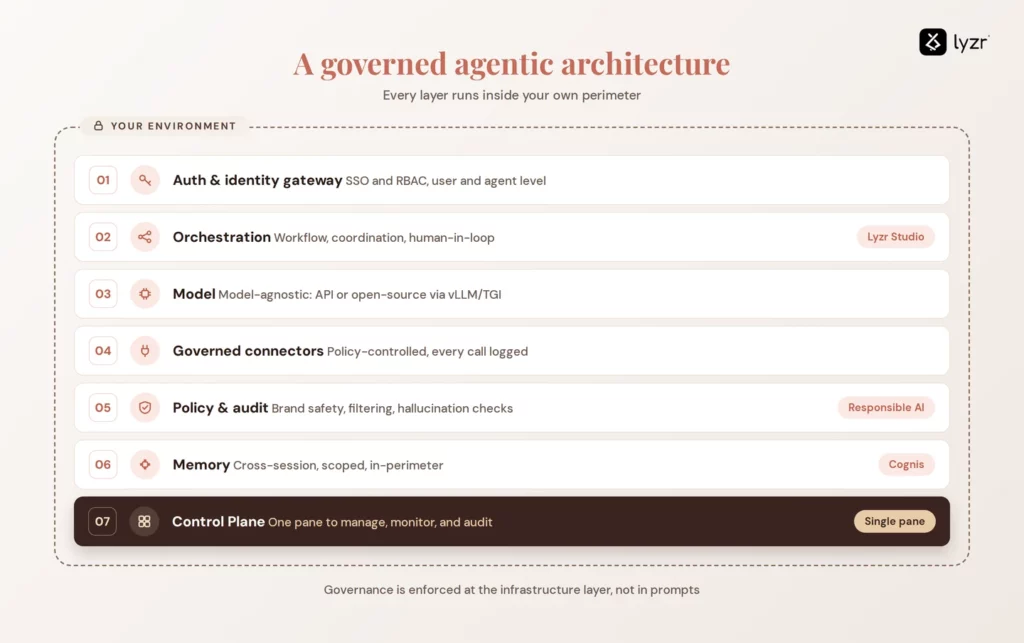
Layer 1: Auth and identity gateway. Enterprise SSO with RBAC applied at both user and agent level. Every action is attributable.
Layer 2: Orchestration. Lyzr Studio or Architect by Lyzr provides workflow definition, agent coordination, and human-in-the-loop checkpoints.
Layer 3: Model. Model-agnostic. OpenAI, Anthropic, and Google models via API where policy allows; open-source models via vLLM or TGI where full sovereignty is required.
Layer 4: Governed connectors. All data, tool, and RAG integrations flow through a policy-controlled connector layer. Every call is logged.
Layer 5: Policy and audit. Responsible AI as a Service enforces brand safety, prompt filtering, and hallucination detection at the infrastructure layer.
Layer 6: Memory. Cognis manages agent memory across sessions, scoped to context and persisted inside the customer perimeter.
Layer 7: Control Plane. A single pane for managing, monitoring, and auditing across all agents.
The important pattern: governance is enforced at the infrastructure level, not in prompts. That is what makes the architecture pass enterprise security review.
How to choose: a five-question decision framework
Answer each question honestly. The pattern will point at one of the four modes. Plan against a 24-to-36-month horizon, not your first pilot.
1. What workload type dominates?
- Training large models from scratch → public cloud
- Inference at production scale → on-premise or managed sovereign
- Both → hybrid or managed sovereign
- Edge or IoT → on-premise or edge
2. How sensitive is your data and regulatory exposure?
- Low sensitivity, low regulation → any mode
- Business-sensitive or moderate regulation → VPC minimum, managed sovereign preferred
- Regulated (BFSI, healthcare, government) → on-premise or managed sovereign
- Classified or national security → air-gapped on-premise
3. What is your team’s MLOps maturity?
- No dedicated MLOps team → public cloud or managed sovereign
- MLOps team but no LLM production experience → managed sovereign
- Full LLM production experience with GPU procurement discipline → DIY on-premise viable
The 60-70% threshold rule. When your cloud AI costs reach 60 to 70% of what equivalent on-premise hardware would cost over a comparable period, on-premise economics begin to compete, even after capex and operational overhead. Pair this with GPU procurement lead times, which run into weeks in 2026, and a realistic team size for production on-premise AI.
4. How fast do you need to ship?
- Weeks → public cloud or managed sovereign
- Months → any mode
5. What is your regulatory geography?
- US only → any mode; check HIPAA, GLBA, FedRAMP
- EU only → VPC minimum; check GDPR, EU AI Act, DORA
- Global multi-region → managed sovereign for consistency
- Country-specific data localization → on-premise or in-country sovereign
Most enterprises we work with land on managed sovereign, especially if they answer “regulated,” “moderate MLOps maturity,” and “global multi-region.” That combination is the sweet spot for the fourth deployment mode.
How Lyzr Supports Both Deployment Models
Lyzr’s agentic infrastructure runs across cloud, on-premise, and hybrid environments without forcing a trade-off between capability and control. For regulated enterprises that need full data custody with agentic workflows, Lyzr supports on-premise deployment with complete model isolation and no data egress. For teams that want to prototype in the cloud before hardening for production, cloud-native agents can be configured, tested, and migrated to on-premise infrastructure without re-architecting the agent logic. Responsible AI governance is a foundational layer in every deployment mode, not an afterthought.
If you are evaluating how to take your AI agents from development into production across your chosen infrastructure, start with Lyzr’s production readiness playbook or book a demo and we will walk your specific deployment through it.
The Bottom Line
The on-premise AI vs cloud AI deployment question in 2026 does not have a universal answer.
The era of cloud-first for all AI workloads is over. While the cloud remains essential for bursty training and experimentation, the Total Cost of Ownership analysis decisively favors on-premises infrastructure for sustained inference and fine-tuning workloads.
Enterprise AI deployment decisions in 2026 are typically driven by seven core factors: cost structure, scalability, latency, data control, compliance requirements, operational flexibility, and long-term infrastructure efficiency.
The enterprises winning with AI today are not the ones who picked cloud or on-premise dogmatically.
They are the ones who classified their workloads honestly, built governance into the architecture from day one, and deployed each AI workload on the infrastructure tier that best matched its risk, cost, and latency profile.
That is the 2026 framework. And it is the one that scales.
Ready to Deploy AI Agents on Your Terms?
Lyzr gives enterprise teams the flexibility to run AI agents on-premise, in the cloud, or across a hybrid architecture – with governance, observability, and compliance built in from the start.
Explore Lyzr’s Enterprise AI Platform →
Frequently asked questions
Is on-premise AI cheaper than cloud AI?
For steady-state inference at scale, yes. A Dell-commissioned Enterprise Strategy Group analysis found on-premise inference up to 62% more cost-effective than public cloud and up to 75% more than an API-based service over four years, with one Dell AI Factory scenario reaching a 1,225% ROI. These are vendor-commissioned figures for a specific modeled scenario. The math changes for bursty workloads (favors cloud) or teams without operational headcount capacity (managed sovereign is the middle path).
Can you run AI agents on-premise, not just models?
Yes, and the architecture matters more than the model choice. Agents require orchestration, memory, governance, and audit layers above the model. All must run inside your perimeter for the agent stack to be truly on-premise. This is what an Agentic OS architecture provides.
What is managed sovereign AI (the fourth deployment mode)?
Managed sovereign AI is a deployment pattern where a managed platform vendor runs a full agentic AI stack inside your VPC or on-premise environment. You get data sovereignty, IP ownership, and open-source model flexibility along with vendor-managed operations. Lyzr’s Sovereign AI architecture is designed for this pattern.
Which is more secure, on-premise or cloud AI?
Neither is inherently more secure. Public cloud providers invest heavily in security infrastructure most enterprise IT teams cannot match at scale. On-premise gives you direct control over data handling and compliance alignment. Managed sovereign combines both. IDC projects 75% of enterprise AI workloads will run on hybrid infrastructure by 2027.” This also removes the body-versus-FAQ mismatch, since the body says “most enterprises.
Does the EU AI Act require on-premise AI?
No. GPAI transparency obligations apply from August 2026; high-risk provisions are deferred to December 2027 per the May 2026 Digital Omnibus agreement pending formal adoption. On-premise is one way to meet the Act’s data residency and audit requirements, not a legal requirement. See European enterprise AI governance for the deeper reference.
On-premise vs cloud AI for banking, healthcare, or government?
Regulated industries typically converge on VPC, on-premise, or managed sovereign. Banking (GLBA), healthcare (HIPAA), and government (FedRAMP Moderate/High) each impose requirements that public cloud can satisfy with architectural care but that on-premise or managed sovereign makes easier to defend. See banking agents, healthcare agents, financial services agents, and government for industry patterns.
Where to go from here
The AI deployment decision is about where control lives, not where the model runs. Depending on where you are:
- Exploring: Sovereign AI, private AI adoption, private AI agents
- Business case: enterprise AI plus the reference architecture above
- Security pushback: Responsible AI as a Service, AI governance
- Architecture choice: Control Plane, Lyzr Studio
- POC ready: book a demo, customers, case studies
- Regulated industry: banking, healthcare, financial services, government
Most enterprise CIOs in 2026 land on the fourth deployment mode: managed sovereign AI running in your own environment with unified governance. It is not the only right answer. It is the answer most decision-makers do not see when they get stuck in the cloud vs on-premise frame.
Book A Demo: Click Here
Join our Slack: Click Here
Link to our GitHub: Click Here