You are not shopping for a definition. You have already decided you need an enterprise AI agent orchestration platform, meaning a system that builds, deploys, governs, and coordinates autonomous AI agents across business functions. The problem is that the market has made your job nearly impossible.
Forty percent of enterprise applications will be integrated with task-specific AI agents by the end of 2026, up from less than 5% in 2025, according to Gartner. Every major software vendor noticed. Every one of them has launched an “agentic AI” product in the last 18 months. The marketing language is nearly identical across all of them.
Here is the specific problem: many vendors are engaging in “agent washing”, the rebranding of existing products such as AI assistants, RPA, and chatbots, without substantial agentic capabilities. Gartner estimates only about 130 of the thousands of agentic AI vendors are building genuinely agentic systems.
To be precise about what we are comparing throughout this guide: an agentic OS means an enterprise AI agent orchestration platform. We are not talking about Windows, Linux, or macOS. That disambiguation matters, because several vendors are deliberately blurring the terminology to borrow credibility from both categories.
This guide shows you which enterprise AI agent orchestration platforms actually run agents in governed production, and which ones relabeled their old product and updated the website.
What Actually Separates an Agentic OS Platform from Workflow Automation
You have probably already tried to solve this with a combination of Zapier flows, RPA scripts, and a lot of hope. The problem is not the tools. The problem is the category.
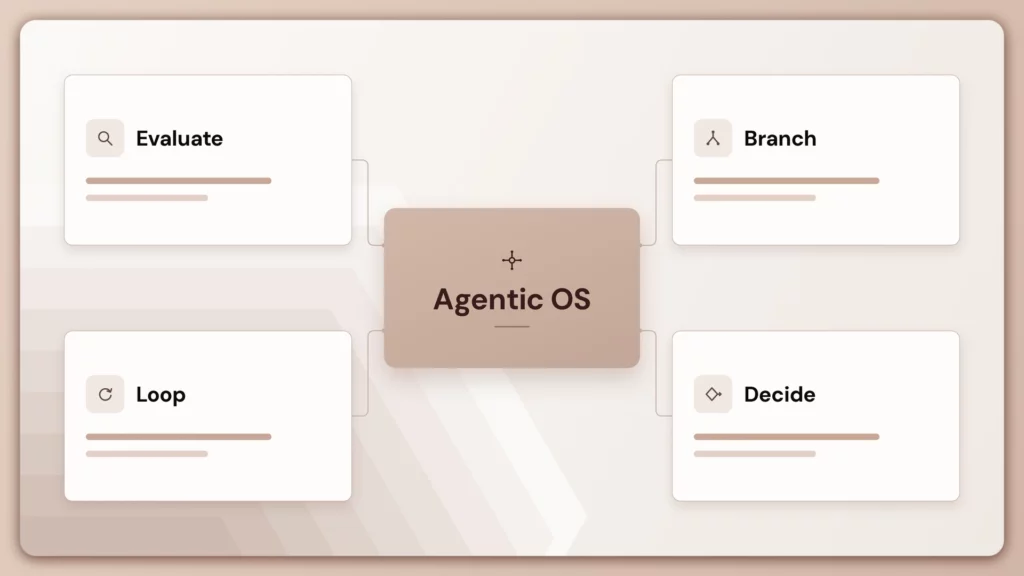
Traditional automation tools are trigger-response machines. If X happens, do Y. They are rigid, they do not reason, and they cannot handle ambiguity. An agentic workflow is fundamentally different. It evaluates conditions, branches based on what it finds, loops until a goal is met, and makes decisions mid-process.
As organizations accelerate digital transformation, agentic AI in enterprise applications will move beyond individual productivity, setting new standards for teamwork and workflow through smarter human-agent interactions.
A copilot can draft a purchase order. It cannot submit it to your ERP, route it through approval, and track the delivery. That gap between AI understanding and AI execution is the problem that an enterprise agentic OS platform is built to close. Most enterprise AI investment is still trapped at the surface, with systems that suggest, summarize, and assist but do not actually complete work. If your AI stack fits that description, you are not running an agentic OS. You are running an expensive autocomplete.
According to the 2026 Gartner CIO and Technology Executive Survey, only 17% of organizations have deployed AI agents to date, yet more than 60% expect to do so within the next two years. This rapid rise toward the Peak of Inflated Expectations highlights a growing gap between ambition and execution.
The Five Criteria to Judge Any Best Agentic OS Platform Against
Before you look at a single vendor, you need a scorecard. Apply these five criteria to every platform you evaluate, including the ones not in this guide. They separate platforms built for governed enterprise production from everything else.
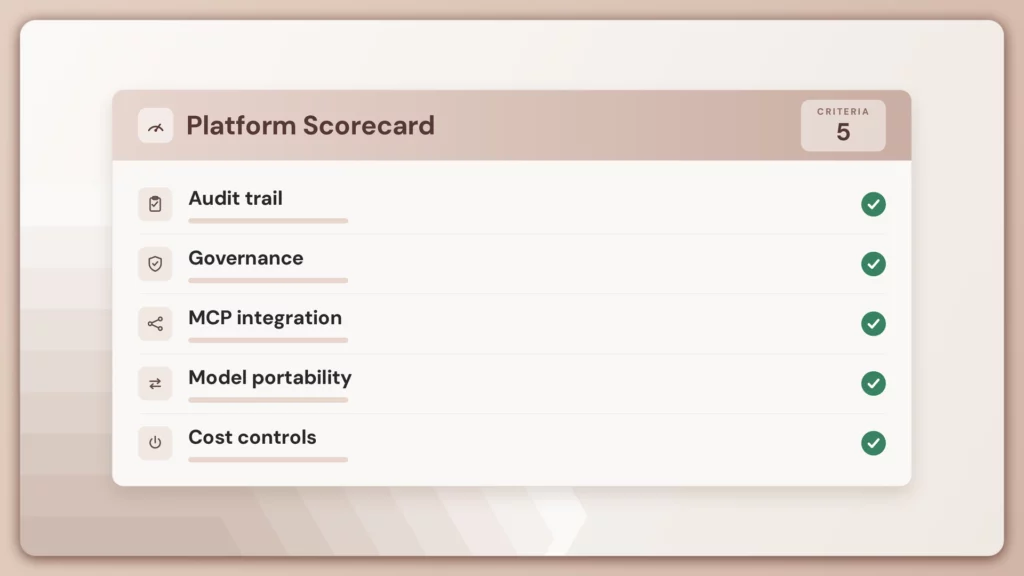
1. Production track record and AI agent audit trail
Has the platform run complex multi-agent orchestration workloads in real enterprise production? Not pilots. Not demos. Can it provide a complete, immutable audit trail for every decision and action an agent takes? In regulated industries, this is not a nice-to-have. It is the baseline.
2. Designed-in versus bolted-on governance
This is the sharpest criterion on the list. Governance and policy enforcement should be deterministic, enforced at the infrastructure level, rather than probabilistic, embedded in prompts that can be circumvented. If a vendor’s governance story is a layer added after the core product was built, that is a red flag. Ask specifically where governance lives in the architecture.
3. Depth of integration with the real stack via MCP
The modern standard for connecting AI agents to external systems is the Model Context Protocol (MCP), which has become the industry’s shared language for tool access. Through MCP, an enterprise agentic OS platform can connect to CRMs, ERPs, ticketing systems, databases, file storage, and custom internal APIs, treating each as a callable capability rather than a hard-coded integration. Superficial API connectors are not the same thing. Ask how many enterprise systems are natively supported and what the integration maintenance burden looks like.
4. Model portability and no vendor lock-in
A platform that binds you to one LLM provider is a platform that controls your AI roadmap. Model portability is not a technical preference. It is a strategic requirement. Both Forrester and Gartner identify 2026 as the breakthrough year for multi-agent systems, where specialized agents collaborate under central coordination. You need a platform that lets you swap or combine models as that landscape evolves.
5. Cost controls with a kill switch
Agentic systems can make thousands of decisions and API calls per minute. Without granular cost controls, budget overruns are not a risk, they are a certainty. The platform must offer real-time budget tracking, configurable alerts, and a master kill switch to halt all agent activity instantly. This is the criterion most buyers forget to ask about until after their first production incident.
The Best Agentic OS Platforms Compared
Gartner estimates only about 130 of the thousands of agentic AI vendors are building genuinely agentic systems. The five platforms below represent the realistic shortlist for enterprise buyers. Each one is real, each one has genuine strengths, and each one has genuine constraints.
Microsoft Copilot Studio
For enterprises standardized on Microsoft 365, Copilot Studio has evolved significantly. For enterprises already standardized on Microsoft 365, Copilot Studio offers compelling deployment speed. Agents surface inside the tools your team already uses, with Entra Agent ID providing identity and access management across agents. The GPT-5 integration via Azure OpenAI delivers strong reasoning capability for internal workflow automation.
The constraint is structural. Outside the Microsoft 365 universe, Copilot Studio requires connector configuration or custom API development for every enterprise system not covered by Power Platform’s catalog. Its core value proposition is Microsoft-centric. CIOs with a mixed or SAP-heavy stack will find the integration overhead higher than the marketing suggests.
On governance: Copilot Studio is the no-code, low-code route, and you are working within Microsoft’s guardrails. Complex cross-system orchestration or custom grounding pipelines quickly hit its limits. Governance for true agentic use cases is handled via Power Platform and Purview, which means it is bolted on rather than designed in.
Pricing: Microsoft 365 Copilot adds $30/user/month to M365 Business or Enterprise subscriptions. Copilot Studio credit packs run $200 per 25,000 credits per month. The credit-pack model can produce unpredictable monthly totals at scale.
Best for: Enterprises fully standardized on Microsoft 365 with automation needs that stay within that ecosystem.
Salesforce Agentforce
Agentforce ARR reached $800 million, up 169% year-over-year, and Salesforce closed 29,000 deals, up 50% quarter-over-quarter. Those are real adoption numbers, not projections. More than 60% of Agentforce and Data 360 Q4 bookings came from existing customer expansion.
The Atlas Reasoning Engine provides a Reason-Act-Observe loop for multi-step autonomous decision-making. Agent Script pairs deterministic workflows with flexible LLM reasoning. This combination significantly reduces hallucination risk for sales and service workflows within the Salesforce data model.
The constraint mirrors Microsoft’s. Full value is only within the Salesforce ecosystem, creating structural lock-in that becomes expensive to unwind. Workflows that touch your ERP, a separate HR system, or a custom database will require significant custom development.
Pricing: Flex Credits at $0.10 per action, which resolves the original $2/conversation model but still produces unpredictable monthly totals for high-volume workflows.
Best for: Enterprises where the primary automation workflows live inside the Salesforce data model, and where CRM-native governance is the priority.
ServiceNow AI Platform (AI Control Tower)
ServiceNow is no longer positioning itself only as a workflow platform with AI features. At Knowledge 2026, ServiceNow repositioned itself not as a workflow automation vendor with AI features, but as what the company calls the “AI Control Tower for Business Reinvention,” an orchestration layer that governs every AI agent, model, and action running across the enterprise.
The governance architecture here is genuinely designed-in. At the center is ServiceNow’s AI Control Tower, a unified command center that governs, secures, and manages AI agents at scale, giving organizations complete visibility into agent performance and outcomes without trading speed for control. As AI adoption grows, organizations can extend these capabilities with the help of Scalable ServiceNow Managed Services Providers to continuously optimize, govern, and scale their ServiceNow environment.
Central to this vision, the AI Control Tower now features deeper governance, observability, real-time risk scoring, and an explicit kill switch for rogue agents, covering all AI in the enterprise, not just ServiceNow’s, across AWS, Azure, Google Cloud, and Microsoft 365.
The production evidence is credible, and much of it is ServiceNow running on itself. The company reports saving roughly $500 million in 2025 by running ServiceNow on its own platform, with 91% of service requests now supported by AI and case resolution up to 99% faster on its IT help desk using the L1 IT Service Desk AI Specialist. Customer results reinforce it. The City of Raleigh runs a virtual agent, Ral-E, at a 98% deflection rate. Honeywell’s internal assistant eliminated the majority of its service desk conversations. Those are production outcomes, not prototype results.
The constraint is functional scope. ServiceNow is strongest within IT, HR service delivery, and customer service management. Enterprises whose primary automation needs sit outside these functions will find it less native. Pricing is enterprise custom-quote only.
Best for: IT, HR, and ITSM-heavy enterprises that need a genuine governance architecture and are already in the ServiceNow ecosystem.
Open-Source Frameworks (LangChain, AutoGen, CrewAI)
These frameworks give you maximum flexibility and full control over every layer. That is exactly the problem. You own every layer, from infrastructure to governance to monitoring. Building your own agentic platform from open-source frameworks is viable when agent workflow logic constitutes core IP or sovereign data requirements prevent third-party platform use. The cost and maintenance implications are high.
LangChain, launched in 2022, is one of the most widely adopted frameworks due to its broad ecosystem of integrations. It serves as an accessible interface for nearly any LLM and is an ideal starting point for enthusiasts or startups looking to explore agentic AI. For production-scale enterprise deployment, however, the governance gap is real. There is no built-in audit trail, no RBAC, no cost controls, and no kill switch. You have to engineer all of that yourself.
Gartner predicts over 40% of agentic AI projects will be canceled by the end of 2027, due to escalating costs, unclear business value, or inadequate risk controls. Open-source frameworks are where that statistic lives. Model portability is excellent. Everything else is a DIY problem.
Best for: Engineering teams running proof-of-concept work, not production enterprise deployments.
Lyzr: The Enterprise Agentic OS Platform
Lyzr is a platform, not a single agent. That distinction matters more here than anywhere else on this list.
Lyzr is the full-stack agent infrastructure platform that enables enterprises to build, govern, and deploy a secure, autonomous AI workforce. It provides what it calls the “Third Way” for enterprise AI, combining the flexibility of open-source with the security of a managed platform, all within the customer’s own environment to ensure 100% data privacy and IP ownership.
The governance layer is the Lyzr Control Plane, a single pane of glass for managing, monitoring, and auditing every agent across the organization. Governance is deterministic and enforced at the infrastructure level, not embedded in prompts. The system is engineered to run on private cloud or on-premise infrastructure, ensuring complete control, data privacy, and ownership of AI assets. The platform is SOC 2 and ISO 27001 certified, offering enterprise-grade compliance and security.

On model portability: the platform’s model-agnostic architecture allows enterprises to deploy agents using models from OpenAI, Google, Anthropic, or open-source alternatives, reducing dependency on a single AI vendor. On multi-agent coordination, Lyzr’s Orchestration as a Service is the coordination layer that lets multiple agents collaborate on complex workflows, so organizations can run multi-agent systems that execute end-to-end business processes across departments.
Lyzr has attracted more than 400 enterprise customers, including organizations such as Accenture, AWS, Hitachi Energy, Publicis, and AirAsia. Accenture has invested in Lyzr through Accenture Ventures, with a collaboration focus on banking, insurance, and financial services.
Pricing: Lyzr publishes transparent pricing: a free Community plan, $19/month Starter, and $99/month Pro (or $79/month billed annually). Production workloads are billed at $0.08 per agent run on Lyzr Cloud and $0.03 per agent run on Lyzr VPC or On-Premise, with LLM token costs passed through at market rates. Enterprise Cloud and On-Premise tiers are custom-quoted.
Best for: Enterprises that need governed, cross-functional AI agent orchestration across multiple departments and industries, especially in regulated sectors.
The Agentic OS Platform Comparison Table
| Platform | Production Track Record | Governance | Integration Depth | Model Portability | Cost Controls & Kill Switch |
|---|---|---|---|---|---|
| Microsoft Copilot Studio | Strong within M365; newer for true cross-system agents | Bolted-on via Power Platform / Purview | Excellent within Microsoft; requires custom work outside | Low (Azure OpenAI-centric) | Yes, within Azure admin; credit-pack model can be opaque at scale |
| Salesforce Agentforce | Strong within Salesforce; 29,000+ deals closed | Designed-in for Salesforce data; limited outside it | Excellent within Salesforce; poor outside it | Low (Salesforce model-focused) | Yes, within Salesforce billing; Flex Credits model can be unpredictable |
| ServiceNow AI Platform | Strong via Action Fabric and MCP; connectors across AWS, Google Cloud, Azure, SAP, Oracle, and Workday | Designed-in (AI Control Tower is a genuine governance architecture) | Strong via Action Fabric and MCP; 450+ system connectors | Moderate (supports Azure OpenAI, Gemini, Claude) | Yes, explicit kill switch via AI Control Tower; custom pricing |
| Open-Source (LangChain, AutoGen, CrewAI) | None out-of-the-box; entirely DIY | None built-in; must engineer from scratch | High potential; requires significant dev work per integration | Excellent | None; must build from scratch |
| Lyzr | Enterprise-proven; 400+ enterprise customers; Accenture partnership | Designed-in (Lyzr Control Plane; SOC 2 and ISO 27001 certified) | High (Orchestration as a Service; native connectors; MCP support) | Excellent (model-agnostic) | Yes, built-in and granular; transparent per-run pricing ($0.08 Cloud / $0.03 VPC) |
Horizontal comparison scorecard visual showing five enterprise AI orchestration platforms rated across five criteria using green amber red indicators, warm earth tone design, professional enterprise infographic. Alt text: Agentic AI platform comparison scorecard for enterprise buyers 2026 showing governance integration and model portability ratings
How to Match a Best Agentic OS Platform to Your Situation
The right enterprise agentic OS platform is not the same for every buyer. Here is how to self-select.
You are in a regulated industry (banking, healthcare, insurance)
Governance is your primary criterion, not your secondary one. You need designed-in governance enforced at the infrastructure level, a complete audit trail, and SOC 2 or ISO 27001 as a baseline.
The EU AI Act phases in over several years. Transparency obligations, including disclosure that a user is interacting with AI, apply from August 2026. The heavier obligations for high-risk systems were pushed back under the May 2026 Digital Omnibus agreement and are now set to apply from December 2027, pending formal adoption. High-risk status is defined by use case under Annex III, covering areas like credit scoring, insurance pricing, and employment decisions, not by whether a system happens to be multi-agent.
The deadline moved. The requirements did not get easier. When those obligations land, high-risk systems will need documented risk management, data governance, human oversight, and immutable records of what the system did and why. If you are deploying agents into credit, claims, or hiring workflows now, you are building toward that bar regardless of the exact date. Platforms with bolted-on governance will struggle to meet it.
For regulated environments, the Lyzr Control Plane’s deterministic enforcement model and on-premise deployment capability are directly relevant. See how Lyzr handles compliance workflows in detail:
You are all-in on Microsoft or Salesforce
The native tools are a logical starting point, and deployment speed is genuinely faster within those ecosystems. Name the lock-in risk explicitly in your evaluation. Ask your vendor what it costs and how long it takes to migrate agents to a different platform if your needs change in two years.
You need function-specific entry points
You may be starting with one department, marketing, sales, HR, or finance, and planning to expand. This is where a platform with function-specific agents under a single governance layer becomes relevant. You want to avoid a situation where each department adopts a different agent platform, creating a fragmented, ungoverned AI estate.
You have data sovereignty or on-premise requirements
Ask this question in the first meeting, not the last. Not every vendor offers on-premise or private cloud deployment. Several SaaS-only platforms will not meet your data residency requirements. Treat on-prem capability as a qualifying question, not a preference. Lyzr’s system is engineered specifically to run on private cloud or on-premise infrastructure, ensuring complete control, data privacy, and ownership of AI assets.
Where to Start Once You Have Chosen
Do not try to automate everything at once. Start with one high-value business process. Choose something complex enough to demonstrate real value but not so mission-critical that a failure is catastrophic. Good candidates include internal report generation, complex customer support ticket routing, or procurement data analysis.
Run a structured pilot. Measure three things: time saved, cost reduction, and error rate improvement. Those three metrics build a business case that your CFO and board can evaluate. They also tell you whether the platform’s governance and integration story holds up under real production conditions, not just demo conditions.
Enterprises adopting Lyzr are already seeing measurable results. A Fortune 100 technology company implemented Lyzr’s Agentic OS across its corporate venture capital division, using more than 200 interconnected agents to streamline investment sourcing and evaluation. A leading semiconductor firm used Lyzr to replace a closed AI platform, cutting development time for its Customer Service OS by leveraging Lyzr’s pre-built agent blueprints.
See how a 90-person sales team standardized meeting readiness using the same approach.
Lyzr’s 3-month pilot program is specifically designed for enterprises that want to test agents with minimal risk and deploy them in production if the use case validates. A pilot with a clear success metric is a much safer entry point than a platform-wide commitment.
How Lyzr Fits the Best Agentic OS Platform Picture
Lyzr enterprise agentic OS platform architecture diagram showing the Control Plane at center connecting multiple function-specific agent offerings across marketing sales HR banking and insurance, warm earth tone enterprise illustration. Alt text: Lyzr enterprise agentic OS platform architecture showing Control Plane and function-specific agents
Lyzr is a platform, not a single agent. That sentence is the most important thing to understand about how it differs from most of what you will see in vendor demos.
Lyzr is building the agent infrastructure layer for enterprises, the system that lets companies run not just a few copilots but an entire AI workforce in production. The vision is a private, governed AI workforce, where specialized agents operate across every function and stay fully under the enterprise’s control of its own data and systems. With Lyzr, enterprises get the infrastructure, governance, and expertise to design, deploy, and grow this private AI workforce across every function, while staying fully in control of their data and systems.
The OS family is what makes the cross-enterprise breadth concrete. Each offering follows the same platform architecture and is governed by the same Lyzr Control Plane:
- Skott, the Agentic OS for Marketing by Lyzr – runs the marketing function end-to-end, from content creation to campaign execution.
- Jazon, the Agentic OS for Sales by Lyzr – handles outreach, lead qualification, and pipeline automation.
- Diane, the Agentic OS for HR by Lyzr – automates hiring, onboarding, and employee operations. While AI handles screening and scheduling, teams still rely on standardized hr contracts to finalize each hire with proper legal documentation.
- Amadeo, the Agentic OS for Banking by Lyzr – addresses loan origination, KYC, compliance monitoring, and dispute management.
- Benjie, the Agentic OS for Insurance by Lyzr – automates claims processing, policy renewals, underwriting, and customer support.
Marketing is one function. The same platform governs agents across every adjacent function listed above. When your marketing team adopts Skott, the Agentic OS for Marketing by Lyzr, and your HR team later adopts Diane, the Agentic OS for HR by Lyzr, both are operating under the same Lyzr Control Plane, with the same audit trail, the same RBAC policies, and the same kill switch. That is the differentiator. One governed platform, not five separate agent tools stitched together with hope.
The underlying platform primitives include Lyzr Studio for low-code agent building, Architect by Lyzr for visual orchestration, Orchestration as a Service for the coordination layer, Agents as a Service for managed deployment, and the Cognis memory layer for persistent agent context across sessions.
TL;DR: The Honest Verdict
- The market is noisy. Most “agentic OS” claims are rebranded workflow automation. Only about 130 vendors globally are building genuinely agentic systems (Gartner).
- Use five criteria. Production track record, designed-in governance, integration depth via MCP, model portability, and cost controls with a kill switch.
- Ecosystem tools have real limits. Microsoft Copilot Studio and Salesforce Agentforce are strong within their ecosystems and weak outside them.
- Open-source is not production-ready. LangChain, AutoGen, and CrewAI require you to build governance, audit trails, and cost controls from scratch.
- ServiceNow is a genuine governance architecture for IT and ITSM-heavy enterprises, with credible production evidence.
- Lyzr’s differentiator is cross-enterprise breadth under one governed Control Plane, not a single-function agent.
Your Action Checklist
- Define your primary automation use case before you talk to any vendor.
- Ask every vendor specifically where governance lives in their architecture, not just what governance features they list.
- Ask about on-premise or private cloud deployment in your first meeting.
- Request a production reference customer in your industry, not a case study PDF.
- Map the integration points your use case requires and test them in a pilot, not in a demo.
- Ask for a full breakdown of how costs scale at 10x your pilot volume.
- Confirm the kill switch mechanism before any agent touches a production system.
- Run a 90-day pilot with three measurable success metrics before committing to a platform.
- Evaluate the vendor’s OS roadmap: will it cover adjacent functions as your program expands?
Frequently Asked Questions About the Best Agentic OS Platforms
What is an agentic OS platform for enterprise?
An enterprise AI agent orchestration platform, sometimes called an agentic OS, is a software system that builds, deploys, manages, and governs autonomous AI agents. It provides the infrastructure for those agents to plan, reason, and execute complex tasks across multiple business systems, with persistent memory across sessions, coordination between multiple agents, tool orchestration, and policy enforcement.
It is not a desktop or server operating system. The “OS” metaphor refers to the coordination and governance layer it provides for AI agents, the way Windows manages applications on a computer, but applied entirely to enterprise AI agent fleets. An Agentic AI Operating System is a software infrastructure layer that manages the full lifecycle of autonomous AI agents, including scheduling, memory management, tool orchestration, governance policy enforcement, and observability, enabling multiple agents to operate concurrently and scale across enterprise environments. Unlike traditional automation or basic LLM APIs, an Agentic AI OS provides resource management, process isolation, and security controls at the cognitive layer.
What makes a platform “agentic” rather than just automation?
Traditional automation tools follow a rigid, predefined script. If X happens, do Y. Agentic platforms are goal-oriented. You give an agent an objective, and the platform gives it the tools, memory, and authority to figure out the steps to achieve it.
An agent framework provides the build layer: orchestration primitives, tool-calling abstractions, and multi-agent coordination patterns. An AI agent development platform includes the build layer plus the production layer: deployment infrastructure, lifecycle management, governance, monitoring, versioning, rollback, and enterprise integration. If a platform lacks governance, monitoring, and production infrastructure, it is automation with a new name.
How do you evaluate agentic OS platforms?
Apply the five criteria in this guide: production track record and audit trail, designed-in versus bolted-on governance, depth of integration with your actual tech stack via MCP, model portability and no vendor lock-in, and cost controls with a kill switch. Ask for production references, not pilot case studies. Test the integration points your specific use case requires. And ask the governance question in the first meeting, not the last.
Gartner’s 2026 Hype Cycle for Agentic AI names agent-washing as an explicit market problem and flags security, governance, and skills gaps as key obstacles slowing production adoption. Those three gaps are exactly what your five-criteria scorecard is designed to expose.
Can these platforms run on our own cloud or on-prem?
It varies significantly by vendor. Several SaaS-only platforms will not meet data residency or regulatory requirements. Ask this question early. Lyzr’s system is engineered to run on private cloud or on-premise infrastructure, ensuring complete control, data privacy, and ownership of AI assets. ServiceNow and Microsoft offer private cloud options within their respective ecosystems. Open-source frameworks can be deployed anywhere, but you own all the infrastructure and security work.
Make on-prem capability a qualifying question, not a preference. If a vendor cannot answer it clearly in the first meeting, that tells you something.
What do these platforms cost?
Pricing transparency is a consistent gap across this market. Microsoft Copilot Studio credit packs are $200 per 25,000 credits per month. Salesforce Agentforce moved to Flex Credits at $500 per 100,000 credits, which can produce unpredictable monthly totals for high-volume workflows. ServiceNow AI Platform pricing is enterprise custom-quote only.
Lyzr publishes transparent per-run pricing: $0.08 per agent run on Lyzr Cloud and $0.03 per agent run on Lyzr VPC or On-Premise, with LLM token costs passed through at market rates. Enterprise tiers for all vendors are custom-quoted. Demand a full cost model at 10x your pilot volume before you sign anything.
Is a single AI agent or copilot the same as an agentic OS platform?
No. A single agent or copilot performs a specific task in response to a prompt. An enterprise agentic OS platform is the infrastructure that makes multiple agents work together, over time, across systems, clients, and projects.
A single agent is useful. An agentic OS makes a workforce of agents useful, governed, and auditable. The difference is roughly the same as the difference between a single spreadsheet and an ERP system. Agentic AI sits at the Peak of Inflated Expectations in Gartner’s 2026 Hype Cycle, reflecting extraordinary market attention and aggressive adoption intent. A single copilot is not an agentic OS. Do not let a vendor claim otherwise.
Will an agentic OS platform replace jobs?
It will change jobs. The goal of an enterprise agentic OS is to automate complex, repetitive, and data-intensive work. That frees your human team to focus on strategy, creative judgment, and high-value client relationships.
As organizations accelerate digital transformation, agentic AI in enterprise applications will move beyond individual productivity, setting new standards for teamwork and workflow through smarter human-agent interactions. The enterprises seeing the best results are treating agents as a new category of team member, not as a replacement for existing ones. The role of the human moves up the stack, into oversight, strategy, and the decisions that require genuine judgment.
Enterprise team collaborating with AI agents on a unified dashboard, warm earth tones, humans and AI working together, professional 2026 illustration style. Alt text: Enterprise team using agentic AI orchestration platform alongside human workers 2026
Related reading from Lyzr:
- How to Build a $10M AI Practice
- Global Organization Scaled Crisis Simulations with Lyzr
- Lyzr vs AWS Bedrock Agents
- AI Agents on Apache Kafka
Book A Demo: Click Here
Join our Slack: Click Here
Link to our GitHub: Click Here