TL;DR
- Agentic RAG replaces single-shot retrieval with an agent that plans, routes, iterates, and verifies before generating an answer.
- Six patterns exist: Router agent, Agent-as-retriever, Corrective RAG, Self-RAG, Adaptive RAG, and Agentic GraphRAG.
- Production deployments need governance, hallucination detection, and a framework-agnostic control layer, not just a better prompt.
Agentic RAG is a retrieval-augmented generation approach where an autonomous agent, not a fixed pipeline, controls retrieval. It plans sub-queries, routes across data sources, iterates on weak results, and checks its own context before an LLM generates the answer.
Jump to: Agentic RAG vs traditional RAG · Six patterns of agentic RAG · When to use agentic RAG · Production agentic RAG
What is agentic RAG?
Agentic RAG is a retrieval-augmented generation approach where autonomous AI agents control the retrieval process. They plan sub-queries, route across sources, iterate when results are weak, and verify context before generation. Traditional RAG runs a single retrieval pass and hands the top results to the model. Agentic RAG treats retrieval as a decision the agent makes repeatedly, not a step it executes once.
That distinction matters because it is not one architecture. It is six patterns, each trading latency and cost for a different kind of accuracy. Router agent, Agent-as-retriever, Corrective RAG, Self-RAG, Adaptive RAG, and Agentic GraphRAG solve different failure modes. Most published guides stop at the pattern taxonomy. The harder question, the one that decides whether a system survives contact with production, is what governance, audit, and hallucination controls sit underneath it. That is where this guide spends its second half.

Agentic RAG vs traditional RAG
Traditional RAG retrieves once and generates once. It converts a query into an embedding, searches a vector database for the closest chunks, and passes them to the model. Agentic RAG replaces that fixed path with a loop the agent controls.
Four differences separate the two approaches. Retrieval loop count: traditional RAG runs one-shot, top-k retrieval; agentic RAG runs an iterative, agent-controlled loop that can re-search. Query rewriting: traditional RAG uses the user’s original query as-is; an agent can decompose or reformulate it autonomously. Multi-source routing: traditional RAG typically hits one index; an agent routes sub-questions to a vector store, a SQL database, a knowledge graph, or a live API depending on what each sub-question needs. Answer verification: traditional RAG trusts whatever it retrieved; agentic RAG can add a self-check step that flags weak or contradictory context before generation.
None of this is free. Agent reasoning, tool calls, and repeated retrieval passes consume more tokens and add latency per query. Agentic RAG earns its complexity on ambiguous, multi-step, or multi-source questions. It is overkill for a single, well-indexed knowledge base.
Traditional RAG vs agentic RAG: capability comparison
| Capability | Traditional RAG | Agentic RAG |
|---|---|---|
| Retrieval loop | Single-shot, top-k retrieval | Iterative, agent-controlled |
| Query rewriting | Fixed, uses original query | Autonomous decomposition and rewrite |
| Data source routing | One index, pre-defined path | Dynamic routing across sources |
| Answer verification | None, trusts retrieved context | Self-check before generation |
| Best-fit query complexity | Simple, single-hop lookups | Multi-hop, ambiguous questions |
| Token cost per query | Low | Moderate to high |
| Typical latency | Low | Moderate to high |
How agentic RAG works: plan, route, iterate, check
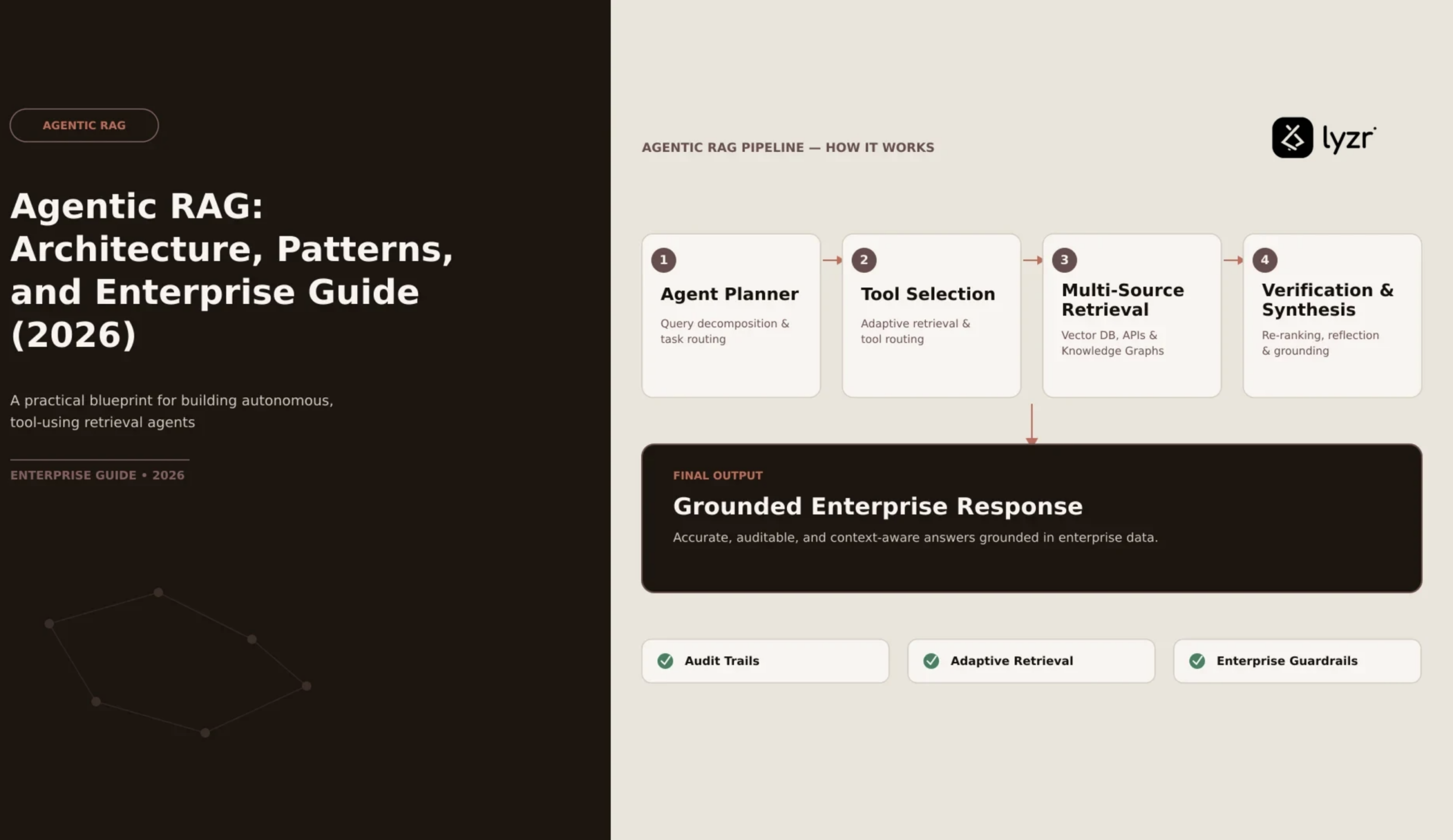
Agentic RAG runs a four-step loop, commonly built on the ReAct pattern (reason, then act, then observe, then repeat). The agent plans by decomposing the query into sub-tasks it can answer independently. It routes each sub-task to the tool best suited to it, using tool calling defined through a JSON schema so the agent knows which function does what. It iterates by re-querying or switching sources when a retrieval pass comes back thin or off-topic. It checks by reconciling results across sources and flagging contradictions before the final generation step.
Take a quarterly financial review that pulls from a PDF filing, an internal SQL database, and a live web source for analyst commentary. Traditional RAG fetches top-k chunks from one index and hopes the answer is in there. An agentic system plans the three sub-tasks, routes each to the right source, reconciles a number that disagrees between the filing and the database, and only then generates a summary. That reconciliation step is the entire value proposition, and it is exactly what a single retrieval pass cannot do.
The Model Context Protocol (MCP), an open standard for connecting agents to external tools and data, is becoming the default wiring for this kind of multi-source routing, alongside Anthropic’s tool-use conventions and OpenAI’s function-calling schema. Whichever standard you pick, the routing logic is the same: match the sub-task to the source, not the source to the query.
Six patterns of agentic RAG
Agentic RAG splits into six architectural patterns. Picking the wrong one is the most common reason teams either overspend on latency or underperform on accuracy.
Router agent. A single agent classifies the incoming query and routes it to one retrieval pipeline, vector search, SQL, or web. Low latency, simple to reason about, and effective when your data sources are cleanly partitioned by type.
Agent-as-retriever. The agent chooses its own retrieval strategy, selecting tools, formulating queries, and deciding when it has enough context. More flexible than a router, at a higher token cost per query.
Corrective RAG (CRAG). The agent evaluates retrieval quality and self-corrects, triggering a web search or reformulating the query when results are weak. Improves accuracy on ambiguous or out-of-domain questions.
Self-RAG. The model critiques its own retrieval and output using reflection tokens, deciding when to retrieve, what to retrieve, and whether the retrieved context is sufficient before answering.
Adaptive RAG. The agent matches retrieval effort to query complexity, skipping retrieval for simple questions, running single-shot retrieval for moderate ones, and going iterative only when the question demands it. This is usually the most cost-efficient pattern for mixed workloads and pairs naturally with the multi-agent systems used to route work across specialist agents.
Agentic GraphRAG. The agent traverses a knowledge graph, in tools like Neo4j or ArangoDB, to retrieve entity relationships rather than document chunks. Strong for multi-hop questions where the answer depends on how entities connect, not just what a document says.

Implementing agentic RAG in LangChain, LangGraph, and LlamaIndex
Three frameworks cover most agentic RAG builds, and none of them is the wrong choice for every case. LangChain supports the agent-as-retriever pattern directly through create_retriever_tool and native tool calling, and it is the fastest path to a working prototype. LangGraph represents the agent’s reasoning as an explicit state machine, which gives you tighter control over loops and branches, making it the better fit for corrective and adaptive RAG where the flow has real conditional logic. LlamaIndex’s query engine abstractions, including sub-question query engines, are built for the router pattern and have strong native support for Agentic GraphRAG.
The Anthropic Claude Agent SDK and the OpenAI Agents SDK now support these same patterns natively, and Google’s ADK is close behind. What matters more than picking one is recognizing that enterprises rarely standardize on a single framework. One team builds in LangGraph, another in LlamaIndex, a third ships a custom stack. Before locking a governance strategy to a specific framework’s roadmap, it helps to see how a shared layer sits above all three. On the retrieval layer itself, vector databases like Pinecone, Weaviate, Qdrant, Chroma, Milvus, and pgvector are largely interchangeable at the pattern level. What differs is how each platform wraps them for production knowledge retrieval and multi-model support across GPT, Claude, Gemini, Llama, Mistral, and Cohere Command.
Compare framework-agnostic platforms
When to use agentic RAG
Use agentic RAG when a question genuinely requires multiple retrieval steps in a specific order, not because it sounds more advanced. Four situations justify it. Multi-step tasks where the answer depends on data pulled from several systems in sequence. Uncertain sources where the first search may fail and you need adaptive retry logic rather than a single fixed attempt. Multi-modal retrieval that spans SQL databases, vector search, live web APIs, and knowledge graphs in the same query. Regulated workflows where a step-by-step audit trail of every retrieval decision is a compliance requirement, not a nice-to-have.
Skip it for single-source Q&A, simple factual lookups, and cost-sensitive workloads where the token overhead of an agentic loop buys you nothing. Many teams reach for agentic RAG to fix a problem that better chunking, reranking, or embedding choices would solve at a fraction of the cost. Optimize your retrieval pipeline first. Add agent control only for the specific failure modes a standard pipeline cannot fix.
Production agentic RAG: what enterprise deployments need
Every framework tutorial stops at the pattern. Production stops at governance. Only one in five companies has a mature model for governance of autonomous AI agents, according to Deloitte’s State of AI in the Enterprise 2026 report. Agentic RAG multiplies the number of decisions an autonomous system makes per query, which multiplies the surface area that needs oversight.
Four things separate a working demo from a deployed system. A governance layer that enforces role-based access control on which retrieval sources an agent can reach, isolates data per user, and logs an audit trail for every retrieval, tool call, and generated response, the kind of control Responsible AI as a Service is built to provide. Hallucination detection at runtime, since an agent’s own self-verification step can fail silently, which is why an infrastructure-level check like Hallucination Manager needs to sit outside the agent’s own reasoning loop. A framework-agnostic Control Plane, because your LangChain, LangGraph, and custom agents all need one shared observability and policy layer rather than three separate ones, with Cognis handling the memory layer underneath. Deployment modes, managed sovereign, VPC, or fully on-premise, for regulated industries where retrieval sources contain PII, PHI, or classified data, and where sovereign AI requirements dictate where processing can occur.
Financial institutions running agentic RAG across per-employee knowledge graphs already build audit trails into every retrieval step, precisely because their financial data and regulatory exposure demand it. 23% of organizations are actively scaling an agentic AI system in at least one business function, and another 39% have begun experimenting, according to McKinsey’s 2025 State of AI survey. Governance is the gap between that scaling cohort and the rest.

See how the Control Plane runs agentic RAG in production
Frequently asked questions
What is agentic RAG?
Agentic RAG is a retrieval-augmented generation approach where an autonomous agent controls the retrieval process. The agent plans, routes, iterates, and verifies rather than doing a single top-k fetch.
What is the difference between RAG and agentic RAG?
Traditional RAG uses fixed-path, single-shot retrieval. Agentic RAG uses an agent to loop through multi-step retrieval, rewrite queries, route across sources, and verify context before generation.
How does agentic RAG work?
It follows a four-step loop: plan, route, iterate, and check. The agent breaks the query into sub-tasks, picks the right source for each, retries on weak results, and verifies before generating.
What is the difference between agentic AI and agentic RAG?
Agentic AI is the broader category of autonomous, goal-driven systems. Agentic RAG is one capability within that category, focused specifically on intelligent, agent-controlled retrieval and generation.
When should I use agentic RAG?
Use it for multi-step questions or when data spans SQL databases, vector search, and web APIs. Skip it for simple, single-source lookups where the added token cost is not justified.
What is the best framework for building agentic RAG?
LangChain, LangGraph, and LlamaIndex all support agentic RAG with different tradeoffs. LangChain is simplest to prototype, LangGraph gives explicit state control, and LlamaIndex has strong query engine primitives.
What is corrective RAG?
Corrective RAG (CRAG) is a pattern where the agent evaluates retrieval quality and self-corrects. If results are weak, it triggers a web search or reformulates the query to improve accuracy.
What is self-RAG?
Self-RAG is a pattern where the model critiques its own retrieval and generation using reflection tokens. It decides when to retrieve, what to retrieve, and whether the retrieved context is sufficient.
What is agentic GraphRAG?
Agentic GraphRAG is a pattern where the agent traverses a knowledge graph to retrieve entity relationships rather than document chunks. It is strong for multi-hop reasoning across connected data.
How do I run agentic RAG in production?
Production agentic RAG needs a governance layer, runtime hallucination detection, a framework-agnostic Control Plane, and deployment modes that fit regulated data, including sovereign AI environments.
Where to go from here
Where you go next depends on where you are in the decision.
- Just learning the basics: read the RAG glossary entry.
- Deciding traditional vs. agentic: read how to optimize traditional RAG first.
- Choosing a framework or platform: read framework-agnostic platforms.
- Building the production case: read the Control Plane pillar.
- Planning an enterprise rollout: read the production playbook or the agentic AI roadmap.
- Ready to build or evaluate: book a demo.
Agentic RAG is not a feature you turn on. It is an architectural commitment. Get the pattern right and it fixes real accuracy problems. Get the governance wrong and it just fails in a more expensive, harder-to-audit way than the traditional RAG it replaced.
Related reading: what are AI agents · enterprise workflow automation · workflow automation · monitoring for agentic systems · agent orchestration · production readiness assessment · 101 AI use cases · architect agent use cases · customer stories · case studies · try Lyzr Studio
Book A Demo: Click Here
Join our Slack: Click Here
Link to our GitHub: Click Here