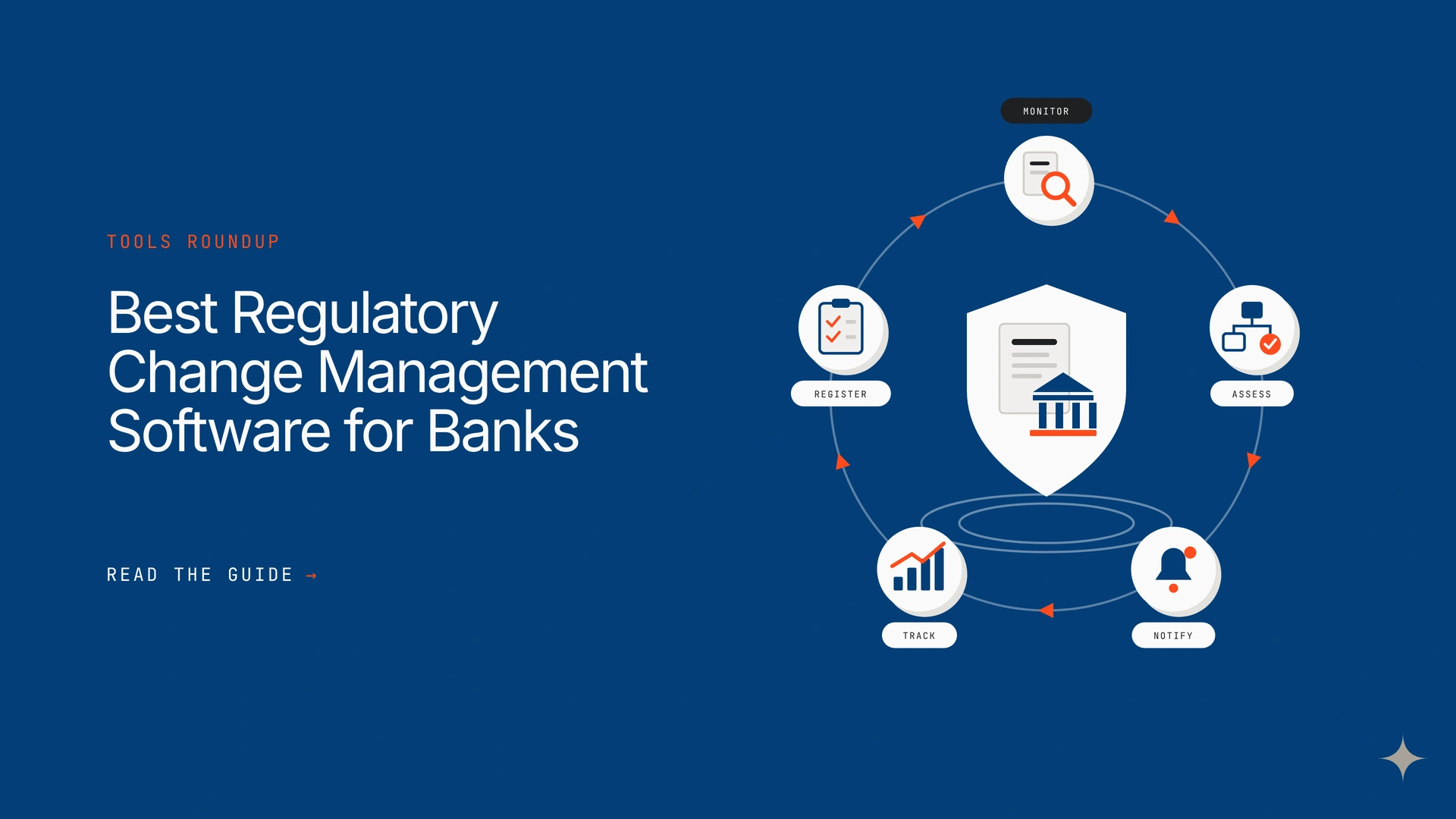
The best regulatory change management software for a bank finds the rule changes that matter, decides which apply, maps them to the bank’s own policies and controls, routes the work to named people and keeps the evidence. This guide compares eight tools on those five steps. Madison, Lyzr’s agentic GRC product for US banks and credit unions, is the pick for tracing a change through your own policy, procedure and control library, with a named person signing each decision. ServiceNow, SAI360, SmartSuite, AuditBoard and IBM OpenPages are workflow platforms, several of which take their regulatory content from other providers, Compliance.ai (now part of Archer) leads with content, and RegTrack is built for India. Pick by where your process breaks.
TL;DR
- Two kinds of tool: content-led tools that tell you what changed, and workflow-led platforms that route the work. Madison is chain-led: it connects the change to your own documents.
- Best for rule to evidence: Madison links a rule to the obligation, applicability, policy, procedure, control, test and evidence, and records who signed it. It is our product, so read its limits.
- Best if you run ServiceNow or Archer: ServiceNow RCM for existing ServiceNow GRC shops, Compliance.ai within Archer for content-led monitoring.
- Content often comes from elsewhere: AuditBoard’s RegComply takes content from CUBE, and IBM OpenPages loads feeds from Thomson Reuters, Wolters Kluwer, Ascent and Reg-Track.
- Check the AI claim: vendors describe AI mapping and summaries, but the pages we read rarely explain how, and a person should approve the result.
- How we judged: vendor pages and press releases, with gaps stated. “Not described” means we did not find it, not that it is absent.
What should regulatory change management software do for a bank?
Regulatory change management software helps a bank see new and changed rules, decide which apply, work out what they touch, assign the work and prove it was done. The weak point is rarely the alert. It is the step between “a rule changed” and “this policy and this control need to change, and here is who approved it.” For a buyer’s checklist see how to evaluate a regulatory change agent.

| Capability | What good looks like | Question to ask |
|---|---|---|
| Regulatory intelligence | Timely, multi-source updates in plain language, filtered to your regulators and products. | Who supplies the content, and can we swap it? |
| Applicability and impact | The tool shows what applies to you and what a change touches, with a reason a person can check. | Does it cite the rule text behind each conclusion? |
| Mapping to policy and control | A change links to the specific policies, procedures and controls affected, and shows gaps. | Does it work from our documents or from a template library? |
| Workflow and approval | Tasks with owners and due dates, with maker-checker approval and escalation. | Can a requester approve their own work? |
| Audit readiness | A log and evidence repository you can export for an examiner. | Is each decision tied to a version and a named signer? |
How we assessed: we read each vendor’s own pages and press releases, and say where a page failed or was wrong. Nearly all sources are vendor marketing. “Not described” means not found on the pages we reviewed, not that the capability is absent. Madison is our product and is listed first for that reason.
The best regulatory change management software for banks at a glance
| # | Tool | Best for | Type | Watch for |
|---|---|---|---|---|
| 1 | Madison by Lyzr | Tracing a change through your own policies, procedures and controls, signed by a named person | Chain-led | Not a global content feed; no write-back to the core |
| 2 | ServiceNow RCM | Teams already running ServiceNow GRC | Workflow-led | Feed provider and AI method not described |
| 3 | Compliance.ai (Archer) | Content-led monitoring that maps changes to policies and controls | Content-led | Archer’s financial services page could not be read |
| 4 | SAI360 | Global teams wanting impact ratings and policy mapping | Workflow-led | Content providers not named; deployment not stated |
| 5 | AuditBoard RegComply | Audit and compliance teams on AuditBoard | Workflow-led | Content comes from CUBE; site now redirects to Optro |
| 6 | IBM OpenPages | Large enterprises with an OpenPages GRC engine | Workflow-led | Loads feeds from other providers; AI not described on page |
| 7 | SmartSuite | Mid-sized teams wanting a configurable lifecycle | Workflow-led | No AI for change described; no bank content on page |
| 8 | RegTrack | Organizations bound by Indian law | Content-led | Legal updates limited to Indian law |
Madison by Lyzr
Madison is a workforce of AI agents for compliance and risk in US banks and credit unions. It reads the rules, your policy and procedure library and your examination history, builds a live map of how they connect, and hands finished, sourced work to a named person who decides.
Most regulatory change tools start from the alert. Madison starts from the connected model. Twelve links sit in one record: regulation, rule section, obligation, applicability, policy, procedure, control, test, finding, remediation, evidence and request. When a rule changes, the agent shows what it touches in your own documents, and a coverage gap appears as an obligation with no policy, a policy covering nothing, or an obligation with a policy but no control.

| Regulatory change job | How Madison handles it |
|---|---|
| See and assess the change | Shows which obligations a change creates or alters and whether they apply, with outputs traced to rule text so a person can check them. |
| Map to your documents | Agents propose the mapping to policies, procedures and controls, and people approve it. See how to map policies to controls with an agent. |
| Find coverage gaps | Flags an obligation with no policy, a policy covering nothing, or an obligation with a policy but no control. |
| Examinations and issues | Answers examiner requests from the chain behind them, in one register, rather than from folders and email. |
| Third-party and AI oversight | Holds vendors, models and agents as governed objects with owners and evidence in the same register. |
| Accountability | Signs each decision against the exact version, with the signer’s role. It never remediates on its own and does not write back to the core banking system. |
Where Madison leads
Working from your own library. The working session starts with the bank’s policy library and leaves with a coverage map, so the first output is about your documents rather than a generic template. Every conclusion carries a citation and a signature.
Where to look harder
Madison is built for US banks and credit unions. If you need a global, multi-jurisdiction content feed or a large analyst network, compare it with content providers in Madison vs Wolters Kluwer and Madison vs CUBE, and confirm source coverage with Lyzr.
Best for: compliance and risk teams at US banks and credit unions who want a change traced to their own policies, procedures and controls, with the evidence signed. Read AI in compliance vs AI governance and see how it fits after SR 26-2. Start with a Madison working session.
2. ServiceNow Regulatory Change Management
Best for: enterprises already running ServiceNow GRC that want regulatory change in the same workflow platform.
ServiceNow’s product page describes automated scanning of the regulatory horizon, mapping multiple providers’ taxonomies to a single regulatory taxonomy, automated alert triage with routing rules, configurable impact assessments from an automated engine, and “AI-driven regulatory compliance mapping and automated workflows”. It says teams can update policies, assign tasks, monitor progress and record evidence, and keep an audit trail of changes.

Pick it if: ServiceNow is your system of record for GRC and you have content from another provider.
Source: ServiceNow RCM product page (2026). Vendor marketing.
3. Compliance.ai (Archer)
Best for: banks that want content-led monitoring of regulatory updates, mapped to internal policies and controls.
Archer announced the acquisition of Compliance.ai in February 2024. The release says Compliance.ai continuously monitors regulatory updates using a patented “expert-in-the-loop” approach to machine learning and AI, and automatically maps regulatory changes to internal policies, procedures and controls. Separately, Archer’s Evolv AI Compliance page describes turning regulations and policies into guardrails for AI on AWS Bedrock, with draft guardrails that go live only once approved.

Pick it if: you run Archer and want a content-led monitor feeding it.
Sources: Archer acquisition release (Business Wire, February 2024, date inferred from the release ID) and Archer Evolv AI Compliance page (October 2026). Vendor-authored.
4. SAI360
Best for: global teams that want daily regulatory feeds, impact ratings and mapping to policies and controls.
SAI360’s 2024 solution sheet describes daily content feeds curated for your industry with plain-language summaries, machine learning classification of each notification by regulator, source, country and type, impact analysis with a rating and the affected policies, processes and controls, and action plans with escalation and sign-off. Its solution page, updated September 2026, adds AI that reads legislation, summarizes documents and extracts requirements, mapping to policies, controls and business units, multilingual capability and exportable logs.

Pick it if: you operate across jurisdictions and want one suite from content to policy library.
Sources: SAI360 solution sheet (2024) and regulatory change management page (September 2026). Vendor-authored.
5. AuditBoard RegComply
Best for: audit, compliance and risk teams already on AuditBoard that want regulatory updates linked to controls and audit work.
AuditBoard launched RegComply on April 23, 2025. It says the product is powered by regulatory change and obligations data from CUBE RegPlatform, and describes AI-powered workflows that map obligations to risks, controls, policies and issues, AI-recommended mapping, change alerts and stakeholder input collection. A quoted beta customer, the chief audit executive at Origin Bank, cites 20 to 40 percent time savings, which is the vendor’s own cited estimate.

Pick it if: AuditBoard is your platform and you accept CUBE as the content layer.
Sources: AuditBoard launch release (April 23, 2025, now hosted at optro.ai) and Help Net Security (April 24, 2025), which reprints it. See Madison vs CUBE.
6. IBM OpenPages
Best for: large global enterprises that want a configurable GRC engine and bring their own regulatory content.
IBM’s OpenPages regulatory compliance page says teams can load content feeds from Thomson Reuters Regulatory Intelligence, Wolters Kluwer, Ascent and Reg-Track, with rules-based setup that processes incoming regulatory data automatically. It describes breaking requirements down, evaluating business impact, creating actionable tasks, connecting regulatory data to risks, controls and policies, and out-of-box workflows.

Pick it if: you already run OpenPages and subscribe to one of the named content providers.
Source: IBM OpenPages regulatory compliance page (metadata April 2024). Vendor marketing.
7. SmartSuite
Best for: mid-sized teams that want a configurable, task-driven regulatory change lifecycle.
SmartSuite’s page describes a five-stage lifecycle of monitor, assess impact, define obligations, implement, and validate and report. Updates are entered by the compliance team or imported from subscription feeds through CSV, a REST API, Zapier or Make. Each change links to policies, controls, processes and systems, assessments are assigned to subject-matter experts with a due date, automations send reminders and escalate late items, and an activity history keeps the timeline.

Pick it if: you want a configurable workflow and will bring your own content feed.
Source: SmartSuite regulatory change management page (updated October 29, 2026). Vendor marketing.
8. RegTrack (TeamLease RegTech)
Best for: organizations bound by Indian law with many state-level statutory obligations.
RegTrack describes a proprietary compliance database, with a claim of tracking 69,233 compliances across seven categories. Its FAQ says it scans more than 3,700 government websites using AI, machine learning and OCR, and shares updates within 24 to 48 hours. It is hosted on Microsoft Azure, offers mobile apps, has an assistant chatbot labelled as not legal advice, and lists a typical go-live of six to eight weeks.

Pick it if: you operate in India and need statutory tracking across states.
Sources: RegTrack product page and FAQ (undated). Vendor marketing.
How do the regulatory change management tools compare?
| Tool | Regulatory content | AI described | Applicability and impact | Map to policy and control | Workflow and approvals | Audit trail or evidence |
|---|---|---|---|---|---|---|
| Madison | Rules read for US banks (confirm coverage) | Agents propose, people approve | Yes, traced to rule text | Yes: twelve-link chain | Named person signs | Signed to exact version |
| ServiceNow | Automated scanning; provider not named | AI-driven mapping, method not described | Configurable engine | Update policies, record evidence | Alert triage, tasks | Audit trail |
| Compliance.ai (Archer) | Own monitoring | ML with expert-in-the-loop | Not described | Maps to policies, procedures, controls | Issue management (Archer) | Chain of evidence (Evolv page) |
| SAI360 | Daily feeds; providers unnamed | Classification, summaries, extraction | Impact rating | Policies, controls, business units | Action plans, escalation | Logged, exportable |
| AuditBoard | CUBE RegPlatform | AI-recommended mapping | Centralized view | Risks, controls, policies, issues | Alerts, input collection | Not described |
| IBM OpenPages | Loads named provider feeds | Not described on page | Evaluates impact | Risks, controls, policies | Out-of-box workflows | Not described |
| SmartSuite | Manual or imported feeds | Not described | Assessment tasks, rating | Policies, controls, systems | Tasks, escalations | Activity history |
| RegTrack | Indian law only | AI, ML, OCR scanning | Applicability assessment | Mapping at implementation | Performer, reviewer | Document management |
Based on the pages and sources named in each entry. “Not described” means not found on the pages we reviewed, not that the capability is absent. US bank focus is not shown as a column because none of the vendor pages read gave verified, bank-specific regulatory content other than Madison’s positioning.
Where does the regulatory content come from?
This is the question that surprises buyers. Several workflow platforms do not produce the regulatory content themselves. They load it from a provider, so you are buying two relationships, and you should evaluate the content separately from the workflow.

Madison’s approach is different: it reads the rules and builds the map from your own policy library, so the first thing you see is how a change lands on your documents. See Madison vs Wolters Kluwer for how a content provider compares.
How do you choose regulatory change management software for your bank?
Step 1: Find where the process breaksIs it seeing the change, deciding applicability, mapping it, getting approvals or producing evidence? Buy for the break.
Step 2: Decide who supplies contentChoose the content source first. Some platforms ship their own, others load a provider’s, and some expect you to import it.
Step 3: Test on your own libraryGive each shortlisted tool your policy library and a real recent rule change. The mapping it proposes is the test. See how to check an agent’s mapping.
Step 4: Check the AI claimAsk how mapping and summaries are produced, whether each cites rule text and who approves the result.
Step 5: Check approvals and auditConfirm maker-checker routing, version-linked sign-off and exportable evidence.
Step 6: Ask for US bank referencesAsk for banks of your size and charter type using the tool for the job you have.
| Question to ask a vendor | Why it matters |
|---|---|
| Who supplies the regulatory content, and under what terms? | You may be buying two vendors. |
| Show a change traced to our policy and control, with the rule text cited. | An examiner will ask why. |
| Can a requester approve their own task? | Maker-checker is a basic control. |
| What do you call AI: classification, summary, mapping or extraction? | The terms cover very different things. |
| What is shipped and what is a preview or roadmap? | Roadmap items are not controls. |
| Which US banks use it for this job? | Logos are not evidence of fit. |
If your gap is the chain from rule to evidence, start with Madison. For AI used inside the bank, see AI agent inventory for banks and the AI governance glossary, and for supervisors’ questions see what regulators ask banks about AI agents.
See a rule change land on your own policy library
Bring your policy library to a Madison working session and leave with a coverage map and a list of gaps.
Frequently asked questions
What is the best regulatory change management software for banks?
It depends on where your process breaks. In this comparison, Madison is the pick for tracing a change through your own policies, procedures and controls with a named person signing it. ServiceNow, SAI360, SmartSuite, AuditBoard and IBM OpenPages are workflow platforms, Compliance.ai (Archer) leads with content, and RegTrack covers Indian law. Test on your own policy library.
What is regulatory change management software?
It is software that helps an organization see new and changed rules, decide which apply, work out what they affect, assign the resulting work and keep evidence that it was done. Tools differ in whether they supply regulatory content, how they map changes to policies and controls, and how they handle approvals and audit trails.
How does regulatory change management software work?
Typically it ingests regulatory updates, classifies and summarizes them, assesses applicability and impact, links each change to the affected policies, procedures and controls, assigns tasks to owners with due dates and approvals, and stores the evidence. Where a tool is weak is usually the mapping step, so test it on your own documents.
What is the difference between regulatory intelligence and regulatory change management?
Regulatory intelligence tells you what changed, usually as a content feed with summaries. Regulatory change management is the process that follows: deciding what applies, mapping it to your policies and controls, assigning and approving the work and keeping evidence. Some tools do both and some do one.
Do I need a content provider as well as a workflow platform?
Often yes. AuditBoard’s RegComply says its content comes from CUBE RegPlatform, and IBM OpenPages says teams can load feeds from Thomson Reuters Regulatory Intelligence, Wolters Kluwer, Ascent and Reg-Track. Ask every vendor who supplies the content and whether you can change provider.
Which regulatory change management tools are built for US banks?
Madison is built for US banks and credit unions. Other vendors describe financial services use, but the pages we read gave little verified, bank-specific regulatory content, and Archer’s financial services page could not be read. Ask each vendor for references from US banks of your size and charter type.
Is ServiceNow Regulatory Change Management good for banks?
ServiceNow describes automated horizon scanning, taxonomy mapping, alert triage, configurable impact assessments and an audit trail. It fits teams already running ServiceNow GRC. Its product page names no feed provider and does not explain how its AI mapping works, so ask about both.
What is the difference between Compliance.ai and Archer Evolv?
Archer announced the acquisition of Compliance.ai in February 2024. Compliance.ai is described as monitoring regulatory updates and mapping them to policies, procedures and controls. Archer’s Evolv AI Compliance page separately describes turning regulations and policies into guardrails for AI on AWS Bedrock. Check which one a vendor is quoting.
How does AI help with regulatory change management?
AI can classify updates, summarize documents, extract obligations and propose mappings to policies and controls. The pages we read rarely explain how these work or how accurate they are, so require citations to the rule text and a named person to approve each result.
How is Madison different from AuditBoard or ServiceNow?
AuditBoard and ServiceNow describe workflow platforms that route regulatory work and link it to controls and records. Madison holds twelve links, from regulation to examiner request, as one model built from your own documents, with agents proposing and a named person signing each decision against the exact version. Madison is not a platform for general workflow.
Can Madison replace our regulatory intelligence provider?
Madison reads the rules and builds a map from your policy library for US banks and credit unions. If you rely on a provider for global, multi-jurisdiction horizon scanning, confirm Madison’s source coverage with Lyzr and compare it using our Wolters Kluwer and CUBE comparisons.
How should a bank evaluate regulatory change management software?
Run each shortlisted tool on your own policy library and a real recent rule change, and check that it cites rule text, shows what the change touches, routes approvals with maker-checker and exports evidence. Also ask who supplies the content and for US bank references.
Book A Demo: Click Here
Join our Slack: Click Here
Link to our GitHub: Click Here
Got a use case in mind?
8 weeks from use case to agents running in production.
Platform, people and FDEs, all in. Bring your environment. We'll co-build and stay until it's live.
Talk to UsFree resource
101 AI Agents Use Cases
100+ production-ready AI agent use cases across Marketing, Sales, HR, Banking, Insurance, Operations and a lot more
Download now