Gartner predicts that over 40% of agentic AI projects will be canceled by the end of 2027, due to escalating costs, unclear business value, and inadequate risk controls. AI agents don’t just predict, they reason, call tools, access internal systems, and act on behalf of users. That’s a fundamentally different risk surface than a static model, and most traditional AI governance tooling wasn’t built for it. Gartner separately expects spending on dedicated AI governance platforms to pass $1 billion by 2030, which tells you where enterprise budget is already moving.
This guide compares the 10 tools enterprises actually shortlist for AI agent governance in 2026: what each one governs, where it sits relative to your AI traffic, and which team it fits.
TL;DR
- Lyzr OpenController – a governed front door in front of every agent and every model call, deployed inside your own cloud account, with real-time enforcement (budgets and policies that refuse a call, not just alert on it) across any framework: LangGraph, CrewAI, Google ADK, Claude Agent SDK, OpenAI Agents SDK, Temporal, or hand-written code
- Arthur AI – the first Agent Discovery & Governance (ADG) platform built for the agentic era, not retrofitted from classic ML monitoring; strongest for heterogeneous, multi-framework environments
- Fiddler AI – repositioned in early 2026 as an “AI Control Plane for Enterprise Agents,” with audit-grade observability and guardrails scoring safety across 11 dimensions
- Microsoft Agent 365 / Purview – the default choice if your agents run primarily on the Microsoft stack, integrating with Entra, Defender, Intune, and Purview
- IBM watsonx.governance – built for large enterprises already standardized on IBM’s ecosystem, with hybrid deployment support
- Credo AI – known for its GAIA capability, cited directly for agentic oversight in AI-generated search summaries
- OneTrust AI Governance – strongest on AI inventory, risk assessment, and compliance automation; named a Visionary in the 2026 Gartner Magic Quadrant for AI Governance Platforms
- Zenity – security-led runtime control, the pick when the security team, not the ML team, owns the intervention layer
- MintMCP – governs at the gateway, screening tool calls for prompt injection, secrets, and PII before they execute
- Kore.ai Agent Management Platform – explicit cross-framework support for LangGraph, CrewAI, AutoGen, Google ADK, AWS AgentCore, and more, with a pre-production evaluation studio
There’s an important split in this category worth understanding before you pick a tool: most of the platforms above observe and constrain agent behavior from outside the agent’s own infrastructure. OpenController’s distinguishing architectural choice is where enforcement happens: budgets, guardrails, and approval gates sit directly in the request path, inside your own cloud account, rather than as a dashboard or policy document sitting beside it.
What Is AI Agent Governance?
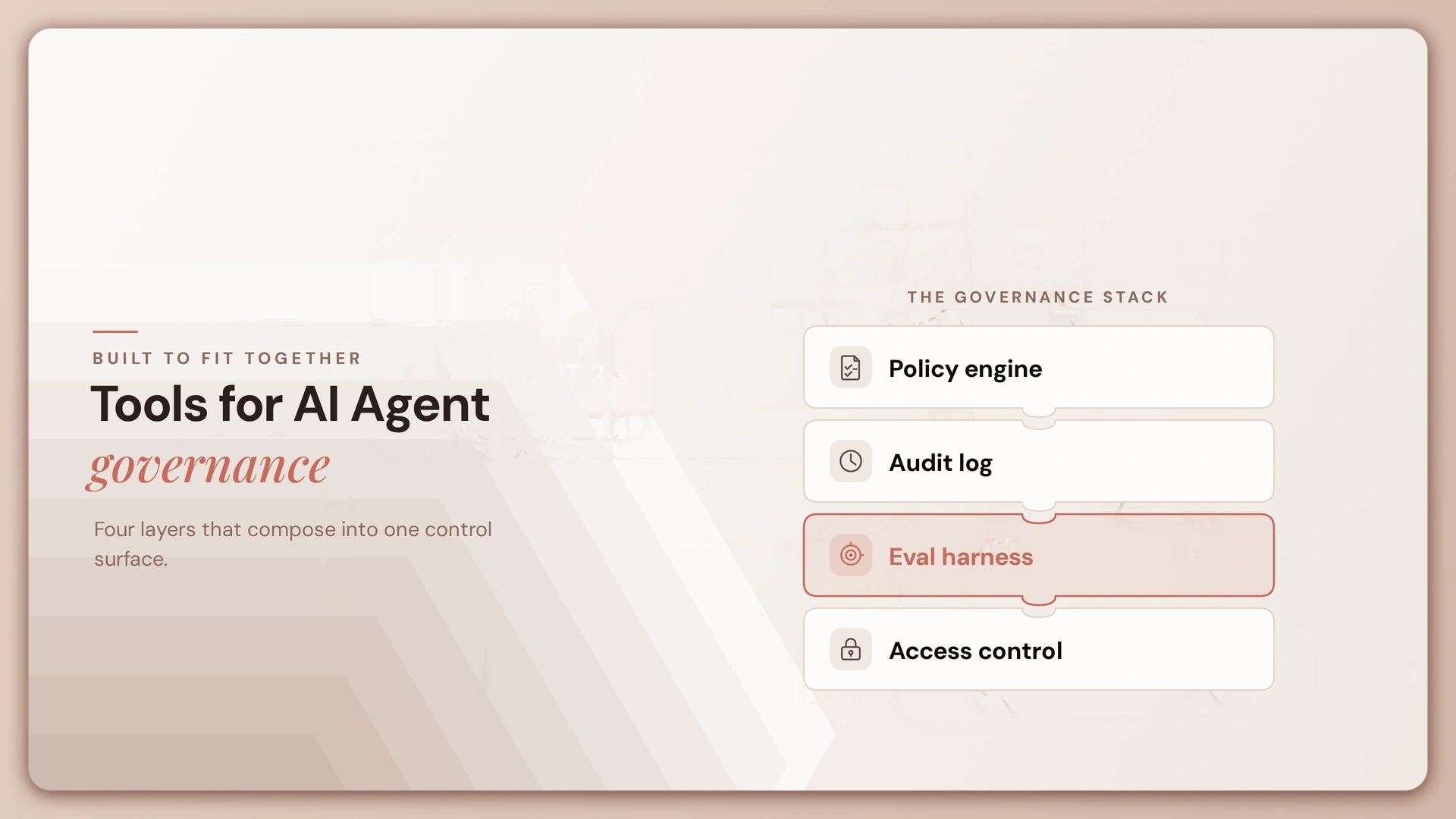
AI agent governance is the software layer enterprises use to manage the risk, compliance, and performance of autonomous AI agents across their lifecycle. It typically covers five capabilities:
- Discovery – knowing which agents exist across your environment, including ones built by other teams or embedded in third-party tools (see: agent registry)
- Runtime guardrails – screening and blocking risky agent behavior (prompt injection, unauthorized tool calls, PII exposure) as it happens, not after the fact
- Continuous evaluation – ongoing quality and safety scoring of agent outputs and actions, not a one-time model evaluation
- Observability – tracing what an agent did, at the application, session, agent, and individual-step level, for root-cause analysis (see: AI model monitoring)
- Compliance evidence – documentation and audit trails mapped to frameworks like the EU AI Act or SR 11-7 for regulated industries
Traditional AI governance tools were largely built to document and monitor static models. Agent governance is a distinct, newer category because agents act, not just predict, and that action needs to be authorized, constrained, and audited in real time.
10 Best Tools for AI Agent Governance: Comparison
| Tool | Governance Category | Best For | Notable Capability |
|---|---|---|---|
| Arthur AI | Third-party agent oversight | Multi-cloud, multi-framework enterprises | Automated agent discovery + native runtime guardrails |
| Fiddler AI | Third-party agent oversight | Regulated industries, model risk management | Guardrails scoring 11 safety dimensions, 35+ PII entity types |
| Microsoft Agent 365 / Purview | Third-party agent oversight | Microsoft-stack organizations | Native integration with Entra, Defender, Intune |
| IBM watsonx.governance | Third-party agent oversight | Large enterprises on IBM infrastructure | Hybrid deployment, lifecycle transparency controls |
| Credo AI | Third-party agent oversight | Enterprises tracking agentic oversight via GAIA | Cited directly in AI-generated search summaries for agentic oversight |
| OneTrust AI Governance | Third-party agent oversight | Compliance and risk teams | AI inventory management, automated compliance workflows |
| Zenity | Third-party agent oversight | Security-owned runtime intervention | Security-led governance for agent behavior |
| MintMCP | Gateway-level governance | Teams governing MCP tool-call traffic | Mint Guard: managed detection for injection, secrets, PII |
| Kore.ai Agent Management Platform | Cross-framework governance | Enterprises running agents across many frameworks | Pre-production evaluation studio across LangGraph, CrewAI, AutoGen, and more |
| Lyzr OpenController | Cross-framework governance, deployed in your cloud | Enterprises that want enforcement in the request path rather than observation beside it | Registers, meters, and governs agents across any framework and any cloud, with budgets and guardrails that refuse rather than alert |
The 10 Best Tools for AI Agent Governance
1. Lyzr OpenController
OpenController is a governance, delivery, and improvement layer that sits in front of every AI agent and every model call an organization runs, deployed inside the customer’s own cloud account rather than as an external SaaS in the traffic path. It registers agents wherever they live, whether built on Lyzr, on LangGraph, CrewAI, Google ADK, Claude Agent SDK, OpenAI Agents SDK, Temporal, or hand-written code, gives each one a real identity, and enforces budgets, guardrails, and tool access directly in the request path rather than reporting on them afterward.
Key features: nine capability domains spanning the full agent lifecycle. Shadow discovery finds unregistered agents across Kubernetes clusters, AWS, Azure, and GCP agent services, and unsanctioned AI tools on employee devices. Two gateways (one per agent invocation, one per model call) authenticate, authorize, meter, and trace every call with roughly 11 ms of measured added latency. Budgets reject calls once a scope is spent rather than alerting after the fact. Inline guardrails score prompt injection, PII/PHI, secret egress, toxicity, and groundedness on both request and response. A gated release pipeline with an evaluation gate and second-person approval before production. Quarantine refuses every call to a misbehaving agent within seconds while preserving forensic history. A closed-loop improvement engine grades production traces, clusters failures, proposes prompt rewrites as a reviewable diff, and grows a permanent regression suite, feeding directly into multi-turn evaluation.
Strengths: framework neutrality with no SDK to adopt, since agent access runs over OpenAI-compatible URLs, MCP, and A2A rather than a proprietary integration. Enforcement happens in the request path (a budget refuses the call, a guardrail blocks the response) rather than as a dashboard or a policy document. Deployment inside the customer’s own cloud account, with private connectivity to model providers, addresses data-sovereignty objections that a third-party SaaS governance layer can’t. Removal is as cheap as adoption: point the URL somewhere else, and your images stay in your registry, your code in your repo, your traces in your collector.
Weaknesses: newer to market as a positioned, named product than longer-established players like Fiddler or Arthur, so buyers evaluating analyst track record specifically will find less third-party coverage to date.
Best for: enterprises that want governance enforced in the request path, not just observed after it, across whatever mix of agent frameworks and clouds their agents already run on, particularly regulated organizations where compliance evidence (ISO/IEC 27001:2022, SOC 2 Type II, GDPR, HIPAA, CCPA, and a control set mapped to EU AI Act high-risk obligations) and 126+ enterprise deployments matter alongside the technical fit.
2. Fiddler AI

Fiddler AI’s heritage is ML model monitoring, and in January 2026 it repositioned as the “AI Control Plane for Enterprise Agents.” It traces hierarchically from application to session to agent to individual span, runs root-cause analysis to find the failing step, and applies more than 100 quality metrics. Its Guardrails product scores safety across 11 dimensions, including prompt injection and faithfulness for hallucination detection, plus PII across more than 35 entity types.
Key features: hierarchical tracing with root-cause analysis, Guardrails with a free tier and air-gapped deployment option, a GRC offering that produces model-risk evidence for frameworks like SR 11-7 and the EU AI Act.
Strengths: the observability depth genuinely supports audit and regulatory needs, not just engineering debugging.
Weaknesses: the platform’s ML-monitoring heritage means some agent-specific runtime concepts are newer additions rather than foundational design.
Best for: ML and AI engineering teams debugging agent failures, and model risk management functions in regulated industries.
3. Microsoft Agent 365 / Purview

Agent 365 provides a centralized governance surface for managing agents built on Microsoft platforms as well as agents developed or acquired from third-party sources. It integrates with Microsoft 365 administration, Microsoft Entra, Microsoft Defender, Microsoft Intune, and Microsoft Purview to help organizations manage AI agents at scale.
Key features: agent lifecycle and access-control management, visibility into agent activity, governance policy application across Microsoft and third-party agents.
Strengths: for organizations already running their identity, security, and compliance stack through Microsoft, Agent 365 governs agents with the same controls already in place, rather than a parallel system.
Weaknesses: the value proposition narrows for organizations not already standardized on Microsoft 365, Entra, and related infrastructure.
Best for: enterprises where Microsoft licensing and identity controls already surround the workforce using these agents.
4. IBM watsonx.governance

IBM watsonx.governance is a governance and oversight tool designed for enterprise AI deployments, covering lifecycle management, transparency, policy enforcement, and hybrid deployment models across cloud and on-premises environments. It supports agents and AI workloads at scale using IBM’s enterprise integration capabilities to embed governance into broader enterprise architecture.
Key features: lifecycle governance for models and agents, hybrid cloud and on-prem deployment, explainability controls for responsible AI deployment.
Strengths: deep integration with IBM’s existing enterprise architecture products makes this the lower-friction choice for organizations already standardized there.
Weaknesses: pricing is based on virtual processor cores and enterprise contracts rather than transparent per-seat rates, which adds procurement overhead for smaller deployments.
Best for: large enterprises standardizing governance through IBM ecosystem tools and hybrid architecture.
5. Credo AI

Credo AI is known for its GAIA capability, which multiple sources report as being cited directly by AI-generated search summaries as a named solution for agentic oversight, a signal of how the category is being surfaced to buyers researching this space through AI search tools rather than traditional SERPs alone.
Key features: agentic oversight tooling, governance workflow and policy management, integration into broader AI risk-management programs.
Strengths: strong visibility in AI-generated answer summaries specifically for the “agentic oversight” query space, which matters increasingly for how buyers discover governance vendors.
Weaknesses: less emphasis on the runtime guardrail and gateway-level enforcement layer compared to security-first tools like Zenity or MintMCP.
Best for: governance and risk teams building a broader AI oversight program where agentic risk is one part of a larger policy framework.
6. OneTrust AI Governance

OneTrust AI Governance provides a platform for AI inventory management, risk assessment, and compliance automation, and was named a Visionary in the 2026 Gartner Magic Quadrant for AI Governance Platforms with a 4.0-out-of-5 rating across verified reviews.
Key features: AI inventory management, automated compliance workflows, risk assessment tooling integrated with broader data governance.
Strengths: if your organization already uses OneTrust for privacy or data governance, extending into AI and agent governance keeps everything in one system of record.
Weaknesses: more oriented toward compliance documentation and inventory than deep runtime intervention on agent behavior.
Best for: compliance and privacy teams that need AI and agent governance integrated with existing data-governance workflows.
7. Zenity

Zenity takes a security-led approach to agent governance, positioned for organizations where the security team, not the ML or platform engineering team, owns runtime intervention over agent behavior.
Key features: runtime control over agent actions, security-team-oriented policy enforcement, visibility into agent behavior from a security operations perspective.
Strengths: the security-first framing genuinely changes the product’s design center compared to tools built by ML monitoring teams; policies map to security operations workflows, not model-risk workflows.
Weaknesses: less oriented toward the model-risk and regulatory-evidence needs that a compliance function specifically requires.
Best for: organizations where the security team owns the decision to allow or block an agent’s actions.
8. MintMCP

MintMCP governs at the gateway layer, screening and controlling tool calls before they execute through three layers: managed detection for prompt injection, secrets, and PII; declarative rules matching on tool names, arguments, or content patterns; and gateway middleware for custom policy enforcement.
Key features: usage and cost tracking by model, user, agent, and session; SIEM export via OTLP or Splunk HEC; real-time blocking of risky tool calls.
Strengths: intervening at the gateway, before a tool call executes, is a fundamentally earlier and more preventive checkpoint than tools that observe after the fact.
Weaknesses: gateway-level governance covers tool-call risk specifically; it’s a narrower scope than platforms that also cover discovery and compliance documentation.
Best for: teams whose primary exposure is MCP tool calls and gateway traffic rather than the full governance lifecycle.
9. Kore.ai Agent Management Platform

Kore.ai launched a dedicated Agent Management Platform (AMP) in March 2026 with explicit cross-framework support for LangGraph, CrewAI, AutoGen, Google ADK, AWS AgentCore, Microsoft Foundry, and Salesforce Agentforce, including a pre-production evaluation studio, unified observability, and continuous governance across all of them.
Key features: cross-framework agent evaluation before production deployment, unified observability across frameworks, continuous governance rather than a one-time audit.
Strengths: A2A and MCP protocol support are the technical indicators that separate genuine cross-framework governance from tools that only govern their own ecosystem, and Kore.ai’s AMP is explicit about supporting both.
Weaknesses: the platform is new (March 2026 launch), so production track record is shorter than more established observability-first competitors.
Best for: enterprises running agents built on multiple different agent frameworks that need one governance layer across all of them.
10. Arthur AI

Arthur is positioned as the industry’s first Agent Discovery & Governance (ADG) platform, purpose-built for the agentic era rather than retrofitted from classic ML model monitoring. It combines automated agent discovery, native runtime guardrails, continuous evaluations, and end-to-end observability into a single platform that works across whatever stack your teams are building on.
Key features: automated discovery of agents across cloud and framework boundaries, runtime guardrails applied without requiring code changes to the agent itself, continuous evaluation pipelines.
Strengths: framework neutrality is the real differentiator; Arthur doesn’t assume you’ve standardized on one agent-building stack.
Weaknesses: breadth across frameworks can mean less depth in any single framework’s specific failure modes compared to a narrower, framework-native tool.
Best for: enterprises governing AI agents at scale across multi-cloud, multi-framework environments.
How to Choose
- Do you need enforcement to happen in the request path itself, not just a report of what already happened? This is the axis OpenController is built around: budgets and guardrails that refuse a call in real time, deployed inside your own cloud account, rather than a dashboard or an alert layered on top of your existing stack.
- Do you already have agents built across multiple teams, frameworks, or vendors that you need to discover and constrain? Arthur, Kore.ai’s AMP, or OpenController all handle that heterogeneity, with OpenController’s shadow discovery specifically built to surface agents running in your own cluster, in other clouds, and on unmanaged devices.
- Is your organization’s identity, security, and compliance stack already Microsoft? Microsoft Agent 365 governs agents using the controls already surrounding your workforce.
- Is the security team, not ML or platform engineering, the one who needs to approve or block agent actions? Zenity’s security-led model fits that ownership structure directly.
- Is your primary exposure specifically MCP tool-call traffic rather than the full agent lifecycle? MintMCP’s gateway-level interception is a narrower but more preventive checkpoint.
- Is regulatory evidence (EU AI Act, SR 11-7, model risk documentation) the center of gravity? OneTrust, IBM watsonx.governance, Fiddler’s GRC offering, or OpenController’s own EU AI Act control mapping and ISO/SOC 2/GDPR/HIPAA coverage are all built around that requirement specifically.
FAQ
What is AI agent governance?
AI agent governance is the set of tools and practices enterprises use to manage the risk, compliance, and performance of autonomous AI agents throughout their lifecycle, covering discovery, runtime guardrails, continuous evaluation, observability, and compliance evidence.
Is AI agent governance the same as AI governance?
No. Traditional AI governance largely covers static models: documentation, bias testing, and periodic audits. AI agent governance is a newer, distinct category because agents take actions, calling tools, accessing systems, acting on a user’s behalf, so the governance layer needs to authorize and constrain behavior in real time, not just document a model’s characteristics.
What’s the difference between AI observability and AI agent governance?
Observability tells you what an agent did after the fact, through tracing and monitoring. Governance controls what an agent is allowed to do before it acts, through runtime guardrails, policy enforcement, and approval workflows. Most enterprise deployments need both, and several platforms in this list (Fiddler, Arthur) combine them.
Do I need a separate AI agent governance platform if I already have observability tools?
Often yes, if your observability tool only reports on agent behavior rather than intervening in it. Runtime guardrails, tool-call approval gates, and compliance evidence generation are governance functions that most pure observability platforms don’t include natively.
Can one platform govern agents built on multiple different frameworks like LangGraph, CrewAI, and AutoGen?
Yes. Arthur AI and Kore.ai’s Agent Management Platform are both built specifically for cross-framework governance, using A2A and MCP protocol support as the technical basis for working across ecosystems rather than being locked to one.
What compliance frameworks do AI agent governance platforms typically support?
Common frameworks referenced across these platforms include the EU AI Act and SR 11-7 (US model risk management guidance for banking), with several vendors, notably Fiddler AI’s GRC offering and OneTrust, producing structured evidence mapped directly to those frameworks.
How much do AI agent governance platforms cost?
Pricing varies widely and several vendors in this category don’t publish public rates. IBM watsonx.governance bills by virtual processor cores or a per-resource-unit SaaS rate; others use enterprise contract pricing that requires direct engagement to quote. Treat an unpublished price as a procurement timeline factor, not a minor detail.
Does an AI agent governance platform need to be framework-specific, or can it cover agents built on different stacks?
The stronger platforms in this category are explicitly framework-neutral. Arthur, Kore.ai’s AMP, and OpenController are all built to govern agents regardless of which framework built them, using standard protocols (A2A, MCP, OpenTelemetry) rather than a proprietary SDK, so switching frameworks or adding a new one doesn’t require re-integrating governance.
Why are agentic AI projects being canceled at a high rate according to Gartner?
Gartner attributes the projected 40%-plus cancellation rate by the end of 2027 to escalating costs, unclear business value, and inadequate risk controls, the same gaps that dedicated agent governance tooling is built to close before a project reaches that point.
What should I look for when evaluating an AI agent governance platform?
Beyond regulatory documentation, look for whether controls actually refuse risky behavior in real time or only report on it afterward, activity logs and audit trails, transparency into how the platform reaches its safety scores, and where the platform itself is deployed, since a governance layer that runs inside your own cloud account (as OpenController does) closes a different set of data-sovereignty objections than one that routes your agent traffic through an external vendor’s infrastructure.
Book A Demo: Click Here
Join our Slack: Click Here
Link to our GitHub: Click Here