“Wait… Who Changed the Agent?”
That’s becoming a very common question inside AI teams.
An agent behaved correctly last week.
Now it suddenly:
- responds differently
- calls the wrong workflow
- retrieves the wrong memory
- breaks production logic
- ignores previous instructions
And nobody knows exactly why.
Was it:
- a prompt update?
- a memory change?
- a workflow modification?
- a tool configuration issue?
- a runtime update?
This is the problem many teams are now running into with AI agents.
The agents themselves are getting smarter.
But the AI agent workflows around them are still immature.
And that’s creating a new category of infrastructure problem:
version control for AI agents.
Traditional Software Already Solved This Problem
In software engineering, teams already know how to manage change.
Developers use:
- Git
- pull requests
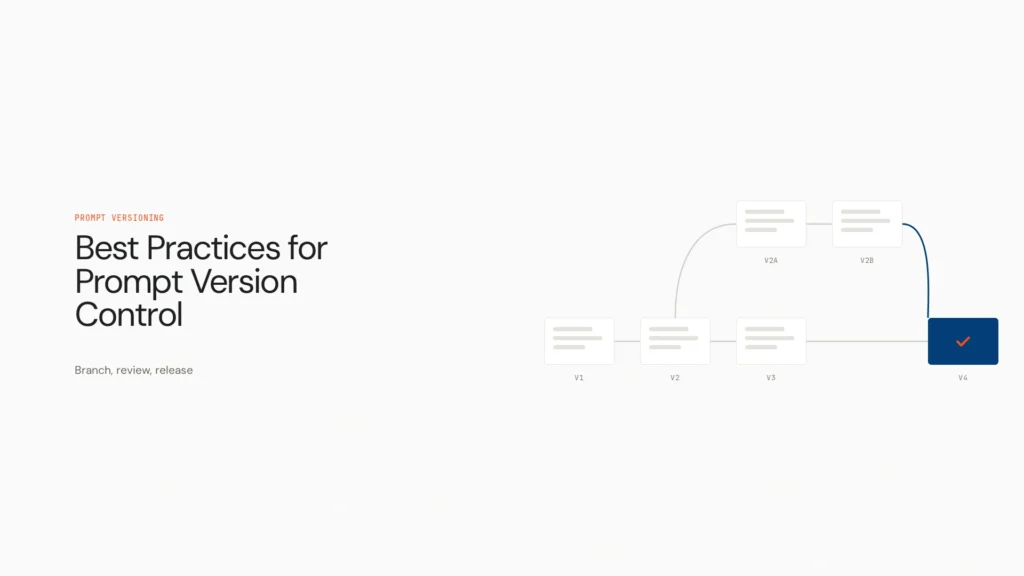
- branches
- rollback systems
- CI/CD pipelines
- audit trails
These workflows exist for one reason:
production systems change constantly.
AI agents are no different. In fact, they change even faster. Prompts evolve weekly. Memory systems get updated. Workflows expand. Models change. Policies shift. Tools get added or removed.
Yet many AI systems are still managed through:
- runtime dashboards
- hidden configurations
- disconnected workflows
- undocumented prompt changes
That becomes difficult to manage at scale.
AI Agents Are Becoming Operational Infrastructure
A year ago, most AI agents were experimental.
Now they’re increasingly tied to:
- customer support
- finance operations
- sales workflows
- internal knowledge systems
- compliance reviews
- enterprise automation
Which means one bad update can create real operational problems.
Here’s where teams usually start feeling the pain:
| Early AI Stage | What Happens Later |
| One developer manages the agent | Multiple teams start collaborating |
| Prompts are edited manually | Changes become difficult to track |
| Agents run in staging | Production deployments begin |
| Memory is lightweight | Long-term context grows |
| Governance is ignored | Audit requirements appear |
This is the moment where teams realize:
AI agents need the same operational discipline as software systems.
Why Version Control for AI Agents Matters
Without version control, AI agents become difficult to manage reliably.
Teams lose visibility into:
- what changed
- who changed it
- when it changed
- why it changed
- which version is deployed
That creates serious operational risk.
Especially once agents start handling:
- customer-facing workflows
- enterprise systems
- financial operations
- regulated data
Here’s what version control actually enables for AI agents:
| Capability | Why It Matters |
| Change tracking | Understand what modified behavior |
| Rollback support | Recover quickly from failures |
| Branching | Test workflows safely |
| Pull requests | Review changes before deployment |
| Audit trails | Improve governance |
| Deployment history | Track production versions |
| Collaboration workflows | Multiple developers can work safely |
Without these systems, AI operations become extremely fragile.
The Bigger Problem: AI Agents Aren’t Just Prompts
Many teams still think version control simply means saving prompts in Git.
That’s only one part of the problem.
| Component | Purpose |
| Prompts | Agent instructions |
| Workflows | Task execution flow |
| Memory | Long-term context |
| Runtime Rules | Execution behavior |
| Tools | External integrations |
| Policies | Governance controls |
| Orchestration | Agent coordination |
| Hooks | Triggered actions |
| Deployment Config | Infrastructure setup |
Versioning only the prompt is like versioning only one file in an entire application.
The operational complexity is much larger now.
This Is Where GitAgent Comes In
GitAgent approaches AI agents differently.

Instead of treating agents like isolated runtime abstractions, GitAgent treats the repository itself as the agent.
Everything lives inside Git:
- prompts
- memory
- workflows
- policies
- hooks
- deployment logic
- runtime configuration
That means AI agents can finally follow the same workflows engineering teams already trust.
What a Git-Native AI Agent Actually Looks Like
A GitAgent project includes structured files like:
- agent.yaml
- SOUL.md
- RULES.md
- memory/
- skills/
- hooks/
- knowledge/
This creates something many AI teams currently lack:
operational transparency.
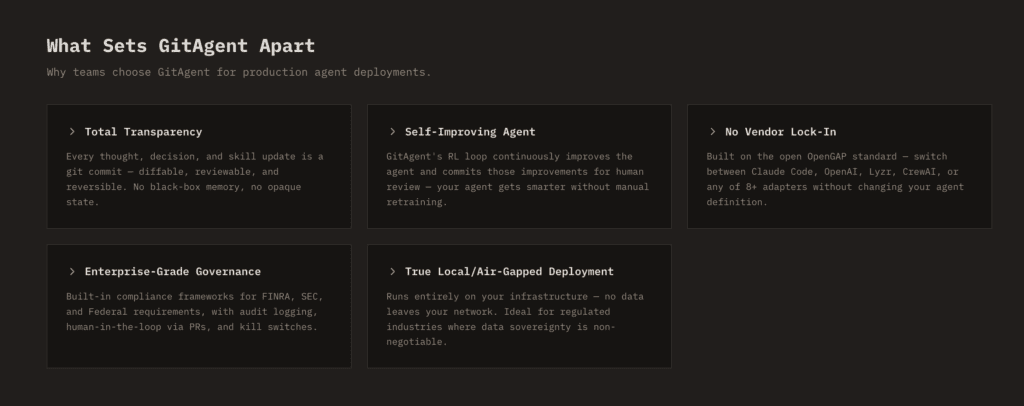
Every update becomes:
- reviewable
- trackable
- reversible
- portable
Instead of hidden runtime behavior, teams get clear operational visibility.
Git Workflows Become AI Workflows
This is where GitAgent feels fundamentally different from many agent platforms.
Instead of inventing completely new operational systems, it reuses workflows developers already understand.
That means:
- memory updates can go through pull requests
- deployments can happen through branches
- rollback becomes a standard Git operation
- agent reviews happen before production deployment
For engineering teams, this creates a much cleaner operational model.
GitAgent vs Traditional AI Agent Workflows
| Traditional Agent Systems | GitAgent |
| Runtime-heavy configuration | Git-native structure |
| Hidden prompt changes | Version-controlled updates |
| Manual deployment workflows | Branch-based deployments |
| Limited rollback visibility | Full Git rollback |
| Fragmented governance | Built-in auditability |
| Framework lock-in | Multi-framework portability |
| Difficult collaboration | PR-based workflows |
| Low operational transparency | Clear version history |
The difference becomes much more important once AI systems scale across teams.
Why Enterprise Teams Care About This
Enterprise AI systems introduce operational requirements that prototypes usually ignore.
Enterprise AI systems introduce operational requirements that prototypes usually ignore. That includes governance, auditability, compliance, deployment controls, approval systems, and rollback safety.
Without proper version control, enforcing these workflows consistently becomes extremely difficult, especially as AI agents evolve rapidly over time.
This becomes even more important in industries like financial services, healthcare, enterprise SaaS, government, and other regulated environments where undocumented AI behavior can create serious operational and compliance risks.
In these environments, undocumented AI behavior creates real operational exposure.
One of the Biggest Advantages: Portability
Another major issue teams run into is framework lock-in.
An agent built inside one ecosystem often becomes difficult to move elsewhere.
GitAgent solves this differently.
The same agent definition can export across:
- Claude Code
- OpenAI Agents SDK
- CrewAI
- OpenClaw
- Lyzr
- GitHub Models
That flexibility becomes extremely valuable as AI infrastructure evolves rapidly.
AI Agents Need the Same Discipline as Software
This is the larger shift happening across the industry right now. AI agents are no longer experimental demos. They’re becoming production infrastructure.
And production infrastructure requires:
- versioning
- governance
- deployment discipline
- auditability
- collaboration workflows
- rollback systems
The companies treating AI agents like unmanaged runtime experiments will eventually struggle operationally.
The companies treating them like software systems will scale much more reliably.
Final Thoughts
The AI industry spent the last few years focusing heavily on model intelligence.
Now the focus is shifting toward operational reliability.
Because building AI agents is no longer the hardest part.
Managing them is.
That’s why version control for AI agents is becoming such an important layer of the modern AI stack.
GitAgent brings Git-native workflows directly into AI operations, making it easier for teams to:
- version agents
- review changes
- manage deployments
- improve governance
- reduce operational chaos
As AI systems move deeper into enterprise operations, those workflows become less of a nice-to-have and more of a requirement.
Book A Demo: Click Here
Join our Slack: Click Here
Link to our GitHub: Click Here