TL;DR
- A control plane as a service is a managed, framework-agnostic layer that registers, evaluates, identity-maps, promotes and audits every AI agent your organization runs, whether it was built in LangGraph, CrewAI, Agentforce, Bedrock or custom code.
- Forrester named the category in December 2025.
- Gartner expects 150,000+ agents per Fortune 500 enterprise by 2028.
- This piece covers what the layer does, why observability alone is not it, and what it looks like in production.
You shipped the agent. It passed the demo. Leadership loved it. You handed it over to the production team, and then… silence.
Three weeks later, someone from compliance asks, “Which version of the agent is running in prod right now?” Nobody knows. The engineer who built it has moved on to the next project. The logs are somewhere.
The approval trail doesn’t exist. And now there are 6 more agents in the pipeline.
Sound familiar? If you’re building enterprise AI at any scale right now, this isn’t a horror story, it’s Tuesday.
This is exactly the problem that control plane as a service was built to solve. And in 2026, it’s no longer a nice-to-have. It’s the difference between an AI strategy that scales and one that quietly collapses under its own weight.
What Even Is a Control Plane for AI Agents?
Let’s start simple. In traditional software, a control plane is the layer that tells everything else what to do, routing decisions, policy enforcement, lifecycle management. Think of it as the air traffic control tower. The planes (your agents) do the flying, but the tower decides when they take off, which runway they use, and what happens if something goes wrong.
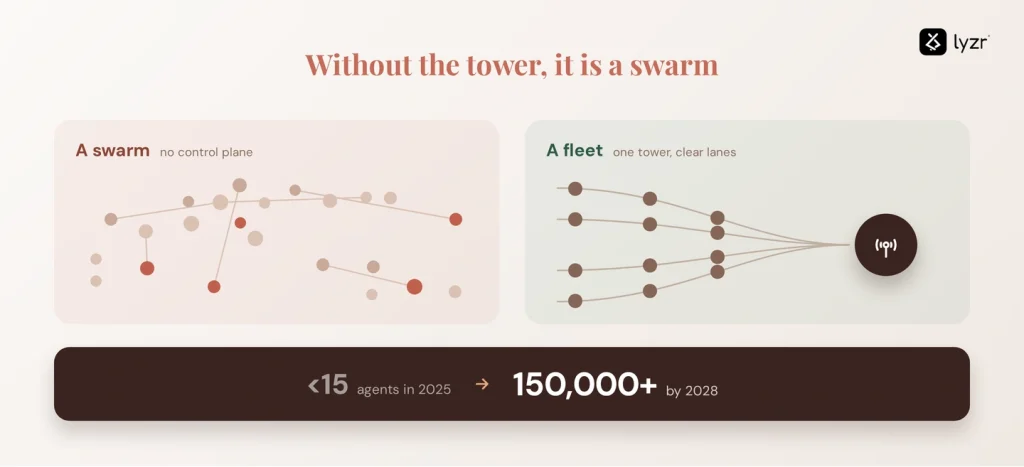
An AI agent control plane does the same thing, but for your fleet of AI agents running across departments, clouds, and frameworks.
Quick check: How many AI agents does your organization have in production right now? 5? 20? More than you can name off the top of your head?
If you paused on that question, you’re not alone. IBM’s Institute for Business Value found that 96% of enterprises are already using AI agents in some capacity, but most have no centralized system to govern them. Gartner projects the average Fortune 500 will be running over 150,000 agents by 2028, up from fewer than 15 in 2025. That’s a 10,000x explosion in less than 3 years.
Without a control plane, that’s not a fleet. That’s a swarm.
The Kubernetes Moment Nobody Wants to Miss Twice
Here’s a pattern worth paying attention to.
In 2014, Docker made containers easy to spin up, and container technology spread from a novelty to the default way software shipped almost overnight. By 2016, engineering teams had containers running everywhere, local machines, staging servers, production clusters, with no standard way to manage any of it. Deployments were inconsistent. Nobody knew what was running where. Rollbacks were painful guesswork.
Then Kubernetes arrived. It brought order. Standardized deployment. Health checks. Version history. Rollbacks that actually worked. Today, nobody serious about infrastructure skips Kubernetes.
AI agents are on the exact same trajectory, just moving 3x faster.
Forrester formally recognized the “agent control plane” as an emerging market category in December 2025, defining it as infrastructure that inventories, governs, orchestrates, and assures heterogeneous AI agents across vendors and domains. Within months, Google, Microsoft, IBM, ServiceNow, Fiddler AI, and Galileo all launched products in this space.
The category arrived. The question now is: are you building governance before the sprawl hits, or after?
Why “Just Monitor It” Doesn’t Cut It Anymore
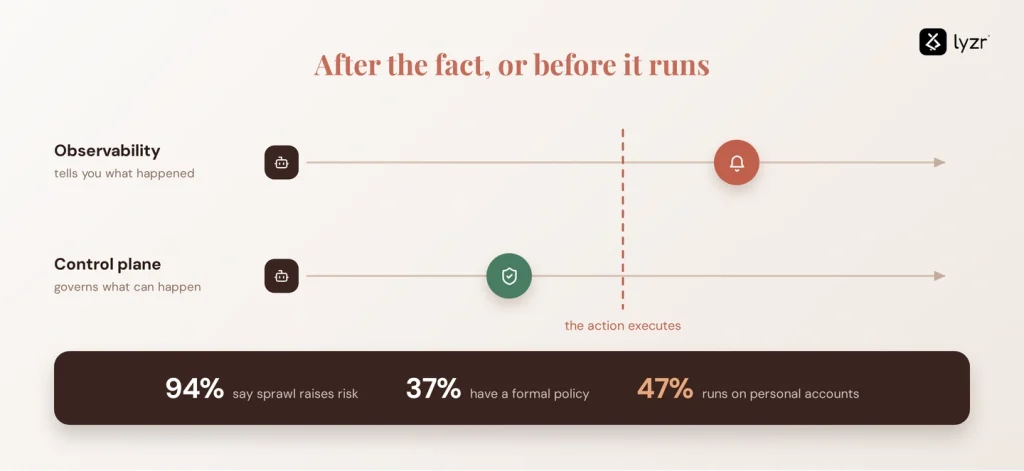
A lot of teams think observability tools solve this. They don’, and here’s the critical distinction:
Observability tells you what happened. An AI control plane governs what can happen.
Tools like Langfuse, Datadog, and Arize are excellent at surfacing what an agent did after the fact. But if your agent accessed the wrong dataset, violated a compliance rule, or produced a hallucinated output that triggered a downstream business decision, you’re reading about it in a retrospective, not stopping it in real time.
A control plane intercepts agent actions before they execute. It enforces policy at runtime. It’s the difference between a fire alarm and a sprinkler system.
And with the EU AI Act’s high-risk system requirements taking effect August 2, 2026, plus Colorado’s AI Act already in effect since February 2026, enterprises need more than dashboards. They need auditable evidence of governanc, who approved what, when, and under what policy.
Here’s what’s at stake without a control plane:
- 94% of enterprises say AI sprawl is already raising their security risk and complexity
- 98% of organizations report unsanctioned AI use, yet only 37% have formal AI governance policies
- 47% of enterprise AI usage flows through personal accounts that IT cannot see or govern
That last number should make every CISO uncomfortable.
So What Does a Control Plane as a Service Actually Do?
Good question. Let’s break it down practically, because the term gets thrown around a lot without much substance.
1. It Gives Every Agent a Lifecycle, Not Just a Launch
Without a control plane, most agents have a birth (the demo) and a vague ongoing existence in production. A control plane enforces a structured lifecycle: build → test → evaluate → approve → deploy → monitor → version → rollback if needed.
Every step is tracked. Every deployment has a commit hash. Every approval has a name attached to it.
2. It Makes Your Deployment Framework-Agnostic
This is where it gets interesting for engineering teams. Your enterprise didn’t build all its agents on one framework. You’ve got LangGraph agents from one team, CrewAI pipelines from another, maybe some custom-built logic from a third. A good control plane doesn’t care. It accepts them all through the same governed pipeline.
3. It Enforces Guardrails Before Code Hits Production
Static code analysis. Security scans. Vulnerability assessments on container images. Responsible AI policy checks. Hallucination scoring. These aren’t manual reviews; they run automatically as part of the CI/CD pipeline. If an agent fails evaluation, it doesn’t go to production. Period.
4. It Gives Agents an Identity
This one’s underrated. When a human employee takes an action in your enterprise systems, there’s an identity attached: an Okta user, an audit trail, an access level. Your AI agents? Most of them are anonymous processes with elevated permissions and no accountability chain.
A control plane maps every deployed agent to a unique identity. That identity controls what the agent can access, logs what it does, and gets revoked cleanly if the agent fails evaluation or gets decommissioned.
5. It Creates a Registry Your “Agent Workforce” Inventory
Think of this as your enterprise’s catalog of its AI workforce. Who’s running in prod right now? What framework did they use? Which cloud are they on? What version is live? When was the last evaluation run? All of that, in one place, searchable by team, function, or use case.
The 3 Planes Forrester Says You Need to Think About
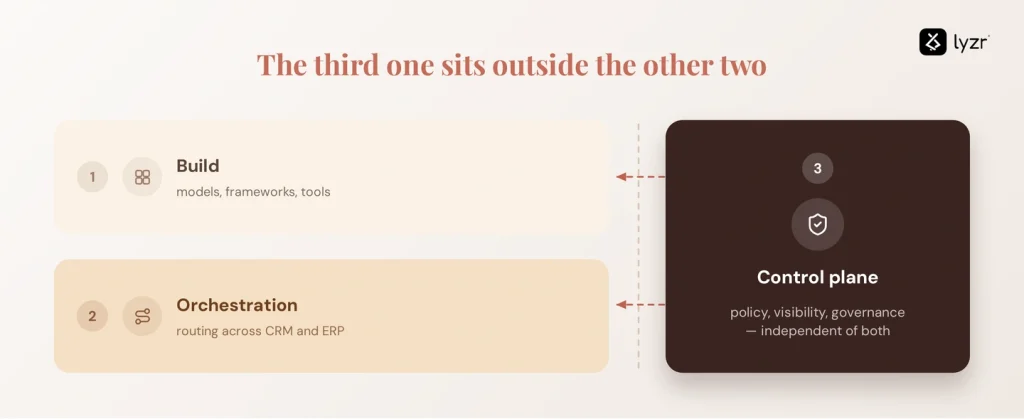
Forrester’s December 2025 research is worth understanding because it gives you a clean mental model for how this space is organized:
Plane 1: The Build Plane: Where you create agents. Model access, frameworks, tool integrations, vector stores. LangChain lives here. CrewAI lives here.
Plane 2: The Orchestration Plane: Where you embed agents into business workflows. Routing logic, process composition, sequential execution across systems like CRM and ERP.
Plane 3: The Control Plane (the new one): An independent oversight layer that sits outside both of the above. Consistent policy enforcement, visibility, governance, and management, regardless of how or where agents were built and run.
The key word is independent. The control plane can’t be embedded in your build tools or your orchestration fabric. It needs to operate externally to provide real, unbiased governance. Just like JPMorgan’s model risk governance function validates AI models independently from the teams that build them.
What Are Companies Getting Wrong Right Now?
Let’s be honest about the common failure patterns, because they’re expensive.
Mistake #1: Treating deployment as the finish line. Most agent projects define success as “agent is live.” That’s actually just the starting point. The harder work is maintaining, versioning, governing, and scaling that agent over time.
Mistake #2: One-off pipelines per team. Engineering team A built their own CI/CD for agents. Team B did it differently. Team C used a third approach. Now you have 3 security models, 3 approval workflows, and 3 ways things can go wrong. A control plane standardizes this across the org.
Mistake #3: Skipping the evaluation gate. Agents that haven’t been evaluated for hallucination, relevance, and Responsible AI compliance before going to production are a liability, not an asset.
Mistake #4: No rollback story. When something goes wrong in production (and it will), can you roll back in 60 seconds? If the answer involves manual intervention, you have a problem.
Is Your Organization Ready? A Quick Self-Assessment
Before you move on, take 60 seconds. How many of these can you answer “yes” to right now?
- [ ] Do you have a complete inventory of every AI agent running in your organization?
- [ ] Can you roll back a production agent to its previous version in under 5 minutes?
- [ ] Does every deployed agent have a documented approval trail?
- [ ] Are your agents evaluated for hallucination and Responsible AI compliance before going live?
- [ ] Do your agents have unique identities with auditable access controls?
- [ ] Can you demonstrate AI governance with evidence to a regulator today?
If you answered “no” to 3 or more of those, you need a control plane. Not someday. Now.
What to Ask Any Control Plane Vendor
| Question | Why it matters | Red flag answer |
| Do I have to rebuild my agents? | Migration cost kills adoption | “Rebuild in our framework” |
| Is the control plane independent of the build and orchestration layers? | Forrester’s definition requires it; self-governing tools are not governance | “It’s built into our agent builder” |
| What exactly happens when an agent fails evaluation? | Half-deployed agents are the sprawl you’re trying to fix | “It stays deployed and we alert you” |
| Does every agent get its own identity? | Shared service accounts = no attribution, no revocation | “Agents use a shared API key” |
| Where does my data run? | Data residency and regulator questions | “Our multi-tenant cloud” |
| Can I roll back to a specific prior version in one step? | Incident response time | “Redeploy from your backup” |
| Can you produce evidence for an auditor without custom work? | EU AI Act, ISO 42001, SOC 2 | “We have dashboards” |
Meet Lyzr: Control Plane as a Service in Practice
Here’s where it gets practical.
Lyzr Agent Control Plane is built specifically for enterprises that are past the “let’s try an AI agent” phase and are now asking: how do we run dozens of agents reliably, securely, and at scale?
Think of it as the Vercel for AI agents, the same way Vercel took the pain out of deploying web apps (CI/CD, previews, rollbacks, edge deployment), Lyzr does the same for your agent fleet.
Here’s what makes it genuinely different:
1. It Meets You Where You Are
You don’t need to rebuild your agents in a new framework. LangGraph, CrewAI, Strands, custom code: Lyzr’s control plane accepts them all via a code drop-in. Point it at your repository, and it takes over from there. This matters enormously for enterprises with existing agent investments they can’t simply throw away.
2. Every Deployment Is Git-Driven
Webhooks listen for code pushes. Every change triggers the full pipeline automatically. Every deployment creates a version tag. The entire audit trail, who pushed what, when it was evaluated, who approved it, when it went live, is preserved. Rollback means reverting to a previous version tag. No guesswork.
3. The Evaluation Gate Is Non-Negotiable
Before any agent reaches production, Lyzr runs a full automated evaluation suite:
- RAI Scans (Responsible AI policy compliance)
- Hallucination checks (factual accuracy validation)
- Relevance and correctness scoring
- Container vulnerability scans
- Security analysis on the agent code itself
If an agent fails? All provisioned non-prod resources get cleaned up automatically. No half-deployed, forgotten agents floating in your cloud infrastructure.
4. Multi-Cloud Without Multi-Headaches
Deploy to AWS Bedrock AgentCore or GCP Vertex AI Agent Engine, from the same pipeline. Switch target runtimes by changing a configuration. The platform handles the cloud-specific details (VPCs, IAM roles, container registries) through preset configuration bundles. And when something fails, cleanup is cloud-aware: each provider’s resources get cleaned up independently.
5. Identity for Every Agent, Automatically
Through Okta integration, every deployed agent gets its own identity tied to its environment (non-prod or production). Fine-grained access control. Audit trails per agent action. Automatic identity revocation when an agent fails evaluation or gets decommissioned. This is the missing governance layer that most enterprise AI deployments are running without.
6. The Agent Registry: Your AI Workforce Catalog
One searchable catalog. Every agent, every framework, every cloud, every version, every deployment status. A LangGraph agent, a CrewAI agent, and a Lyzr agent, side by side, governed consistently.
Let’s Talk Numbers (Because Governance Has a Real ROI)
Here’s the math that enterprises often miss when evaluating whether to invest in a control plane:
- The average data breach in 2025 cost $4.88M (IBM Cost of a Data Breach Report). An agent with unchecked access to sensitive data isn’t an AI problem, it’s a financial exposure.
- 40% of enterprise applications will feature task-specific AI agents by 2026, up from fewer than 5% in 2025 (Gartner). Without governance infrastructure in place now, you’re building debt at scale.
- Teams with standardized deployment pipelines ship 2-5x faster than teams managing bespoke per-agent processes. The control plane pays for itself in engineering hours alone.
The Bottom Line: Building Agents Is Now Table Stakes. Governing Them Is the Moat.
The competitive advantage in enterprise AI in 2026 isn’t who can build the smartest agent. Everybody has access to the same models. The advantage goes to whoever can deploy agents reliably, govern them consistently, and scale them without the whole thing becoming a compliance nightmare.
Most enterprise agent initiatives don’t fail because of bad ideas; they stall because production is messy. Fragmented pipelines. Unclear approvals. Missing guardrails. What starts as a promising agent never makes it to real users.
Control plane as a service changes that equation. It brings structure to how agents move from code to production. And when deployment becomes predictable, scaling stops being the bottleneck, and building the right agents becomes the only thing you need to focus on.
Lyzr’s Agent Control Plane is purpose-built for exactly this, enterprises that are done experimenting and ready to ship.
Book an Architecture Review: bring your lowest-scoring control point and the one agent that is stuck. Thirty minutes, on your stack, no slides.
Download the Control Plane one-pager (PDF)
Not sure where you stand? Take the AI Agent Sprawl Audit
Related reading:
- The CIO Playbook to AI Agent Governance: the full framework, board case, and maturity worksheet in one downloadable guide
- Agent Versioning: The Missing Layer in the AI Agent Development Lifecycle
- AI Agent Registry: Why Enterprises Need a System of Record for AI Agents
- Lyzr Agent Control Plane: The Vercel for AI Agents
Frequently Asked Questions
An agent control plane is an independent layer that inventories, governs, evaluates and audits every AI agent an organization runs, regardless of which framework built it or which cloud runs it. Forrester formally defined the category in December 2025. It sits outside the build plane (LangChain, CrewAI, Agent Studio) and the orchestration plane (workflow routing) so that oversight remains available even when an agent misbehaves.
It is the managed delivery model of an agent control plane: you connect your repositories, clouds and identity provider and consume registry, identity, evaluation, staged promotion and observability as a service, instead of building each piece per team. Lyzr’s Control Plane is an example; it deploys inside your own AWS or GCP environment.
The data plane is where work executes: models run, agents process requests, tools get called. The control plane decides what those agents are allowed to do, with which identity and data, and records what they did. Same split as networking and Kubernetes. See Control Plane vs Data Plane: What Every CISO Needs to Know.
Orchestration decides how agents do the work (routing, hand-offs, sequencing). A control plane decides whether they should be doing it at all, under what policy, and proves it afterward. Orchestration is one capability inside a control plane, not a substitute for it.
No. Observability (Langfuse, Datadog, Arize) tells you what an agent did after the fact. A control plane enforces policy before and during execution: evaluation gates, identity scopes, PII and hallucination guards. Observability is layer four of seven in Lyzr’s stack, not the whole stack.
Those are build and orchestration tools; each governs only its own agents. Once you have agents on more than one of them, you have more than one security model, approval workflow and audit trail. A control plane puts all of them through one governed pipeline without rebuilding any of them.
The Act (high-risk obligations now due December 2027 after the Digital Omnibus) requires demonstrable governance: evidence, not policy documents. A control plane generates that evidence automatically: immutable deployment logs, evaluation results, approval chains and step-level traces.
Book A Demo: Click Here
Join our Slack: Click Here
Link to our GitHub: Click Here