Your agent worked perfectly in the demo.
It called the right API. It handled the edge case your VP asked about. Everyone in the room nodded.
Six weeks later, it’s in a staging environment quietly failing at tasks nobody thought to test, because the CRM schema changed, the model provider pushed a silent update, and nobody built anything to catch either.
This is not a model problem. It never was.
Only 5% of enterprise AI agents ever reach production the other 95% die in prototype. They demo well, get budget approved, and then quietly stall in pre-production. The agents fail security review, miss observability, hallucinates in edge cases, and simply lacks the governance every enterprise needs but no prototyping tool provides.
That gap has a name now. Enterprises spent the last few years obsessing over which model to pick and how to phrase the perfect prompt. In 2026, the smartest teams stopped asking “which LLM” and started asking “what did we build around it.” That question is harness engineering, and it’s rewriting how production enterprise AI agents actually get shipped.
What Harness Engineering Actually Means
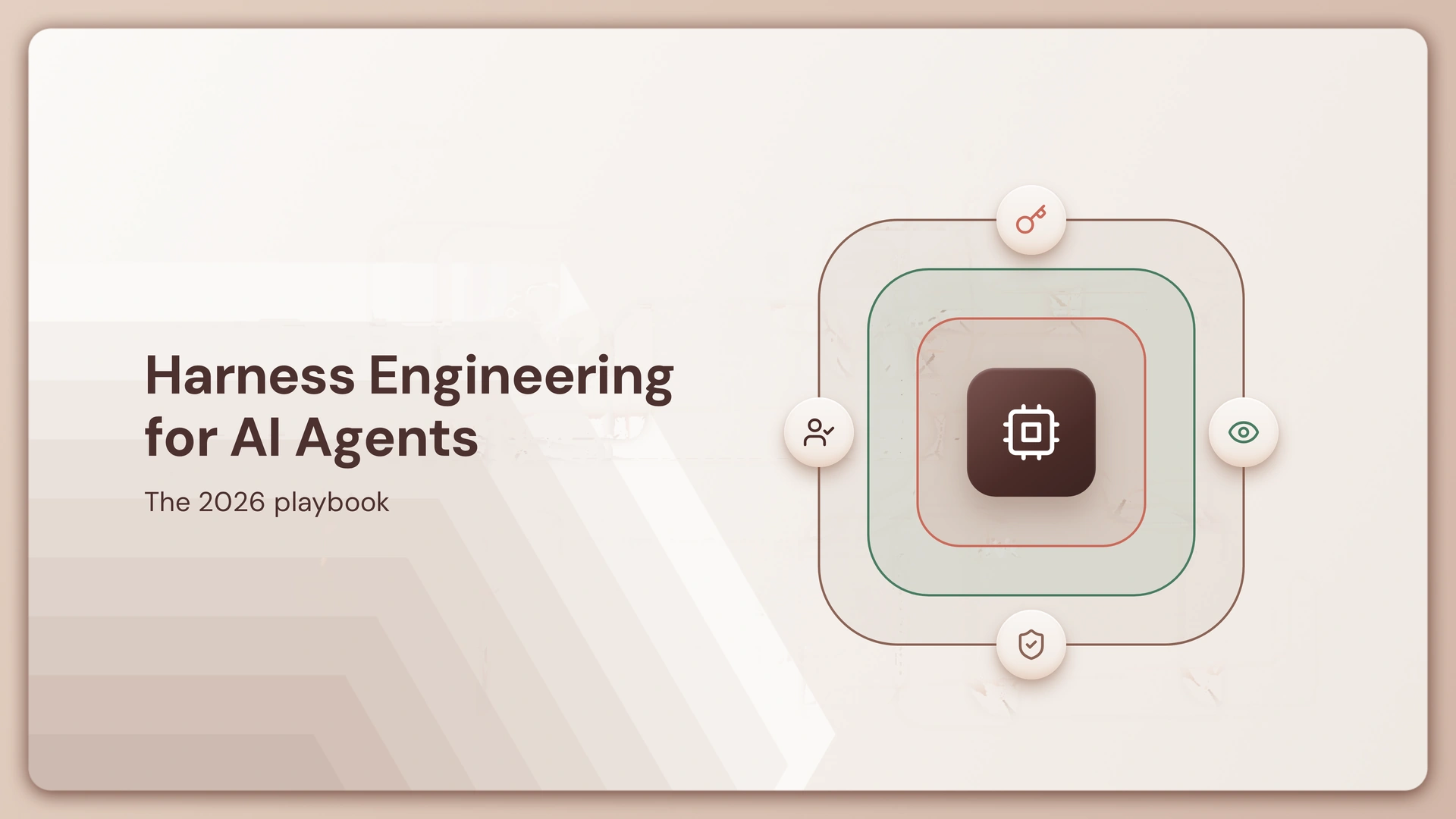
Harness engineering is an autonomous software system that perceives its environment, reasons about goals, takes actions using tools and memory, and operates under enterprise-grade governance – but more precisely, it’s the discipline of designing that execution environment itself: defining which tools the agent can call, where it gets information, how it validates its own decisions, and when it should stop.
The agent’s underlying language model does the reasoning. The harness is everything that turns that reasoning into dependable action.
The industry has settled on a simple formula to describe it: Agent = Model + Harness. The formula he gave the field is simple: Agent = Model + Harness. This formula, popularized by Mitchell Hashimoto in 2026, has become the foundational definition of what an AI agent actually is.
The model contains the raw intelligence, and the harness makes that intelligence useful and actionable. Harness engineering is how we build the environment around AI models to turn them into reliable, autonomous agents.
The metaphor the term borrows from is deliberately unglamorous. The concept was named around the metaphor of a transition to a world where powerful but unpredictable horses (LLM agents) plow the fields. Horses can run faster than humans, but left unattended, they veer off course and wander into neighboring fields. The AI model is the horse. The harness is everything that channels its power productively. The engineer is the rider who provides direction.
That’s not just a safety framing, either. A well-designed harness does not just prevent agents from going wrong. It makes them more capable by giving them the right context, the right tools, and the right constraints at the right time.
The best harnesses aren’t cages. They’re the difference between an agent that improvises its way into a mess and one that operates with the same discipline you’d expect from a senior employee who knows exactly what they’re allowed to touch, including where it goes to look things up in the first place, whether that’s a document store or a governed knowledge search layer.

Where the Term Actually Came From
This didn’t emerge from a research lab roadmap. It came from someone hitting the same wall enough times to name it.
Mitchell Hashimoto built HashiCorp and co-created Terraform. In February 2026, he published a blog post describing a habit he’d developed while working with AI agents: every time an agent made a mistake, he engineered a permanent fix into the agent’s environment.
He called it “engineering the harness.” Within weeks, OpenAI and Anthropic published engineering articles expanding on the idea, and the term Harness Engineering had arrived.
It caught on because it named something engineers were already doing without a word for it. It resonated because it names a problem every engineer building AI agents has already hit. Prompt engineering gets you better single-turn outputs. Context engineering manages what the model sees. But neither addresses what happens when an agent runs autonomously for hours, making hundreds of decisions without supervision.
Martin Fowler, whose name carries weight in software engineering circles for good reason, gave it a compact definition of his own: “I like ‘harness’ as a word to describe the tooling and practices we can use to keep AI agents in check.” The scope has since grown well past “keeping agents in check” into something closer to a full operating discipline, but the safety framing is where most enterprise teams still start, and for good reason. This is exactly the terrain the CIO Playbook to AI Agent Governance was written to map.
Harness, Context, Prompt: Where Each One Actually Sits
You’ve probably already invested in prompt engineering. Maybe context engineering too, if you’ve built any retrieval pipeline in the last year. Neither of those investments is wasted. They just aren’t the whole system.
Think of it as a computing stack. The model is the CPU, context is the RAM, and the harness is the operating system. Each layer assumes the previous one is in place. A brilliant prompt sent into an agent with no tool guardrails is still going to break something. A perfectly retrieved context window doesn’t stop an agent from calling the wrong API with the right information.
Prompt, Context, and Harness Compared
| Discipline | What It Controls | Primary Failure Mode It Fixes |
|---|---|---|
| Prompt Engineering | Wording, structure, and examples in a single exchange | Inconsistent, one-off outputs |
| Context Engineering | What the model sees before it reasons – documents, history, retrieval | Reasoning over incomplete or wrong information |
| Harness Engineering | Tools, checks, escalation, and recovery across every turn | Unpredictable behavior at production scale |
Prompt engineering shapes instructions, context engineering shapes what the model sees, and harness engineering shapes the full agent environment: tools, memory, constraints, and feedback. None of the three replaced the others. Each one revealed that the layer before it, while necessary, wasn’t sufficient on its own.
Why the Harness Outweighs the Model Choice
Here’s the number that should reset how your team allocates engineering time this year. A study from Stanford and Tsinghua University found that the same underlying model can produce performance gaps of up to 6x depending on how the agent wrapper – the harness – is designed. The model stayed constant. Only the scaffolding changed.
That’s not a rounding error. That’s the difference between an agent your team trusts with a customer-facing workflow and one you quietly stop using.
Databricks ran the comparison in a real enterprise context. When Databricks paired GPT-5.5 with the OfficeQA Pro Agent Harness – designed for complex, multi-part enterprise document tasks – it scored 52.63%, up from 36.10% with GPT-5.4, cutting errors nearly in half. The model improved, but the harness is what made that improvement translate into reliable production performance.
This is the uncomfortable truth most model-selection debates skip past: swapping GPT for Claude for Gemini rarely fixes an unreliable agent. Rebuilding what surrounds the model usually does.
The Real Cost of Skipping It
The failure pattern is now well documented enough to have a price tag. According to LangChain’s 2026 State of AI Agents report, 57% of organizations have agents in production, with quality cited as the top barrier to deployment by 32% of respondents. Quality, not capability. Not cost. Not lack of use cases. Quality – the exact thing a harness is built to guarantee.
The production gap compounds from there. Analysis of enterprise AI agent deployments across 2024 and 2025 reveals that fewer than 1 in 8 agent initiatives successfully reach production operation, and harness engineering is the discipline that closes that gap. Gartner’s outlook is blunter still: over 40% of agentic AI projects will be canceled by the end of 2027, due to escalating costs, unclear business value or inadequate risk controls, according to Gartner, Inc.
The pattern behind those cancellations is consistent: agents that score well in testing behave unpredictably in production.
That last line is worth sitting with. Testing isn’t the problem. The gap between how an agent behaves under test conditions and how it behaves against messy, real production traffic is exactly what a harness is designed to close, and exactly what most teams building on raw model APIs never build.
Meanwhile, teams that do invest in the harness layer see it pay off in a very literal metric: how many of their agents actually ship. Companies that use evaluation tools get nearly 6x more AI projects into production.

The Building Blocks of an Enterprise Harness
A harness isn’t one tool. It’s a coordinated set of controls, and skipping any one of them tends to reintroduce exactly the risk the others were built to remove.
Tool access and action guardrails
An agent should only ever be able to reach the tools its role requires, and nothing else. Scoped API permissions prevent agents from executing unauthorized real-world actions, ensuring only approved individuals can trigger high-risk workflows or modify AI model behavior.
Enterprise guardrails span four categories: behavioral, data, tool + action, and operational. Treating all four with the same weight for every agent is a common mistake – a customer-facing chatbot and an agent with database write access don’t need identical controls, and forcing them to share a governance model usually just slows down the low-risk one without adequately constraining the high-risk one. This is precisely the calculus that regulated industries like banking have to get right before any agent touches a live account; Lyzr’s Banking Playbook walks through what that looks like in practice.
Observability that catches drift, not just crashes
An agent that worked fine last week can fail this week without any code change – the underlying model got a silent update, an upstream API shifted its response format, or usage patterns moved somewhere nobody tested. Organizations that can trace every agent action and detect behavioral drift before it causes harm are the ones that can confidently expand agent autonomy over time.
Verification before, not after, action
Every enterprise-grade harness needs a checkpoint between “the agent decided to act” and “the action executed.” A governed pipeline treats every request, adversarial or ordinary, through the same sequence of pre-flight checks and output guardrails before anything reaches a live system.
Escalation that scales trust gradually
You don’t hand a new hire the keys to the building on day one, and you shouldn’t do it with an agent either. Progressive delegation outperforms binary switches. Teams succeeding with agents follow a “Principle of Least Autonomy,” earning trust through phases: shadow mode, supervised execution, spot checks, then full autonomy with monitoring.
This is precisely what one of the most cited production examples demonstrates at scale. Minions are Stripe’s homegrown coding agents, responsible for more than a thousand pull requests merged each week. Though humans review the code, minions write it from start to finish. That number isn’t a statement about the model Stripe uses. It’s a statement about how much trust their harness has earned through exactly this kind of graduated rollout.
Harness Engineering Doesn’t Disappear as Models Improve
There’s a fair objection here: won’t next year’s model just make half of this unnecessary? Partially, yes, and that’s fine.
As AI models become better at planning, multi-step reasoning and error correction, some of the work currently handled by harnesses will likely move closer to the model itself. But harness engineering isn’t likely to disappear. The model contains the intelligence. The harness turns that intelligence into reliable work, and as long as that remains true, harness design will matter.
One implication worth planning around: a harness built for today’s model may carry constraints that are dead weight against next quarter’s model. Every model upgrade is a moment to ask what you can remove, not just what you should add.
There’s also a risk hiding inside the harness itself that most software-first framings miss entirely. 39% of data engineers cite schema drift as their top AI risk, according to Atlan research. Schema drift is the most common invisible harness failure. The harness architecture is intact – the data inside it silently changes. A harness that governs tool access flawlessly is still fragile if nobody’s watching whether the data underneath it stays trustworthy.
Where This Fits Into How Lyzr Thinks About Production Agents
Building all five layers of a harness from scratch, per agent, per team, is exactly the kind of duplicated engineering effort that stalls agentic AI projects before they reach a single real user. It’s also why platforms built specifically for enterprise AI agents exist in the first place, not to replace harness engineering, but to make it something you configure once instead of rebuild every time. This is the exact problem the CTO and Head of AI functions are now expected to solve at the infrastructure level, not the individual-agent level.
A fleet-wide view of tool access, versioning, and behavior across every deployed agent matters more than any single team’s observability stack built in isolation, which is why platform-level ownership of this layer, the kind platform teams increasingly own, tends to outperform a patchwork of point solutions.
The point isn’t that any platform removes the need to think about harness design. It’s that the components – tool permissions, tracing, escalation, evaluation – shouldn’t be five separate procurement decisions made by five different teams with no shared governance model between them.
Frequently Asked Questions
What is harness engineering for AI agents?
Harness engineering is the discipline of designing the execution environment around an autonomous AI agent – defining which tools the agent can call, where it gets information, how it validates its own decisions, and when it should stop. It sits outside the model itself, governing everything that turns raw model capability into dependable, auditable behavior in production.
What is the difference between an AI agent and an AI harness?
An AI agent is the complete working system made up of both the model and the harness. The harness is the execution layer that provides tools, memory, guardrails and workflow control. The model reasons. The harness is everything that lets that reasoning act safely.
What is the difference between harness engineering and prompt engineering?
Prompt engineering optimizes a single exchange with the model – phrasing, structure, examples. Harness engineering governs the entire system the agent operates in, across every turn, for as long as it runs. The three disciplines are nested layers, not competing methodologies – think of it as a computing stack: the model is the CPU, context is the RAM, and the harness is the operating system, where each layer assumes the previous one is in place.
What is the difference between AI guardrails and AI governance?
Guardrails are the operational controls – the constraints on what an agent can say, access, and do in a live conversation. Governance is the broader framework – the policies, accountability structures, audit processes, and oversight models that define how an organization manages AI risk over time. Guardrails live inside the harness. Governance is the organizational layer that decides what those guardrails should enforce.
Why do most enterprise AI agent projects fail to reach production?
Most agents die in prototype – they demo well, get budget approved, and then quietly stall in pre-prod, failing security review, missing observability, hallucinating in edge cases, or simply lacking the governance plumbing every enterprise needs but no prototyping tool provides. That combination of missing observability, missing guardrails, and missing verification is precisely what harness engineering is built to solve.
Can guardrails be added to an agent after it’s already deployed?
Technically yes, but it’s significantly harder and riskier than building them in from the start. Guardrails added after a production incident tend to address symptoms rather than root causes, and architecture-level controls in particular are difficult to bolt on without effectively rebuilding the agent’s topology. The cheaper time to design the harness is before the first real user touches the agent, not after the first incident report.
The Model Was Never the Hard Part
Every enterprise still evaluating agentic AI in 2026 through a “which model should we pick” lens is asking last year’s question. The harder, more valuable question is what happens between the moment your agent decides to act and the moment that action actually touches a customer, a database, or a compliance boundary.
That gap is where projects die quietly in pre-prod, and it’s where the small fraction of agent projects that do reach production pulled ahead of everyone else. Harness engineering isn’t a rebrand of MLOps or a fancier word for guardrails. It’s the recognition that an agent’s reliability was never primarily a model problem, it was always a systems problem wearing a model’s face.
The teams that internalize that distinction this year will spend less time debating which frontier model to adopt next quarter, and more time building the execution environment that makes any model they choose behave like it belongs in production. That’s the actual competitive advantage available right now, and it’s still sitting mostly unclaimed.
Book A Demo: Click Here
Join our Slack: Click Here
Link to our GitHub: Click Here