Your compliance officer asked a simple question last quarter: can we prove, in writing, who can access our AI systems and under what law.
Nobody on the technical team had a clean answer.
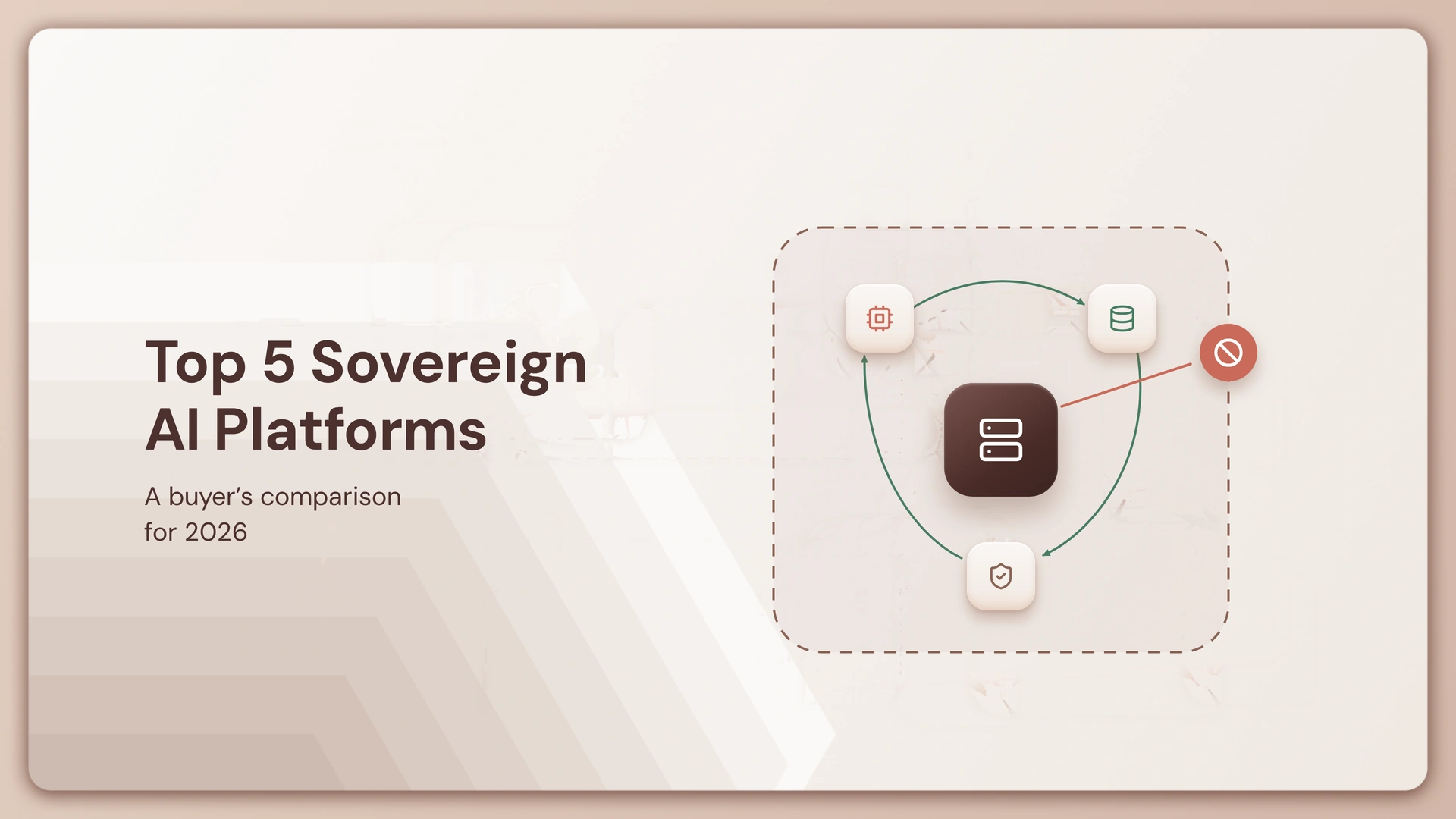
That conversation is happening in boardrooms across banking, healthcare, insurance, and government right now, and it’s why “sovereign AI platforms” has become one of the most searched procurement terms of 2026. The problem is that the term gets used loosely. A hyperscaler’s regional data center and a fully air-gapped, customer-controlled agent stack both get called “sovereign,” and buyers who don’t separate the two end up signing contracts that don’t actually solve their problem.
Residency without control is a locked door with someone else holding a copy of the key, and the framing in 2026 has shifted from where data sits to who controls the stack.
That shift is the entire reason this comparison exists. Below are five real categories of platforms enterprises are evaluating right now, measured against the same eight criteria, so you can see where each one actually delivers control and where it just relocates the same risk.
TL;DR
-
- Sovereign AI is not a data center location. It’s control over data, models, infrastructure, and operations across the full AI lifecycle.
-
- According to Gartner, February 2026, sovereign cloud IaaS spending will reach $80 billion in 2026, up 35.6% from 2025.
-
- This guide compares five real categories of sovereign AI platforms: hyperscaler sovereign clouds, Oracle’s enterprise sovereign stack, IBM’s governance-first approach, European sovereign specialists, and Lyzr’s agent-native Sovereign AI architecture.
-
- The evaluation runs across eight criteria: deployment flexibility, data residency, governance, security, compliance, model support, scalability, and enterprise readiness.
-
- The AI Act’s high-risk system obligations take effect August 2, 2026, which is pushing “where is my data” questions into “who controls the stack” territory for every buyer on this list.
What “Sovereign” Actually Has to Mean Before You Compare Anything
Sovereign AI is the capacity to independently develop, deploy, and govern AI using your own infrastructure, data, models, and talent.
Sovereign AI is either a country’s or an organization’s capacity to independently develop, deploy, and govern artificial intelligence using its own infrastructure, its own data, its own models, and its own talent – it is not about owning the technology, it’s about retaining full control over the entire AI life cycle, from the physical compute to the algorithmic logic.
That distinction matters because most “sovereign” marketing collapses the concept into a single question: where does the data live. That’s data residency, and it’s only one layer.
Data residency is the physical or logical location where data is stored and processed, while data sovereignty is the legal and practical control over data – which jurisdiction’s laws apply, who can demand access, and who holds the keys.
A regional cloud zone can satisfy the first without ever touching the second.
A sovereign-cloud region from a large US provider can keep your data on European soil and still leave the parent company subject to laws like the US Cloud Act, which can compel access regardless of where the bytes live.
That’s the gap buyers keep falling into, and it’s why the evaluation below treats “deployment location” and “actual control” as two separate line items, not one.
The urgency behind this isn’t theoretical.
71% of surveyed executives call sovereign AI an “existential concern” or “strategic imperative” in McKinsey’s sovereign AI agenda research.
And the money is already moving: by fiscal 2026, NVIDIA’s sovereign AI revenue had tripled to more than $30 billion, and Gartner projects sovereign cloud IaaS spending to reach $80 billion in 2026.
IDC expects worldwide sovereign cloud spending to exceed $250 billion by 2027.
The Eight Criteria That Separate Real Sovereignty From a Sovereign-Sounding Region
Every platform in this comparison gets scored against the same eight dimensions, because a platform that’s strong on one and silent on the rest isn’t sovereign, it’s incomplete.
Deployment flexibility – can it run on-premise, in a private cloud, in a specific VPC, or fully air-gapped, and can different workloads run in different topologies simultaneously.
Data residency – does data physically stay within the boundary you specify, at rest and in transit.
Governance – can you enforce granular access policies, track every action an agent or model takes, and produce an audit trail your regulator will actually accept. A dedicated enterprise AI security framework is what turns this from a policy document into something enforceable.
Security – encryption, key ownership, and whether the infrastructure provider itself can be locked out of your model weights and data.
Compliance – does the platform map to the frameworks you’re actually being audited against: GDPR, HIPAA, DORA, NIS2, or the EU AI Act.
Model support – are you locked into one vendor’s models, or can you bring your own, swap between them, and keep operating if one provider goes down.
Scalability – does performance hold up under real production load, including multi-agent workloads, not just single-model inference.
Enterprise readiness – support, SLAs, and whether you’re buying a product or assembling one yourself.
Key evaluation criteria for buyers include data residency, operational autonomy, GPU availability, model support, RAG and retrieval capabilities, governance and compliance features, identity and access control, audit logging, latency and cost optimization, integration support, and deployment flexibility.
1. Hyperscaler Sovereign Clouds (Microsoft Azure, AWS, Google Cloud)
The hyperscalers responded to sovereignty demand by wrapping existing regions in stricter access controls and calling it sovereign.
Microsoft Azure Sovereign AI provides region-specific cloud environments designed for strict data governance and compliance, and integrates tightly with Azure AI services, enabling organizations to deploy AI workloads while maintaining full control over data residency and access policies.
AWS and Google Cloud follow similar patterns: dedicated sovereign regions, strong access controls, and deep integration with each provider’s own AI tooling.
Where this falls short: the legal entity operating the infrastructure is still frequently a US-incorporated company.
EU regions of US cloud providers mean data is physically in the EU but the legal entity is US-incorporated and subject to the CLOUD Act, and sovereign deployment requires an EU-incorporated entity or an on-premises model.
That’s residency, dressed up as sovereignty. For buyers whose primary risk is jurisdictional exposure rather than latency, that distinction is the whole ballgame. It’s also the same lock-in dynamic that shows up whenever a stack is built entirely around one provider’s tooling; a framework-agnostic platform approach avoids tying deployment flexibility to a single vendor’s roadmap.
Best fit: enterprises already deep in one cloud ecosystem, where the primary requirement is regional data placement rather than full legal and operational independence.
2. Oracle and IBM: The Enterprise Data-and-Governance Stack
Oracle and IBM approached sovereignty from the data platform side, and independent analysts currently rank them among the strongest performers for it.
Recent buyers guide research ranked the top three overall leaders as Oracle, Databricks and IBM, with AWS, Databricks, Google Cloud, IBM, Oracle and Teradata rated as Exemplary.
Oracle, Databricks, Teradata and IBM achieved the highest performance as Leaders, supported by broad capabilities across AI and data platform functionality and strong platform adaptability, governance and deployment flexibility across enterprise environments, demonstrating enterprise-grade platform capabilities supporting sovereign deployment models.
Oracle’s Sovereignty AI platform supports distributed AI workloads with control over data location, GPU compute, and enterprise governance.
IBM’s Sovereign Core provides a foundation to deploy AI workloads with data, operational, and governance controls, suitable for public sector and enterprise AI.
Both are genuinely strong on the data-governance and audit layer. Where they’re thinner is the agent layer sitting on top of that data: orchestrating multiple models, enforcing tool-level permissions on autonomous actions, and giving a compliance team visibility into what an agent decided to do, not just where the underlying data sat while it decided it.
Best fit: organizations whose primary sovereign AI concern is data lineage, governance, and large-scale analytics infrastructure, with agent workflows as a secondary build-out.
3. European Sovereign Specialists (Aleph Alpha, Mistral, Scaleway)
For EU buyers specifically, jurisdiction isn’t a nice-to-have, it’s the entire point, and a distinct set of European vendors has built around that constraint.
Aleph Alpha’s enterprise product, PhariaAI, is designed for regulated deployment across on-premises, private cloud, and sovereign-cloud options, with the model trained in Germany and the legal entity German, and partnerships secured with the German federal government and with Bosch, SAP, and other Tier-1 German enterprises.
Scaleway and Mistral round out the picture as EU-native infrastructure and model providers with no CLOUD Act exposure. Worth noting for anyone currently evaluating Aleph Alpha specifically: Cohere’s acquisition of Aleph Alpha was announced on 24 April 2026 and remains subject to regulatory approval at the time of writing, which adds a layer of vendor-risk diligence to that particular choice.
The honest trade-off here is scope.
These are typically foundation model providers, not orchestration platforms, and buyers need to add the fleet management, governance registry, and audit-trail layer themselves, since there’s no native agentic workforce OS.
You get genuine jurisdictional independence, but you’re still assembling the rest of the stack yourself.
Best fit: EU-headquartered enterprises and public-sector buyers where legal entity and national jurisdiction are non-negotiable, and who have the engineering capacity to build the orchestration layer on top.
4. NVIDIA-Powered Sovereign AI Factories
NVIDIA sits underneath most of the platforms above, but it’s also sold directly as sovereign infrastructure to governments and telecoms building domestic AI capacity.
NVIDIA Sovereign AI provides GPU-accelerated infrastructure for enterprises, governments, and telecoms aiming to build domestic AI capabilities and model training pipelines.
This is compute-layer sovereignty: owning the silicon and the training pipeline rather than renting cycles from a foreign cloud. It’s a foundational choice for national AI strategies, but it answers a different question than the one most enterprise buyers are asking. Owning the GPUs doesn’t tell your compliance team who can see what an AI agent did with a customer’s data last Tuesday.
Best fit: governments and large telecoms building national or regional AI compute capacity from the ground up, less relevant for enterprises buying an application-layer platform today.
5. Lyzr: Sovereign AI Built at the Agent Layer
Every platform above answers “where does the infrastructure sit.” Lyzr’s architecture starts from a different question: what happens when autonomous agents, not just models, are making decisions inside that infrastructure.
The Control Plane deploys inside your own cloud environment, your AWS VPC, your GCP project, with zero data egress, and for air-gapped or on-premises requirements, those are supported architecturally from day one.
That’s the deployment flexibility criterion satisfied at the infrastructure level. What differs is what sits on top of it.
The architecture addresses governance through Agent Studio, Cognis (the persistent memory layer), Knowledge Graph, Knowledge Base, and Orchestration as a Service, together forming what Lyzr calls the Agent Control Plane: the production infrastructure that lets regulated enterprises deploy AI agents responsibly at scale, within their own perimeter, with the audit and governance characteristics their regulators expect.
For no-code teams, Lyzr Architect provides the no-code agent builder on top of the same architectural primitives as Agent Studio. Enterprises building on Knowledge Base and Knowledge Graph primitives are effectively running a governed agentic RAG architecture inside their own perimeter rather than sending retrieval traffic to a shared, external service.
The practical difference shows up in what a governance team can actually verify.
Whether agents are built using open-source frameworks, cloud-native platforms, or custom applications, the Control Plane provides a common registry, centralized identity management, policy enforcement, observability, and audit capabilities while ensuring that all data remains within the organization’s own environment – a deployment model particularly suited to government agencies and highly regulated sectors, letting organizations adopt AI at scale without compromising compliance, operational oversight, or data ownership.
That’s the gap the other four categories leave open. Infrastructure sovereignty and data governance are necessary, but agents act, they call tools, they touch systems, they make judgment calls at machine speed.
Full data privacy and sovereignty means agents run within your cloud environment, not on shared infrastructure, and every agent is evaluated, approved, and identity-mapped before it goes live.
A sovereign cloud region doesn’t give you that. An agent control plane does.
Best Agentic OS Platforms: Enterprise Buyer’s Guide (2026)
Best fit: enterprises that have already solved (or are actively solving) infrastructure-level sovereignty and now need the agent orchestration, audit, and governance layer that sits on top of it, especially in banking, insurance, healthcare, and government. Platform and infrastructure teams leading these rollouts often start with a narrower, use-case-specific deployment; the Lyzr for Platform Teams approach is built around exactly that kind of incremental, perimeter-respecting adoption.
Sovereign AI Platform Comparison
| Criteria | Hyperscaler Sovereign Cloud | Oracle / IBM Data Stack | EU Specialists | NVIDIA Sovereign Factories | Lyzr Agent Control Plane |
|---|---|---|---|---|---|
| Deployment flexibility | Regional cloud zones only | Strong, multi-environment | On-prem / EU-only, strong | Compute layer only | On-prem, VPC, air-gapped, hybrid |
| Data residency | Regional, provider-managed | Strong | Native, jurisdiction-first | N/A (infrastructure) | Full residency, zero egress |
| Governance | Provider-defined policies | Strong data lineage | Model-level, not orchestration | N/A | Agent-level policy, identity, audit |
| Security | Strong, provider-managed keys | Strong | Strong, EU legal entity | Hardware-level | Customer-held keys, tool-level permissions |
| Compliance | Regional certifications | Strong regulatory mapping | Native EU/GDPR fit | N/A | Built for AI Act, DORA, NIS2, HIPAA contexts |
| Model support | Provider’s own models primarily | Broad, multi-vendor | Own models + some BYOM | N/A | Multi-model routing, BYOM |
| Scalability | Very high (hyperscale) | High | Moderate, infra-dependent | Very high (national scale) | Built for multi-agent production load |
| Enterprise readiness | High, but still cloud-locked | High | Moderate, DIY orchestration | Low for app-layer buyers | High, purpose-built for agent production |
Legal exposure remains the line every buyer needs to check independently: a sovereign-cloud region from a large US provider can keep your data on European soil and still leave the parent company subject to laws like the US Cloud Act, which can compel access regardless of where the bytes live.
Why the Agent Layer Is Where This Decision Actually Gets Made
Here’s the pattern that shows up once you’ve done a few dozen of these evaluations: buyers spend 80% of their diligence time on infrastructure sovereignty and 20% on what happens once agents start acting inside it. That ratio is backwards.
Infrastructure sovereignty answers a static question: where does the data sit, who holds the keys. Agent governance answers a dynamic one: what did the AI do, on whose authority, and can you prove it after the fact.
Organizations deploying AI in regulated contexts, including credit scoring, hiring, and medical diagnostics, must demonstrate governance over the full pipeline, not just the data storage layer.
That full-pipeline requirement is exactly where infrastructure-only sovereign clouds run out of road, and it’s exactly where a governance-first agent control plane picks up. This is precisely the review compliance functions have started running before any AI agent goes into production; the Lyzr for Compliance Teams model is built around that full-pipeline review rather than a data-location checkbox.
The regulatory clock makes this less abstract than it sounds.
General-purpose AI obligations apply from 2 August 2026.
And once that date passes, “we don’t know what our agents did with that data” stops being a gap and starts being a finding.
Frequently Asked Questions
What is sovereign AI?
Sovereign AI is an organization’s or nation’s capacity to independently develop, deploy, and govern AI using its own infrastructure, data, models, and talent.
It is either a country’s or an organization’s capacity to independently develop, deploy, and govern artificial intelligence using its own infrastructure, its own data, its own models, and its own talent, and it’s about retaining full control over the entire AI life cycle, from the physical compute to the algorithmic logic.
It’s broader than picking a data center location.
What’s the difference between data sovereignty and data residency?
Data residency is about physical location; data sovereignty is about legal control.
Data sovereignty is the principle that nations have legal and regulatory authority over data generated or processed within their national borders, while data residency refers to the geographical location of the data centers, servers, or other systems that store or handle it.
A platform can satisfy one without satisfying the other.
Is a cloud provider’s “EU region” the same as sovereign deployment?
No, and this is one of the most common procurement mistakes.
EU regions of US cloud providers mean data is physically in the EU but the legal entity is US-incorporated and subject to the CLOUD Act, and sovereign deployment requires an EU-incorporated entity or an on-premises model.
Does the EU AI Act require sovereign deployment?
No, but it makes sovereign deployment considerably easier to comply with.
The AI Act does not mandate data residency; it mandates documentation, risk classification, human oversight, and audit trails – however, sovereign deployment makes satisfying those obligations easier because the buyer controls the full audit trail.
DORA and NIS2 add contractual data-location requirements for specific entity types.
How does an enterprise actually achieve sovereign AI?
By treating it as a full-stack requirement, not a checkbox on a data center form.
Sovereign AI infrastructure tackles this by letting you deploy cloud-like platforms while retaining control over where data lives, how models get trained, and where inference happens.
That means auditing infrastructure deployment, model portability, and agent-level governance separately, since a platform can be strong on one and weak on the others.
The Decision Underneath the Decision
Every platform in this comparison can tell a true story about sovereignty. Hyperscalers can point to regional certifications. Oracle and IBM can point to governance depth. European specialists can point to legal jurisdiction. NVIDIA can point to owned compute. None of those stories are false. They’re just incomplete for the question most buyers are actually asking in 2026, which isn’t “where does my data sit” anymore. It’s “when an autonomous agent takes an action on my behalf, can I prove who authorized it, what it touched, and that it never left my perimeter.”
That’s the question an agent control plane is built to answer, and it’s why the sovereignty conversation is quietly moving up the stack, from infrastructure to orchestration, faster than most procurement checklists have caught up to.
Before you sign anything, run your shortlist through all eight criteria, not just the two or three your current vendor is strongest on. The gap usually shows up in the ones nobody asked about first.
If you’re mapping your own sovereign AI requirements against an agent-native architecture, the Lyzr Sovereign AI team walks enterprise and government buyers through exactly this evaluation, criteria by criteria, against their existing infrastructure.
Book A Demo: Click Here
Join our Slack: Click Here
Link to our GitHub: Click Here