A hiring manager at a mid-size insurer posted a role last quarter titled “AI Agent Engineer.” Three years earlier, that req didn’t exist in any taxonomy her HR system recognized.
She wasn’t hiring a data scientist. She wasn’t hiring a prompt writer. She needed someone who could take a language model that already worked in a demo and turn it into something that could process claims, escalate exceptions, and not fall over the first time a customer asked something unexpected.
That gap between “the model can do this” and “the system does this reliably, every day, in production” is exactly where the Agent Engineer lives.
This piece is a working definition of that role: what it actually involves, how it’s distinct from the AI job titles already crowding LinkedIn, what skills separate a credible candidate from a resume padded with framework names, and why enterprise hiring for this exact title is accelerating through 2026.
What Does an Agent Engineer Actually Do?
An Agent Engineer designs, builds, and maintains autonomous AI systems that reason, plan, use tools, and take action toward a goal with minimal human intervention.
An agentic AI engineer is an AI professional who designs, builds, and maintains intelligent systems made up of autonomous agents that can reason, plan, use tools, and take action toward goals with minimal human intervention.
That’s the textbook version. In practice, it means something more specific: this person owns the difference between a language model that answers a question and a system that finishes a job.
An LLM by itself is a powerful but static reasoning engine. Ask it something, it answers, the interaction ends. An AI agent is what happens when that engine gets connected to tools, memory, and a mission: it can check a database, call an API, remember what happened five steps ago, and decide what to do next without a human typing the next instruction each time.
The Agent Engineer builds that connective tissue. They’re not primarily training the model underneath. They’re architecting everything around it: how it retrieves context, which tools it’s allowed to call, how it recovers when a step fails, and how anyone downstream can trust its output enough to act on it.
Where This Title Actually Came From
The role didn’t emerge from a rebrand. It emerged from a bottleneck.
The first wave of enterprise generative AI was about single-shot outputs: summarize this, draft that, answer this question. That wave was largely a prompt engineering problem.
Once organizations tried to move past single exchanges into full workflows, that limitation became the whole problem. A model that drafts a great email still needs something to check the calendar, personalize the message, and confirm the send, none of which happens without someone building the surrounding system.
That’s the gap agent engineering fills. Agent engineering is the iterative process of refining non-deterministic LLM systems into reliable production experiences, because the delta between “it works on my machine” and “it works in production” can be huge, and unlike traditional software, agents give you neither known inputs nor defined outputs.
Agent Engineer vs Prompt Engineer vs AI Engineer: Where the Lines Actually Sit
This is where most articles get sloppy, treating all three as points on the same career ladder. They’re not. They differ in what they’re optimizing.
Prompt Engineer. A Prompt Engineer designs and optimizes the instructions that control AI model behavior. Their unit of work is the instruction itself: system prompts, few-shot examples, phrasing that reduces hallucination. It remains a genuinely valuable skill, one that shows up inside good enterprise prompt management practice, but it’s rarely a standalone department anymore.
AI Engineer. An AI Engineer builds applications that use pre-trained AI models as components. They’re closer to a traditional software engineer with an AI specialization, someone who understands LLM APIs, vector databases, and RAG pipelines, plus the unique challenges of AI systems like non-deterministic output and cost-per-request. In some cases, this role is also called an AI systems engineer, particularly when the focus is on integrating models into reliable, production-ready systems. They ship the feature. They may or may not focus specifically on agentic, multi-step behavior.
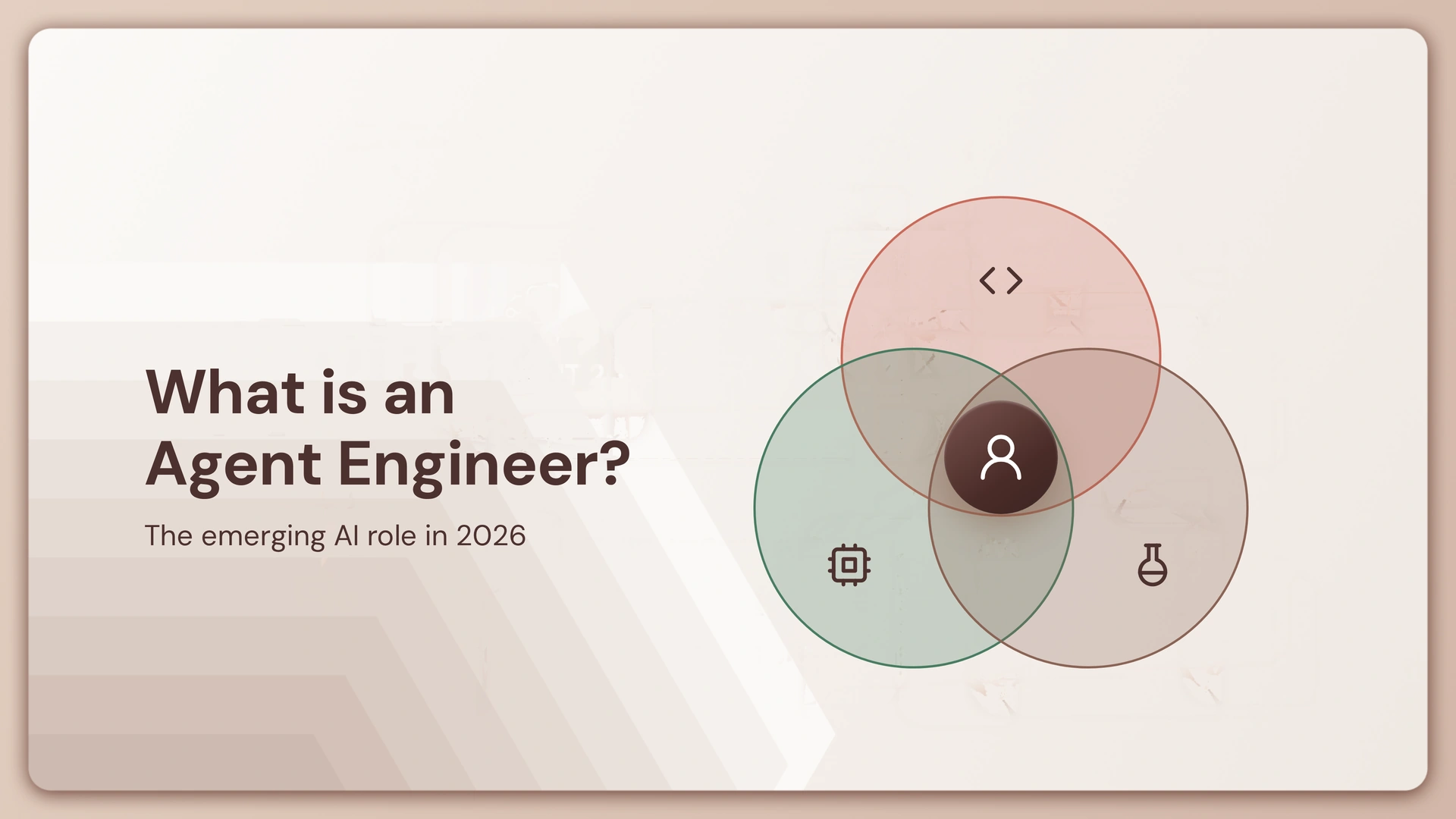
Agent Engineer. This is where scope narrows back to a specific problem: systems that don’t just respond, but act, adapt, and persist across many steps. The work includes tool calling to connect the agent to external systems it can take actions in, sub-agent orchestration to coordinate multiple specialized agents working on parts of a larger task, memory design to decide what the agent remembers between steps and across sessions, and evaluation harnesses to measure whether the agent completed the task correctly, not just whether it produced plausible output.
The practical distinction: a Prompt Engineer optimizes what you say to the model. An AI Engineer builds the product around the model. An Agent Engineer builds the system that lets the model act, and stays accountable for what happens when it acts wrong.
Is “Agent Engineer” Even a Real Job Title?
Not everyone agrees it should be one, and that disagreement is worth sitting with rather than glossing over.
LangChain has argued the opposite of the framing most of this space uses. “Agent engineering isn’t a new job title. Instead, it’s a set of responsibilities that existing teams take on when they’re building systems that reason, adapt, and behave unpredictably.”
In their model, software engineers and ML engineers write prompts and build tools for agents to use and trace why an agent made specific tool calls, platform engineers build agent infrastructure that handles durable execution and human-in-the-loop workflows, product managers write prompts and define agent scope, and data scientists measure agent reliability and identify opportunities for improvement, spread across existing roles rather than consolidated into one.
That’s a legitimate model for some organizations, especially ones already staffed with strong platform and ML teams who can absorb the work.
But the hiring data tells a different story for a growing share of the market. A 2026 New AI Roles Report from the engineering hiring platform Second Talent finds AI Agent Engineer is the fastest-growing role of 2026, identifying it among ten engineering job titles that did not exist in any stable form three years ago and are now core hires at any company shipping AI features.
And it’s not confined to AI-native startups. General Motors, for instance, posted a role stating: “We are seeking an AI Agent Engineer to design, build, and operationalize AI-powered agents that enhance employee productivity and decision-making in a complex enterprise environment.”
Both things can be true. The responsibilities are real regardless of org chart. Whether your company needs a dedicated title for them or can distribute them across existing engineers depends on how many agentic workflows you’re actually running, and how much is riding on them not breaking silently. Left unmanaged, that question often surfaces the hard way, once an enterprise realizes how much agent sprawl has already crept into its stack without anyone formally owning it.
The Core Skills That Separate a Real Agent Engineer From a Resume Full of Framework Names
Framework literacy alone doesn’t cut it anymore. Too many candidates list the same three tools.
Software engineering fundamentals that don’t bend for AI. System design, API integration, and production discipline still apply. Agent behavior can regress via subtle prompt, model, or tool changes, so strong engineers insist on evaluation gates, structured outputs, and reproducible tests, which is how releases stay predictable and regressions get caught before customers see them.
Fluency in the modern agent stack. This means developing expertise across large language models, from frontier models to smaller, specialized ones, vector databases for semantic retrieval of relevant context, and agent architecture patterns like tool-calling optimizations and reasoning-improvement processes. The specific frameworks matter less than understanding why each layer exists.
Evaluation, not just building. This is the differentiator that separates senior candidates from everyone else. Anyone can wire up a demo agent. Far fewer can prove it’s reliable enough to run unsupervised, and there’s an enormous difference between building a demo and deploying an AI agent at scale.
Judgment about non-determinism. Tooling and best practices change quickly in the agent space, so strong performers evaluate new frameworks and providers without chasing hype, running small experiments and incorporating improvements selectively rather than triggering frequent rewrites.
Domain fluency. A financial services Agent Engineer and a healthcare one aren’t interchangeable. Beyond technical competence, agent engineers need to possess innate curiosity and respect for the complexity of their customers’ challenges, since their role requires understanding and applying expertise in a given domain to the development of an AI agent.
Salary Snapshot: What the Market Is Actually Paying
Compensation data reflects how scarce this systems-thinking skill set still is, even as the title spreads across industries.
| Level | Typical Base Range | What It Reflects |
|---|---|---|
| Entry-level Agent/AI Engineer | $100K – $135K | Average annual pay for an AI Agent Engineer in the United States sits around $111,552 a year, with broader AI engineering entry offers landing nearby. |
| Median, mixed experience | ~$142K | Glassdoor puts the median AI engineer salary at $142,110, with a typical range of $113,718 to $180,018. |
| Senior / multi-agent specialist | $200K – $350K+ | The full AI engineer salary range in 2026 spans roughly $100K at entry level to $350K or more at the senior end, with the widest premiums going to production deployment experience. |
The premium isn’t flat across a career. The AI-skill premium widens sharply with seniority, from roughly 6% at entry-level to more than 70% at senior levels compared with equivalent non-AI technical roles. That gap is the real signal behind every one of these job postings: production experience, not framework familiarity, is what the market is actually pricing.
Why Enterprises Are Actually Opening These Reqs Right Now
The honest answer is that the low-hanging fruit got picked already. Chatbots, summarizers, and Q&A tools were the easy first wins. What’s left requires systems that touch real processes, and that’s a fundamentally different engineering problem than shipping a better chat interface.
The market signal is already broad-based, not confined to a handful of AI labs. Gartner projects that forty percent of enterprise applications will be integrated with task-specific AI agents by the end of 2026, up from less than 5% today. That’s not a niche hiring trend. That’s a large share of the enterprise software market shifting under the same pressure, and much of that demand is showing up beyond frontier labs, spreading into companies far outside AI-native startups across finance, retail, and industrial operations.
And the work is already delivering measurable outcomes at companies willing to invest in it properly. Clay uses agents to handle everything from prospect research to personalized outreach and CRM updates, while LinkedIn uses agents to scan massive talent pools for recruiting, ranking candidates and surfacing the strongest matches instantly. Neither of those started as a prompt engineering project. Both required someone thinking in systems, not single interactions.
None of that adoption curve exists because the title sounds impressive. It exists because most candidates have shipped toy agents while very few have run multi-agent systems with eval pipelines, traces, and rollbacks in a live enterprise environment. That scarcity is the real story behind every one of those job postings.
What This Means If You’re Building an AI Team Right Now
Don’t hire for the title. Hire for the specific failure mode you’re trying to prevent.
If your organization is running one or two contained AI features, an AI Engineer with agentic exposure can probably cover it. If you’re standing up multiple agents that need to hand off work to each other, maintain state across sessions, and be trusted with real decisions across HR, finance, or customer operations, you’re past the point where “someone on the team knows LangChain” is a staffing strategy.
That’s the threshold where a dedicated Agent Engineer, or a small team of them, stops being optional. The role exists in software and IT organizations because agentic systems need someone to turn rapidly evolving frameworks and model capabilities into reliable, secure, cost-effective, and reusable platform primitives that the rest of the business can actually depend on. Getting that governance layer right early is exactly what Heads of AI at fast-moving enterprises are now being measured on.
The role also doesn’t operate in a vacuum. It sits close to platform engineering work, where someone has to own identity, permissions, and observability for every autonomous decision an agent makes, and to multi-agent orchestration, where the challenge shifts from building one reliable agent to coordinating several. Enterprises that separate these concerns cleanly, rather than assuming one hire covers all of it, tend to move from pilot to production faster.
The gap between a working demo and a production system is where most agent initiatives actually die, and it’s the exact gap an Agent Engineer is hired to close.
Frequently Asked Questions
What does an agent engineer do?
An Agent Engineer designs, builds, and operates AI systems that plan, use tools, and complete multi-step tasks with minimal human intervention. Day-to-day, that means integrating tools and APIs, designing memory and state management, building evaluation frameworks, and deploying and monitoring agents once they’re live rather than just in a demo environment.
Is agent engineer a real job title, or is it just a rebrand?
Both views have real evidence behind them. LangChain argues the responsibilities get absorbed into existing software, platform, and product roles rather than becoming a distinct hire. But job market data shows a growing number of enterprises, from General Motors to consulting firms, posting the title explicitly, with hiring platforms tracking it as one of the fastest-growing categories of 2026. Whether it warrants a standalone title in your organization depends on how many production agent workflows you’re actually running.
How is an agent engineer different from a prompt engineer?
A Prompt Engineer optimizes the instructions given to a model for a single interaction. An Agent Engineer builds the entire system around the model, including tool access, memory, orchestration across multiple steps, and evaluation, so the model can complete a multi-step objective without constant human input. Prompt engineering is a skill an Agent Engineer uses; it isn’t the whole job.
How is an agent engineer different from an AI engineer?
An AI Engineer builds applications that use pre-trained AI models as components, often shipping a single AI-powered feature end to end. An Agent Engineer specializes further, focusing specifically on autonomous, multi-step, tool-using systems and the orchestration and evaluation infrastructure those systems need to run reliably in production.
What skills do you need to become an agent engineer?
Strong software engineering fundamentals, fluency with agent frameworks and orchestration tools, hands-on experience with vector databases and retrieval, and the ability to build evaluation and monitoring systems for non-deterministic behavior. Evaluation experience specifically is what separates competitive candidates from the rest, since most applicants can build a demo agent but few have run one in production with proper testing and rollback processes.
How much do agent engineers make?
Entry-level agent engineering roles typically start around $111,000 annually, with the broader AI engineering median sitting closer to $142,000. Senior specialists working on multi-agent systems in production can see a salary premium that widens sharply with seniority, sometimes exceeding 70% over equivalent non-AI technical roles at the top end.
Is demand for agent engineers actually growing, or is this hype?
The hiring data points to real, sustained growth rather than a passing trend. Multiple 2026 industry reports identify AI Agent Engineer as one of the fastest-growing job categories, and postings now come from established enterprises across automotive, finance, and consulting, not just AI-native startups.
The Role Is Still Being Written
The Agent Engineer title is young enough that its edges are still being argued over, by vendors, by hiring platforms, and by engineers figuring out where their own work actually fits. That’s normal for any role born from a genuine shift rather than a marketing cycle.
What isn’t up for debate is the underlying work. Someone has to own the difference between an AI system that looks impressive in a demo and one that survives contact with a real customer, a real dataset, and a real failure at 2 a.m. Whether your organization calls that person an Agent Engineer, folds the work into an existing AI Engineer’s scope, or spreads it across a platform team, the responsibilities aren’t optional anymore for any company serious about moving past pilots.
The question worth asking in your next planning cycle isn’t whether this role exists. It’s whether anyone on your team currently owns it.
Book A Demo: Click Here
Join our Slack: Click Here
Link to our GitHub: Click Here