TL;DR
- AI sales agents are autonomous systems that execute sales tasks end to end: prospecting, qualification, meeting booking, CRM updates.
- Three types exist: autonomous outbound agents, inbound qualification agents, and assistive sales copilots.
- Evaluate platforms on category fit, channel coverage, CRM integration, AI-native architecture, and compliance controls.
- Production deployment requires TCPA, CAN-SPAM, and GDPR compliance, plus CRM governance and brand safety controls.
AI sales agents are autonomous software systems that handle sales work without step-by-step human instruction. They prospect, qualify leads, book meetings, and update CRM records on their own. This guide breaks them into three types, names the platforms leading each category, and gives you a seven-question framework to pick one for your organization.

What are AI sales agents?
AI sales agents are goal-driven systems built to complete sales tasks with minimal human input. Give one a target account list and a goal, and it researches prospects, personalizes outreach, handles replies, and books the meeting. That is different from a chatbot, which answers single-turn questions, and different from robotic process automation (RPA), which follows fixed rules without reasoning.
The bigger split in the market is architectural. AI-native platforms, built from the ground up around agent reasoning, handle ambiguity and exceptions differently than tools that bolted AI features onto an existing CRM engine. Both have a place. Which one fits depends on how much autonomy you actually want to hand over.
At a high level, 23% of organizations are scaling an agentic AI system somewhere in their enterprises, expanding deployment within at least one business function, and an additional 39% say they have begun experimenting with AI agents, according to McKinsey’s State of AI 2025 report. Sales is one of the functions absorbing that shift fastest, largely because outbound prospecting is repetitive enough to automate and expensive enough in headcount to matter.
AI sales agents vs sales copilots vs traditional sales automation
The three categories get confused constantly, and the confusion costs buyers time. An AI sales agent owns a task end to end: it sends the outreach, reads the reply, decides the next move, and books the meeting. No rep touches it until a human handoff is warranted.
A sales copilot works differently. It sits inside a rep’s existing tools and suggests: draft this email, summarize this call, log this activity. The rep stays in control and approves every action. Copilots increase a rep’s throughput; they do not replace the rep’s decisions.
Traditional sales automation is older and more rigid. Cadences, sequences, and trigger-based workflows run on fixed rules. If a prospect replies off-script, the sequence stops and a human has to step in. There is no reasoning layer, which is also why these tools tend to be cheaper and easier to audit. Some of these same agentic workflows now sit underneath both agents and copilots, which is part of why the category lines blur.
One sentence to keep: agents complete tasks, copilots assist humans completing tasks, automation runs rules.
Three types of AI sales agents
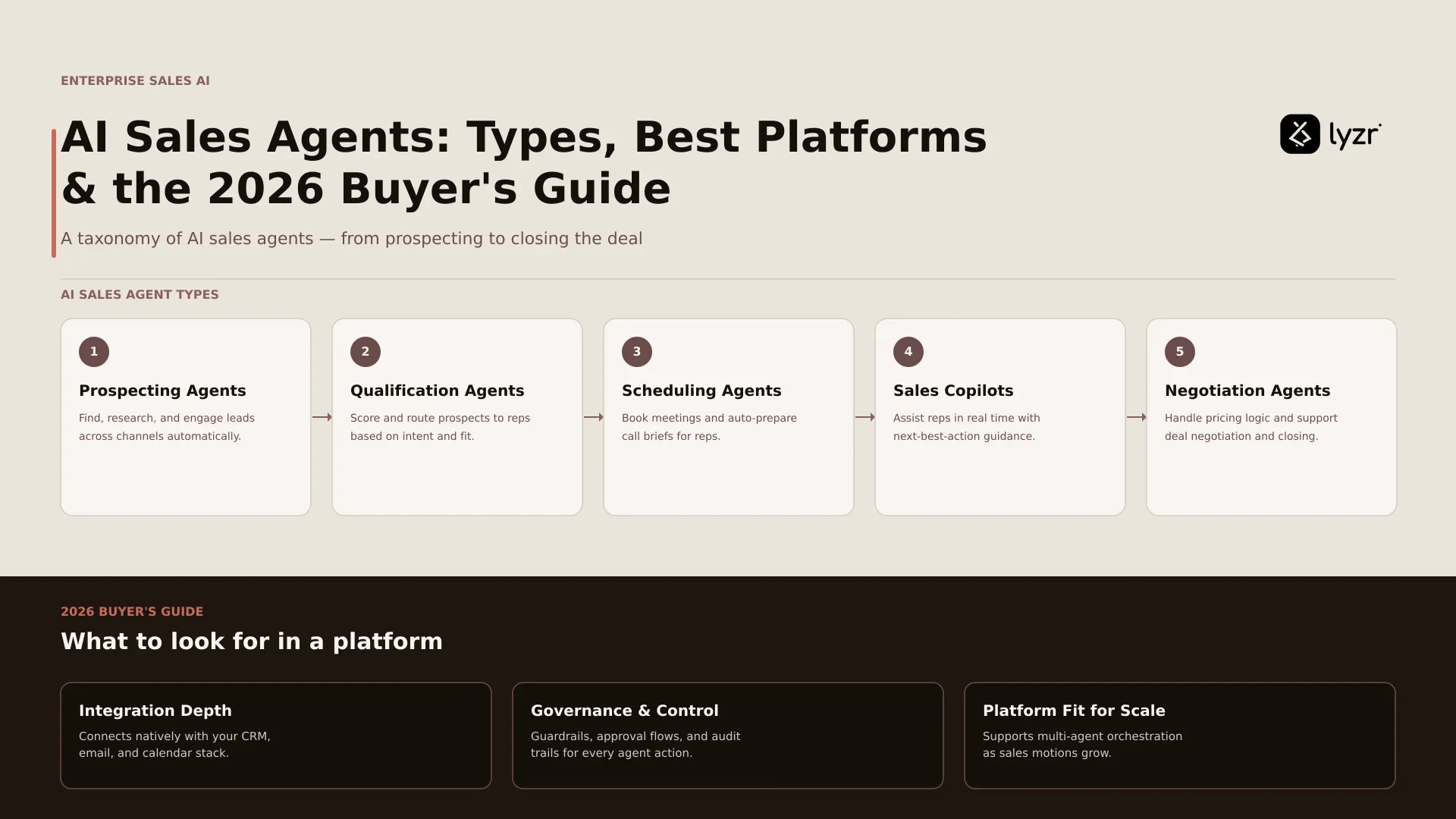
The market has settled into three categories. Which one solves your actual bottleneck determines your shortlist.
Autonomous outbound agents
These act as digital sales development representatives (SDRs). They scrape lead data, personalize cold outreach, run multi-step sequences across email and LinkedIn, handle objections, and book meetings without a rep in the loop. Jazon by Lyzr, Artisan (Ava), and 11x (Alice) are the named platforms buyers evaluate most often here. Outbound autonomous agents fit teams that want to scale pipeline generation without adding SDR headcount.
Inbound qualification agents
These engage inbound leads in real time, on website chat or voice, and qualify need, budget, and timing before handing a booked meeting to a rep. Fin for Sales, Podium AI Employee, and SalesCloser AI lead this category. They fit teams with meaningful inbound volume that leaks after hours or between shifts.
Assistive sales copilots
These support human reps without taking over the workflow. They summarize calls, draft follow-ups, suggest talking points mid-call, and log CRM activity. HubSpot Breeze, Salesforce Einstein Copilot, and Regie.ai are the recognized names here. They fit teams that want AI leverage without changing a human-led sales motion.
Match the category to the bottleneck, not the other way around. An outbound-only platform will not fix inbound lead leakage, and a copilot will never replace an SDR’s outreach volume.

Top capabilities of AI sales agents in 2026
Enterprise-grade AI powered sales agents share a core set of capabilities regardless of category. Look for these seven when comparing platforms:
- Multi-channel outreach across email, LinkedIn, voice, WhatsApp, and SMS
- Omnichannel memory, so context from an email thread carries into a LinkedIn message or call
- CRM enrichment and auto-logging into Salesforce, HubSpot, or Pipedrive
- Real-time buyer intent signals from site behavior and past engagement
- Personalized message generation that holds a defined brand voice
- Conversation intelligence, including call summaries and objection tracking
- Meeting scheduling tied to live calendar availability
Capability matrix by agent type
| Capability | Outbound autonomous | Inbound qualification | Assistive copilot |
|---|---|---|---|
| Multi-channel outreach | ✓ | ~ | ✕ |
| Omnichannel memory | ✓ | ✓ | ~ |
| CRM enrichment and auto-logging | ✓ | ✓ | ✓ |
| Real-time buyer intent signals | ✓ | ✓ | ~ |
| Personalized message generation | ✓ | ✓ | ✓ |
| Conversation intelligence | ~ | ✓ | ✓ |
| Meeting scheduling | ✓ | ✓ | ✕ |
No single platform maxes out every row. That is the point of the taxonomy: pick the category that matches your gap, then judge platforms inside it. For teams running sales and marketing agents together, the same capability logic extends to marketing agents handling adjacent top-of-funnel work. For a structured rollout plan, the Lyzr sales playbook walks through sequencing these capabilities against a quarter-by-quarter plan.

Leading AI sales agent platforms in 2026
Positioning here is by category, not a single ranked list. Fit depends on your bottleneck and existing stack.
Outbound autonomous: Jazon by Lyzr is built AI-native and framework-agnostic, meaning it is not tied to one underlying model or orchestration layer. Artisan (Ava) targets B2B outbound with a heavier design emphasis. 11x (Alice, Julian) focuses on email and LinkedIn volume. Nooks adds parallel dialing for voice-heavy outbound teams.
Inbound qualification: Fin for Sales handles chat and voice qualification. Podium AI Employee spans multiple local business channels. SalesCloser AI and MeetChat specialize in voice-first and chat-to-meeting flows, respectively.
Assistive copilots: HubSpot Breeze ships a Prospecting Agent and Customer Agent inside HubSpot’s CRM. Salesforce offers Einstein Copilot and Agentforce SDR. Regie.ai focuses on content generation, Gem-E by UserGems on job-change signals, and Apollo AI on prospecting assistance.
The deeper split running through all three categories: AI-native platforms versus bolt-on AI on a legacy sales engine. If you are actively comparing against Agentforce, see the Lyzr vs Agentforce comparison. If Microsoft Copilot for Sales is on your shortlist, the Lyzr vs Microsoft Copilot comparison covers the architectural gap directly. Adjacent agents worth knowing about if your evaluation extends past outbound: Kathy, an AI competitor analyst, and Dwight, an AI RFP scout, both feed account intelligence back into the same sales motion.
How to evaluate an AI sales agent platform
Seven questions separate a good fit from an expensive mistake.
1. Which category does it serve? Outbound-only platforms will not fix inbound leakage. Copilots will not replace SDR volume.
2. What channels does it support natively? Email is table stakes. LinkedIn, voice, WhatsApp, and SMS separate serious platforms from thin ones.
3. How does it integrate with your CRM? Native, bidirectional connectors to Salesforce or HubSpot matter more than generic API access. Ask what fields it can write to, not just read from.
4. Is it AI-native or bolt-on? AI-native platforms tend to handle unstructured data and exceptions better. Bolt-on features integrate faster with seats you already pay for. Read more on this distinction in framework-agnostic platforms.
5. What compliance controls exist? TCPA (Telephone Consumer Protection Act) for voice, CAN-SPAM for email, GDPR for EU prospects, consent recording for calls where required.
6. How does it handle brand safety and hallucination? A false claim to a real prospect creates legal exposure, not just embarrassment. Run it through an agent diagnostic assessment before you sign.
7. What deployment modes are supported? Regulated industries need VPC or on-premise options. Compare on-premise AI vs cloud AI before assuming SaaS-only is fine.
Production reality: compliance, brand safety, and CRM governance
Sales agents talk to real people, which changes the risk profile compared to internal automation. Three governance areas need answers before go-live.
Compliance controls. TCPA requires opt-in for outbound voice calls. CAN-SPAM requires a working unsubscribe and accurate sender information. GDPR (General Data Protection Regulation) governs consent for EU prospects, and CASL (Canadian Anti-Spam Legislation) does the same for Canadian ones. One-party consent recording rules vary by state and matter for any voice agent.
Brand safety. An agent that fabricates a claim to a prospect is a legal problem, not just a quality one. Lyzr’s Responsible AI as a Service layer and its Hallucination Manager module exist to catch this at the infrastructure level, before an unverified claim reaches a prospect’s inbox.
CRM governance. Agent-written CRM data needs provenance tracking and an audit trail so RevOps can separate human-entered data from agent-entered data. According to Deloitte’s State of AI 2026 report, one in 5 (21%) companies surveyed report currently having a mature model for governance of autonomous agents. That gap is the reason a Control Plane matters: it governs sales agents alongside existing SDR seats and cadence tools from one place, rather than leaving each tool to self-report.
A tier-1 professional services firm uses Jazon for account intelligence and RFP scouting, coordinated through this same governance layer. Full detail on named deployments lives on the customer and case studies pages.
See how the Control Plane governs sales agents in production

For regulated industries evaluating data residency requirements on top of this, sovereign AI covers where agent infrastructure needs to live.
Frequently asked questions
What are AI sales agents?
AI sales agents are autonomous software systems that automate prospecting, lead qualification, meeting bookings, and CRM updates. They use natural language processing to understand buyer intent and converse across channels while updating records on their own.
What are the best AI sales agents in 2026?
It depends on category. Outbound leaders include Jazon, Artisan, and 11x. Inbound leaders include Fin for Sales and Podium. Copilot leaders include HubSpot Breeze and Salesforce Agentforce SDR. Pick by bottleneck, CRM, and channel needs.
What is the difference between AI sales agents and sales copilots?
AI sales agents autonomously complete tasks like sending outreach and booking meetings. Sales copilots assist human reps in-flow with drafts, suggestions, and summaries. Agents own the workflow; copilots augment the human running it.
What are examples of AI sales agents?
Outbound examples include Jazon and Artisan’s Ava. Inbound examples include Fin for Sales and Podium AI Employee. Assistive copilot examples include HubSpot Breeze and Salesforce Einstein Copilot. Each maps to a different sales bottleneck.
Do AI sales agents actually work?
Yes, for the right use case. Outbound agents handle cold prospecting volume reps cannot sustain manually. Inbound agents catch after-hours leads. Copilots cut rep admin time. Results depend on matching agent type to your actual bottleneck.
What is an outbound AI sales agent?
An outbound AI sales agent is an autonomous digital SDR that scrapes lead data, personalizes cold email and LinkedIn outreach, runs multi-step sequences, handles objections, and books meetings. It fits teams scaling outbound without adding SDR headcount.
How much do AI sales agents cost?
Pricing varies by category. Assistive copilots typically price per seat, similar to traditional sales software. Outbound agents often price per lead or per meeting booked. Enterprise deployments scale with channel count and data volume.
Can AI sales agents handle voice calls?
Yes, AI voice sales agents are an established category now. Outbound voice calling requires TCPA opt-in, and recording requires one-party consent compliance where applicable, alongside integration with a dialer like Twilio or Vonage.
How do I evaluate an AI sales agent platform?
Apply a seven-question framework: category fit, channel coverage, CRM integration depth, AI-native versus bolt-on architecture, compliance controls, brand safety guardrails, and available deployment modes. Weight the questions by your actual bottleneck, not vendor marketing.
How do I deploy AI sales agents in production?
Production deployment needs compliance controls for TCPA, CAN-SPAM, and GDPR, brand safety guardrails against hallucinated claims, CRM audit trails, and a Control Plane governing agents alongside existing tools. Start with the production deployment playbook.
Where to go from here
Where you go next depends on where you are in the evaluation.
- Looking for use case ideas? Download the AI sales agent use cases template, or browse the broader 101 AI use cases template and Architect agent use cases for adjacent functions.
- Evaluating outbound autonomous agents specifically? Explore Jazon.
- Interested in the sales function broadly? Explore sales agents, or review the wider AI agent use cases library and Lyzr’s positioning as an Agentic OS.
- Building the business case for your CRO? Read the sales playbook, or the broader agentic AI roadmap playbook for budget framing.
- Planning production deployment? Read the playbook for taking agents to production.
- Ready to build or evaluate? Book a demo, or start directly in Lyzr Studio or Lyzr Architect.
The category question that matters most is not which platform ranks highest. It is which type of agent actually removes your specific bottleneck, and whether the platform behind it can prove, on demand, that it is operating inside the compliance boundaries your legal team already signed off on.
Book A Demo: Click Here
Join our Slack: Click Here
Link to our GitHub: Click Here
