You’re here because you already know you need to monitor your AI agents. Maybe you’ve looked at LangSmith, Langfuse, Arize, or Braintrust, and now you’re trying to figure out which one actually fits your stack.
The hard part isn’t finding an observability tool anymore. It’s deciding what you need to observe, how much control you need, and which platform fits your team.
Quick comparison
| Tool | Best for | Key strength |
|---|---|---|
| Langfuse | Open-source, flexible observability | Self-hosting + OpenTelemetry + tracing |
| LangSmith | LangChain/LangGraph teams | Deep framework integration |
| Arize Phoenix / AX | Production AI observability | Tracing + evaluation + AI quality monitoring |
| Braintrust | Evaluation-driven teams | Production traces + scoring + regression testing |
| Datadog LLM Observability | Enterprise teams | AI monitoring within an existing observability stack |
There isn’t one universal choice here. Each platform approaches AI agent monitoring from a slightly different angle. The right fit depends on how your agents are built, what you need to monitor, and how your team works with production data.
1. Langfuse
Best for: Teams that want an open and flexible observability layer
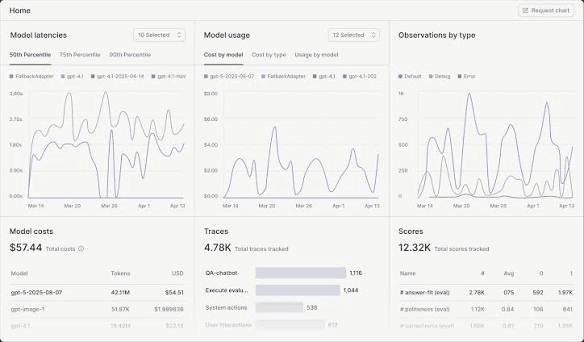
Langfuse is an open-source observability platform built for LLM applications and AI agents. It gives teams visibility into traces, generations, tool calls, retrieval, sessions, latency, token usage, and costs.
Its biggest differentiator is control. Teams can use the managed cloud version or self-host Langfuse, making it a practical option when data control or infrastructure ownership matters.
What Langfuse does well
- Self-hosting and open-source deployment
- OpenTelemetry support
- Detailed execution traces
- Token and cost visibility
- Evaluation workflows
- Support for different frameworks and model providers
Where it fits best
Langfuse makes sense when you want an observability layer that can adapt as your agent architecture changes.
It is particularly useful for engineering teams that want to own their telemetry, customize their setup, or run observability inside their own environment.
Choose Langfuse if:
- Self-hosting is important
- You want an open-source option
- Your agents use multiple frameworks or model providers
- OpenTelemetry is part of your stack
- You want detailed tracing without being tied to one framework
Think twice if: you want a fully managed experience with minimal infrastructure ownership.
2. LangSmith

Best for: Teams building with LangChain and LangGraph
LangSmith is closely integrated with the LangChain ecosystem, making it a natural choice for teams already building agents with LangChain or LangGraph.
Its strength is the connection between development, debugging, tracing, and evaluation. Instead of adding observability as a separate layer, teams can work with these capabilities within the same ecosystem.
What LangSmith does well
- LangChain integration
- LangGraph observability
- Agent debugging
- Tracing
- Evaluation
- Development workflows
Where it fits best
The simplest question to ask is:
Are your agents already deeply tied to LangChain or LangGraph?
If the answer is yes, LangSmith can fit naturally into the existing development workflow.
If your fleet spans several frameworks, custom runtimes, or internal orchestration systems, framework-independent observability may become more important.
Choose LangSmith if:
- You already use LangChain
- You build agents with LangGraph
- Framework-native debugging matters
- You want tracing and evaluation in the same workflow
- Most of your agent development happens within the LangChain ecosystem
Think twice if: your agent fleet is heavily framework-agnostic and you want one observability layer across different runtimes.
3. Arize Phoenix / AX

Best for: Teams that need observability and evaluation together
Arize approaches AI observability from both sides: understanding what an agent did and evaluating whether it did the right thing.
Phoenix is its open-source observability and evaluation platform, while Arize AX provides a broader managed AI engineering environment.
For agent teams, that means tracing can sit alongside evaluation, debugging, and production AI quality monitoring.
What Arize does well
- AI tracing
- OpenTelemetry and OpenInference support
- Evaluation
- Agent debugging
- Production monitoring
- AI quality monitoring
Where it fits best
Arize becomes particularly relevant when your monitoring question goes beyond:
“What happened during this agent run?”
and becomes:
“Was the agent actually doing the right thing?”
That distinction matters as agents move into production, where visibility into execution alone may not be enough.
Choose Arize if:
- Production AI observability is a priority
- Evaluation is part of your workflow
- You use OpenTelemetry or OpenInference
- You need detailed agent debugging
- AI quality monitoring matters alongside tracing
Think twice if: your immediate requirement is basic execution tracing and your team does not need deeper evaluation capabilities.
4. Braintrust

Best for: Teams where evaluation is part of the development loop
Braintrust connects production observability with evaluation and testing.
Instead of treating production traces and evaluation datasets as separate activities, teams can use real agent behavior to improve their testing process.
For example, a problematic production response can be traced back to the agent run, turned into an evaluation case, and used to test a new prompt or model before it reaches production again.
What Braintrust does well
- Production tracing
- Scoring
- Evaluation datasets
- Regression testing
- Model comparison
- Prompt iteration
Where it fits best
Braintrust is particularly useful when evaluation is part of how your team ships changes, not something you run occasionally after deployment.
Choose Braintrust if:
- Agent quality is a major priority
- You maintain evaluation datasets
- Production traces feed into testing
- You compare models or prompts regularly
- Regression testing is part of your development process
Think twice if: your main requirement is infrastructure monitoring, latency tracking, token usage, or basic execution traces.
5. Datadog LLM Observability
Best for: Enterprise teams already using Datadog
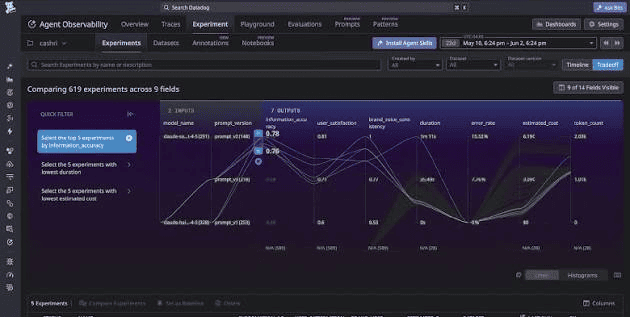
If your organization already relies heavily on Datadog for application performance, infrastructure, logs, or security monitoring, adding AI observability to the same environment can be a practical option.
The main advantage is consolidation. Your AI workloads can be monitored alongside the rest of your application stack instead of creating another monitoring environment.
What Datadog does well
- Enterprise observability
- Application and AI visibility
- Centralized monitoring
- Existing integrations and workflows
- AI monitoring alongside infrastructure
Where it fits best
Datadog makes the most sense when your organization already has a significant Datadog footprint.
If you are starting from scratch and your main challenge is understanding agent behavior, evaluating outputs, or debugging complex AI workflows, a dedicated AI observability platform may offer more specialized capabilities.
Choose Datadog if:
- Your organization already uses Datadog
- You want AI observability alongside application monitoring
- Centralized operational visibility matters
- You want to avoid creating another monitoring silo
Think twice if: deep AI evaluation and experimentation are your primary requirements.
Which AI agent monitoring tool is right for you?
The easiest way to narrow down the options is to start with what matters most to your team.
Use the table below and mark each requirement as High, Medium, or Low. You don’t need every capability to be High. Focus on the areas that are actually important for your setup.
| What matters to your team? | Your priority | Start with |
|---|---|---|
| Open-source and self-hosting | High / Medium / Low | Langfuse / Arize Phoenix |
| LangChain or LangGraph integration | High / Medium / Low | LangSmith |
| Detailed agent tracing | High / Medium / Low | Langfuse / LangSmith / Arize |
| AI evaluation and quality monitoring | High / Medium / Low | Arize / Braintrust |
| Regression testing | High / Medium / Low | Braintrust |
| Multiple frameworks and models | High / Medium / Low | Langfuse / Arize |
| Existing enterprise observability stack | High / Medium / Low | Datadog |
| Cost and token visibility | High / Medium / Low | Langfuse / LangSmith / Arize |
Your decision in simple terms
- If self-hosting and control matter most: start with Langfuse or Arize Phoenix.
- If you’re heavily invested in LangChain or LangGraph: start with LangSmith.
- If evaluating agent quality is a major requirement: look at Arize or Braintrust.
- If regression testing is central to your development process: look at Braintrust.
- If your company already runs on Datadog: consider Datadog LLM Observability before adding another monitoring platform.
The goal isn’t to find the platform with the longest feature list. It’s to find the one that covers the few capabilities your team can’t compromise on.
Book A Demo: Click Here
Join our Slack: Click Here
Link to our GitHub: Click Here