TL;DR
- Gartner now calls this category AI Evaluation and Observability Platforms (AEOPs), and treats evaluation and observability as one converging discipline, not two separate tool classes.
- Most tools on the market solve LLM observability, tracing a single call. Agent observability, tracing a nested tree of tool calls, retrievals, and handoffs, is a harder and different problem.
- Open-source, self-hosted picks: Langfuse, Phoenix, MLflow.
- Framework-native pick: LangSmith, if you’re committed to LangChain/LangGraph.
- Evaluation-first picks: Confident AI, Braintrust.
- Enterprise ML plus LLM: Arize AI.
- Explainability and regulatory reporting: Fiddler AI.
- Already standardized on APM: Datadog, Dynatrace.
- Governance and audit for agents already in production: Lyzr Control Plane, strongest for agents registered on Lyzr, a lighter fit if you only want tracing for agents running entirely outside it.
An agent misroutes a wire transfer. Nobody wrote a bug. No exception fired. The retrieval step handed the agent the wrong account record, and the agent reasoned perfectly from there.
That’s the scenario keeping platform engineering leads up at night in 2026, and it’s why “just add logging” stopped being an answer somewhere around the third production incident. You’re reading this because you’re choosing a tool, not because you need convincing that observability matters. So let’s skip the pitch and get to the part that actually decides the purchase.
What is an AI observability platform?
An AI observability platform is software that monitors, traces, evaluates, and secures AI applications, LLMs, and autonomous agents once they’re running in production, not just in a demo environment. It watches what a system does with real traffic, real users, and real failure modes that never showed up in testing.
Four capabilities show up across nearly every serious platform in this category:
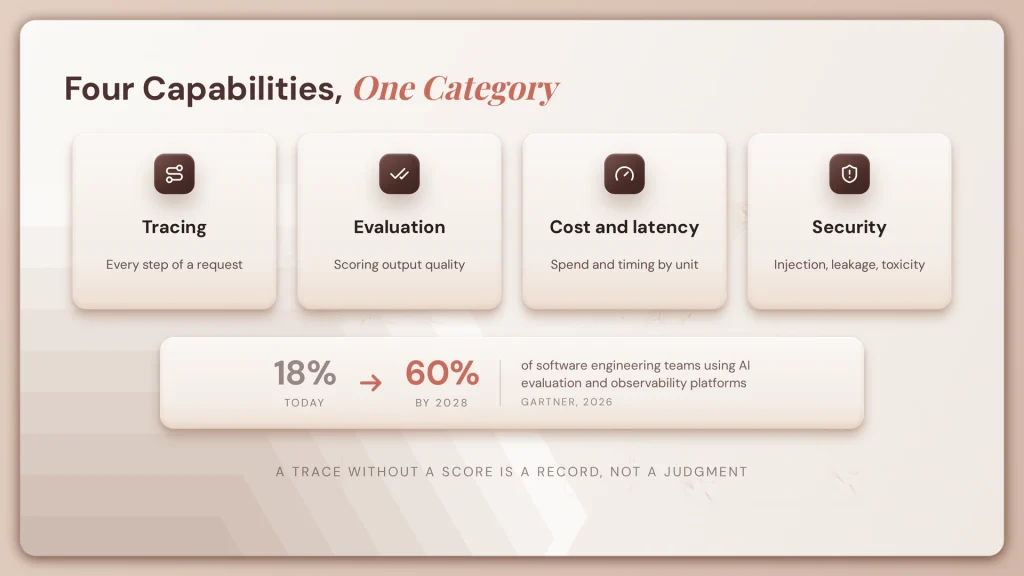
Tracing. The full step-by-step path of a request as it moves through prompts, model calls, retrievals, and tool executions. This is the raw material everything else is built on.
Evaluation. Scoring output quality with automated judges or custom scorers, both before launch and continuously in production. This is where agent evals (systematic scoring of agent outputs against defined criteria) turn a trace into a judgment, not just a record.
Cost and latency tracking. Token consumption, spend attribution, and response timing, including time-to-first-token, broken down by user, agent, or business unit. This is the heart of LLM ops.
Security and guardrails. Detecting hallucination, toxicity, prompt injection, and data leakage before they reach a customer, tied back to your organization’s Responsible AI posture.
Here’s the detail worth sitting with. In February 2026, Gartner released its inaugural Market Guide for AI Evaluation and Observability Platforms (AEOP), formally naming AI evaluation as a distinct technology discipline. The word order in that name is not an accident.
Gartner defines AI evaluation and observability platforms (AEOPs) as tools that help manage the challenges of nondeterminism and unpredictability in AI systems, automating evaluations to benchmark AI outputs against quality expectations such as performance, fairness and accuracy. These tools create a positive feedback loop by feeding observability data, logs, metrics, traces, back to evals, which helps improve system reliability and alignment.
Evaluation and observability used to be two purchases. They’re merging into one, because a trace without a quality score tells you what happened but not whether it was right.
The scale of that shift is not subtle. Gartner’s strategic planning assumption is that by 2028, 60% of software engineering teams will use AI evaluation and observability platforms to build user trust in AI applications, up from 18% today. That’s not a niche tooling upgrade. That’s a category going from optional to standard in under three years.
If you’re building the business case internally, this is the language your procurement and architecture review board will recognize. It’s also the reason enterprise agent evaluation and observability tooling are increasingly the same conversation, not two separate line items.
LLM observability vs. agent observability: why the difference decides your shortlist
Most platforms on this market solve LLM observability, and they solve it well. What they trace is a single model call: prompt in, completion out, tokens counted, latency logged.
Agent observability is a different shape of problem. The same prompt can produce different outputs, a retrieval step can return the wrong document while every HTTP status reads 200, and an agent can loop through fourteen tool calls, burn thousands of tokens, and deliver a confidently wrong answer. Standard monitoring doesn’t catch any of that, because nothing technically failed.
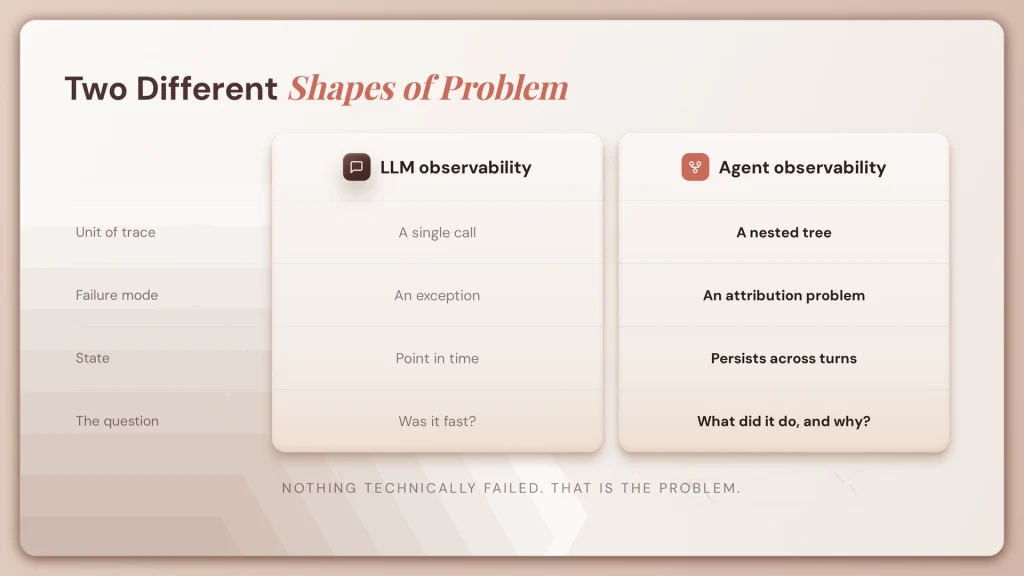
Four things change once you move from single calls to agents:
The unit of trace stops being a call and becomes a tree. A single user request becomes a nested structure of model calls, tool invocations, retrievals, and handoffs between agents, sometimes across a multi-agent architecture with several agents contributing to one outcome.
Failures become attribution problems, not error problems. Nothing threw an exception. The reasoning was sound. The input was wrong.
State persists across invocations. A failure that shows up in turn six can originate in turn two. Point-in-time tracing misses that entirely.
The question changes from performance to governance. AI observability requires dedicated tools that manage and assess the behavior, decision-making and risks of an AI solution, such as model drift, bias and LLM logic, metrics traditional APM was never designed to collect. The question a compliance officer asks isn’t “was it fast.” It’s “what did this agent do, on what basis, and who approved it.”
LLM observability vs. agent observability at a glance
| LLM observability | Agent observability | |
|---|---|---|
| Unit of trace | A single model call | A nested tree of calls, tools, and handoffs |
| Typical failure | Error, timeout, bad output | Correct reasoning over wrong retrieved input |
| State | Stateless per call | Persists across turns and sessions |
| Key question | Was it fast and did it work | What did it do, on what basis, who approved |
| Primary buyer | ML or platform engineering | Platform engineering plus risk and compliance |
This isn’t a quality ranking. Most teams genuinely need LLM observability and never need more than that. The distinction starts to matter the moment your agents take actions instead of just producing text, and it’s the reason agent orchestration and observability increasingly sit inside the same platform rather than two separate tools.
Pause on that for a second, because it reframes the rest of this guide: the tool that wins your tracing bake-off is not automatically the tool that answers your compliance team’s question six months from now.

The AI observability checklist
Keep this open in a tab while you demo vendors. A platform needs a real answer to each of these, not a feature that technically exists somewhere in the docs.
- Tracing and debugging. Can you trace a complex, multi-step agent task from input to output, including every intermediate tool call and model reasoning step?
- Evaluation and quality. Does it support pre-launch model evaluation and continuous production scoring with custom, business-specific metrics, not just generic correctness checks?
- Cost and performance attribution. Can you attribute every token of spend to a specific user, agent, or business unit, and spot latency bottlenecks inside a long chain?
- Root cause analysis. When a user gets a bad answer, can you tell whether it was a bad prompt, a hallucination, a failed tool call, or a bad retrieval, rather than just seeing “request completed”?
- Data security and residency. Where does your prompt and completion data actually live? For regulated teams, this is where sovereign AI deployment options stop being a nice-to-have.
- Framework flexibility. Can you import and monitor agents built on LangChain, CrewAI, AutoGen, or an internal framework without a rewrite? This is where model flexibility vs. vendor lock-in becomes a real cost, not a theoretical one.
- Guardrails and security. Can it detect and block prompt injection, toxic content, or data exfiltration in real time, not just flag it after the fact? This is a natural extension of a Hallucination Manager if you already run one.
- Enterprise-ready features. SSO, RBAC, audit logs, and integration with what you already run.
- Agent-level identity and ownership. Can you answer who owns a given agent and what it’s permitted to do, not just what it did? This is the criterion most tracing tools skip, and it’s exactly the gap that lets shadow AI agents accumulate unnoticed across a large org. It’s also central to AI agent governance as a discipline, not just a feature checkbox.
Quick gut check: what’s actually breaking for you right now
Match your symptom to the right starting point.
- “We just need to see our LangChain traces and debug them.” → LangSmith
- “Self-hosting is a hard requirement, and open source matters to us.” → Langfuse, Phoenix, or MLflow
- “Our biggest problem is judging whether the output is actually good.” → Confident AI or Braintrust
- “We run classical ML models alongside our LLM apps.” → Arize AI
- “Regulators or auditors are asking us to explain a model’s decisions.” → Fiddler AI
- “We’re a Datadog shop and want AI signals in the same dashboard.” → Datadog or Dynatrace
- “Security is asking what our agents are doing with company data, and who’s responsible for each one.” → Lyzr Control Plane
The platforms worth evaluating
Grouped by what they’re actually built for, not ranked. Every entry below includes a genuine limitation, because a comparison that only lists strengths isn’t a comparison, it’s a sales page.
Open source and self-hosted
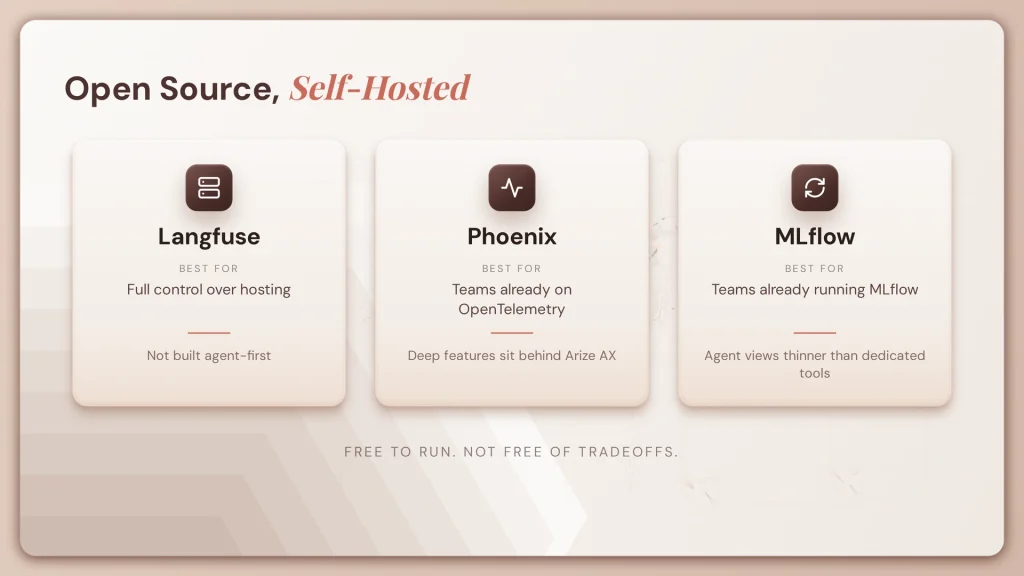
Langfuse. Langfuse is an open source LLM engineering platform that helps teams collaboratively develop, monitor, evaluate, and debug AI applications, and it can be self-hosted in minutes. Because it’s open source, self-hosting is completely free, aside from your own infrastructure costs. Limitation: its trace model is solid but wasn’t built agent-first, so multi-agent handoffs can feel bolted on compared to purpose-built agent tools. Best for: teams that want full control over hosting and are comfortable managing their own infrastructure.
Phoenix. Arize’s open-source project, Elastic License 2.0, OpenTelemetry-native. It has passed 10.2k+ GitHub stars and is fully self-hostable with zero feature gates on the open-source version. Limitation: the deepest production-scale features, drift detection, clustering, advanced analytics, live behind the commercial Arize AX tier, so the open-source version hits a ceiling if you need enterprise-grade monitoring at scale. Best for: ML teams already standardized on OpenTelemetry who are extending into LLM observability, and a natural companion to open source agentic frameworks.
MLflow. The long-standing open-source platform for the ML lifecycle, now extended with LLM and agent tracing. Free to self-host, Apache 2.0 licensed. Limitation: it’s an extension of an ML lifecycle tool, not an agent-native platform built from scratch, so agent-specific views like tool selection quality and reasoning chains are thinner than dedicated tools. Best for: teams already running MLflow for classical ML who don’t want a second system for GenAI.
Tracing and evaluation SaaS
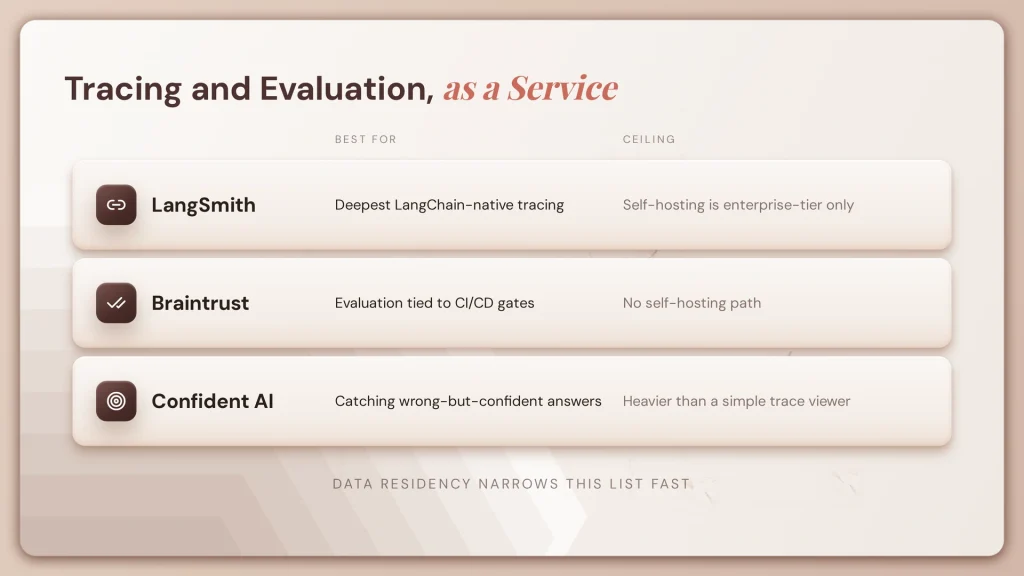
LangSmith. Built by the LangChain team, with tight integration into LangChain and LangGraph, including LangGraph Studio for teams that live in that ecosystem. Limitation: it’s closed source, and self-hosting sits behind an enterprise-tier plan, which rules it out fast for teams with strict data residency requirements. Best for: teams fully committed to the LangChain/LangGraph stack who want the deepest possible framework-specific tracing.
Braintrust. An evaluation-forward platform with tracing built in, designed to capture every decision point in a multi-step workflow so quality regressions are traceable to the step that caused them rather than guessed at from incomplete logs. Limitation: it’s a proprietary SaaS product with no self-hosting path, so data residency requirements can rule it out immediately. Best for: teams that want evaluation and CI/CD regression gates tied directly to production traces.
Confident AI. Built around the open-source DeepEval library, with evaluation treated as the observability layer itself, scoring traces, spans, and conversation threads with research-backed metrics rather than simple pass/fail checks. Limitation: it’s shaped more like an ML-platform workflow than a lightweight tracing tool, so teams that just want a fast trace viewer may find it heavier than they need. Best for: teams whose real fear is a wrong-but-confident answer slipping past automated checks.
Enterprise ML and explainability
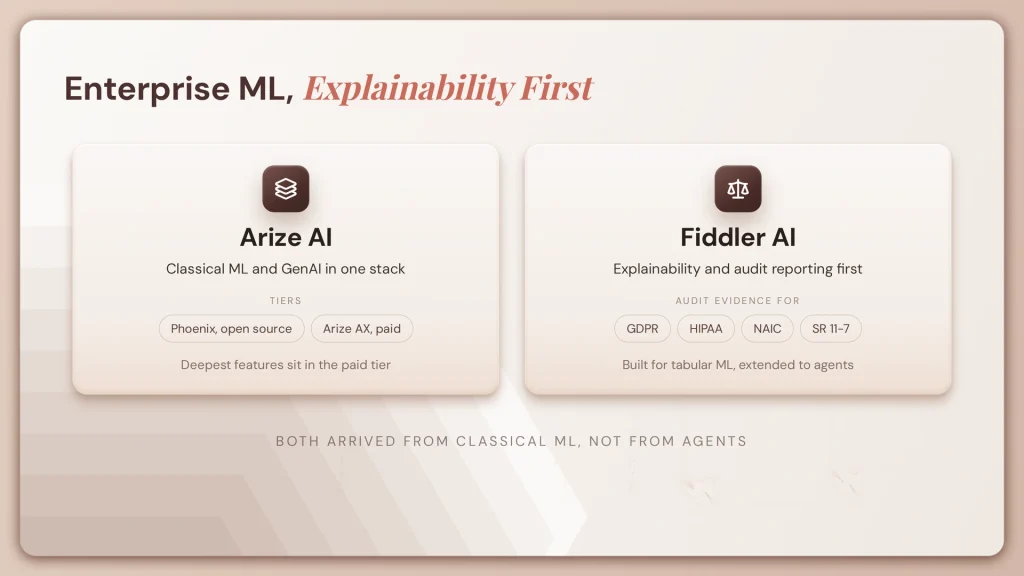
Arize AI. Spans classical ML monitoring and LLM/agent observability under one roof, with the open-source Phoenix as its entry point and Arize AX as the production-scale, enterprise tier. Limitation: the deepest capabilities, session grouping, agent trajectory visualization, and dashboards at scale, sit in the paid tier. Best for: teams running a mix of traditional ML models and generative AI who don’t want two separate monitoring stacks.
Fiddler AI. Built on a foundation of ML explainability, bias detection, and compliance reporting, since extended into LLM and agent observability. The platform provides centralized governance and oversight for agents and predictive models across the enterprise, recording every agent behavior, action, model decision, and performance metric to generate the audit evidence needed to meet evolving regulatory requirements. It’s built to provide audit evidence aligned with enterprise governance and regulatory review requirements including GDPR, HIPAA, NAIC, and SR 11-7. Limitation: these capabilities were extended onto a platform originally designed for tabular, single-inference ML models, so trace visualization for complex multi-agent workflows can feel less native than dedicated agent-tracing tools. Best for: regulated industries, finance, healthcare, insurance, where explainability and audit reporting are the primary requirement, not just tracing.
Full-stack APM
Datadog / Dynatrace. Both extended their existing application performance monitoring platforms with AI-specific tracking. The advantage is real: for teams already standardized on one of these, AI tracing arrives with zero new vendor relationship. Limitation: agent-specific depth, reasoning traces, tool-selection quality, tends to be shallower than purpose-built tools, since the LLM features are a recent extension of a broader APM product rather than the core of it. Best for: platform teams that value one pane of glass over the deepest possible agent tracing.
Agent governance and audit
Lyzr Control Plane. Where the other platforms in this list are built to trace and score AI behavior, the Lyzr Control Plane is built to govern it, and that distinction matters most once agents are taking actions rather than just generating text. It provides tracing and evaluation, but its differentiator is the audit and control layer sitting above them: agent identity, policy enforcement, and an audit log of every action taken. Agents built on LangChain, CrewAI, AutoGen, or a custom stack connect directly, no migration or rewrite required, which is the same framework-agnostic approach that also shows up across the best AI agent frameworks comparison. Limitation, stated plainly: its observability is strongest for agents running on or registered with Lyzr. If your agents run entirely outside that surface and all you want is lightweight call tracing, a dedicated tracing tool is a lighter fit. Best for: teams whose compliance or security function is asking who owns an agent and what it’s allowed to do, not just what it did. More detail on the architecture is in the Lyzr Agent Control Plane writeup, and in Lyzr documentation.
Side-by-side comparison
Verify every cell against current vendor documentation before you buy. Categories change fast in this market, and pricing models especially shift with new funding rounds and acquisitions.
AI observability platforms compared
| Platform | Best for | Open source | Self-host | Agent-native | Evaluation | Governance & audit | Pricing model |
|---|---|---|---|---|---|---|---|
| Langfuse | Open-source tracing | Yes (MIT) | Yes | Partial | Yes | Basic | Usage or free self-host |
| Phoenix | Open-source eval & tracing | Yes (Elastic 2.0) | Yes | Partial | Yes | Basic | Free self-host |
| MLflow | Teams already on MLflow | Yes (Apache 2.0) | Yes | Partial | Yes | Basic | Free self-host |
| LangSmith | LangChain-native teams | No | Enterprise tier only | Partial | Yes | Basic | Trace volume |
| Braintrust | Eval-driven dev, DevEx | No | No | Partial | Yes | Basic | Usage |
| Confident AI | Output quality evaluation | Partial (DeepEval OSS) | Partial | No | Deep | Basic | Usage |
| Arize AI | Hybrid classical ML + LLM | Phoenix only | Enterprise tier | Partial | Yes | Moderate | Enterprise |
| Fiddler AI | Explainability & compliance | No | Yes | No | Yes | Strong | Enterprise |
| Datadog / Dynatrace | APM-standardized teams | No | No | No | Limited | Moderate | Host or ingest-based |
| Lyzr Control Plane | Agent governance & audit | SDKs | Yes | Yes | Yes | Strong | Enterprise |
Bringing it back to your checklist
A few scenarios to make the decision concrete:
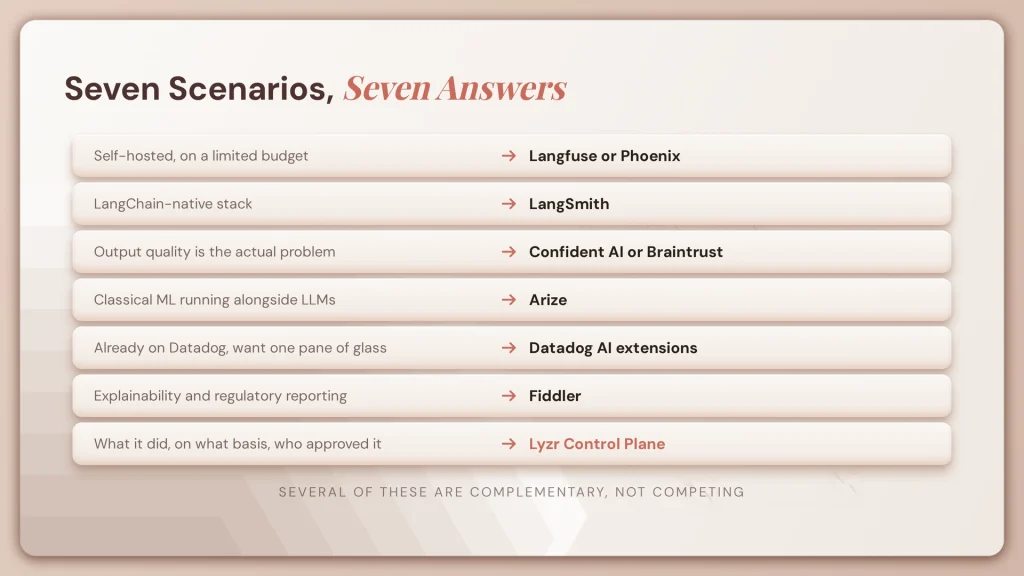
You want tracing, self-hosted, on a limited budget. Start with Langfuse or Phoenix. Both are genuinely capable open-source tools that solve the core tracing problem well.
You’re LangChain-native. LangSmith is the default, unless governance requirements outweigh the framework fit.
Output quality is the actual problem. Confident AI or Braintrust, both built around scoring, not just logging.
You run classical ML alongside LLMs. Arize is the category leader for a unified view across both.
You’re already on Datadog and want one pane of glass. Use its AI extensions, and accept shallower agent tracing as the tradeoff for consolidation.
Explainability and regulatory reporting are the requirement. Fiddler is built for exactly this, and it’s built for compliance teams as much as engineers.
You need to answer what an agent did, on what basis, and who approved it. That’s a governance question, and it’s the specific gap Lyzr Control Plane is built to close.
Here’s what most of these vendor pages won’t tell you: several of these tools are complementary, not competing. A common pattern is a tracing tool for development and a governance layer for production, a developer debugging in Langfuse while the compliance teams audit what the deployed agent actually did last quarter. That’s not a compromise. That’s how buyers who’ve actually done this end up operating.
The agents to production playbook covers the step most teams skip: moving from watching what agents do to controlling it.
Frequently asked questions
What are the best AI observability platforms?
It depends on the need. Langfuse is strong for open-source tracing, Confident AI and Braintrust for evaluation, Arize for hybrid ML and LLM environments, Fiddler for explainability and compliance, and Lyzr Control Plane for agent governance and audit.
What is an AI observability platform?
It’s software that traces, evaluates, and monitors AI applications and agents in production, covering request paths, output quality, cost, latency, and policy violations, rather than just uptime.
What is the difference between observability and monitoring?
Monitoring tells you a system is unhealthy against signals you already defined. Observability lets you investigate why it’s failing, including failure modes nobody anticipated in advance.
What is AI agent observability?
It’s the practice of tracing and evaluating multi-step agent behavior, including nested tool calls, retrievals, handoffs between agents, and a persistent record of what the agent did and on what basis, not just whether a single call succeeded.
What are the top observability tools?
For general infrastructure: Datadog, Grafana, Dynatrace, and New Relic. For AI and agents specifically: Langfuse, LangSmith, Arize, Fiddler, Braintrust, and Confident AI.
What are some major AI observability companies?
Datadog, Dynatrace, New Relic, and Grafana Labs lead general infrastructure observability. Arize, Fiddler, Langfuse, and Braintrust are among the more established names specifically in AI observability.
Are there open source AI observability tools?
Yes. Langfuse (MIT), Phoenix (Elastic 2.0), and MLflow (Apache 2.0) are all open source and self-hostable. Confident AI’s underlying evaluation library, DeepEval, is open source as well.
What is the Gartner Market Guide for AI Evaluation and Observability Platforms?
It’s Gartner’s research covering this category, published in early 2026, which frames the market as the convergence of evaluation and observability into one platform type rather than two separate tool classes, driven by the difficulty of measuring reliability in nondeterministic AI systems.
Do I need both an observability tool and a governance platform?
Often, yes. Tracing tools answer what happened during a run. Governance layers answer who owns the agent, what it’s permitted to do, and who approved its actions, a distinct and increasingly necessary layer for AI in risk and compliance, especially under frameworks like European enterprise AI governance.
How much do AI observability platforms cost?
Open-source, self-hosted options are free aside from your own infrastructure costs. Commercial platforms typically price by trace volume, data volume, or usage, with negotiated enterprise tiers for larger deployments.
Every platform above will show you a clean demo. The real test is what happens in month four, when an agent does something nobody planned for and someone needs an answer by end of day. Whichever tool you pick, run that scenario before you sign the contract, not after.
If your version of that scenario involves a head of AI or a compliance lead asking who’s accountable for this agent, that’s a governance question a tracing tool alone won’t answer. See how agent-level identity and audit logging work against your own framework, or start with Lyzr’s documentation if you’d rather look at the API first.
Book a demo of the Lyzr Control Plane
Book A Demo: Click Here
Join our Slack: Click Here
Link to our GitHub: Click Here