A regional bank’s website runs a loan pre-screening assistant: applicants chat through their revenue, time in business, and debt load, and the assistant drafts a risk narrative the underwriter reads first. Two small-business owners submit nearly identical numbers this week, same industry, same tenure. The only real difference between the two conversations is the name at the top. One narrative reads confident and recommends approval; the other hedges twice and flags “further review.” The tests run before launch scored accuracy and hallucination rate, neither of which compares paired applicants against each other.
Key takeaways
- Fairness in an LLM application isn’t one property. It’s several different, sometimes conflicting metrics: demographic parity, equal opportunity, and consistency in tone and refusal rate.
- No single test catches every kind of bias: counterfactual testing flags one pair, metamorphic testing shows whether that’s a pattern, and LLM-as-a-judge catches what neither can score.
- Which metric matters depends on the application: allocation decisions usually call for equal opportunity, not demographic parity; open-ended chat calls for tone and refusal consistency instead.
- A test suite that passes at launch doesn’t stay passed, since model and prompt updates can reintroduce bias a previous run already cleared.
- Bias examination is becoming a documented legal duty for certain systems under the EU AI Act, not just good practice.
What fairness testing for LLM applications means
Fairness testing for LLM applications is the practice of systematically checking whether a model produces comparable quality, sentiment, and outcomes across different demographic groups, by comparing paired or matched inputs rather than scoring each response on its own, which is exactly what a standard accuracy or hallucination benchmark never does.
That distinction matters because NIST’s own definition of bias is “an effect that deprives a statistical result of representativeness by systematically distorting it,” and a distortion only shows up by comparing two things that should look alike and don’t.
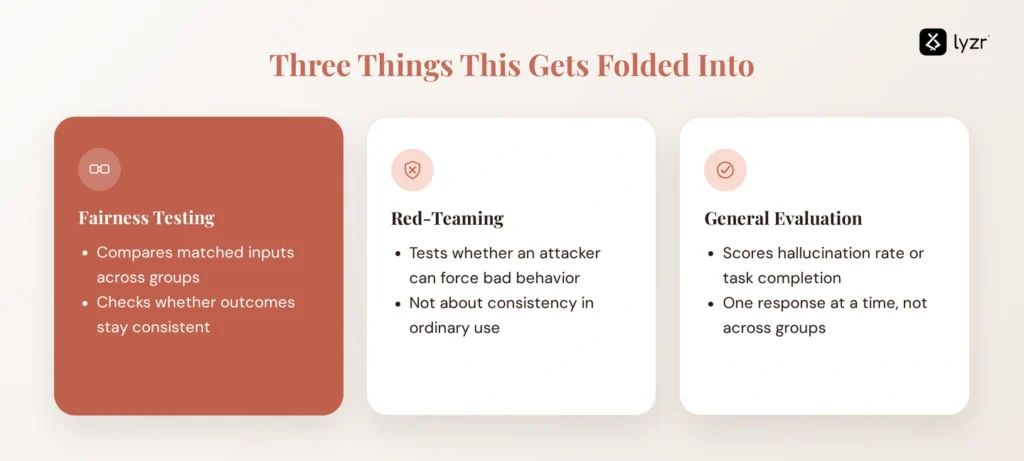
It also isn’t two things it regularly gets folded into: red-teaming an AI agent, which tests whether an attacker can force bad behavior rather than whether ordinary use treats groups consistently, and general LLM evaluation, which scores hallucination rate or task completion one response at a time rather than comparing outcomes across groups.
Why fairness can’t be reduced to one metric
Bias doesn’t come from one place, so no single check catches all of it. NIST’s SP 1270 splits it into three categories: systemic (institutional procedures that favor some groups), statistical and computational (a training sample that isn’t representative), and human (introduced through labeling and design choices). Fixing the training data addresses exactly one of those three.
The same fragmentation shows up in the metrics. Demographic parity asks whether different groups get positive outcomes at the same rate. Equal opportunity asks something narrower: whether qualified people get approved at the same rate, regardless of group. The two can point in opposite directions: if the real qualification rate genuinely differs across groups, forcing equal approval rates means rejecting qualified applicants in one group, or approving unqualified ones in another, just to make the ratio come out even. Most checklists default to demographic parity as “the” fairness metric. For most allocation decisions that’s the wrong default; equal opportunity is judged against who deserved the outcome, closer to what a regulator actually asks about.

Neither metric applies where nothing is being allocated. A support or advice assistant doesn’t approve or deny anything, but it can still answer one group with a warmer tone or refuse a near-identical request more often, a third axis, sentiment and refusal consistency, that needs its own test.
Three fairness testing ways, and what each one misses alone
Three testing methods exist because each catches a failure the others don’t; run only one, and the other two failure modes stay invisible.
Counterfactual testing: swap the attribute, hold everything else constant
Counterfactual testing changes exactly one protected attribute in a real input, a name, a pronoun, a stated age or location, leaves everything else untouched, and compares the two outputs. This is what would have caught the loan write-up at the top of this piece: same financials, different name, different verdict.
It’s cheap to run per pair and easy to explain to a reviewer. Its limit is its strength: one pair proves an inconsistency exists once, not whether it’s a fluke or a pattern the model repeats.
Metamorphic testing: look for the pattern, not just one flagged pair
Metamorphic testing runs the same idea at scale: instead of one “correct” answer, it builds many counterfactual pairs from real traffic and checks a relation across all of them, same sentiment, same refusal decision, comparable confidence. A single pair might disagree from ordinary sampling variance, not bias. Dozens showing the same disagreement is a pattern, and that’s what turns a suspicion into evidence.
LLM-as-a-judge: catching what a rule can’t score
Some disparities aren’t a wrong answer, they’re a different tone: a warmer response, a more patient explanation, phrasing that leans on a stereotype without a flagged word in sight. A keyword filter misses that. Routing paired outputs to a second, capable model scored against a structured rubric catches it, because judgment is what the task requires.
The catch most explainers skip: the judge model can carry the same bias it’s checking for, so treating its score as ground truth without calibrating it against human-labeled examples just moves the bias one layer downstream.
Which fairness metric actually fits your use case
Picking the right metric for the wrong kind of application is how a fairness effort produces a report nobody can act on. The first question: is this application allocating something, or just responding to someone?
| Application type | Best-fit metric | Why | Testing method that catches it best |
| Resource or decision allocation (loan pre-screening, hiring, pricing) | Equal opportunity | Forcing equal approval rates when qualification rates differ can mean rejecting qualified applicants just to hit a ratio | Counterfactual testing on matched applicant pairs |
| Open-ended assistants and chat | Sentiment and refusal consistency | Nothing is allocated, so parity metrics don’t apply; the risk is tone or refusal shifting by group | LLM-as-a-judge on paired conversations |
| Content moderation or classification | Demographic parity in false-positive/refusal rates | The harm is one group getting flagged or blocked more often, regardless of whether content was actually violative | Metamorphic testing across paraphrased pairs |
The allocation question settles half the decision by itself: once you know whether something is being approved, denied, or priced, only one or two of the three metrics are even in play.
Popular fairness testing frameworks and tools
A handful of open-source projects and standards make up the current fairness testing landscape:
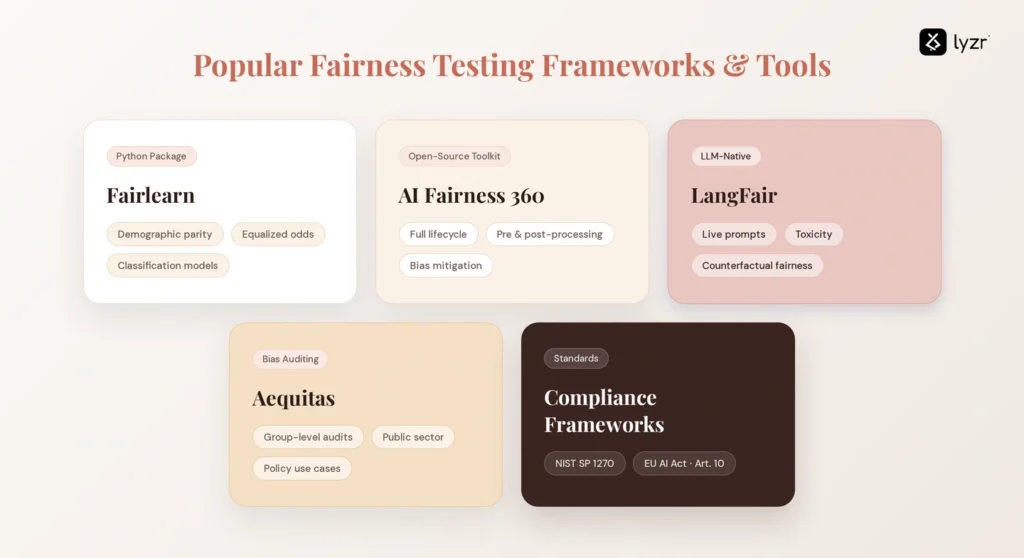
- Fairlearn. A Python package for assessing and mitigating unfairness in machine learning models, built around group fairness metrics like demographic parity and equalized odds. It’s designed for structured, classification-style outcomes rather than open-ended generative text.
- AI Fairness 360 (AIF360). An open-source toolkit offering a broad set of fairness metrics plus bias-mitigation algorithms that apply across a model’s full lifecycle, from preprocessing the data to post-processing the outputs.
- LangFair. Built specifically for LLMs, it runs use-case-level bias and fairness assessments using an application’s own prompts rather than static benchmarks, covering toxicity, stereotype, and counterfactual fairness checks.
- Aequitas. A bias-auditing toolkit originally built for public-sector and policy use cases, useful for group-level audits before or alongside LLM-specific testing.
- Compliance frameworks. NIST’s SP 1270 bias taxonomy and the EU AI Act’s Article 10 data-examination duty function less as testing tools and more as the standards a fairness test suite ultimately has to satisfy.
Building a fairness test suite without boiling the ocean
Start with the two or three protected attributes actually relevant to the domain and jurisdiction, rather than testing every attribute against every use case on day one. A lending product and a hiring product don’t share the same regulatory exposure, and a suite covering both at once usually covers neither well.
Build counterfactual pairs from real production traffic rather than synthetic templates alone, since synthetic pairs miss the phrasing real users actually produce. Set a pass/fail threshold and treat crossing it as a release blocker, not a report read later. Retest after every model or prompt change: a fairness property measured against one model version doesn’t carry over to the next.
Before building any of this out, it helps to know how mature the current testing posture already is. Lyzr’s agent governance maturity assessment is built for exactly that gap.
Why a one-time test suite isn’t enough, and what has to run after launch
Everything above is a pre-launch discipline: a snapshot of how the system behaves on the day it’s tested. Production doesn’t hold still; models get updated, prompts drift, and the population an assistant serves changes as the product grows. A suite that passed cleanly at launch doesn’t keep passing itself.
Regulators are starting to treat this as an ongoing duty, not a one-time audit. The EU AI Act requires providers of high-risk AI systems, under Article 10, to examine their data “in view of possible biases that are likely to affect the health and safety of persons, have a negative impact on fundamental rights or lead to discrimination prohibited under Union law,” and to put in place “appropriate measures to detect, prevent and mitigate” whatever that finds, a standing obligation, not a box checked once before release. The cost of skipping it compounds: Gartner predicts AI regulatory violations will drive a 30% increase in legal disputes for tech companies by 2028, with analyst Lydia Clougherty Jones citing inconsistent global rules that risk “opening enterprises up to other liabilities.”
This is where testing has to hand off to continuous enforcement. The release-blocker threshold from the section above only matters if something actually stops a workflow that fails it, and that’s what Lyzr OpenController‘s Ship and Run stages are built for: evaluating and governing every agent before it reaches production, then monitoring it live afterward instead of waiting for the next scheduled audit. For the bias-specific detection and mitigation itself, Lyzr’s Responsible AI platform includes a Fairness & Bias Manager built to go “beyond simple checks with continuous bias monitoring and mitigation tools that ensure fair and accurate AI outputs.” To see either against your own application, book a demo.
FAQ
Systematically checking whether an LLM application produces comparable quality, sentiment, and outcomes across demographic groups, by comparing matched inputs rather than scoring one response at a time. It’s what catches disparities a standard accuracy benchmark never surfaces.
Demographic parity checks whether different groups receive positive outcomes at the same rate overall. Equal opportunity checks whether qualified people get approved at the same rate. The two can conflict when the real qualification rate differs across groups.
There are three methods: counterfactual testing compares an input against a version with a protected attribute changed, metamorphic testing runs that across many pairs to separate a pattern from noise, and LLM-as-a-judge scores paired outputs against a rubric for harms the first two can’t quantify.
For certain systems, yes. The EU AI Act’s Article 10 requires high-risk AI providers to examine their data for possible bias and put measures in place to detect, prevent, and mitigate whatever that finds, an ongoing duty rather than a one-time check.
Lyzr’s Responsible AI platform includes a Fairness & Bias Manager built for continuous bias monitoring and mitigation, picking up where a pre-launch test suite stops. Its agent governance maturity assessment helps teams prioritize building one.
Book A Demo: Click Here
Join our Slack: Click Here
Link to our GitHub: Click Here