TL;DR
- AI in HR breaks into four capability types: predictive, generative, conversational, and agentic, and in 2026 they increasingly chain together instead of operating as separate tools.
- Adoption is now mainstream, but most organizations have not redesigned HR workflows around it, which is where the real risk sits.
- Bias, data privacy, over-automation, adoption friction, and hallucination are the five risks HR leaders actually face, not generic AI caution.
- Governance in employment AI is not optional. The EEOC, NYC’s Local Law 144, and the EU AI Act all treat HR-related AI as high-scrutiny by default.
- HR earns influence over enterprise AI strategy by adopting agentic tools with audit trails and human checkpoints built in, not by moving fastest.
AI in HR is the use of machine learning, generative models, conversational interfaces, and autonomous agents to support human resources work, from sourcing candidates to predicting attrition. It spans four distinct capability types that increasingly operate together rather than as separate point tools, and it is reshaping recruiting, onboarding, performance management, and retention across the HR function.
That definition sounds tidy. The reality inside most HR organizations is not.
Two things are true at once in 2026. AI is no longer experimental in HR, it is operational. And HR is frequently absent from the room where enterprise AI strategy gets decided, even though HR data and HR decisions sit at the center of the highest-scrutiny AI use cases in the entire company. The way HR changes that isn’t by deploying AI faster than legal, compliance, or IT can track it. It’s by adopting agentic systems that carry governance as a built-in feature, not an afterthought, and by treating AI as a collaborator inside HR process, never a replacement for it.
This piece works as a reference: a clear taxonomy, an honest risk section, a real look at governance obligations, and a comparison of how organizations are actually implementing this today.
What “AI in HR” means in 2026
Four distinct capability types make up the AI-in-HR landscape. They are not interchangeable, and understanding which one you’re evaluating matters more than the vendor name attached to it.
Predictive AI analyzes historical HR data to forecast outcomes before they happen. In practice, this looks like an attrition model that flags a team at elevated flight risk three to six months before anyone resigns, based on tenure, engagement scores, and manager-change history.
Generative AI produces new content from a prompt or a dataset. In HR, that’s a system drafting a job description, summarizing hundreds of exit interviews into three themes, or turning a benefits policy PDF into a plain-language FAQ.
Conversational AI handles natural-language interaction at scale. An HR helpdesk chatbot that answers “how many PTO days do I have left” at 11pm on a Sunday, without a ticket, is conversational AI doing its job.
Agentic AI is the capability that reasons across steps and executes a workflow rather than answering one question. An agent that writes the job description, posts it, screens the resumes against the role’s actual requirements, shortlists candidates, and schedules interviews, handing off to a recruiter only at decision points, is agentic. This is the part of the taxonomy that’s actually new, and it’s why HR technology conversations in 2026 sound different from a few years ago.

Why it matters now
HR leadership has made AI the top stated priority for the year, but adoption has outpaced process redesign. Gartner’s annual survey of 426 CHROs across 23 industries and four global regions identified this directly.
“harnessing AI to revolutionize HR as CHROs’ top priority, requiring a clearly defined, HR-focused AI strategy” for 2026.
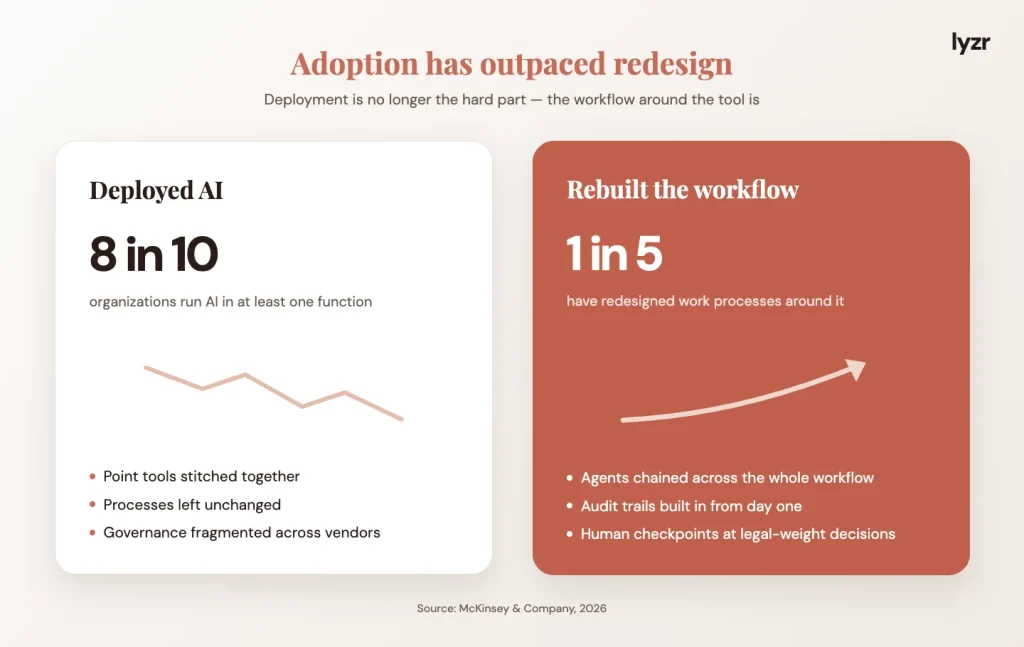
The gap shows up in execution. According to McKinsey & Company data, adoption has significantly outpaced redesign.
“nearly 8 in 10 organizations have deployed AI in at least one function, but only 1 in 5 have rebuilt work processes and protocols as a result”
Separately, a Gartner survey found that expectations and results diverge for more than half of managers.
“forty-five percent of managers say that the use of AI has improved the work of their teams as much as they expected”
Deployment is not the hard part anymore. Redesigning the workflow around the tool is. That gap has a real cost. Research published through the National Institutes of Health’s PMC database suggests that inefficient practices weighed down by compliance burden can suppress productivity by roughly 8%, which is part of why workflow redesign, not just tool adoption, is the variable that actually moves outcomes.
Where AI is used today
Five functions dominate current HR deployment, and each one is worth understanding before evaluating a vendor.
Talent acquisition remains the most mature use case: sourcing, resume screening, and interview scheduling condensed into a single pipeline, often run through a dedicated talent acquisition layer.
Onboarding uses generative and agentic tools to build role-specific plans instead of a generic PDF, an area covered in depth in how AI agents change onboarding.

Performance management increasingly runs on structured, continuous performance review support rather than an annual form, an approach detailed in the AI-powered performance enablement playbook.
Learning and development has moved from one-size-fits-all training to personalized paths, the subject of a closer look at AI agents for learning and development.
Employee engagement and helpdesk support now runs through conversational systems and sentiment analysis, covered in AI in employee engagement, often paired with dedicated HR helpdesk and ESAT survey agents that feed the workflow back into the loop.
Challenges, risks, and limitations
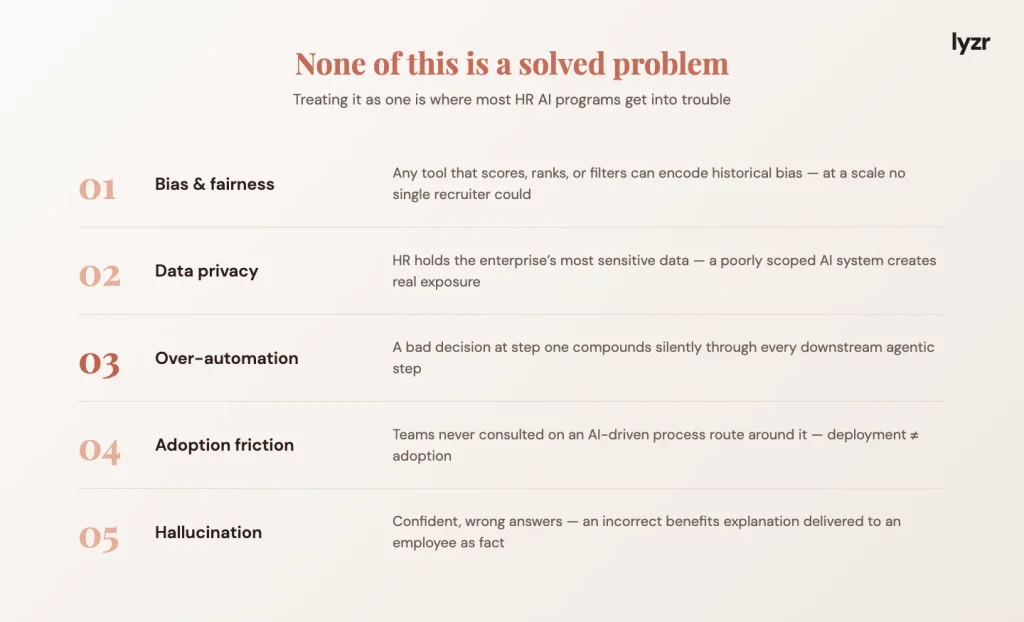
None of this is a solved problem, and treating it as one is where most HR AI programs get into trouble.
Bias and fairness in AI-assisted decisions. Any tool that scores, ranks, or filters candidates or employees can encode the historical bias present in its training data, and it does so at a scale a single biased recruiter never could.
Data privacy. HR holds some of the most sensitive personal data in the enterprise, from health accommodations to compensation history, and feeding that into a poorly scoped AI system creates exposure that legal and security teams are right to flag.
Over-automation risk. Chaining agentic workflows together without a human checkpoint means a bad decision at step one, a miswritten job requirement or a bad shortlist criterion, compounds silently through every downstream step.
Change management and adoption friction. Employees and managers who were never consulted on a new AI-driven process tend to route around it, which is a large part of why deployment numbers and workflow-redesign numbers diverge so sharply.
Accuracy and hallucination risk. Generative and conversational tools can produce confident, wrong answers, and in HR that might mean an incorrect benefits explanation or a fabricated policy detail delivered to an employee as fact.
Governance and regulation
Employment AI is not a lightly regulated category, and treating it as one is a compliance risk, not just a reputational one.
In the United States, the EEOC treats algorithmic hiring tools as a formal selection procedure.
“The use of algorithmic decision-making tools to ‘make or inform decisions about whether to hire, promote, terminate, or take similar actions toward applicants or current employees’ is subject to the EEOC’s long-standing Uniform Guidelines on Employee Selection Procedures under Title VII”, guidance that followed the agency’s “2021 launch of an agency-wide ‘Artificial Intelligence and Algorithmic Fairness Initiative'”.
New York City goes further with a binding local statute.
“The NYC Bias Audit Law (Local Law 144) mandates employers and employment agencies using Automated Employment Decision Tools within New York City undergo an annual, third-party bias audit”, and “covered organizations must publish a summary of audit results and notify candidates at least 10 business days before using an AEDT in any hiring process”. Penalties are real: “non-compliance can result in civil penalties of up to $1,500 per violation per day”.
The EU AI Act treats the entire category as high-risk by default.
“AI systems used in recruitment are classified as high-risk under the EU AI Act (Annex III, Category 4), including tools that screen, rank, or evaluate candidates, with high-risk requirements covering transparency, human oversight, and bias monitoring taking full effect on 2 August 2026”. Non-compliance is not a slap on the wrist: “penalties under Article 99 reach €15 million or 3% of global turnover”.
What “governed” looks like in practice, concretely: every agent action logged in an audit trail that can be reconstructed after the fact, human-in-the-loop checkpoints inserted at the decisions that carry legal weight (who gets an interview, who gets a promotion recommendation), and a Control Plane that registers every agent in production, enforces access policy, and can roll back a workflow if it fails a pre-deployment check. Lyzr’s own Control Plane architecture, for example, runs agents through a non-production environment where:
“an automated suite checks Responsible AI policy compliance, factual accuracy, and response quality before the system opens a pull request to the production branch for designated approvers, and removes every resource it created if the agent fails”
That’s the difference between responsible AI as a slide and governance as an operating mechanism.

Implementation paths
Comparing paths to deploy AI in HR
| Path | What it is | Speed | Governance burden | Best fit |
|---|---|---|---|---|
| Build in-house | Custom models and scripts built by an internal data or IT team | Slow, often 12+ months | Falls entirely on the internal team | Large enterprises with dedicated AI engineering capacity |
| Point tools and copilots | Single-purpose SaaS tools (a screening tool, a chatbot) stitched together | Fast to deploy, slow to unify | Fragmented across vendors, hard to audit end to end | Teams solving one narrow problem |
| Governed agentic framework | A platform that chains agents across a workflow with built-in audit and oversight | Moderate, typically weeks | Centralized, auditable by design | Organizations that need multi-step automation without losing control |
For a serious HR technology architect, the third path is the emerging standard, because it’s the only one that gives multi-step automation and centralized governance in the same system. That path runs on an AI framework built to hold both the workflow and the oversight together.
Lyzr’s agentic approach
Diane is the Agentic OS for Enterprise HR by Lyzr, a system of specialized agents rather than a single chatbot.
“An HR leader defines the people objective, and Diane activates the agents, orchestrates every workflow from hiring to retention, and comes back with what actually moved the needle”
It combines a hiring agent, an HR helpdesk agent, and engagement-survey agents that hand off to each other rather than operating as isolated tools, built in Lyzr Studio and run under the same Control Plane described above.
On timelines, Lyzr’s own deployment data, not a third-party benchmark, shows this isn’t a multi-year rollout.

“Lyzr agents are designed for rapid deployment, and while legacy enterprise systems can take over a year, Lyzr’s agents typically go live in four to eight weeks”, an internal figure worth stating plainly as Lyzr’s own data rather than dressing it up as independent research.
Real-world results
Keka, an HR technology company, used a Lyzr AI Hiring Assistant to manage its recruitment workflow end to end.
“Using a Lyzr AI Hiring Assistant, Keka saw a 50% time savings for recruiters, attracted higher-quality applicants, and improved the candidate experience”, a directional case study, not a claim about every deployment.
Outside Lyzr’s own customer base, IBM’s internally deployed AskHR agent is one of the more thoroughly documented examples of agentic HR in production.
“AskHR achieved a 94% containment rate of common questions, led to a 75% reduction in support tickets raised since 2016, and handled more than 11.5 million employee interactions in 2024 alone”, contributing to “a 40% reduction in IBM’s HR operational costs over the past four years”.
The pattern across both examples: the gains come from redesigning the workflow the agent sits inside, not from bolting a chatbot onto an unchanged process.
Further reading
- How agentic hiring pipelines are structured end to end
- Direct sourcing as a candidate pipeline strategy that pairs with AI screening
- AI Sourcing approaches to surfacing qualified candidates faster
- The challenge of hiring the right people amid rising AI-generated job application fraud
- Employee feedback systems and how continuous listening pairs with AI analysis
- Rewards systems and formal employee milestones that pair AI-surfaced feedback with action
- The broader shift toward a modern HR platform built around intelligence and automation
Frequently asked questions
What is the role of AI in HR?
AI’s role in HR is to support, not replace, the judgment calls HR leaders make, by handling pattern-recognition and administrative work at scale, screening resumes, drafting communications, predicting attrition risk, and chaining those steps into agentic workflows, while HR retains the decisions that affect a person’s employment.
Is there an AI for HR?
Yes. HR-specific AI systems range from single-purpose chatbots and screening tools to full agentic suites like Diane, which orchestrates multiple specialized agents across hiring, onboarding, and engagement rather than performing one narrow task.
What are the 7 pillars of HR?
HR frameworks commonly group the function into seven pillars: recruitment and selection, onboarding, performance management, learning and development, compensation and benefits, employee relations, and legal and regulatory compliance. AI now touches nearly all seven, though at different levels of maturity.
Which AI tools are used in HR?
The category spans predictive analytics platforms for attrition and workforce planning, generative tools for drafting job descriptions and communications, conversational chatbots for HR helpdesk support, and agentic systems that chain those capabilities into a single workflow, such as an AI recruiter agent handling the full top-of-funnel process.
What is the benefit of using AI in HR recruitment processes?
The primary benefit is compressed cycle time without sacrificing screening quality. Keka’s deployment of a Lyzr hiring assistant, cited above, cut recruiter time by half while improving candidate experience, a pattern consistent with broader recruiting automation results.
How do you start using AI in HR?
Start with one workflow with a clear before-and-after metric, such as time-to-shortlist, rather than deploying broadly. Pick a governed platform that logs every agent decision from day one, since retrofitting audit trails onto an ungoverned rollout is far harder than building them in from the start.
What are some real examples of AI in HR in action?
IBM’s AskHR agent and Keka’s Lyzr-powered hiring assistant are two documented examples: one an internally built enterprise deployment, the other a vendor-deployed agent, both showing measurable time and cost reduction when the surrounding workflow was redesigned around the agent rather than left unchanged.
AI in HR in 2026 is not a finished system to install once. It’s an ongoing discipline of pairing agentic capability with the audit trails, human checkpoints, and Control Plane oversight that let HR move fast without losing the seat it’s fighting to keep at the enterprise AI strategy table.
The next real step is deciding which single workflow, hiring, onboarding, or helpdesk, deserves that kind of governed automation first.
Book a demo to walk through what that looks like for your HR stack specifically.
Book A Demo: Click Here
Join our Slack: Click Here
Link to our GitHub: Click Here