TL;DR
- AI in recruitment now touches nearly every stage of hiring, from sourcing and job descriptions to screening, interviews, and analytics.
- Adoption has moved fast: 39% of organizations have adopted AI somewhere in HR, and 27% use it specifically for recruiting, according to SHRM’s State of AI in HR 2026 report.
- Candidates are adopting AI just as quickly as employers, which is creating a signal problem: 91% of recruiters and hiring managers say they’ve spotted or suspected candidate deception involving AI.
- Not all recruitment AI is the same. Predictive AI, generative AI, conversational AI, and agentic AI solve different problems, and treating them as one thing leads to bad tool decisions.
- The EU AI Act now classifies most hiring AI as high-risk, with enforcement obligations phasing in from August 2, 2026, which is reshaping how US companies hiring into the EU build these systems.
- The winning strategy isn’t more automation. It’s keeping a human accountable for the decision an algorithm can only recommend.
Recruiters and candidates are both running AI now
A recruiter posts a job on Monday morning.
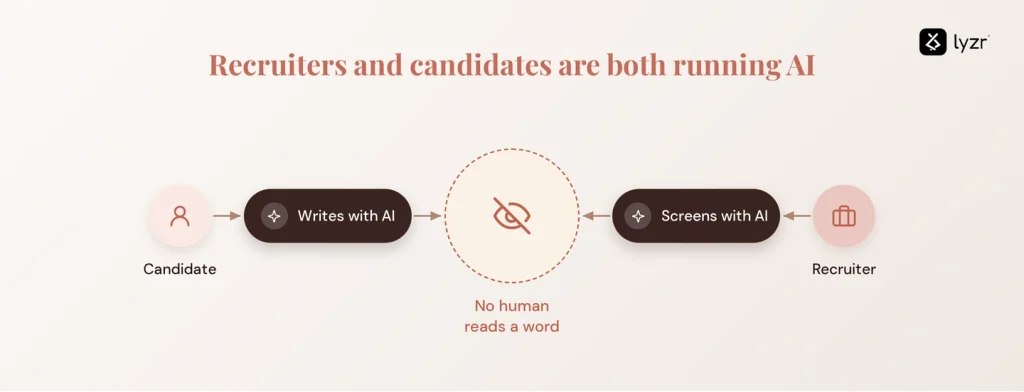
By Friday, there are 400 applications. Most of them were written, at least in part, by AI. On the other side of the process, that same recruiter is running an AI tool to screen, score, and rank every one of those 400 applications.
Neither side is doing anything wrong. Both are doing exactly what the tools were built for.
But something has quietly broken in the middle. When a generative AI tool can write a tailored cover letter in nine seconds, and a screening algorithm can process that letter in even less time, the entire transaction happens without a human reading a word of it. AI in recruitment has solved for speed. It has not solved for whether the fastest match is actually the right one.
This matters more in 2026 than it did even a year ago. According to Resume Genius’s 2026 hiring trends survey of 1,500 US hiring managers, AI use in hiring is now nearly universal, with 87% of hiring managers saying their company has implemented it in at least one part of recruitment, up from 82% in 2025. Adoption isn’t the question anymore. What to do with it is.
This guide walks through what AI actually does across the hiring process, where predictive AI ends and agentic AI begins, and why the central challenge of 2026 recruiting isn’t processing more applications. It’s finding the ones worth trusting.
What is AI in recruitment?
AI in recruitment is the set of technologies that automate, predict, generate, or assist with tasks across the hiring process, from sourcing candidates through onboarding new hires. It is not one tool or one technique. It’s a category that includes machine learning models that rank resumes, generative models that draft job posts, conversational agents that answer candidate questions, and increasingly, agentic systems that carry out multi-step recruiting workflows on their own.
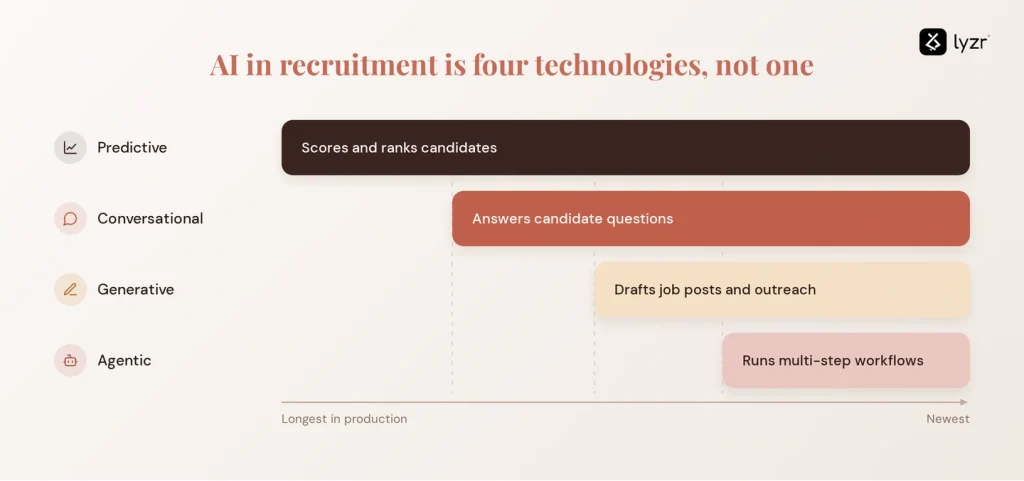
The mistake most explainers make is treating AI recruitment as a synonym for generative AI, because that’s the technology everyone has personally used through a chatbot. In practice, the oldest and most widely deployed form of AI in hiring is predictive, not generative. It has been scoring, ranking, and filtering candidates for over a decade, long before anyone typed a prompt into ChatGPT.
How AI is used across the recruitment process
AI recruitment automation now shows up at almost every stage of the funnel. Here’s what it does at each one, the problem it’s solving, and what actually changes as a result.

- Candidate sourcing. AI scans professional networks, portfolios, and public data to surface passive candidates who match a role’s requirements but never applied. This solves the problem of only ever seeing people who happen to be actively job hunting. The outcome is a pipeline that includes people a keyword search would have missed entirely. Platforms built for AI talent sourcing now rank and surface candidates automatically, which is especially useful for hard-to-fill technical roles where teams need to hire AI engineers or other specialized talent across a wide geography.
- Job description generation. Generative AI drafts job descriptions based on role level, past postings, and brand tone. This solves the problem of inconsistent, jargon-heavy, or unintentionally exclusionary postings. Resume Genius found that the share of hiring managers using AI to write job descriptions increased from 31% in 2025 to 46% in 2026, which suggests this is one of the fastest-growing applications of the technology.
- Candidate-job matching. Machine learning models compare a candidate’s profile against role requirements and score fit. This addresses the sheer volume problem: no team can manually compare 400 resumes against a job spec in a day. The outcome is a shortlist, not a decision.
- AI resume screening. This is the most widely adopted use case in AI hiring. Resume Genius reported that AI use in resume screening rose from 35% to 58% between 2025 and 2026, the largest jump among comparable use cases. It parses resumes into structured data, checks them against criteria, and filters out clear mismatches. It solves a real time problem. It also means a growing share of candidates never have a resume read by a human at all.
- Candidate ranking. Predictive AI orders candidates by likelihood of success, often using patterns from prior successful hires. This solves the “several good options, limited interview slots” problem. The risk, covered later, is that “success” gets defined by whoever the company already hired.
- Candidate engagement. AI automates status updates, follow-ups, and personalized outreach. It solves candidate drop-off caused by silence, one of the most common complaints in the hiring process. The outcome is fewer ghosted candidates and a stronger employer brand.
- Recruitment chatbots. Conversational AI answers candidate FAQs and guides them through applications around the clock. This frees recruiters from repetitive questions and gives candidates instant answers outside business hours.
- Interview scheduling. AI coordinates calendars across recruiters, hiring managers, and candidates without the email back-and-forth. It solves a logistics problem that has nothing to do with candidate quality but eats hours of recruiter time every week.
- Candidate assessments. AI administers and scores skills tests, coding challenges, and situational judgment tests. This addresses the gap between what a resume claims and what a candidate can actually do, giving teams a data point beyond self-reported experience.
- Interview assistance. AI transcribes and summarizes interviews, flagging skills mentioned and structuring notes for debriefs. It solves inconsistent note-taking and interviewer memory bias, and creates a searchable record instead of a handful of scribbled impressions.
- Recruitment analytics. Dashboards surface time-to-hire, source effectiveness, and funnel drop-off points. This replaces gut-feel decisions about where the hiring process is breaking with actual data on where candidates disengage.
- Skills identification. AI maps the skills already present across a workforce, exposing gaps and internal mobility opportunities. This solves the problem of hiring externally for a skill that already exists three teams over.
- Candidate rediscovery. AI re-surfaces strong candidates from past searches sitting dormant in the ATS, looking for “silver medalist” candidates who might fit a new role. This turns previously wasted sourcing effort into a warm pipeline for new openings at no added cost.
- Recruitment workflow automation. AI connects individual steps, such as automatically moving a screened candidate into scheduling, so automation removes the manual handoffs between tools. Recruitment agencies use similar logic to match customer job postings against their existing talent pipelines instead of starting sourcing from zero each time.
- Agentic recruitment workflows. This is where the category is heading. Instead of one tool per task, an AI agent can be given an objective, such as sourcing, contacting, and scheduling initial screens with five qualified candidates, and coordinate the individual tools needed to get there. It’s covered in more depth below.

The AI recruitment paradox: more applications, less signal
Here’s the pattern worth naming directly, because it’s the one thing most explainers of AI recruitment software skip entirely.
AI makes it easier to apply. Application volume rises. Companies respond by using more AI to filter that volume. Candidates, in turn, learn to write for the filter rather than for the person who might eventually read it. Each side’s efficiency gain cancels out the other’s, and what’s left over is a pile of applications that all look optimized and none of which reliably indicate who can actually do the job.
The data backs this up more starkly than most recruiters expect. According to Greenhouse’s 2026 AI Hiring Report, 91% of recruiters and hiring managers have spotted or suspected candidate deception, and 74% say they are more worried about fake credentials than they were a year ago. The tactics are specific: AI-generated resume exaggeration accounts for 63% of the fraud recruiters observe, followed by fake references at 48%, and candidates using AI during interviews at 35%.
Meanwhile, a separate 2026 dataset found 78% of job seekers now use AI in their applications or would consider it, and 63% say they’ve sat through an AI-run interview in the last six months. Trust hasn’t caught up to adoption on either side. Only 26% of job applicants trust AI to evaluate them fairly, even though 52% believe it already is, according to Gartner survey data.
This is the paradox in one sentence: a screening system optimized to process more applications faster will, without oversight, get better at identifying who is good at prompting AI and no better at identifying who is good at the job. Automating a weak filter doesn’t fix it. It just runs the weak filter at scale, on both sides of the transaction, faster than either side can catch it.

The fix isn’t turning AI off. It’s building in points where a human evaluates something AI can’t fake as easily, like live problem-solving, specific past work, or a structured interview built around behavior rather than keywords.
AI vs GenAI vs agentic AI in recruitment
Not all AI in recruitment behaves the same way, and lumping it together is why so many teams buy the wrong tool for the wrong problem.
Predictive AI and machine learning are the forecasters. They analyze historical hiring data to identify patterns and rank candidates by predicted fit. This is the oldest form of AI recruitment technology, and it carries the oldest known risk: it learns from whoever a company already hired, patterns and all. If those past hires skewed toward one background, the model learns that pattern as a proxy for success, whether or not it actually is.
Generative AI is the writer. It drafts job descriptions, personalizes outreach messages, and summarizes long interview transcripts into digestible notes. In hiring specifically, 27% of talent professionals surveyed by LinkedIn admit they already use generative AI in their hiring cycles, and 62% are optimistic about AI’s impact on recruitment. Unlike predictive models, generative AI doesn’t rank people. It produces content around the process.
Conversational AI is the concierge. It answers candidate questions, guides applicants through a career site, and handles routine back-and-forth without a recruiter present. It’s the layer candidates interact with most directly and trust the least, largely because it’s rarely disclosed clearly when they’re talking to one.
Agentic AI is the coordinator, and it’s the newest of the four. Rather than executing one task, an agentic system can be given a goal, plan the steps needed to reach it, and act across multiple tools with defined permissions, checking back in at points that require human sign-off. In recruiting, that could mean an agent that sources candidates, drafts outreach, schedules interviews, and logs everything into the ATS as one connected workflow rather than four disconnected tools a recruiter has to babysit.

What are the benefits of AI in recruitment?
The benefits are real, and they show up mostly in time and scale rather than in decision quality. AI reduces the hours spent on repetitive screening and scheduling, widens the pool of passive candidates a team can realistically reach, and gives recruiters faster ways to communicate with applicants throughout the process. It also produces analytics that were previously invisible, like exactly where in the funnel candidates disengage.
According to SHRM’s 2025 Recruiting Benchmarking data, the average cost per hire in the US is approximately $4,700 for non-executive roles, with a time to fill of about 44 days. Reducing manual screening and scheduling time is one of the more measurable ways AI narrows both numbers, which is also why teams increasingly track recruitment ROI alongside time-to-hire when evaluating whether a tool is actually paying for itself.
None of this means AI improves who gets hired. That’s a separate question, and it’s the one worth being honest about.
What are the risks and limitations of AI in recruitment?
The core risk of AI in recruitment is that it can automate a bad decision at scale just as easily as a good one. A predictive model trained on biased historical hiring data will reproduce that bias systematically, not occasionally, and it will do so with the appearance of objectivity that makes it harder to challenge than a single biased human reviewer.

This isn’t theoretical. AI resume screening tools favor white-associated names 85% of the time, according to a 2024 University of Washington study that analyzed over three million resume-job comparisons. A separate 2025 academic project, FAIRE, found measurable racial and gender bias in AI-driven resume evaluations across multiple commercial platforms.
The legal consequences are already on the record. The EEOC’s first AI hiring discrimination settlement came from EEOC v. iTutorGroup in August 2023, which resulted in $365,000 paid to over 200 candidates auto-rejected by age-filtering software. More recently, Mobley v. Workday became the largest AI-hiring legal action in US history, after a federal judge conditionally certified an age discrimination collective covering applicants over 40 rejected by Workday’s AI screening tools since 2020.
Beyond legal exposure, there’s the everyday risk of false negatives: a strong candidate with a non-traditional background gets filtered out because their resume doesn’t match the pattern the model learned to reward. There’s the explainability problem, where even the vendor can’t fully account for why a specific candidate was scored the way they were. And there’s the paradox already covered: AI-polished materials on the candidate side make it harder to tell who genuinely fits the role, not easier.
How to use AI in recruitment responsibly
Using AI responsibly in recruitment means treating every AI output as a recommendation a human reviews, not a decision a human rubber-stamps. That distinction is the difference between augmenting a hiring process and quietly outsourcing it.
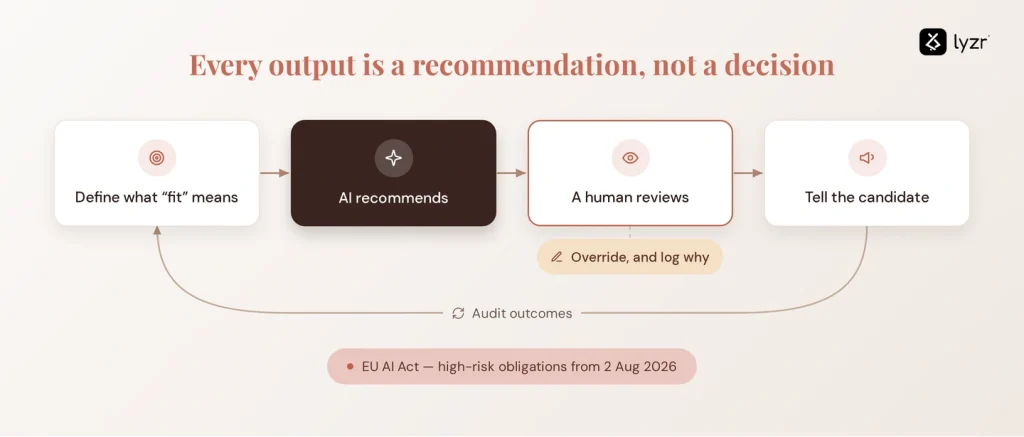
In practice, that means a few concrete habits. Run regular bias audits on screening and ranking tools rather than assuming a vendor already did it. Build in a way for recruiters to override an AI recommendation and document why. Tell candidates when AI is involved in evaluating them, since disclosure is quickly becoming both a trust issue and a legal one. Define clear criteria for what “fit” means before a model starts scoring against it, so the definition doesn’t quietly become whatever the historical data says it is. And revisit hiring outcomes periodically to check whether the people the system rates highly are the people who actually succeed, not just the people who resemble past hires.
Regulation is starting to formalize a version of this. The EU AI Act classifies most recruitment AI as high-risk, and the high-risk system requirements take effect August 2, 2026, with penalties under Article 99 reaching €15 million or 3% of global turnover. Importantly, obligations split between two parties: both the providers of the AI software and the companies that deploy it have separate compliance responsibilities.
And the European Commission’s draft guidance has clarified that AI tools may be classified as high-risk where they materially influence employment decisions, even if a human makes the final call, which means “a human reviewed it” alone won’t satisfy the regulation if that review is superficial. US companies hiring into the EU, or using vendors that serve EU clients, are increasingly affected by this even without a European entity of their own. This is a compliance framework in active development, not settled US law, so specifics should be confirmed with legal counsel rather than treated as fixed.
Building an inclusive hiring process around these principles, rather than bolting compliance on afterward, tends to hold up better as rules continue to shift.
What does the future of AI recruitment look like?
The clearest forecast, based on where the technology and the tooling are heading in 2026, is a shift from single-task automation toward connected, multi-step workflows. Instead of a recruiter operating five separate AI tools for sourcing, screening, scheduling, assessment, and analytics, the more likely direction is one orchestrated system that carries a candidate through several of those stages with a human checking in at defined points rather than managing every handoff manually.
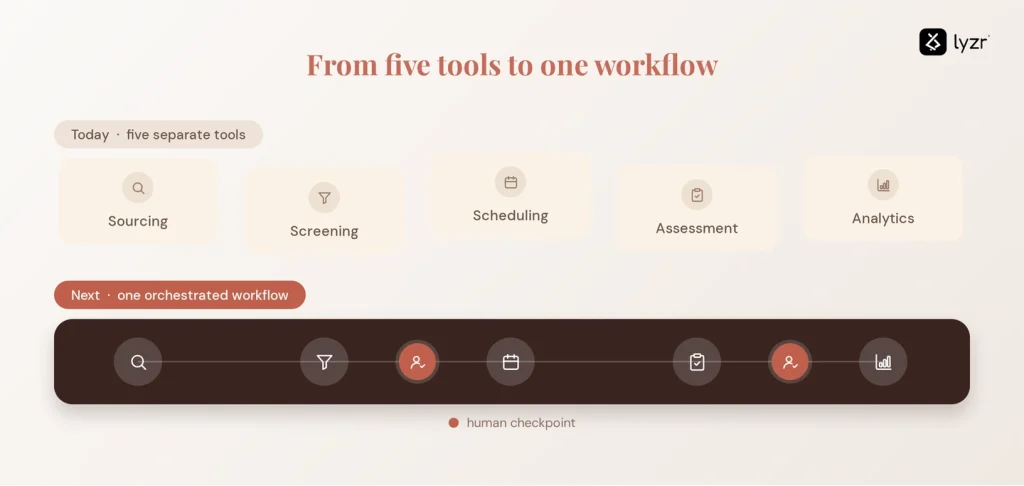
This is what agentic AI represents in practice: not a smarter chatbot, but a system capable of executing a defined recruiting objective across tools, with permissions and audit trails that keep a human accountable for what happens along the way. Lyzr and similar platforms are building toward this model specifically because single-purpose point tools don’t solve the coordination problem, only the task problem.
Some HR tech teams are already prototyping this shift. Building a recruiting agent typically starts in a low-code environment like Lyzr Agent Studio, where a team selects an LLM provider, defines the agent’s objective, and connects it to existing recruiting tools such as an ATS or calendar system. It’s the same logic behind how AI agents are increasingly coordinating tasks across other departments, and it echoes what happened when an HR tech company modernized its hiring pipeline with automated sourcing and screening rather than relying on isolated point tools.
It’s worth being precise that this is a forecast, not a settled outcome. Regulatory requirements like the EU AI Act’s human oversight mandates, and the trust gap documented throughout 2026 hiring data, mean the market’s actual adoption curve for agentic recruiting will likely move slower than the technology itself.
State of AI Agents in Enterprise: 2026
Frequently asked questions
What is AI in recruitment?
AI in recruitment is a category of technologies used to automate, predict, generate, and assist across the hiring process, from sourcing candidates to onboarding new hires. It spans predictive models, generative tools, conversational agents, and increasingly, agentic systems that coordinate multi-step workflows.
How is AI used in recruitment?
AI is used to source passive candidates, draft job descriptions, screen and rank resumes, power chatbots, schedule interviews, administer assessments, transcribe interview notes, and surface analytics on hiring performance. Each function targets a different bottleneck in the funnel rather than a single universal problem.
What are the benefits of AI in recruitment?
The main benefits are faster screening and sourcing, reduced time on repetitive administrative work, quicker candidate communication, and access to hiring analytics that weren’t previously visible. These gains are largely about speed and scale rather than automatically better hiring decisions.
What are the risks of AI in recruitment?
The main risks are algorithmic bias inherited from historical hiring data, false negatives that filter out strong non-traditional candidates, limited explainability in how scores are generated, and a growing difficulty distinguishing genuine candidate signal from AI-polished application materials. Documented legal cases, including EEOC v. iTutorGroup and Mobley v. Workday, show these risks carry real financial and legal exposure.
How does AI screen candidates?
AI screens candidates by parsing resumes and applications into structured data, then comparing that data against job requirements to generate a match score or ranking. Newer LLM-based screening tools evaluate context and phrasing rather than relying purely on keyword matches, though this introduces its own explainability challenges.
Can AI replace recruiters?
No, and current data doesn’t support that outcome. AI handles high-volume, repetitive tasks like screening and scheduling, but relationship-building, negotiation, and judgment calls about fit and potential remain human-led functions. The more accurate framing is that recruiters who use AI well are replacing recruiters who don’t, not that AI is replacing recruiters directly.
What is AI-powered recruitment?
AI-powered recruitment refers to a hiring approach that integrates AI tools across multiple stages of talent acquisition, from sourcing through analytics, rather than using AI for a single isolated task. The goal is a faster, more data-informed process where humans retain decision-making authority.
How does AI recruitment work?
AI recruitment applies different types of AI to different hiring stages: predictive models for ranking and matching, generative AI for content creation, conversational AI for candidate interaction, and agentic AI for coordinating multi-step workflows. These systems typically connect to an existing ATS or hiring platform rather than replacing it outright.
What are AI recruitment tools?
AI recruitment tools are software products built to perform specific AI-driven hiring functions, such as sourcing platforms, resume screening software, interview scheduling assistants, and recruitment chatbots. Most modern ATS and recruiting platforms now embed at least some of these capabilities natively rather than requiring separate point solutions. For a closer look at where these tools overlap and where they don’t, see this breakdown of AI tools for HR.
How is generative AI used in recruitment?
Generative AI is used to draft job descriptions, personalize candidate outreach, and summarize interview transcripts into structured notes. It creates content around the hiring process rather than making ranking or screening decisions itself, which distinguishes it from predictive AI.
What is agentic AI in recruitment?
Agentic AI in recruitment is a system capable of planning and executing multi-step recruiting objectives, such as sourcing, contacting, and scheduling candidates, by coordinating across tools with defined permissions rather than requiring a human to manage each step. It represents the shift from isolated task automation to connected workflow orchestration, and is still an early, developing category as of 2026.
How does AI reduce bias in hiring?
AI can reduce bias by applying identical screening criteria to every candidate, removing identifying details before evaluation, and flagging inconsistent decision patterns human reviewers might miss. It doesn’t eliminate bias automatically, though. If the training data reflects past biased hiring, AI can encode and scale that same bias unless teams actively audit outcomes and criteria.
Where the real hiring advantage sits in 2026
AI didn’t make hiring worse. It made hiring faster on both sides of the table at the same time, which is a different problem than the one most teams think they’re solving.
The recruiters getting real value out of AI in recruitment right now aren’t the ones running the most tools. They’re the ones who can point to exactly where in their funnel a human is still making the call, what evidence that human is looking at, and why an algorithm’s score alone was never going to be enough.
The next time an ATS flags a candidate as a 98% match, that number is worth a second question: what data produced it, and who is accountable if it’s wrong. That question, more than any new tool, is what separates faster hiring from better hiring in 2026.
Related reading
- A broader look at AI in recruitment
- Recruit CRM’s guide to AI resume parsing
- Centralizing hiring data through a recruitment platform
- Recruiting software built for small business teams
- Employer of record options for early-stage companies hiring globally
- Comparing recruitment platforms available in India
- Additional sourcing tools on the market
Book A Demo: Click Here
Join our Slack: Click Here
Link to our GitHub: Click Here