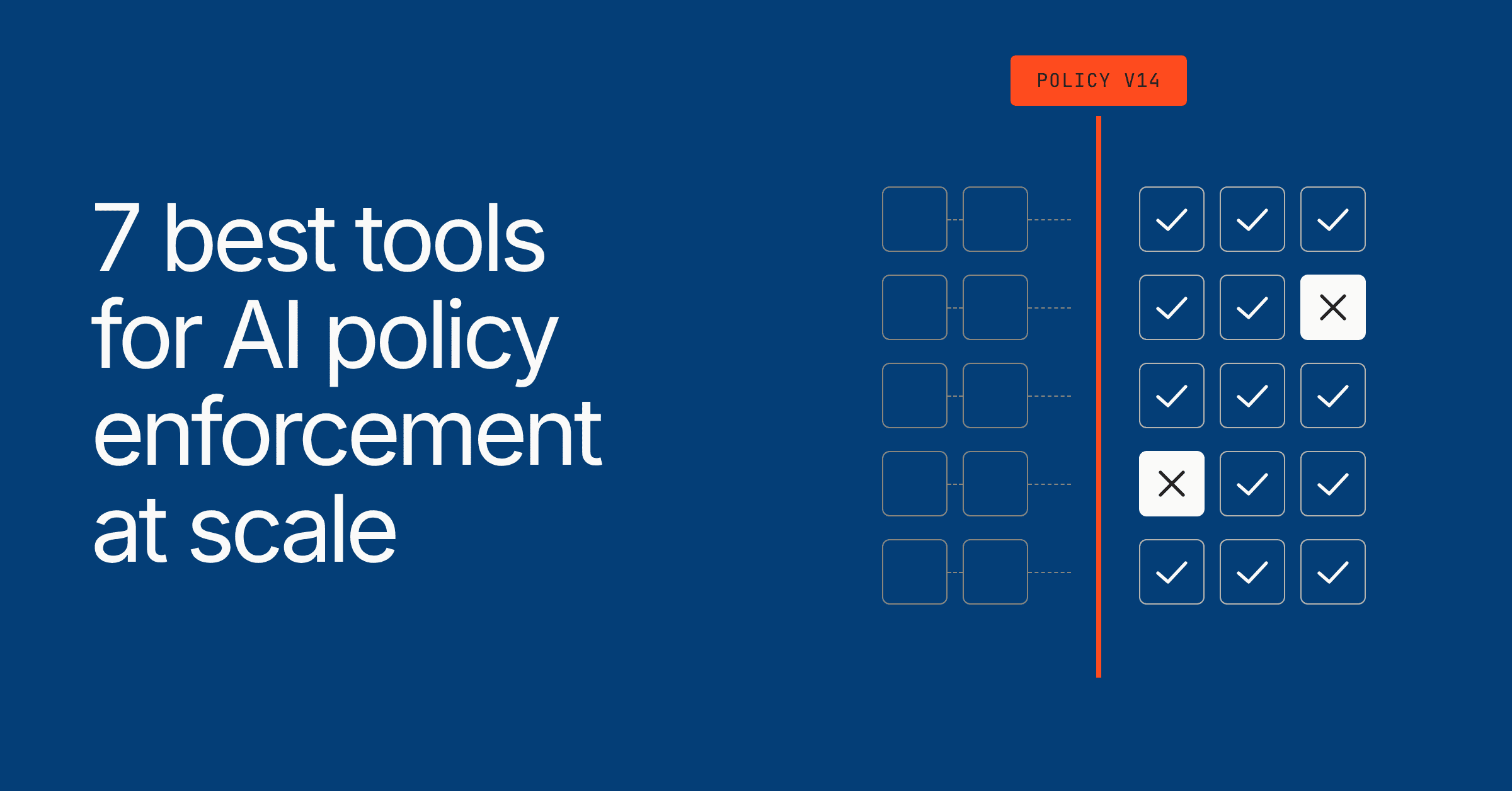
Writing an AI policy takes a week. Making it hold on the ten-thousandth agent call, in a cloud account nobody on the governance team has ever logged into, is a different job.
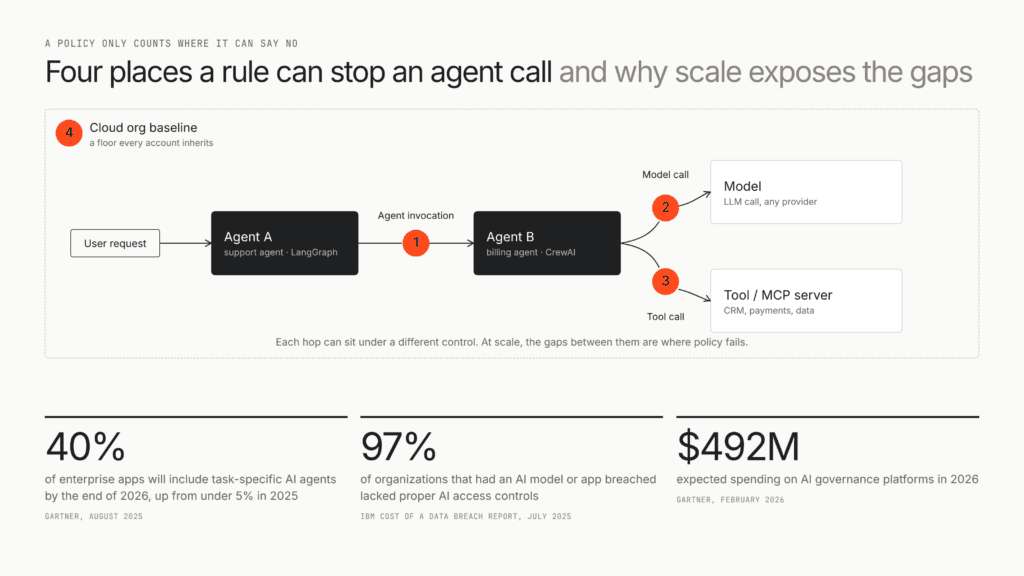
That job is getting bigger fast. Gartner expects 40% of enterprise apps to include task-specific AI agents by the end of 2026, up from under 5% in 2025. Meanwhile, IBM’s 2025 breach study found that 13% of organizations had a breach involving an AI model or application, and 97% of those lacked proper AI access controls. Rules on paper didn’t help. Nothing applied them.
This guide compares seven tools by the one thing that matters at volume: whether your rule actually runs on every call, everywhere your agents live.

Get the short answer
Every tool below blocks bad calls somewhere. The real difference is how far one policy travels and what you can do once an agent misbehaves. Match your setup to a line, then jump to that review.
- Agents span several clouds and frameworks, and you want one rulebook that refuses calls in the request path and can quarantine an agent? Lyzr Opencontroller.
- Everything runs on Amazon Bedrock and AgentCore? Bedrock Guardrails with AgentCore Policy.
- Your estate is Google Cloud and Gemini? Google Cloud Model Armor.
- Azure and Foundry are home, and you want fixes at fleet scale? Microsoft Foundry Control Plane.
- Security owns AI risk and already runs Palo Alto? Prisma AIRS.
- Your platform team already runs Kong for APIs? Kong AI Gateway.
- A few engineers want open-source rails inside one or two apps? NVIDIA NeMo Guardrails.
A policy only counts where it can say no
Ask a vendor “do you enforce policy?” and everyone says yes. The better question is where. In an agent system, a rule can bite at four points: when one agent invokes another, when an agent calls a model, when it calls a tool or MCP server, and at the cloud boundary as an organization-wide baseline.
Most tools cover one or two of those points well. At scale that leaves gaps, because agents don’t stay put. A support agent built on LangGraph in AWS calls a model in Azure and a tool exposed through someone’s MCP server, and each hop may sit under a different control.
Gartner sees the same sprawl from the budget side. It expects spending on AI governance platforms to reach $492 million in 2026, and its survey of 360 organizations found those using such platforms were 3.4 times more likely to achieve highly effective AI governance.
How we judged scale
We read public documentation and announcements as of October 2026. Lyzr publishes this guide and lists its own product first; where another tool is the better fit, we say so.
| Test | The question behind it |
|---|---|
| Reach | Does one policy apply across accounts, clouds and frameworks, or one environment? |
| Blocking | Can it refuse a call in the request path, or only flag it afterwards? |
| Agent and tool coverage | Does it see agent-to-agent and tool calls, not just prompts? |
| Containment | Can you cap spend or cut off a misbehaving agent without redeploying it? |
| Evidence | Does every decision leave a record an auditor can read? |
Seven best tools for AI policy enforcement at scale
Lyzr Opencontroller: one rulebook in the request path
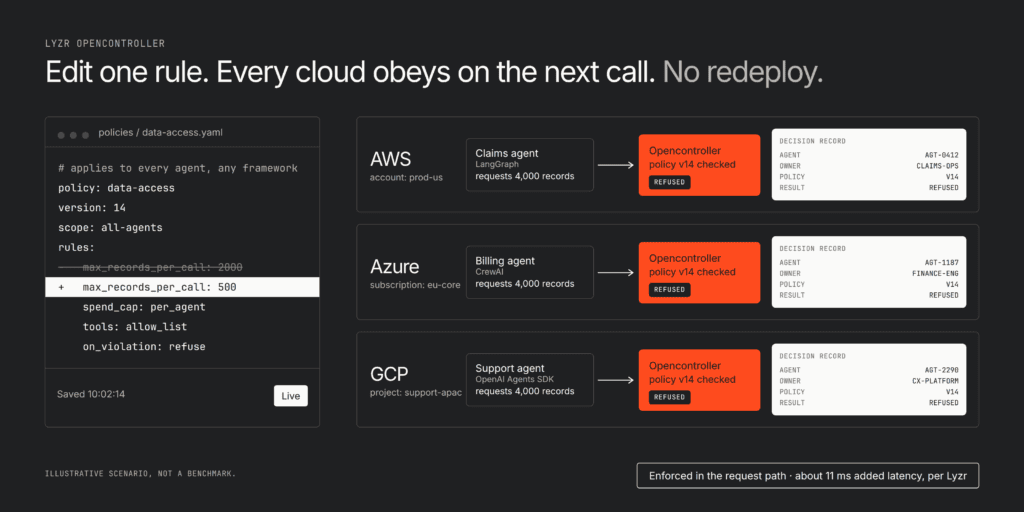
Opencontroller puts two gateways in front of your estate, one for agent invocations and one for model calls. Each call is authenticated, authorized, metered and traced, then checked against policy and refused in the request path if it breaks a rule. Lyzr measures the added latency at about 11 ms.
Because enforcement happens at the gateway, the same rule covers agents built on LangGraph, CrewAI, Google ADK, the OpenAI Agents SDK, the Claude Agent SDK, Temporal or hand-written code. It discovers agents, models, tools and data across clouds, accounts, Kubernetes clusters and SaaS-embedded agents. Spend limits reject calls once a user, agent or project budget runs out, and quarantine refuses every call to or from a misbehaving agent within seconds. It runs in your own AWS, GCP or Azure account, or on-premises and air-gapped.
Good fit if
- Your agents span more than one cloud or framework and you want a single policy layer above them.
- Agent traffic and logs must stay inside your own infrastructure.
Look elsewhere if
- You only run on one hyperscaler and its native guardrails already cover your use cases.
- You mainly need content filters inside a single chatbot. An in-app library is lighter.
Before you size a rollout, the free AI Agent Sprawl Audit shows how many agents you’d actually be governing.
2. Amazon Bedrock Guardrails and AgentCore Policy: AWS-wide floors
Since April 2026, Bedrock Guardrails can be enforced across accounts. A guardrail set in the management account is attached to an AWS Organizations policy and applied to model invocations in every member account, with account and application guardrails layered on top. For tools, AgentCore Policy (generally available since March 2026) checks each agent-to-tool request at AgentCore Gateway against Cedar rules, which teams can write in plain language.
Strongest when: your models, agents and tools all live on AWS.
Falls short when: traffic leaves AWS or you need agent-to-agent rules.
3. Google Cloud Model Armor: floor settings down the resource tree
Model Armor screens prompts and responses for prompt injection, sensitive data and harmful content. Its floor settings set a minimum standard at organization, folder or project level that every template must meet, and apply inline protection to Gemini models and Google Cloud MCP servers. Through Agent Gateway on Gemini Enterprise Agent Platform, it also screens traffic between agents, MCP servers and external LLMs, either blocking or logging only.
Strongest when: your AI agent guardrails need to follow Google Cloud’s org hierarchy.
Falls short when: much of your traffic runs outside Google Cloud.
4. Microsoft Foundry Control Plane: fleet-wide fixes for Azure
Foundry Control Plane sets guardrail policies at subscription or resource group level. Azure Policy flags deployments that miss the required content filters or prompt shields, and admins fix them from one dashboard, while the deployment’s own guardrails do the runtime blocking. Through AI Gateway, built on Azure API Management, it enforces token-per-minute limits and token quotas per project. Admins can stop Foundry agents or block requests to registered custom agents.
Strongest when: Azure is your center of gravity and remediation at volume matters.
Falls short when: most agents run outside Azure or the data must stay self-hosted.
5. Palo Alto Networks Prisma AIRS: enforcement from the security side
Prisma AIRS 3.0, launched in March 2026, inventories agents, models and connections across cloud, SaaS and endpoints, then red-teams them. In July 2026, Palo Alto made its Prisma AIRS AI Gateway generally available, built on its Portkey acquisition. It routes LLM, MCP and agent-to-agent traffic, inspects it inline, and sets budgets and rate limits per team or application. It runs as SaaS or hybrid, with the data plane in your own Kubernetes cluster.
Strongest when: your CISO owns AI policy and already runs Palo Alto.
Falls short when: you need fully on-premises or air-gapped deployment, or policy owned outside security.
6. Kong AI Gateway: policy for LLM, MCP and A2A traffic
Its MCP Tool ACLs start from deny-all, grant access tool by tool per consumer or group, and log every attempt. Version 3.14, released in April 2026, added Agent Gateway for agent-to-agent traffic. Plugins handle semantic prompt guarding, PII sanitizing and token-based rate limits. It runs as SaaS in Konnect or self-hosted.
Strongest when: a platform team already runs Kong and wants AI rules in the same place.
Falls short when: you need agent discovery or a one-click way to cut off an agent.
7. NVIDIA NeMo Guardrails: open-source rails inside the app
NeMo Guardrails is an Apache 2.0 toolkit that adds input, output, dialog, retrieval and execution rails to an LLM application, with flows written in Colang. LLM-based self-check rails add a model call per check, and every app carries its own config.
Strongest when: one team wants fine control over a few applications.
Falls short when: you need one policy enforced across hundreds of agents you didn’t build.
All seven against the scale tests
| Capability | Lyzr | Bedrock + AgentCore | Model Armor | Foundry | Prisma AIRS | Kong | NeMo |
|---|---|---|---|---|---|---|---|
| One policy across clouds and frameworks | ✅ | ❗ | ❗ | ◐ | ✅ | ✅ | ❗ |
| Refuses a call before it executes | ✅ | ✅ | ✅ | ◐ | ✅ | ✅ | ✅ |
| Governs agent-to-agent calls | ✅ | ❗ | ◐ | ❗ | ✅ | ✅ | ❗ |
| Authorizes individual tool and MCP calls | ✅ | ✅ | ◐ | ◐ | ✅ | ✅ | ◐ |
| Spend or token limits per agent | ✅ | ❗ | ❗ | ◐ | ◐ | ✅ | ❗ |
| Stops or quarantines a live agent | ✅ | ❗ | ❗ | ✅ | ❗ | ❗ | ❗ |
| Discovers agents across the estate | ✅ | ❗ | ❗ | ◐ | ✅ | ❗ | ❗ |
| Self-hosted, on-premises or air-gapped | ✅ | ❗ | ❗ | ❗ | ◐ | ✅ | ✅ |
Key: • full · ◐ partial, limited to one platform, or project/team level only · ○ not documented publicly. Editorial assessment from public documentation, October 2026.
Our view: native cloud guardrails are the cheapest good decision you can make, so switch them on today. They just stop at the edge of their own cloud. Gateways from Palo Alto and Kong travel further, but they govern traffic, not the agent itself. If you also need to find every agent, cap its budget and pull it offline in seconds, you want a control layer built around agents.
Run the scale test in a demo
Ask each vendor to run this live, with your own agents:
- Change one rule, such as a per-agent spend cap or a blocked tool.
- Time how long until the next call in a second account or cloud obeys it.
- Trigger the rule from an agent built on a different framework than the demo agent.
- Pull the decision record: which policy version, which agent, which owner.
If step 2 needs a redeployment, or step 3 fails, you’ve found the edge of that tool’s reach. For the wider rollout plan, the How to Take Agents to Production playbook pairs well with this test.
See one policy hold across your estate
Opencontroller enforces your rules on live agent and model calls, across clouds and frameworks. Bring a real policy to the demo and watch it refuse a call.
Book a demo of Opencontroller →
FAQ
Guardrails usually filter content in prompts and responses. Policy enforcement is wider: who may call which agent, tool or model, how much they can spend, and what happens when they break a rule.
It adds some time. Lyzr measures about 11 ms for Opencontroller. Rails that call an LLM to check each message add a full model call, so ask every vendor for measured numbers.
Not with gateway-based tools. Opencontroller, Kong and Prisma AIRS sit in the request path, so a rule changes in one place and every agent behind the gateway follows it. AgentCore Policy also works outside agent code, at AgentCore Gateway. In-app libraries such as NeMo Guardrails are configured inside each application, so every app needs its own update.
Partly. Opencontroller discovers agents embedded in SaaS platforms alongside the ones on your clouds and Kubernetes clusters, so they show up in one inventory. Blocking a call is a different matter: it only works when that agent’s traffic passes through your gateway. Before you buy, ask each SaaS vendor how its agents reach models and tools.
Book A Demo: Click Here
Join our Slack: Click Here
Link to our GitHub: Click Here