Key Takeaways
- A self-improvement loop turns failures and feedback into candidate changes, then tests them.
- A useful loop has execution, trace capture, evaluation, diagnosis, modification, verification and retention.
- Reflection improves one response. Self-improvement changes future behaviour.
- Memory stores what was learned. Evaluation decides whether it helped.
- A change shouldn’t automatically become the production version.
- Enterprise loops need versioning, evaluation gates, observability, approval and rollback.
An agent can pass every pre-launch evaluation and still start failing in ways the test set never covered. A support agent keeps misrouting one type of request. A research agent makes the same evidence-selection mistake. A coding agent gets the same reviewer correction across ten tasks.
Normally an engineer has to spot the pattern, edit the prompt or code, rerun evaluations, deploy and watch the result. An AI agent self-improvement loop tries to connect those steps. The agent doesn’t just produce another answer. The system turns experience into a controlled change and tests whether that change improves future behaviour.
What is an AI agent self-improvement loop?

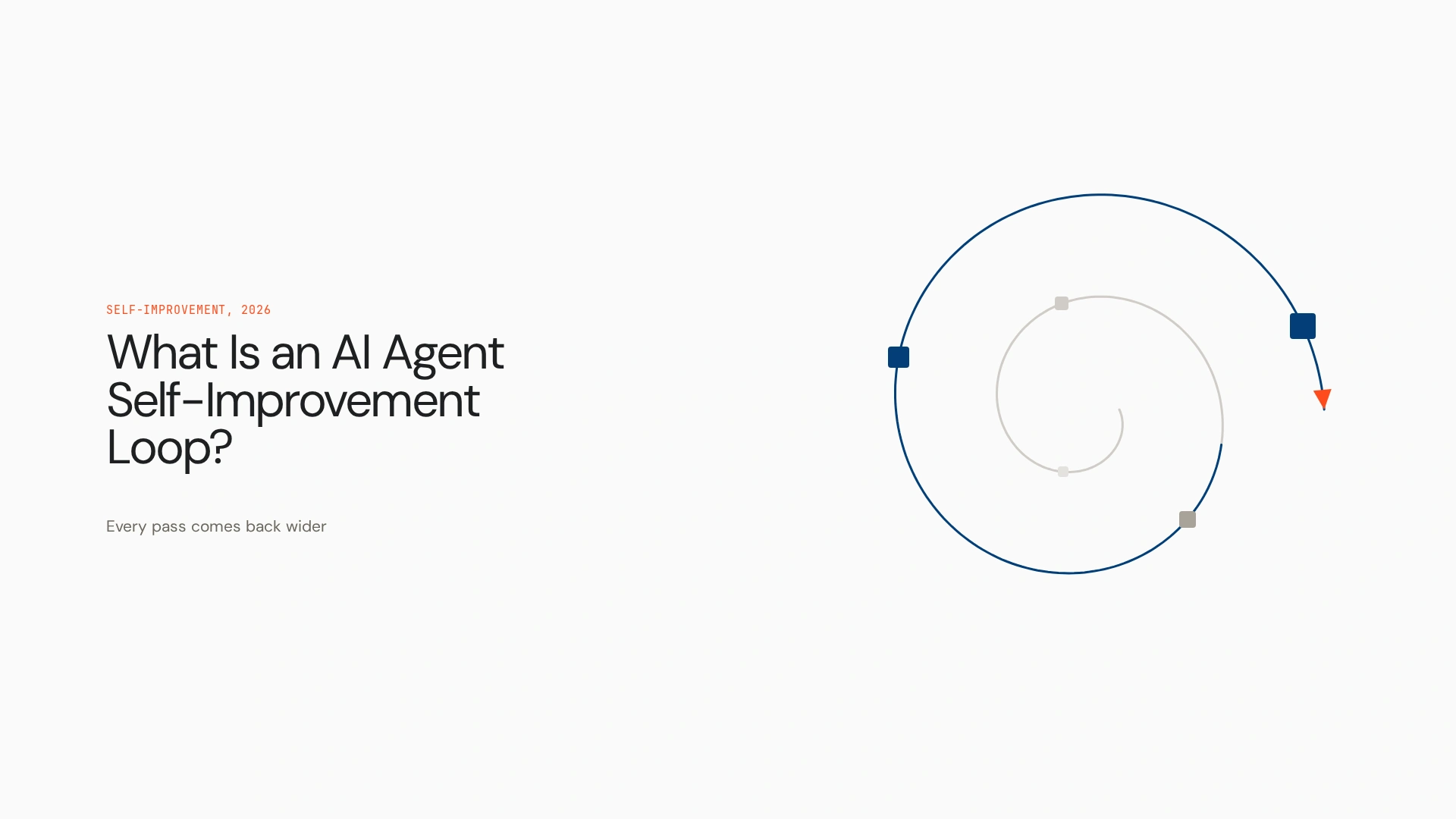
An AI agent self-improvement loop is a closed-loop workflow in which an agent’s behaviour is observed, evaluated, diagnosed, modified and tested again, so that verified improvements become part of its future behaviour.
“Self” doesn’t mean the foundation model retrains itself. What improves is usually the system around the model: instructions, prompts, tool selection, tool parameters, workflow, skills, memory, retrieval, routing, validation rules or code. OpenAI’s improvement-loop cookbook defines this as the harness, the full contract around the model, including instructions, tools, routing, output requirements and validation checks. The model can stay unchanged while the harness improves a lot.
The seven stages of the loop

- Execute. The agent does a real task. Capture inputs, outputs, tool calls, intermediate steps, errors, latency, cost and outcome.
- Capture evidence. Store the trace and context. Without a record of what happened, there is nothing to diagnose.
- Evaluate. Decide whether the result met the standard, using deterministic tests, ground-truth data, rubrics, human feedback, model-based evaluators, tool-call success or business outcomes. The loop can only improve reliably if it can measure improvement reliably.
- Diagnose. Separate what went wrong from why. Causes include a missing instruction, poor tool selection, weak retrieval, wrong routing, thin context, ambiguous tool schemas or a bad memory.
- Propose a change. A prompt update, behavioural rule, tool strategy, skill edit, memory update, retrieval adjustment, routing change or code change.
- Verify. Run the modified agent against regression cases, previous failures, benchmark tasks, hidden evaluations, safety checks and cost and latency limits. The new version has to beat the old one.
- Retain or reject. Keep improvements as versioned changes and discard the rest. A system that can generate changes but can’t reliably reject bad ones isn’t trustworthy.
What can an agent actually improve?
| Improvement target | Example | Risk |
|---|---|---|
| Memory | Remember a validated procedure | Lower |
| Prompt or instructions | Add a missing decision rule | Lower |
| Skill | Improve a reusable workflow | Medium |
| Tool use | Select a better API | Medium |
| Retrieval | Improve source selection | Medium |
| Routing | Send tasks to a different agent or model | Medium |
| Harness | Change instructions, tools and validation together | Higher |
| Code | Modify the agent implementation | Higher |
| Model or policy | Change model or system-level behaviour | Higher |
Self-improvement is a spectrum. Not every system should be allowed to modify its own code, and the next section compares reflection, self-correction, and self-improvement to clarify the differences.
Reflection vs self-correction vs self-improvement
| Pattern | What changes | Time horizon |
|---|---|---|
| Reflection | Current reasoning or output | Same task |
| Self-correction | Current output or action | Same task |
| Memory | Future context | Future tasks |
| Self-improvement | Agent configuration or behaviour | Future tasks |
| Recursive self-improvement | The improvement system itself | Repeated cycles |
Take a support agent that gives a wrong refund-policy answer. Reflection: “My answer may have missed the latest policy.” Self-correction: it revises the answer before replying. Memory: it records the correct policy reference. Self-improvement: it changes its retrieval or instructions so similar requests come out right. Recursive self-improvement: it modifies the mechanism that discovers and implements those improvements.
An agent that says “my answer could have been better” is reflecting. An improvement loop identifies a recurring failure, records it, proposes a change, tests it, compares it with the previous version, versions the result and monitors whether it persists.
A concrete example: misrouted billing disputes
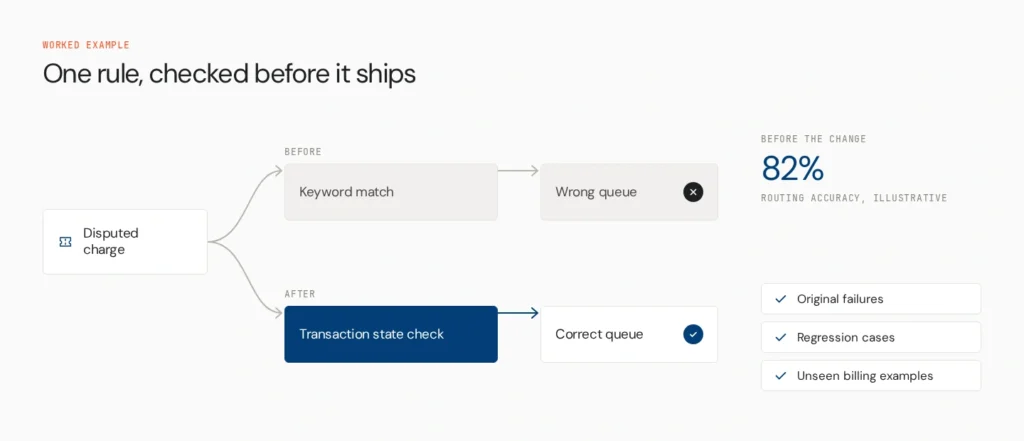
A customer support agent handles simple billing questions well but often routes disputed charges to the wrong queue.
- Trace evidence: production traces show it classifies disputes by keywords, ignoring account state and transaction context.
- Evaluation: a test set shows recurring failures on disputed transactions. In this illustration, routing accuracy is 82% before the change. These numbers are illustrative only.
- Diagnosis: the routing instruction never requires checking transaction status before choosing a queue.
- Candidate change: add a rule requiring transaction-state verification before routing.
- Verification: run the new version on the original failures, regression cases and unseen billing examples.
- Promotion: promote only if routing improves without unacceptable regression elsewhere.
- Monitoring: keep watching traces after deployment.
The loop isn’t “the agent noticed its mistake.” It is the system that converts repeated evidence into a tested, versioned behavioural change.
Why the evaluation layer is the hardest part
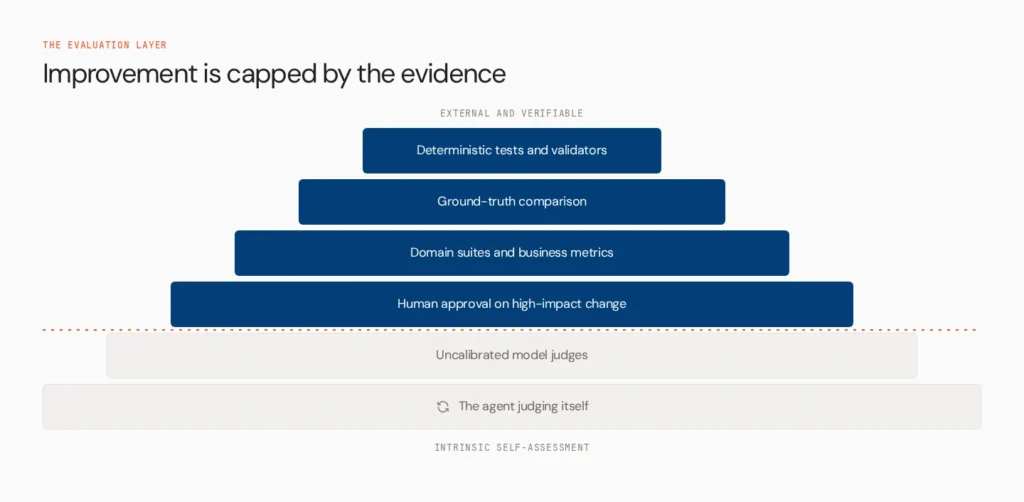
An agent cannot improve beyond the quality of the evidence used to judge it.
Stronger signals include deterministic tests, ground-truth comparison, structured business metrics, formal validators, domain test suites and human approval for high-impact changes. Weaker signals include the agent judging itself, uncalibrated LLM judges, “the response sounds better,” single-run success and internal confidence.
This creates the self-confirming loop problem. If the same model proposes a change, evaluates it and decides it is better, the system can reinforce its own mistakes. Research on self-improvement points to evaluator design as a central issue, and distinguishes external, verifiable signals from intrinsic self-assessment.
Where memory fits
Memory answers “what should the system remember?” Self-improvement answers “what should it change because of what it learned?”
Three kinds matter. Episodic memory records what happened in one task. Semantic memory holds generalised lessons. Procedural memory holds reusable rules, skills and workflows, and is the most relevant here, because a validated lesson can become a behavioural rule.
Don’t write every failure straight to memory. A bad observation becomes a bad rule. The pipeline should run experience, diagnosis, validation, generalisation, then memory, not experience straight to memory.
How self-improving agents avoid getting worse
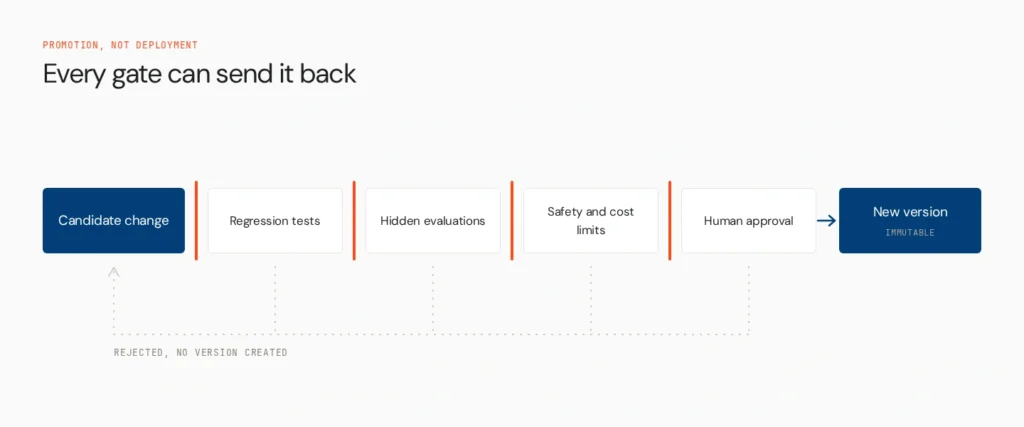
The loop shouldn’t be observe, change, deploy. It should be observe, diagnose, propose, test, compare, approve, version, deploy, monitor.
Useful safeguards include regression tests, hidden evaluation sets, human approval, version control, rollback, change diffs, scope limits, cost limits, safety checks, canary deployment and environment separation. Every improvement should create a new version, never silently modify production state. For reversal, see AI agent rollback patterns for enterprise.
Human-in-the-loop vs autonomous improvement
Human involvement isn’t simply good or bad. Think in levels:
- Human-driven: the agent flags problems, a person makes changes.
- Agent-proposed: the agent proposes, a person approves.
- Automatically tested: the agent proposes, automated evaluation decides, humans review higher-risk changes.
- Policy-bounded autonomy: low-risk improvements promote automatically inside defined limits.
- Fully closed loop: the system proposes, implements, evaluates and promotes without routine approval.
Enterprises should generally aim for level 4, not leap to level 5.
What is recursive self-improvement?
Recursive self-improvement is a system improving the mechanism or implementation that produces its improvements. One loop improves an agent’s search strategy. A second modifies that strategy again based on results. At the extreme, an agent modifies its own code, evaluates the new version and uses it as the next starting point.
Research on AI research agents, such as AIDE², describes recursively modifying an agent’s own code and keeping versions that score best on hidden evaluations. This is a far stronger claim than ordinary production self-improvement. A production agent that updates its prompt after a task isn’t recursively redesigning itself. Even the strong version stays bounded by evaluation quality, compute, search space, safety constraints, permissions and the improvement objective.
How people build this today
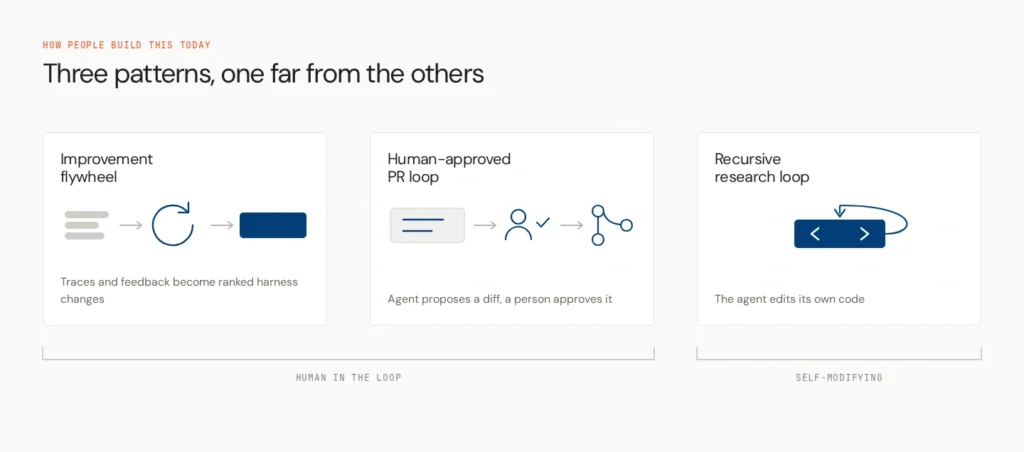
Three patterns show the range.
The improvement flywheel. OpenAI’s agent improvement loop cookbook starts with real traces, adds human and model feedback, converts feedback into Promptfoo evals, ranks harness changes with HALO and produces a Codex-ready handoff. Its value is connecting runtime evidence to concrete harness changes, so feedback doesn’t sit as disconnected comments.
The human-approved PR loop. BerriAI’s open-source self-improving-agent follows a simple pattern: the agent proposes a minimal diff, a person approves and a draft pull request opens. It is MIT-licensed and works with the Claude Agent SDK and other frameworks. It shows version-controlled, human-gated change, not solved autonomy.
The recursive research loop. Code-level self-modification of research agents, as in AIDE², sits at the far end.
Where an AI control plane fits
A self-improvement loop creates changes. A control plane governs which changes are allowed to become production state.
The improvement layer finds problems and proposes changes. The evaluation layer decides whether a change is better. The deployment layer moves an approved version into an environment. The AI control plane surrounds all of it with identity, versioning, evaluation gates, environment promotion, policy, observability, auditability, rollback and lifecycle management.
The loop asks “how can this agent get better?” The control plane asks “which improvement may become the production version, under what policy, and how do we know what changed?”
Lyzr’s Opencontroller is built around that governance layer, centred on registry, identity, evaluation, staged promotion and observability. Lyzr’s Agent Improvement Engine describes a workflow where production traces reveal quality issues, suggested configuration changes appear as diffs and accepted changes create a new agent version.
| Self-improvement loop | AI control plane |
|---|---|
| Finds opportunities to improve | Governs how improvements move through the lifecycle |
| Analyses failures | Tracks production state |
| Proposes changes | Controls promotion |
| Runs evaluations | Enforces evaluation gates |
| Generates candidate versions | Maintains version and lifecycle context |
| Optimises behaviour | Governs identity and permissions |
You need the improvement loop to learn. You need the control plane to operate what it learns safely at scale.
How to build an enterprise loop
- Capture production traces. See AI agent observability.
- Define evaluation signals before allowing autonomous changes.
- Classify recurring failures as prompt, tool, retrieval, memory, routing or infrastructure problems.
- Generate candidate changes, narrow and attributable.
- Test against regression data. Never judge from the triggering example alone.
- Create a version for every accepted change.
- Promote through environments: development, evaluation, staging, production.
- Monitor the new version for persistence.
- Roll back when necessary.
The loop is continuous, but deployment is controlled. The Agents to Production playbook covers readiness.
Improve the system, not just the prompt. If an agent gives unsupported answers, the fix may be retrieval or validation. A wrong tool choice may need better tool metadata or routing. A mistake repeated across sessions points to memory. A correct answer that breaks policy belongs in governance.
How to know the loop is working
Track task success, regression rate, error recurrence, tool-call success, human correction rate, evaluation score, cost per successful task, latency and policy violations. Also track improvement acceptance rate (successful candidate changes divided by candidates evaluated). A high rate isn’t automatically good, because a weak evaluator accepts bad changes. Pair it with regression rate after promotion.
A loop also needs an exit condition: stop when gains fall below a threshold, regression appears, cost exceeds budget, safety constraints break, a candidate fails evaluation or the target is met.
What can go wrong
| Failure mode | What happens | Control |
|---|---|---|
| Self-confirming evaluation | Agent judges its own change better | External, grounded evals |
| Reward hacking | Optimises the metric, not the task | Multiple signals |
| Regression | One task improves, another breaks | Regression suite |
| Memory pollution | A bad lesson persists | Validated memory writes |
| Drift | Unreviewed changes accumulate | Versioning and review |
| Evaluation gaming | Learns the test, not the task | Hidden evaluation sets |
| Cost explosion | Loop runs excessively | Budgets and run limits |
| Unsafe autonomy | High-impact change without review | Policy gates, human approval |
Choosing the right level of autonomy
Keep human approval when the agent can modify production code, control financial actions, change permissions or operate regulated workflows, or when the signal is subjective or failure is costly. Allow bounded automation when changes are low risk, evaluation is deterministic, scope is tight, rollback is immediate and changes are versioned. Consider deeper autonomy only with highly reliable evaluation, strong regression testing, a well-defined objective, safe experiment isolation and fully reversible changes. Don’t recommend unrestricted self-modification for enterprise production.
Learning that survives verification
The goal of self-improvement isn’t endless self-modification. It is measurable improvement that survives verification: learn from behaviour, propose a change, prove it helped, govern its promotion.
The improvement loop is where an agent learns from experience. The control plane is where those improvements become governed production changes. See how Opencontroller connects evaluation, versioning, governance, observability and deployment across the agent lifecycle, or book a demo to see how a governed improvement loop could fit your production architecture.
FAQs
A closed-loop workflow in which agent behaviour is observed, evaluated, diagnosed, modified and re-tested, so verified improvements become part of future behaviour.
An agent whose system changes its own configuration, such as prompts, tools, skills or memory, based on evidence, and verifies the change helps. The model itself usually stays the same.
It executes tasks, captures traces, evaluates results, diagnoses failures, proposes changes, verifies them against tests and retains only changes that improve performance.
Reflection critiques or revises the current output. Self-improvement changes behaviour for future tasks and verifies the change helped.
In bounded ways, yes. Continuous improvement works best with strong evaluation, versioning and rollback, and with human approval for high-risk changes.
A system improving the mechanism that produces its improvements, for example modifying its own code or improvement strategy. It is a much stronger claim than ordinary agent self-improvement.
They record failures in traces, diagnose causes, and turn validated lessons into prompt, skill, tool or memory changes. Unvalidated lessons risk becoming bad rules.
A support agent that misroutes disputes, then receives a tested routing-rule change after traces expose the cause. BerriAI’s open-source self-improving-agent is a human-approved example.
Self-confirming evaluation, reward hacking, regression, memory pollution, drift, cost growth and unsafe autonomy. Strong evaluation, versioning and approval gates reduce them.
They version every change, require evaluation gates, keep human approval for high-risk changes, monitor production behaviour, retain audit trails and make rollback immediate. A control plane applies this across agents.
Book A Demo: Click Here
Join our Slack: Click Here
Link to our GitHub: Click Here