A regulator amends a rule, and the real work begins: finding which of your policies, procedures and controls it touches. Regulatory change management AI shortens that search from months of interviews to a traceable, reviewable recommendation. This guide shows, step by step, how Madison’s regulatory change and coverage agent does it.
TL;DR
- What it is: an AI agent that turns a changed rule into obligations, then traces them through your policies, procedures and controls.
- What AI does: reads the rule, drafts the mapping, finds the gaps.
- What people do: a named owner accepts, amends or rejects every recommendation.
- What sets it apart: it works on a connected model of your compliance estate, not a pile of alerts.
- Where to start: your policy library, not an integration project.
What is regulatory change management AI?
Regulatory change management AI uses language models and agents to run the lifecycle of a rule change: detect it, interpret it, work out what it affects inside the institution, and drive the response. Regulatory change management is the parent discipline. AI takes on the reading, mapping and drafting, and accountable people keep the decisions.
Tools in this category differ on three capabilities:

Most tools stop at monitoring, and some reach interpretation. Impact is where the time goes.
Why alerts alone don’t solve it
Every bank has the rules, the policies and the controls. Nobody has the links between them. The rule is public. The policy sits in a Word file on SharePoint. The procedure is an intranet page owned by operations. The control lives in a manager’s spreadsheet. Six owners, six systems, and nothing recording that all of them concern the same duty.

So a rule change raises questions no alert can answer. Where do you start? What obligations does it create? Do they apply to us? Which policies, procedures and controls sit under them? And who already knows the answer?
The problem also runs in reverse. When an examination finds a control inadequate, the questions become why it failed, who owns it, and whether the policy missed the obligation entirely. Both directions need one lookup: what attaches to this duty? Madison is built around that lookup. For the wider picture, see our guide to AI in risk and compliance.
How Madison models your compliance estate
Madison holds regulations, obligations, policies, procedures, controls, tests, findings and evidence as one connected model called Plexus. One obligation reaches many policies, and one control answers to many obligations. Plexus stores every link in both directions, so the agent can walk from a rule down to a control, or from a failed control back up to the rule.

How Madison’s regulatory change agent works, step by step

- Step 1: Watch the rule sources
The agent does regulatory horizon scanning on public primary sources such as the eCFR, the Federal Register and GovInfo, and detects when a section your institution relies on is amended. Rule text is public, so this step needs no connection to your systems. It applies the same logic as a regulatory monitoring agent to the sources banks are examined against.
- Step 2: Break the change into obligations
A rule section is a citable unit, not a task. The agent decomposes it into atomic obligations: if X, you must do Y within Z days. Each obligation keeps a citation to the rule text it came from, so a reviewer can check the reading against the source.
- Step 3: Decide whether each obligation applies
Applicability depends on charter, size, products and states. The agent tests each obligation against your institution profile and proposes whether it applies. This is a judgement, so the output is a proposal in a review queue, never a silent decision.
- Step 4: Trace the change through policies, procedures and controls
For each applicable obligation, the coverage mapper walks the model outward: which policy carries it, which procedures implement it, and which controls prove the procedure ran. The result is the impact assessment an analyst would otherwise assemble by interviewing policy and control owners.
- Step 5: Surface the gaps
Madison flags three kinds of gap: obligations with no policy behind them, policies covering nothing, and obligations with a policy but no control. Teams get a coverage map instead of a hunch. For a closer look at this pattern, see the compliance gap analysis agent blueprint.
- Step 6: Recommend the action and route it to a named owner
The agent drafts the recommended change, such as an amendment to a specific policy section, and routes it to a named person to accept, amend or reject. Madison never remediates on its own, and every recommendation traces back to the rule text it came from.
- Step 7: Record the decision and keep the map current
Each accepted recommendation updates the model and leaves an audit trail: what changed, who approved it, and when. The map stays fresh because it rides review cycles you already run, such as annual policy reviews and control testing, instead of depending on a one-off clean-up.
A worked example
This walkthrough is illustrative, not a real amendment. Suppose a hypothetical change alters what a periodic statement must contain under Regulation Z (12 CFR Part 1026).

- The agent detects the amended section from the public source.
- It extracts a new periodic statement content obligation, with the citation attached.
- It tests applicability against the bank’s products and proposes that the obligation applies to consumer lending.
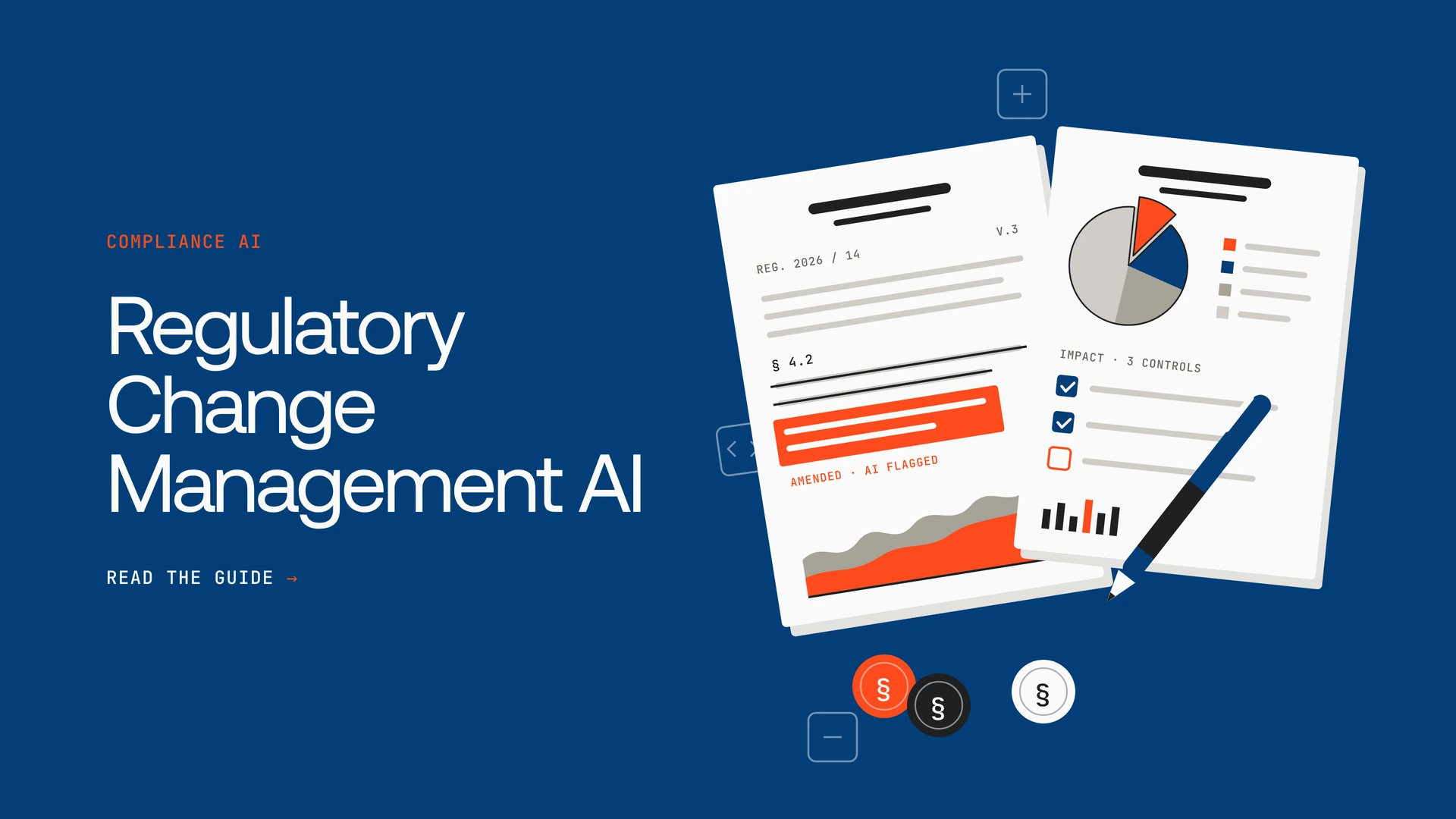
- It traces the obligation to §4.2 of the Consumer lending policy, the statement generation procedure, and the quarterly statement content review control.
- It flags that the review control does not yet test the new content element.
- It recommends amending §4.2 and updating the control, and routes both to the owning compliance officer.
- The owner accepts the policy change, amends the control wording, and the decision is recorded.
Where people stay in control

Madison separates judgement from mechanics. Steps that involve judgement, such as reading a rule or deciding applicability, produce proposals that wait for a named person. Mechanical steps, such as fetching a source, run directly.
Two design rules protect accuracy:

What to look for in regulatory change management software
| Approach | What you get | What is missing |
|---|---|---|
| Alert-only monitoring | Notice that a rule changed | Which of your policies and controls it touches |
| Document-level AI summaries | A plain-language summary of the change | Obligation-level traceability to your own estate |
| Connected-model agents (Madison’s approach) | Obligations, applicability, coverage gaps and cited recommendations | Needs your policy library as input |
When you evaluate regulatory change management tools, ask six questions:
- Does it work at the obligation level, or only at the document level?
- Does it map to your own policies, procedures and controls?
- Does it work both ways, from a change down to controls and from a failed control up to the rule?
- Does every output cite the rule text?
- Is there a named human approval and an audit trail?
- Can it deliver a first useful result from a folder of documents?
For banks sizing up the market, our overview of AI agents for mid-size banks covers where compliance fits among other priorities, and the AI for banking page shows the wider set of banking use cases.
What happens in a first working session
You bring your policy library as it stands today. Madison maps what you already have and shows you every gap. You leave with a coverage map of your own library and the gaps in it. There is no write-back to your core banking system.
Frequently asked questions
What is regulatory change management AI?
It is AI that detects rule changes, interprets the obligations they create, maps them to an institution’s policies, procedures and controls, and drives the response, with people approving each decision.
How does AI help with regulatory change management?
It automates the reading, extraction, mapping and drafting that consume analyst time, keeps a citation to the rule text, and leaves compliance staff to focus on judgement and sign-off.
How does regulatory change management software work?
Most platforms follow four stages: monitor sources, interpret changes, assess impact, and track implementation. Madison adds a connected model so impact is traced through your actual policies and controls rather than guessed.
What are the steps in regulatory change management?
The core steps are identify the change, interpret it, assess applicability and impact, implement the response, and evidence it. Madison’s seven steps above map onto these.
Can AI replace compliance officers in regulatory change management?
No. Madison’s agents propose, and a named person accepts, amends or rejects each recommendation. AI reduces the manual effort, and accountability stays with people.
How accurate is AI at mapping regulations to policies and controls?
Accuracy depends on grounding. Each mapping cites the rule text and your own documents, and a reviewer confirms it before it counts. We do not publish an accuracy percentage, because it varies by institution and document quality.
What is the difference between regulatory monitoring and regulatory change management?
Monitoring tells you a rule changed. Regulatory change management covers the whole arc: interpreting the change, assessing impact, implementing the response and documenting it.
How do banks manage policies and procedures when regulations change?
Traditionally through interviews, spreadsheets and annual reviews. With a mapped model, the policy owner instead receives a specific recommendation tied to the rule and the affected controls.
Does Madison need integration with our core banking system?
The coverage map starts from your policy library, with no write-back to your core system. Evidence retrieval and control testing, where used, need read-only connectors.
Who is regulatory change management AI for?
Compliance analysts and Chief Compliance Officers who answer to regulators and examiners. Madison is built for US banks and credit unions.
See it on your own policy library
Book a working session with your compliance team and leave with a coverage map of your own library.
Book A Demo: Click Here
Join our Slack: Click Here
Link to our GitHub: Click Here