In most companies running LLMs today, somewhere there is a fine-tuned model or a customized prompt sitting in production that nobody remembers registering anywhere.
Gartner expects more than 80% of enterprises to have used generative AI APIs or deployed GenAI applications in production by 2026, up from under 5% in 2023, and the tooling teams use to track what they have built has not caught up nearly as fast. Most are still pointing the same model registry they built for a spam-detection classifier at a fine-tuned LLM, and finding out the hard way that it was never built for this.
Key Takeaways
- An LLM model registry catalogs and versions foundational and fine-tuned language models, along with the adapters, prompts, and tokenizers that shape how each version behaves.
- It is structurally different from a traditional ML model registry: different artifacts, a different lineage problem, and evaluation that runs on judgment instead of a confusion matrix.
- A fine-tuned adapter like a LoRA layer is meaningless without the exact base model version it was trained against, and most registries still do not enforce that link well.
- A registry tells you what you have and whether a version is approved. It does not tell you what is actually running in production right now, which is a separate job.
What is an LLM model registry?
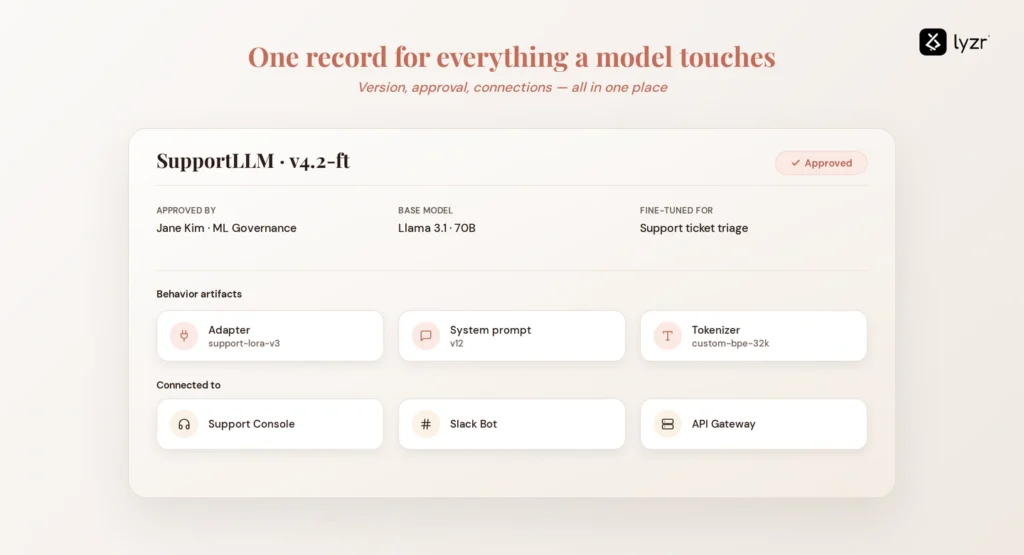
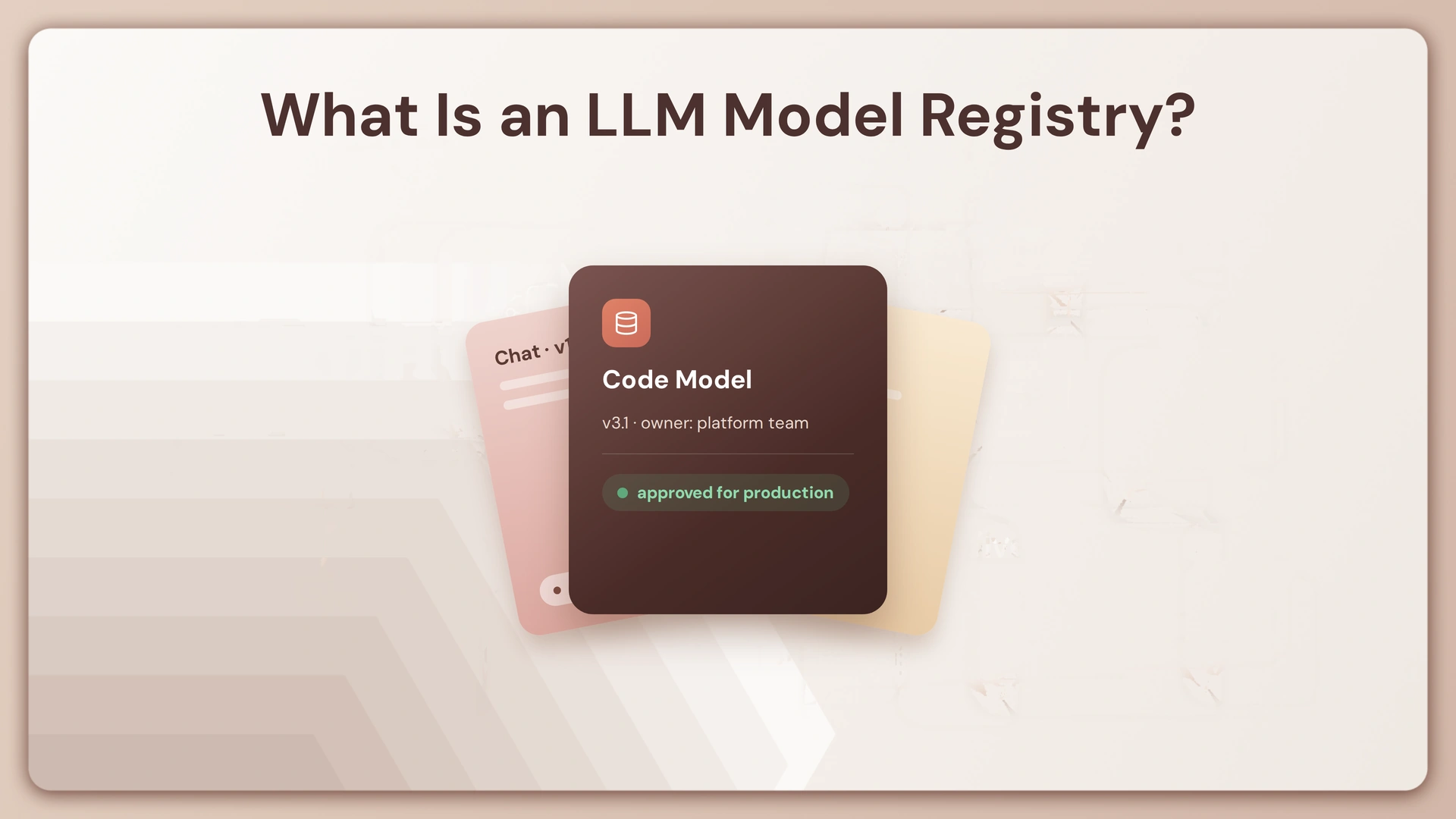
An LLM model registry is a centralized system that catalogs, versions, and governs the lifecycle of foundational and fine-tuned large language models, along with the artifacts that shape their behavior, like adapters, system prompts, and tokenizers. It exists so a team has one place to check which version of a model is running, who approved it, and what it is connected to. But an LLM is not a classifier. It generates open-ended text instead of a fixed label, and that difference is large enough to break most of the assumptions older registry tooling was built on.
Why your ML model registry doesn’t fit an LLM
Picture a team that already runs a standard ML model registry for its fraud-detection and churn models. They start fine-tuning an open-source model like Llama 3 for a support use case and, reasonably, try to register it the same way. It works only halfway.
The registry logs the file, but it will not tell anyone which base checkpoint the adapter was trained against, what the system prompt looked like at evaluation time, or why the toxicity score dropped two points in the last run. That is not a flaw in any one vendor’s tooling. These tools were built to catalog a mathematical function with a fixed input and output, and a fine-tuned LLM is a different kind of thing to catalog.
Traditional ML model registry vs. LLM model registry
| Dimension | Traditional ML model registry | LLM model registry |
| Primary artifacts | Trained classifier or regression weights, feature pipelines, environment files | Base foundational models, fine-tuned adapters (LoRA, QLoRA), system prompts, tokenizers |
| Dependency tracking | Code, library versions, hyperparameters, a specific training data snapshot | Which upstream base model and version an adapter was trained against, plus the exact prompt template it was tuned for |
| Evaluation metrics | Static, deterministic metrics: accuracy, F1, MAE, ROC-AUC | Dynamic, semantic metrics: perplexity, toxicity, bias, groundedness, benchmark suites like MMLU, LLM-as-judge scores |
| Size and storage | Megabytes to low gigabytes per model | Tens to hundreds of gigabytes per fine-tuned model, sometimes into the terabytes |
| Governance and safety | Data drift monitoring, role-based access control | Guardrail alignment, RLHF or DPO tuning history, prompt-injection vulnerability records, logged per version |
Why evaluating an LLM looks completely different
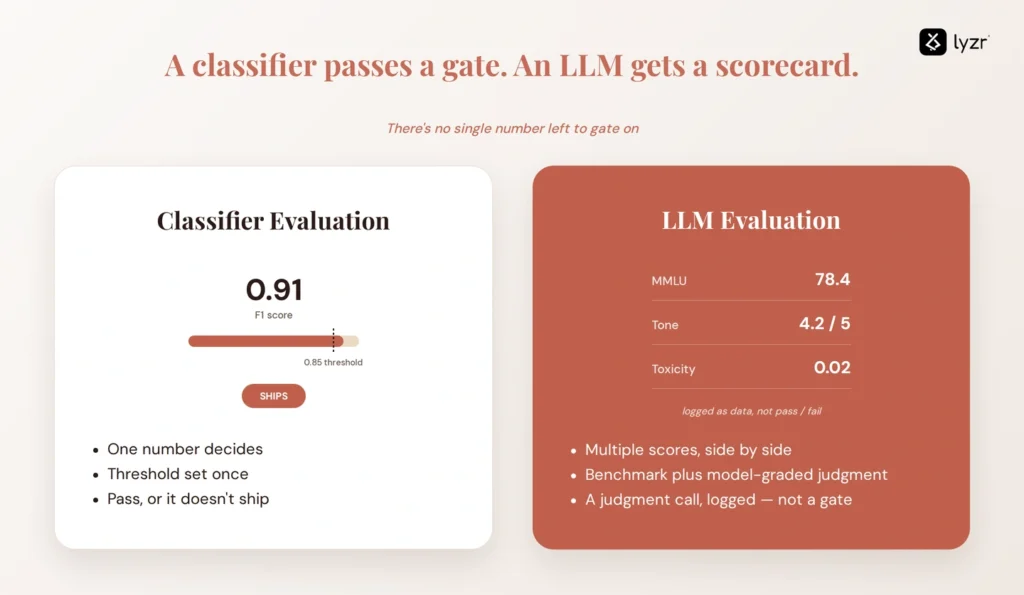
A classifier either gets the label right or it does not, so a registry can gate promotion on a single number: if F1 drops below a set threshold, the model does not ship. An LLM offers no such luxury. Two outputs can both be grammatically perfect and wrong in different ways, or the same prompt can return a different answer twice in a row. That is why LLM registries store results from benchmark suites like MMLU alongside softer, model-graded scores for tone and toxicity. It is a judgment call logged as data, not a pass or fail.
Why governance means something different too
A traditional registry’s governance job is mostly access and provenance: who can promote a model, and can you prove which dataset trained it. An LLM registry inherits that job and adds a second one, because the risk here is not only a bad prediction; it is the wrong sentence going out under a company’s name.
That’s why the LLM side of the table includes guardrail alignment, RLHF or DPO tuning history, and prompt-injection vulnerability records, logged against the specific version rather than the model family. The EU AI Act, NIST’s AI Risk Management Framework, and ISO/IEC 42001 all point in the same direction: a paper trail for what a model was tuned to refuse, not just how accurate it is.
Key components of an LLM model registry
If you strip away the vendor-specific dashboards, and most LLM registries are organized around these four things.
1. Model and adapter versioning
Every checkpoint of the base model and every fine-tuned adapter gets its own version, so a LoRA or QLoRA adapter stays linked to the exact base release it was trained against. Miss that link and the adapter can become unusable the moment someone quietly updates the base model underneath it.
2. Prompt and configuration tracking
System prompts, prompt templates, and tokenizer versions get versioned the way code does. This is newer territory for most tooling. Treating a prompt template as a first-class, versioned artifact, the way a hyperparameter file gets versioned, is still the exception rather than the rule, which is a real gap given how much of an LLM’s behavior a prompt controls.
3. Lineage and dependency mapping
Because almost nobody trains a foundation model from scratch, the registry has to answer a chain of questions: which base model, which fine-tuning run, which dataset snapshot, and which prompt version produced this exact artifact. Break any link and reproducing, auditing, or rolling back the model gets a lot harder.
4. Evaluation and benchmark logging
Results from suites like MMLU sit alongside narrower, task-specific evals and semantic scoring for tone, bias, and groundedness, logged against the version measured, so someone can answer “why did we approve this” months later without re-running the whole evaluation.
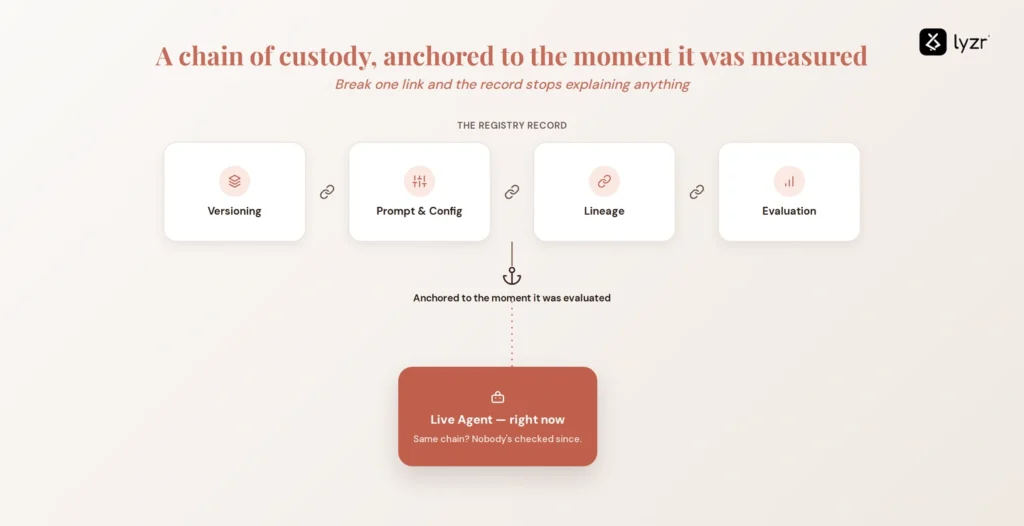
Put together, these four components answer one useful question: what do we have, and did this version clear the bar set for it. That is a record, fixed at evaluation time. It does not say whether that approved version is the one a customer-facing agent is actually calling right now, three deployments later, or whether its behavior has drifted since the day it passed.
OpenController: where runtime governance picks up
That question raised earlier: what is actually running right now, is a runtime question, not a cataloging one. It is the specific gap OpenController, Lyzr’s control plane for AI agent sprawl, is built to close.
Its Find capability automatically discovers agents, models, tools, data, and workflows across an organization’s entire AI estate, spanning cloud accounts, regions, SaaS vendors, Kubernetes clusters, and edge deployments. In practice, this surfaces the fine-tuned model someone deployed without registering it anywhere, a blind spot every registry has by design.
Once a model like that has been found, Ship evaluates and governs an agent and the models it calls before either reaches production, so a newly discovered model does not sit unreviewed in a spreadsheet. It is the closest thing to a registry’s approval gate, except it is enforced against what is actually deployed, not just what got logged somewhere. After that, Run takes over to monitor agents, applications, APIs, and infrastructure in real time from one control plane, enforcing policy in the request path itself rather than flagging problems after the fact. If a model’s behavior drifts or a call violates policy, that is where it gets caught, not in next quarter’s audit.
A registry and a control plane are doing different jobs on the same problem: one is the record, the other is the enforcement. Across enterprises adopting LLMs, we keep seeing heavy investment in the first and almost none yet in the second, which is backward from where the actual risk sits.
Getting started with an LLM model registry
If you are setting this up for the first time, resist the urge to buy or build the most feature-complete option on the market before you know what you need. Start by taking an honest inventory of every fine-tune, adapter, and prompt version already running somewhere, including the ones nobody ever officially registered.
Most teams find at least one they had forgotten about. From there, pick tooling that treats prompts and adapters as first-class versioned artifacts, not something bolted onto a registry built for classifiers, and wire your evaluation suite into the approval step so nothing ships without clearing a defined bar. Decide upfront who signs off on what. Then treat the registry as day one of governance, not the whole of it, since the version record only stays accurate if something watches what happens after a model ships.
To see Find, Ship, and Run working together on a live estate, book a demo of OpenController.
FAQ
A centralized system that tracks the version, lineage, and evaluation history of foundational and fine-tuned large language models, along with the adapters, prompts, and tokenizers that define how each version behaves. It gives a team one place to check which version is approved and what it is connected to.
The core difference is what gets tracked. An ML registry versions a classifier’s weights, training data, and deterministic metrics like accuracy or F1. An LLM registry versions base models, adapters, and prompt templates, and evaluates them with semantic metrics like toxicity and groundedness instead of a confusion matrix.
Some platforms are extending their registries to cover both, but most were not built for LLM-specific artifacts like LoRA adapters and prompt templates. Teams often end up running a classic ML registry alongside separate tooling for LLM assets rather than one tool doing both jobs well.
At minimum: the base model and version, fine-tuning or adapter details, the system prompt and template version, tokenizer version, evaluation results including benchmark scores and semantic metrics, and who approved the version for production.
No. A registry records what was approved at evaluation time. It cannot confirm that the approved version is what is actually running in production, or catch behavior drift after deployment. That is a separate, ongoing job handled by runtime monitoring, not cataloging.
A registry answers what models exist and whether a version is approved. A control plane like OpenController answers what is actually running right now, whether it is that approved version, and whether its behavior still matches what was evaluated, enforced in real time rather than through a periodic audit.
Book A Demo: Click Here
Join our Slack: Click Here
Link to our GitHub: Click Here