Your AI agent is almost there. The prompt is getting longer, the examples keep multiplying, and every new edge case seems to need one more instruction.
At some point, you have to ask a less obvious question: is the prompt the problem anymore?
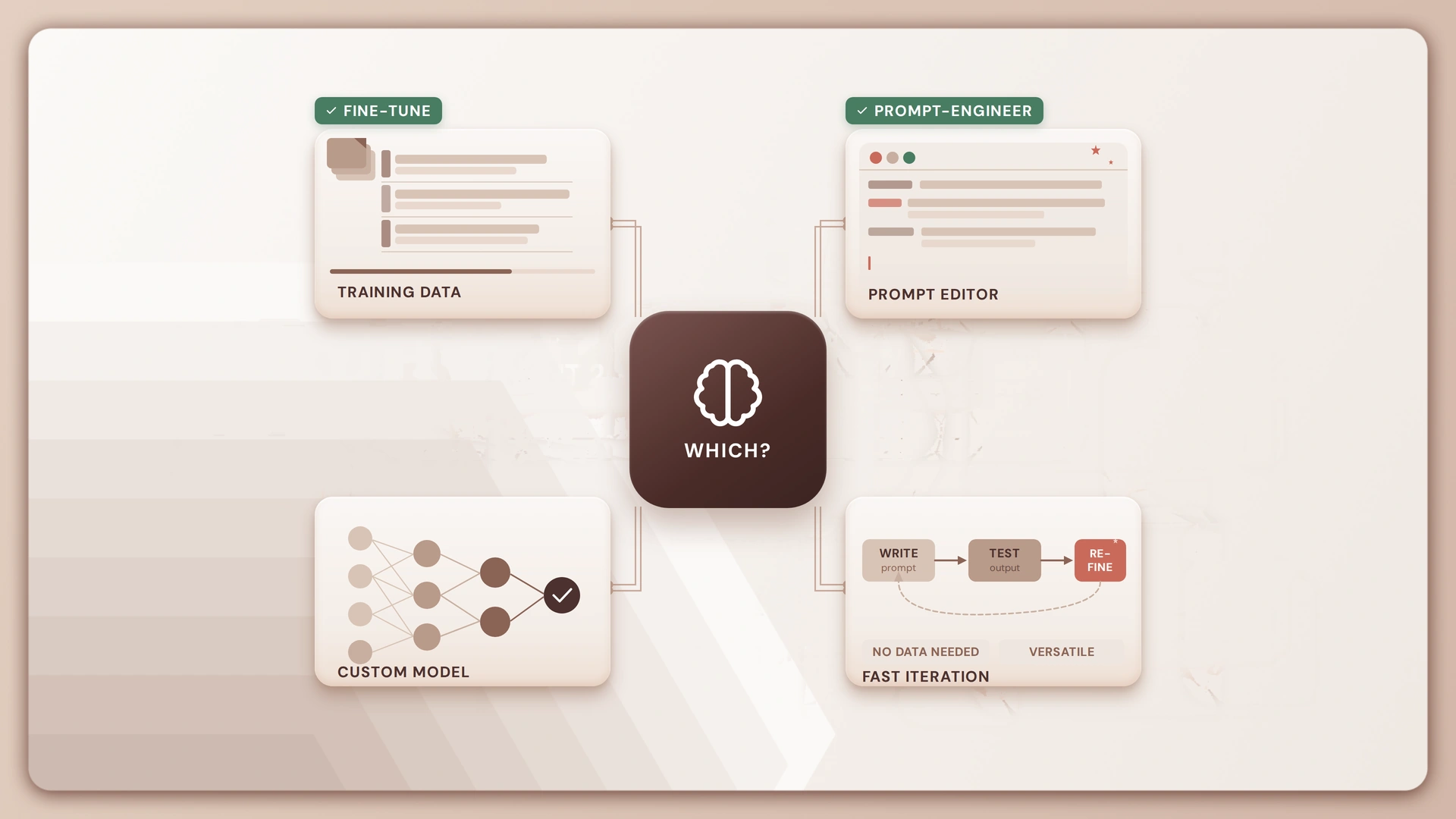
Fine-tuning can change how a model behaves, but it also adds training data, evaluation, versioning, and maintenance to the stack. So the real decision is not prompt engineering vs. fine-tuning. It is knowing which layer is actually failing.
This guide gives you a practical way to make that call, including where RAG, evaluation, tools, and agent architecture fit into it.
First, what are you actually trying to change?
Before choosing a technique, name the problem in one sentence.
A useful rule is simple: prompting changes the instructions, RAG changes the information available at runtime, and fine-tuning changes the model’s learned behavior.
That distinction eliminates a surprising number of unnecessary fine-tuning projects.
| If your problem sounds like… | Start with… | Why |
|---|---|---|
| “The model isn’t following my instructions.” | Prompt engineering | The model may already have the capability. |
| “The model doesn’t know our latest policies.” | RAG | The information needs to be retrieved at runtime. |
| “The output keeps missing the same format.” | Prompting + structured output | Constrain the output before changing the model. |
| “The model needs to use our internal terminology consistently.” | Prompting, RAG, then fine-tuning if needed | First test whether context is enough. |
| “We need the same narrow behavior across millions of calls.” | Fine-tuning | Repeated behavior may be better learned than repeatedly instructed. |
| “The agent keeps choosing the wrong tool.” | Evaluation + prompt/tool design | The problem may be routing or workflow logic, not model knowledge. |
The important part is the last column. Do not fine-tune because a model is imperfect. Fine-tune when the type of imperfection points to a model-behavior problem.
Prompt engineering and fine-tuning solve different problems
It is easy to treat these as two competing ways to “make the model better.” They are not.
Prompt engineering works at inference time. You give the model instructions, examples, constraints, context, and sometimes retrieved information.
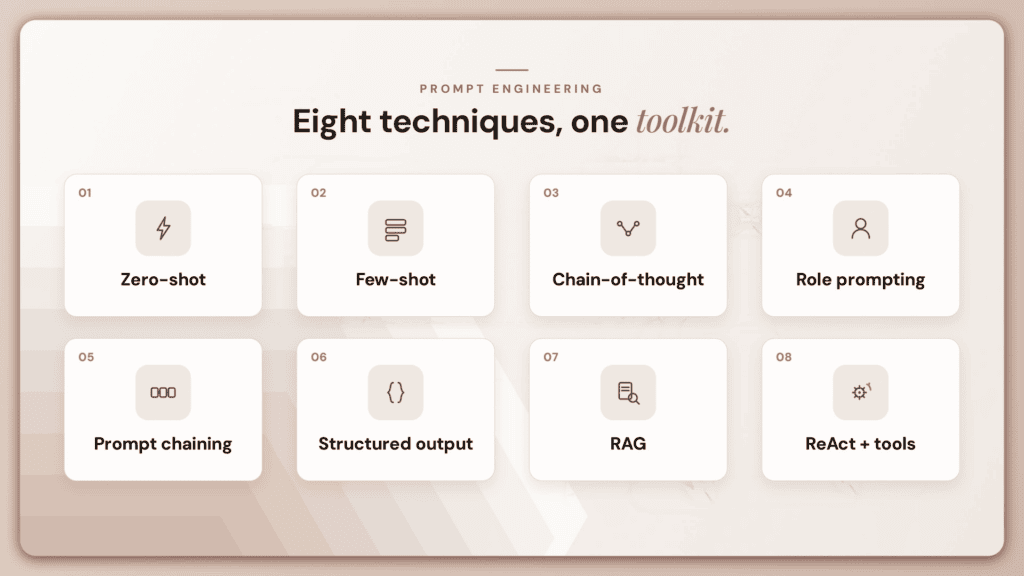
Fine-tuning changes the model itself by training it on examples of the behavior you want.
A quick comparison
| Dimension | Prompt engineering | Fine-tuning |
|---|---|---|
| What changes? | Instructions and context | Model weights |
| Training required? | No | Yes |
| Iteration speed | Minutes to hours | Usually longer |
| Data requirement | A few strong examples can help | Curated training examples |
| Easy to reverse? | Yes | You switch model versions |
| Best for | Flexible behavior, instructions, changing context | Stable, repeated behavior |
| Handles fresh knowledge? | With RAG/context | Poor fit |
| Upfront effort | Low | Higher |
| Maintenance | Prompt/version management | Dataset + model + eval management |
Think of prompting as telling the model how to approach a job.
Fine-tuning is closer to teaching a repeatable habit.
That difference matters even more when you are building an AI agent rather than a one-off chatbot. A production agent can have system instructions, tools, memory, retrieval, guardrails, and multi-step workflows. Changing the model is only one possible lever.
For a broader look at how prompting fits into agent development, see Lyzr’s guide to prompt engineering.
Before you fine-tune, run this 5-minute reality check
Fine-tuning should not be your first debugging step.
Take 20 to 50 representative inputs from production or evaluation data. Run your current system against them and classify the failures. You are looking for a pattern, not a single bad answer.
The failure-pattern checklist
Ask yourself:
- Does the model understand the task when the instruction is explicit?
- Does adding 2 to 5 good examples noticeably improve the result?
- Does the model fail because it lacks information rather than because it behaves incorrectly?
- Would better retrieval or context solve the problem?
- Is the failure repeated across many inputs?
- Can you describe the desired behavior clearly enough to create training examples?
- Do you have enough reviewed examples to measure whether training actually helped?
- Can you evaluate the fine-tuned model against the current baseline?
- Is the task stable enough that the desired behavior will still matter months from now?
If you checked mostly no, fine-tuning is probably premature.
If you checked yes on the last four, you may have a legitimate fine-tuning candidate.
So, when does fine-tuning actually make sense?
The strongest cases have one thing in common: the desired behavior is narrow, repeatable, measurable, and stable.
Here are the situations where the extra work can be justified.
1. The same behavioral failure keeps coming back
You have rewritten the prompt. You added examples. You changed the ordering of instructions. You improved the context.
The model still makes the same kind of mistake.
That is a much stronger signal than simply saying, “the model isn’t accurate enough.”
For example, suppose an insurance classification agent needs to route incoming claims into 12 fixed categories. After several rounds of prompt optimization, it consistently confuses three closely related categories.
If you have hundreds or thousands of reviewed examples showing the correct boundaries, fine-tuning may help the model internalize those patterns instead of spelling out the same rules in every prompt.
2. You need a very consistent output style or format
Some tasks are less about knowing the answer and more about producing it in a very specific way.
Think:
| Task | Desired learned behavior |
|---|---|
| Support ticket classification | Always select one of 8 categories |
| Contract extraction | Return the same field structure every time |
| Brand writing | Follow a highly specific editorial voice |
| Medical coding workflow | Apply a narrow classification scheme |
| Document routing | Map inputs to a fixed set of destinations |
First try structured outputs, schemas, examples, and better prompts.
But if the same formatting or classification behavior must happen across a very large number of requests, fine-tuning can become a more practical option.
3. Your prompts are becoming an instruction manual
This is one of the clearest warning signs.
If your system prompt has grown from 300 words to 3,000 words, and you keep adding exceptions, examples, and “never do X” rules, stop and inspect what is happening.
A long prompt is not automatically bad. Complex agents genuinely need detailed operating instructions.
The question is whether you are using the prompt to describe stable behavior that could be learned.
| What keeps growing | What it may indicate |
|---|---|
| Task instructions | Repeated behavior could be learned |
| Examples | Model needs stronger behavioral guidance |
| Exceptions | Task boundary may need clearer training data |
| Company facts | You probably need RAG |
| Tool rules | Agent/workflow design may be the issue |
| Safety rules | Guardrails should not be replaced by fine-tuning |
This is also where context engineering becomes useful. Before changing model weights, make sure you have designed the context the model actually needs.
4. You need a smaller model to perform a narrow task
This is a less obvious but important reason to fine-tune.
You may not need the most capable general-purpose model for every step of an agent workflow.
If one part of the workflow is simple and repetitive, a smaller model fine-tuned for that exact task may be good enough.
For example:
Large model: decides what the user wants and handles complex reasoning.
Smaller fine-tuned model: classifies the request into one of 20 known categories.
That can make architectural sense when the smaller model is consistently good at the narrow job and the volume justifies the additional model lifecycle.
5. You care about reducing repeated prompt overhead at scale
A long prompt is not just a writing problem.
If a production system sends thousands or millions of similar requests, repeatedly passing the same instructions and examples can affect token usage, latency, and architecture.
Fine-tuning can move some repeatable behavior into the model rather than restating it in every request.
But do the math first.
| Question | What you should measure |
|---|---|
| How many requests do we make? | Requests per day/month |
| How large is the repeated prompt? | Input tokens per request |
| What does it cost today? | Monthly inference cost |
| What would training cost? | Fine-tuning + evaluation + deployment |
| How often will behavior change? | Retraining frequency |
| What happens if quality drops? | Rollback and regression cost |
There is no universal request-volume threshold where fine-tuning suddenly becomes “worth it.” The break-even point depends on the model, pricing, prompt size, traffic, training cost, and how often you need to retrain.
When fine-tuning is the wrong answer
Fine-tuning sounds attractive because it feels like a more permanent fix.
Sometimes that is exactly why it is the wrong fix.
“The model doesn’t know our company data.”
Use retrieval.
If your product catalog, policies, pricing, customer records, or internal documentation changes regularly, you do not want to keep retraining a model just to update facts.
That is where RAG fits.
| Problem | Better first move |
|---|---|
| New company information | RAG |
| Frequently changing policies | RAG |
| Customer-specific information | RAG + access controls |
| Current product catalog | RAG |
| Internal documentation | RAG |
| Stable response behavior | Fine-tuning candidate |
A simple rule helps:
Use retrieval when the problem is “the model needs to know this.”
Consider fine-tuning when the problem is “the model needs to behave this way.”
“The model keeps hallucinating.”
Do not assume fine-tuning will solve hallucinations.
First inspect the information pipeline. Is the model receiving the right context? Is retrieval returning relevant documents? Are citations or source constraints being enforced? Is the agent being asked to answer when it should abstain?
Fine-tuning can change behavior, but it does not magically turn an unreliable knowledge source into a reliable one.
“The prompt is too complicated.”
A complicated prompt is a signal to investigate, not an automatic reason to fine-tune.
You may actually have a context, workflow, or tool-design problem.
For an agent, ask:
- Is the system prompt doing too much?
- Are tools clearly described?
- Is the right information being retrieved?
- Are memory and context being used correctly?
- Are deterministic steps being handled in code?
- Are guardrails sitting in the right layer?
Lyzr’s work on Agent Skills is relevant here because some capabilities are better packaged as reusable skills than buried inside increasingly long agent instructions.
The middle option teams often forget: RAG
Prompting and fine-tuning are not the only two choices.
If the model’s problem is knowledge, RAG can sit between them.
RAG retrieves relevant information at runtime and places it into the model’s context. Fine-tuning, by contrast, changes model behavior through training.
Prompting vs RAG vs fine-tuning
| You need the model to… | Prompting | RAG | Fine-tuning |
|---|---|---|---|
| Follow instructions | ✓ | ||
| Use current company information | ✓ | ||
| Answer from private documents | ✓ | ||
| Follow a stable tone | ✓ | ✓ | |
| Classify into fixed categories | ✓ | ✓ | |
| Learn a narrow repeated behavior | ✓ | ||
| Use changing customer context | ✓ | ✓ | |
| Reduce a very long repeated instruction set | ✓ | ||
| Retrieve evidence before answering | ✓ | ||
| Learn new facts that change every week | ✓ |
The three can also work together.
A production agent might use:
Fine-tuned model + prompt + RAG + tools + evaluation
There is no rule saying you have to pick exactly one.
Let’s test your use case
Here is a quick self-assessment.
Read each question and answer Yes or No.
Question 1: Is the problem about knowledge?
Does the model need access to information that lives in your documents, databases, tickets, policies, or product systems?
Yes → Start with RAG.
No → Keep going.
Question 2: Can a better instruction fix it?
Have you tested a clearer system prompt, a few strong examples, explicit constraints, and the right context?
Yes, and it works → Stay with prompting.
Yes, but it still fails consistently → Keep going.
Question 3: Is the failure narrow and repeatable?
Can you describe the problem as one stable behavior?
For example: “When the input matches patterns A, B, or C, classify it as X.”
Yes → Fine-tuning becomes more interesting.
No → Improve the system design first.
Question 4: Do you have reviewed examples?
Can you build a dataset of input → desired output pairs and confidently say which outputs are correct?
Yes → You can evaluate a fine-tuning experiment.
No → Build your evaluation set first.
Question 5: Can you measure improvement?
Do you have a baseline metric and a clear definition of success?
For example:
Baseline: 82% classification accuracy
Target: 94%+
Regression check: no more than 2% drop on unrelated categories
If you cannot measure the improvement, you are not ready to fine-tune.
Your decision in 30 seconds
Use this as the final checkpoint before committing engineering time.
| If you are saying… | Your next move |
|---|---|
| “The model doesn’t know our data.” | Build or improve RAG |
| “The model doesn’t follow my instructions.” | Improve the prompt |
| “The model needs more context.” | Improve context engineering |
| “The agent is using the wrong tool.” | Review tool definitions and workflow |
| “The model gives the wrong format.” | Try schemas, constraints, and examples |
| “The same narrow behavior fails repeatedly.” | Test fine-tuning |
| “We have lots of high-quality examples.” | Test fine-tuning |
| “We need a smaller model for one repetitive task.” | Consider fine-tuning |
| “We cannot measure whether it improved.” | Build evals first |
If your answer is still unclear, that is useful information. You probably need better evaluation before you need fine-tuning.
Don’t fine-tune until you can pass this checklist
Fine-tuning becomes much easier to justify when the project can answer all of these questions.
Fine-tuning readiness checklist
- We have a clearly defined task.
- The desired behavior is stable.
- We have a representative evaluation set.
- We have reviewed training examples.
- We have tried prompt improvements first.
- We have checked whether RAG solves the knowledge gap.
- We have a measurable baseline.
- We have a target improvement.
- We can compare the base and fine-tuned models.
- We have a rollback plan.
- We know who owns the training dataset.
- We have a plan for retraining when the task changes.
If you cannot tick most of these boxes, spend the next engineering cycle on the system around the model.
That may mean better prompts. It may mean better retrieval. It may mean better agent tooling. It may mean better evaluation.
And sometimes, that work will tell you that fine-tuning is exactly what you need.
What does this look like in a production AI agent?
Suppose you are building a customer support agent.
It has access to a knowledge base, customer records, support tools, and a set of business rules.
You notice that answers are inconsistent.
Instead of immediately fine-tuning, break the problem down:
| Symptom | Investigation | Likely fix |
|---|---|---|
| Wrong product information | Retrieved context | RAG |
| Wrong customer details | Data/tool access | Tool or data-layer fix |
| Wrong tone | System instructions | Prompting |
| Wrong escalation decision | Business rules | Workflow + prompt |
| Wrong ticket category | Repeated classification errors | Fine-tuning candidate |
| Wrong tool selection | Tool descriptions/routing | Agent design |
| Quality changes after deployment | Production traces/evals | Evaluation + improvement loop |
This is why observability and evaluation matter before fine-tuning. If you cannot see where an agent fails, you cannot know whether changing the model fixed the right thing.
Lyzr’s Agent Improvement Engine is built around this idea: production behavior needs to be monitored and improved continuously rather than treated as a one-time deployment problem.
Final takeaway: change the layer that is actually failing
Fine-tuning is not the “advanced” version of prompt engineering.
It is a different intervention.
Use prompting when the model already knows how to do something but needs clearer instructions. Use RAG when it needs information at runtime. Use tools and workflow logic when the problem is execution. And consider fine-tuning when a narrow, repeatable behavior remains stubbornly wrong and you have the data and evaluation setup to prove that training improves it.
If you are building AI agents in production, the goal is not to make the model do everything.
The goal is to give each layer a job it can do well.
Frequently asked questions
Is fine-tuning better than prompt engineering?
No. They solve different problems. Prompt engineering is usually the faster first step when the base model already has the capability you need. Fine-tuning becomes useful when a stable behavioral gap remains and you have enough quality data to train and evaluate against a baseline.
When should I fine-tune an LLM?
Consider fine-tuning when you need consistent behavior on a narrow task, the desired behavior can be represented with high-quality examples, prompting and context improvements have plateaued, and you can measure whether the fine-tuned model is actually better.
Should I use RAG or fine-tuning?
Use RAG when the model needs access to current, private, or changing information. Consider fine-tuning when the model needs to repeatedly behave in a particular way, such as classification, formatting, style, or another stable task.
Can fine-tuning reduce prompt length?
It can reduce the need to repeat some stable instructions or examples in every request, but it should not be treated as a blanket replacement for prompts. Important task constraints, runtime context, safety rules, and user-specific information may still belong in the prompt or surrounding system.
How much training data do I need for fine-tuning?
There is no single number that works for every task. The more important questions are whether the examples are representative, consistently labeled, and aligned with the behavior you want. A smaller set of high-quality examples can be more useful than a much larger noisy dataset.
Does fine-tuning add new knowledge to a model?
It can teach patterns from the training data, but fine-tuning is generally not the right mechanism for frequently changing facts. If the information needs to be updated regularly or retrieved per user, use a retrieval or data-access layer.
Should I fine-tune a model for my company knowledge?
Usually, no. If the goal is to let an agent answer questions using internal documents, policies, product information, or customer-specific data, retrieval is generally a better fit because the source information can be updated without retraining the model.
How do I know if fine-tuning actually improved my model?
Create a fixed evaluation set before training. Compare the base model and fine-tuned model on the same inputs and measure the metrics that matter for the task, such as accuracy, format adherence, tool-selection accuracy, or human preference. Also test unrelated capabilities so an improvement in one area does not hide a regression elsewhere.
Can I use prompting, RAG, and fine-tuning together?
Yes. In fact, they can complement one another. Prompting can define the task, RAG can provide current or private information, tools can handle deterministic actions, and fine-tuning can handle stable repeated behaviors.
What should I try before fine-tuning?
Start with evaluation. Then test prompt improvements, few-shot examples, context engineering, retrieval quality, structured outputs, tool definitions, and workflow logic. If the same measurable behavioral problem remains after those checks, run a controlled fine-tuning experiment.
Book A Demo: Click Here
Join our Slack: Click Here
Link to our GitHub: Click Here