An agent with three tools is easy to reason about. A developer wires them up, documents what each one does, and moves on. That stops being true fast. An organization running hundreds of agents against thousands of tools, APIs, functions, skills, and MCP servers can’t answer basic questions anymore: which tools actually exist, which ones are approved, which agents are allowed to use them, which version is currently live, and who’s responsible if one breaks or gets misused.
That’s the discovery and control problem an agent tool registry is emerging to solve.
What Is an Agent Tool Registry?
An agent tool registry is a centralized catalog for organizing, discovering, and governing the tools and capabilities available to AI agents. Depending on the implementation, it may store tool definitions, descriptions, input and output schemas, ownership information, versions, access policies, MCP servers, skills, or other metadata describing what a tool does and who can use it.
The basic lifecycle looks roughly the same across implementations: a tool gets created and registered, described with metadata, assigned a version, made discoverable, authorized for specific agents or teams, invoked at runtime, and monitored or updated over time. Importantly, the registry itself usually doesn’t perform execution. In most architectures, the registry provides the metadata and discovery layer, while an agent’s runtime or a gateway handles the actual invocation.
Why Do AI Agents Need a Tool Registry?
Function calling solves how an agent invokes a tool. A tool registry solves how an organization manages the growing collection of tools its agents can invoke, which is a different problem entirely.
Without a shared registry, tool definitions scatter across agent code, configuration files, individual repositories, and platform-specific setups. That’s manageable with a handful of tools. At enterprise scale, it produces duplicate tools built by different teams solving the same problem twice, inconsistent descriptions and schemas for what should be the same capability, outdated versions nobody retired, unclear ownership when something breaks, and tools quietly exposed to agents that shouldn’t have had access in the first place.
How Does an Agent Tool Registry Work?
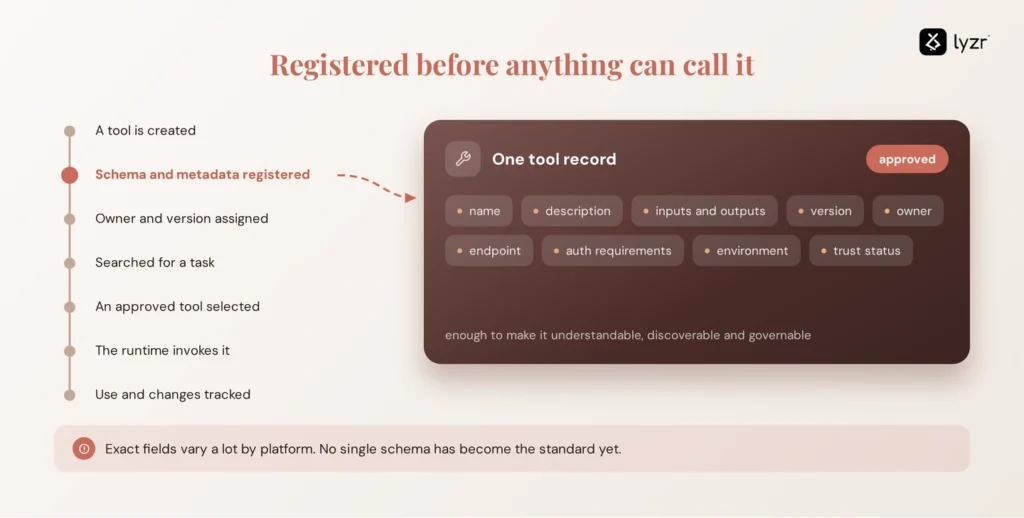
The flow generally runs: a tool is created, its metadata and schema get registered, it’s assigned an owner and a version, a developer or agent searches the registry for something that fits a task, an approved tool is selected, the agent runtime invokes it, and usage or changes get tracked from there, depending on what the platform supports.
A tool definition typically includes some combination of a name and description, its input parameters and expected output, a version number, an owner, a reference to its actual endpoint or implementation, authentication or access requirements, an environment designation, tags or categories, and approval or trust status. Exact fields vary considerably by implementation, and no single schema has become a universal standard yet.
That workflow depends on the information stored in each registry record. The registry needs enough metadata to make a tool understandable, discoverable, and governable before an agent ever calls it.
What Is Stored in an Agent Tool Registry?
A registry generally doesn’t need to contain the full implementation of every tool it catalogs. More often it stores a definition or reference: what the tool is, what it accepts, what it does, where it actually lives, who owns it, and under what conditions it can be used.
| Registry information | Why it matters |
| Tool name and description | Discovery |
| Input/output schema | Reliable function calling |
| Version | Change tracking |
| Owner | Accountability |
| Access policy | Control |
| Endpoint or reference | Invocation or routing |
| Trust/approval metadata | Risk management |
How Is an Agent Tool Registry Different From an MCP Registry?
A tool registry is concerned with discovering and managing the capabilities an agent can invoke broadly. An MCP registry is specifically concerned with discovering and managing MCP servers that expose tools, resources, and prompts through the Model Context Protocol.
| Agent Tool Registry | MCP Registry | |
| Primary purpose | Discover and manage tools available to agents | Discover MCP servers and integrations |
| Scope | Can include functions, APIs, tools, skills, and MCP servers, depending on implementation | MCP-based servers and their exposed capabilities |
| Core question | What capabilities can my agents use? | What MCP servers can my AI applications connect to? |
| Relationship | Can catalog MCP-based capabilities alongside other tool types | Can supply capabilities that appear inside a broader tool registry |
They overlap in practice more often than they compete. An enterprise agent tool registry frequently includes MCP servers as one category among several, rather than treating MCP as a separate concern.
Agent Tool Registry Examples: Google Cloud, AWS, and Open Source
The category is already appearing in enterprise infrastructure, although implementations differ in scope. Some registries focus heavily on tools and MCP servers, while others combine tools with agents, skills, and other agentic artifacts.
Google Cloud’s Agent Registry is a centralized catalog, part of the Gemini Enterprise Agent Platform, that lets teams store, discover, and govern MCP servers, tools, standalone skills, and agents together. Google’s own documentation frames it as the governance pillar and unified inventory for an organization’s agentic components, built around accelerating reuse, simplifying integration through standardized MCP and A2A protocols, and enforcing security boundaries across an agent fleet.
AWS Agent Registry, part of Amazon Bedrock AgentCore and now generally available, is described by AWS as a fully managed discovery service providing a centralized catalog for organizing, curating, and discovering MCP servers, A2A agents, agent skills, and custom resources. One useful way engineers describe the split within AgentCore: the Gateway handles runtime execution, acting as the traffic layer when a tool actually gets called. Within AgentCore, the Registry provides the catalog and governance layer for registered resources, while AgentCore Runtime and Gateway handle runtime execution and connectivity.
Agentregistry, the open-source project associated with Solo.io and contributed to the CNCF, takes a broader approach. It provides a curated, versioned catalog for agents, MCP servers, skills, prompts, plugins, and models, sitting above the underlying artifact and package registries those components may come from.
None of these is objectively “the best” agent tool registry, and the right one depends heavily on which cloud and runtime an organization has already committed to. What they demonstrate together is that centralized discovery and governance for agent capabilities has become infrastructure enterprises are actively building, not a hypothetical.
Are Agent Tool Registries Secure?
A registry can improve control over tool access, but registering a tool doesn’t automatically make that tool safe. The risks worth taking seriously include malicious or compromised tools, overly broad permissions granted by default, unsafe or misleading tool descriptions, outdated versions still in circulation, compromised endpoints, unnecessary access to sensitive data, tools exposed to agents that shouldn’t have them, and supply-chain risk from third-party tools or MCP servers nobody on the team actually audited.
A mature implementation may offer approval workflows, clear ownership, provenance tracking, versioning, access policies, trust or scan metadata, security scanning, environment separation, and audit records. Not every registry provides all of these, and it’s worth checking which controls a given platform actually implements rather than assuming registration itself equals safety.
What Happens When Tool Registries Meet Production AI Agents?

A registry answers what tools are available to an agent. Production operation raises a different, harder set of questions: which agent is actually using this tool? Who authorized that agent in the first place? What other tools and data can it reach beyond this one? Was the agent evaluated before it gained access to this capability? What changed between yesterday’s configuration and today’s? And what did the agent actually do with the tool once it had it?
This is where tool governance turns into agent governance, and it’s the point where a registry alone stops being sufficient.
Agent Tool Registry vs AI Control Plane: What’s the Difference?
| Agent Tool Registry | AI Control Plane | |
| Primary focus | Tools and agent capabilities | AI agents |
| Manages | Tool definitions, versions, metadata, access | Agent identity, lifecycle, configuration, evaluation, deployment, observability, governance |
| Main question | What can this agent use? | Should this agent be running, and how is it behaving? |
| Versioning | Tool versions | Agent and configuration lifecycle |
| Identity | Tool ownership | Agent identity |
| Audit | Tool changes and access | Agent lifecycle and actions |
A tool registry is one governance component. A Control Plane provides the broader governance layer around the agents actually using those tools, and the two aren’t mutually exclusive.
How Does an AI Control Plane Govern Agents Using Registered Tools?
Agents increasingly pull tools from more than one source: a cloud provider’s own registry, an open-source catalog, or an internal team’s private collection. Whichever registries an organization uses, the agents consuming those tools still need consistent governance around identity, evaluation, promotion, configuration, observability, policy, and auditability.
Lyzr’s OpenController sits at that layer. The registry tells you what capabilities exist. The Control Plane gives you the operational context around the agent actually using those capabilities, including whether that agent was evaluated before deployment, what it’s currently permitted to do, and what it did once it was live.
OpenController provides a consistent governance layer across those different sources, so organizations can manage agent identity, evaluation, configuration, observability, policy, and auditability without making the registry itself the center of the agent lifecycle.
If your agents already pull tools from more than one registry, that’s exactly the point where the harder question becomes less about which tools exist and more about which agents should be trusted with them.
Explore Lyzr’s OpenController to see how tool access, evaluation, and agent governance come together, or book a demo to walk through it against your own stack.
Frequently Asked Questions
An agent tool registry is a centralized catalog for organizing, discovering, and governing the tools, functions, and capabilities available to AI agents, typically storing metadata like descriptions, schemas, versions, ownership, and access policies rather than the tool’s full implementation.
A tool is created and registered with metadata and a version, assigned an owner, made searchable, and authorized for specific agents. When an agent needs that capability, its runtime discovers the tool through the registry and invokes it, with usage tracked depending on the platform.
An agent registry generally catalogs AI agents themselves for discovery and management. An agent tool registry focuses on the tools, functions, or MCP servers agents can use. Many current platforms combine both concepts in one catalog, and the terminology is still settling.
A tool registry covers the broader set of capabilities an agent can invoke. An MCP registry specifically covers MCP servers and their exposed tools, resources, or prompts. They frequently overlap, since MCP servers are often one category of tool inside a broader registry.
Google Cloud’s Agent Registry, AWS Agent Registry within Bedrock AgentCore, and the open-source agentregistry project originally released by Solo.io are current examples, each cataloging agents, tools, skills, or MCP servers with some form of governance built in.
Yes. Agentregistry, contributed by Solo.io to the CNCF, is an open-source, vendor-neutral catalog for agents, MCP servers, and skills that integrates with Kubernetes and multiple cloud runtimes.
No. A tool registry manages the tools themselves, their definitions, versions, and access rules. An AI Control Plane governs the agents using those tools across their full lifecycle, including identity, evaluation, deployment, and audit, which is a broader scope than any tool registry covers.
Book A Demo: Click Here
Join our Slack: Click Here
Link to our GitHub: Click Here