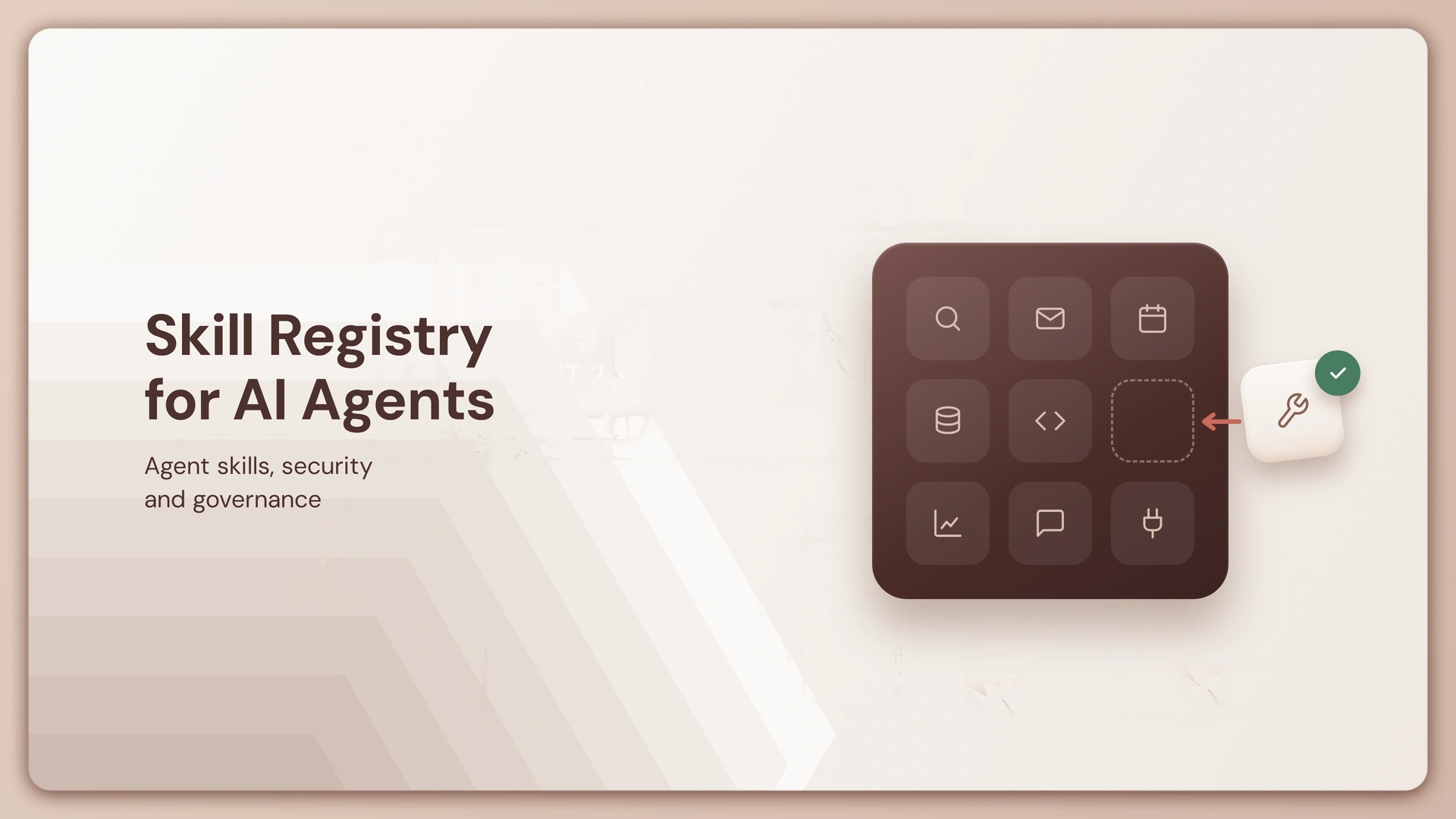
What Is a Skill Registry for AI Agents?
A skill registry for AI agents is a system for packaging, publishing, discovering, and versioning reusable agent capabilities, so a piece of expertise built once can be installed and reused across agents instead of rebuilt from scratch every time. It does for agent capabilities what a package registry does for software libraries: a structured, searchable place to find a capability, check its version, and pull it into a project.
The concept is new enough that most enterprise technology teams are only now running into it, usually while deciding how to reuse a capability one team already built instead of letting a second team quietly rebuild it. This article covers what an agent skill actually is, how skill registries work, how they differ from the increasingly familiar MCP registry, what to check before installing a skill you didn’t write, and where skill management stops being enough on its own once those skills are running inside production agents.
What Is an AI Agent Skill?
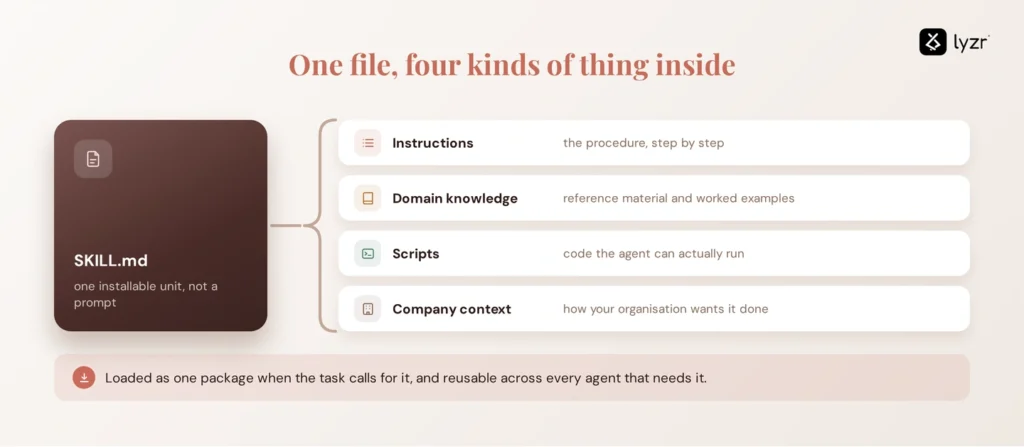
An AI agent skill is a reusable package of instructions, domain knowledge, and optionally scripts or other resources that teaches an agent how to perform a specific task. Anthropic, which introduced the concept publicly as Agent Skills in October 2025, defines the core artifact simply: a SKILL.md file containing instructions, paired with any supporting scripts or reference material the task needs.
That’s a broader definition than it might first sound. A skill isn’t just a prompt. A single skill can bundle step-by-step procedures, reference documentation, executable code the agent can run, and organizational context specific to how one company wants a task done, packaged together as one installable unit. A pre-built skill for editing a PowerPoint file, for instance, can include the instructions for how to approach the edit alongside actual code that manipulates the file format. A custom skill built internally might package a company’s specific escalation policy, the format its support tickets need to follow, and examples of a well-handled case, all as one unit an agent loads when the task calls for it.
How Is an Agent Skill Different From a Prompt?
A prompt is generally an instruction artifact that tells a model how to respond to a particular task or context. A skill can package that instruction with domain knowledge, reference material, procedures, and even executable resources that an agent can use as part of completing a task.
That difference matters for registries. A prompt registry manages reusable prompt artifacts. A skill registry manages a broader, potentially executable capability that an agent can discover and load when it needs to perform a particular type of work.
How Do Agent Skills Work?
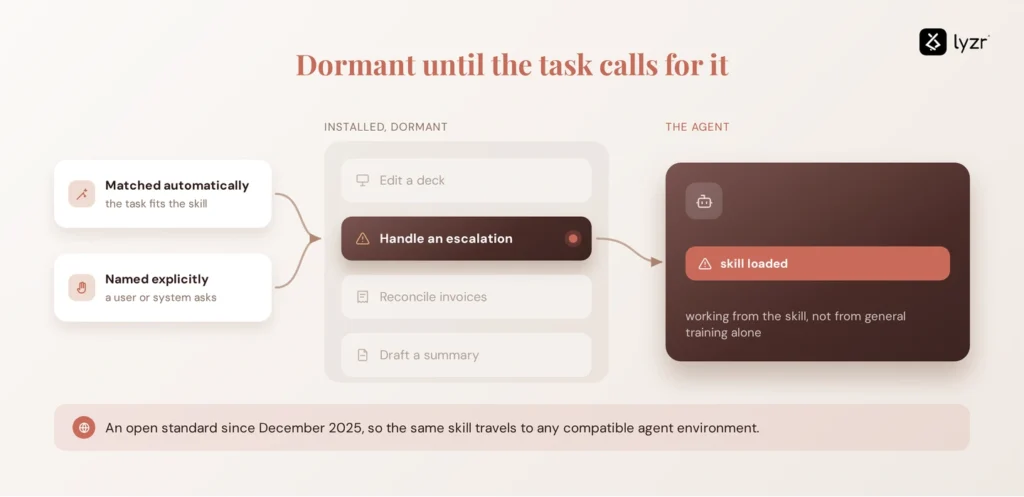
A skill sits dormant in an agent’s environment until it’s relevant. When a task matches what a skill is designed for, the agent loads that skill’s instructions and any bundled resources, then uses them to guide how it approaches the task, rather than the agent working from its general training alone.
Skills get invoked in a few ways depending on the platform: automatically, when the agent recognizes a task matches an installed skill’s purpose, or explicitly, when a user or another system names the skill directly.
The format has also moved beyond a single vendor: Anthropic published Agent Skills as an open standard for cross-platform portability in December 2025. That makes skills more portable across compatible agent environments and strengthens the case for centralized discovery and distribution.
Why Do AI Agents Need a Skill Registry?
Without a registry, every team building agents ends up solving the same packaging problem independently: where does a skill live, how does another team find it, how do you know which version is current, and how do you update it without breaking whoever already installed the old one. A registry answers all four questions with infrastructure instead of leaving each team to invent its own convention.
The practical payoff is reuse. A skill built once by the team that understands a domain, whether that’s a specific compliance workflow, a file format, or an internal process, becomes something other teams can install rather than rebuild. That matters more as the number of agents an organization runs grows, since the alternative is the same capability getting reimplemented, inconsistently, inside every agent that happens to need it.
What Does a Skill Registry Manage?
A production-grade skill registry typically manages five things: the skill package itself, including its instructions and any bundled scripts or resources; version history, so a specific version can be referenced, compared, or rolled back; metadata, like what the skill does, who published it, and what it depends on; discovery, letting someone search or browse for a skill that matches a task; and distribution, the actual mechanism for installing a skill into an agent’s environment.
That combination is what separates a registry from a folder of shared files. A shared folder can hold a skill. It can’t tell you whether the version someone just installed is current, who’s responsible for it, or what changed since the last one.
Once skills become discoverable and reusable across agents, they start to overlap with another part of the agent infrastructure stack: MCP registries and servers. The two are related, but they manage different kinds of capabilities.
How Is a Skill Registry Different From an MCP Registry?
A skill registry manages reusable instructions and domain knowledge. An MCP registry manages connections to external tools and data sources. They solve adjacent but distinct problems, and the cleanest way to hold the distinction is this: a skill teaches an agent how to do something; MCP gives an agent something new it can actually reach and act on.
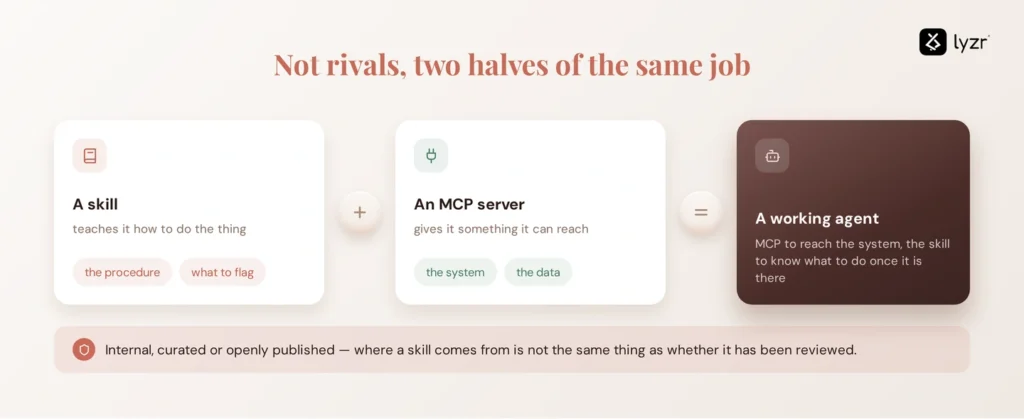
A skill might contain the exact procedure for reviewing a compliance document, including the specific things to check and how to flag an issue. An MCP server might be what actually gives the agent access to the document management system where that document lives in the first place. In practice, most production agents use both together: MCP to reach a system, and a skill to know what to do once it’s there. Neither replaces the other, and framing them as competing technologies misses how they’re actually used.
That distinction matters when deciding where a skill should come from. A skill registry may contain internally developed capabilities, curated third-party skills, or openly published packages, and those sources do not necessarily offer the same level of review or trust.
Where Can You Find AI Agent Skills?
The skills ecosystem now spans several types of sources, from first-party repositories and curated directories to open community marketplaces and internal enterprise registries. Anthropic maintains its own curated directory, including a small set of pre-built skills for common document tasks and a partner directory featuring skills from companies like Atlassian, Canva, Cloudflare, Figma, Notion, and Stripe, each reviewed before publication. Anthropic also publishes an open, source-available repository of example skills on GitHub, intended as a reference for how more complex, production-grade skills are structured.
Alongside that sits a fast-growing set of community marketplaces and directories, sites that let anyone publish a skill with far less review than Anthropic’s own directory applies. This tier is large and largely unaudited by design, which is exactly what makes the next section worth taking seriously before installing anything from it.
This article isn’t a ranking of which registry is best, because that answer depends entirely on whether you need a small number of reviewed, trustworthy skills or a large searchable catalog and are willing to do your own vetting. What matters more than any specific ranking is understanding which tier a given skill came from before it runs inside an agent with real access to your systems.
The source matters because a skill is not just passive documentation. If it contains executable code or instructions that influence an agent’s behavior, installing it introduces a new trust decision into the agent’s environment.
Are AI Agent Skills Safe to Install?
Not automatically, and this is worth taking seriously rather than treating as boilerplate caution. Anthropic’s own documentation is direct about the risk: a skill gives an agent new capabilities through instructions and code, which means a malicious skill can direct that agent to invoke tools or execute code in ways that don’t match what the skill claims to do. The advice from Anthropic itself is blunt: if you’re using a skill from an untrusted or unknown source, audit it thoroughly before relying on it.
That risk is exactly why the tier a skill comes from matters. A skill from a reviewed, curated directory has already had a publisher check its origin and behavior. A skill pulled from an open community marketplace, where anyone can publish, hasn’t necessarily had anyone check anything beyond whether the file is formatted correctly. Before installing a skill from an unfamiliar source, the practical questions are the same ones you’d ask of any third-party code: what does it actually do when it runs, what does it request access to, and who published it.
What Happens When Skills Become Part of Production Agents?
A skill registry solves packaging, discovery, and version control for the skill itself. It doesn’t answer a different set of questions that only matter once that skill is running inside a production agent making real decisions.
The distinction becomes important once a skill moves from a reusable artifact into a production agent. Which agent is actually using this skill? Was that agent, not just the skill in isolation, evaluated with it installed? Who approved the agent to run with this capability enabled? What can the agent actually do once the skill is active, particularly if the skill bundles executable code? And if something goes wrong, is there a record of what the agent did while that skill was in use? None of those are skill registry questions. They’re questions about the agent the skill lives inside, and they get harder to answer the more skills, and the more agents, an organization is running.
How Does an AI Control Plane Govern Agents Using Skills?
This is where the scope expands beyond skill management, and it’s where Lyzr’s OpenController fits. It doesn’t manage skills, and it isn’t trying to replace a skill registry or an MCP registry. What it governs is the agent using those skills: giving each agent a registered identity, running it through an evaluation gate before it reaches production, enforcing what it’s actually permitted to do, and keeping an observability and audit trail of its behavior once it’s live.
Practically, that means when an agent installs a new skill, especially one with bundled executable code, that change can move through the same evaluation and approval process as any other change to the agent, instead of a skill quietly expanding what an agent can do with no record of it happening. The skill registry answers what capability was installed. The Control Plane answers whether the agent running it should be trusted with what that capability actually allows.
Skill Registry vs AI Control Plane
| Skill Registry | AI Control Plane | |
| Manages | Skill packages, versions, and metadata | Agent identity, permissions, evaluation, and lifecycle |
| Answers | “What does this skill do, and which version is it?” | “Which agent is running it, and was that approved?” |
| Evaluation | Skill-level checks where supported | Agent evaluation and promotion |
| Observability | Skill usage where supported | Agent behavior and activity |
| Scope | Individual capabilities | The broader agent estate |
A skill registry is infrastructure for a capability. A Control Plane is infrastructure for everything that capability is now allowed to do inside a live agent.
If your team is already installing skills from outside sources into agents with real production access, that’s worth pairing with the same evaluation and audit discipline you’d apply to any other change reaching those agents.
Explore Lyzr’s OpenController to see how skill changes, evaluations, and approvals fit into one governed view, or book a demo to walk through it against your own agent stack.
Frequently Asked Questions
A skill registry is a system for packaging, publishing, discovering, and versioning reusable AI agent capabilities, letting teams find, install, and update a skill instead of rebuilding it inside every agent that needs it.
An agent skill is a reusable package of instructions, domain knowledge, and optionally scripts or other resources that teaches an agent how to perform a specific task, typically structured as an instructions file plus supporting materials.
A prompt registry versions individual prompt artifacts, generally instruction text. A skill is broader and can bundle instructions, reference documentation, and executable code together as one installable unit, so a skill registry manages a wider range of content than a prompt registry typically does.
A skill registry manages reusable instructions and domain knowledge. An MCP registry manages discoverable MCP servers and the capabilities they expose. They’re complementary, not competing.
Not automatically. A skill can bundle executable code, so a malicious or poorly vetted skill can direct an agent to act in ways that don’t match its stated purpose. Skills from a reviewed, curated directory carry less risk than skills pulled from an open community marketplace with no formal review.
Primarily through two tiers: officially curated directories that review skills before publishing them, and open community marketplaces where anyone can publish with minimal review. Which tier fits a given use case depends on whether trust or catalog size matters more for that task.
No. A skill registry manages the skill as an artifact. Full governance covers the agent using that skill, including its identity, permissions, evaluation history, and audit trail, which is a broader scope than any skill registry is designed to manage.
Book A Demo: Click Here
Join our Slack: Click Here
Link to our GitHub: Click Here