An employee can sign up for a new AI service in minutes, no procurement, no ticket, just an email address and a credit card. A developer can wire a new model API into an application in an afternoon. An AI agent can potentially be reconfigured to call a different model entirely, with nobody on the security team aware it happened.
None of that requires malicious intent. It just requires convenience, and convenience moves faster than most approval processes. The result is an organization that knows which models it intended to approve, but not necessarily which models are actually in use, what data those models are receiving, or whether any of them have been evaluated for the job they’re doing.
Model allowlisting is the control built to close that gap: approved models can be used, unapproved ones cannot. It’s a genuinely useful boundary. It’s also not the whole answer, and knowing exactly where it stops mattering is as important as understanding what it does.
What Is Model Allowlisting?
Model allowlisting is a security and governance practice where an organization explicitly approves which AI or ML models can be accessed or used, while preventing access to anything outside that approved set. Approval can be defined at different levels depending on the organization: by provider, by specific model, by model version, by deployment type, by environment, by use case, or by the sensitivity of the data involved.
Not every organization allowlists at the same granularity. Some approve at the provider level and call it done. Others need version-specific control, because a model update can change behavior in ways that matter for a regulated use case. Mature implementations tend to need more granular control as the number of applications and agents using models grows, not less.
Why Do Organizations Allowlist AI Models?
The practical reasons cluster around a handful of real problems. Data protection is usually the first: preventing sensitive information from being sent to a public model or endpoint nobody vetted. Shadow AI is the second, giving security teams a way to actually control unauthorized model usage instead of discovering it after the fact, usually during an incident review. Compliance follows closely, since regulated industries often need to show that the models touching certain data went through a defined review. Risk management matters because restricting applications to evaluated models means fewer surprises about how a system behaves in production. And cost and operational control matter too, since uncontrolled model usage tends to produce uncontrolled provider bills.
The point underneath all five: allowlisting gives a security team a known inventory of permitted models, instead of forcing them to chase down every new model that shows up on its own.
How Does Model Allowlisting Work?

The implementation flow generally runs: identify the models currently in use or requested, define the criteria a model has to meet for approval, evaluate candidates against those criteria, build the approved inventory, enforce access against it, monitor actual usage, and revisit the list on a schedule rather than letting approvals sit indefinitely.
Enforcement itself depends heavily on architecture. It might run through network or proxy controls restricting outbound traffic to approved provider endpoints, through an API gateway that only routes to permitted models, through an internal AI platform that simply doesn’t offer anything unapproved, or through identity and access policies tied to specific applications. Worth being direct about a limitation here: an allowlist only sees what passes through the enforcement point it’s attached to. If a developer can still reach an unapproved model outside that point, the allowlist isn’t actually stopping it, it’s just not seeing it.
Once the enforcement point is defined, the next question is what exactly belongs on the approved list.
What Should Be on an Approved Model List?
A useful list is more than a name like “GPT-4” or “Claude” written down somewhere. It needs enough context to establish exactly what was approved and under what conditions.
| Information | Why it matters |
| Provider | Establishes the model’s source |
| Model name/identifier | Defines exactly what’s approved |
| Version | Prevents ambiguity as models change |
| Deployment type | Distinguishes public API, private deployment, hosted model |
| Approved use case | Defines what the model is allowed to support |
| Data classification | Determines what information may be sent to it |
| Owner | Establishes accountability |
| Approval status | Shows whether use is currently permitted |
| Evaluation record | Shows what was actually tested |
| Review date | Prevents an approval from becoming permanent by default |
That last field matters more than it looks. An approval granted a year ago, for a model that’s since been updated by its provider, isn’t really still describing what’s running today.
Model Allowlisting vs Blocklisting: What’s the Difference?
Allowlisting defaults to deny: only explicitly approved models are permitted. Blocklisting defaults to allow: models are permitted unless specifically prohibited.
| Model Allowlisting | Model Blocklisting | |
| Default | Deny | Allow |
| Access | Only approved models | All models except those blocked |
| New models | Require approval | Usually allowed until blocked |
| Control | More restrictive | More permissive |
| Best suited for | High-control enterprise environments | Lower-risk or more open environments |
| Maintenance | Requires maintaining an approved inventory | Requires continuously identifying models to block |
Blocklisting becomes harder to maintain as new models, providers, and hosted endpoints continue to appear, because someone has to identify and block each new addition individually. That said, allowlisting isn’t automatically the right answer everywhere. Architecture, risk tolerance, and use case all factor into which default actually fits an organization.
How Is Model Allowlisting Different From Application Allowlisting?
Application allowlisting controls which software can execute on a system in the first place. Model allowlisting controls which AI models an organization permits applications or users to access. They’re the same underlying pattern, default-deny instead of default-allow, applied to a different layer.
The endpoint security world already has a mature version of this idea. ThreatLocker’s application allowlisting blocks any application not explicitly approved from running at all, and its Ringfencing capability adds a second layer on top: even for applications that are approved, it controls what they’re allowed to do, which files and network resources they can reach, and which other applications or system tools they can launch. The distinction the company draws is a clean one: allowlisting stops untrusted applications from running, ringfencing stops trusted applications from being abused once they’re already permitted.
That second half of the idea maps onto AI governance more directly than it might first appear. An approved model is the AI equivalent of an approved application. The analogy is useful because it highlights the next governance question: approving the model establishes which model may be used, but it doesn’t establish what the application or agent using that model is allowed to access, invoke, or change.
What Are the Limitations of Model Allowlisting?
Approving a model doesn’t mean approving every way that model can end up being used. An approved model can still create real risk if the wrong data gets sent to it, if it’s connected to sensitive tools it shouldn’t reach, if an agent built on it has more permissions than its task requires, if the model or its configuration changes after approval, if an application bypasses evaluation entirely, if system instructions shift in ways nobody reviewed, or if multiple approved models get combined into a workflow nobody assessed as a whole.
Model allowlisting establishes which models an organization trusts. It does not establish whether every application or agent using those models is actually operating within the boundaries that approval assumed.
That distinction becomes especially important when the approved model sits underneath an autonomous agent. The model may be approved, but the agent introduces its own identity, instructions, tools, permissions, and runtime behavior.
What Happens When Approved Models Power AI Agents?
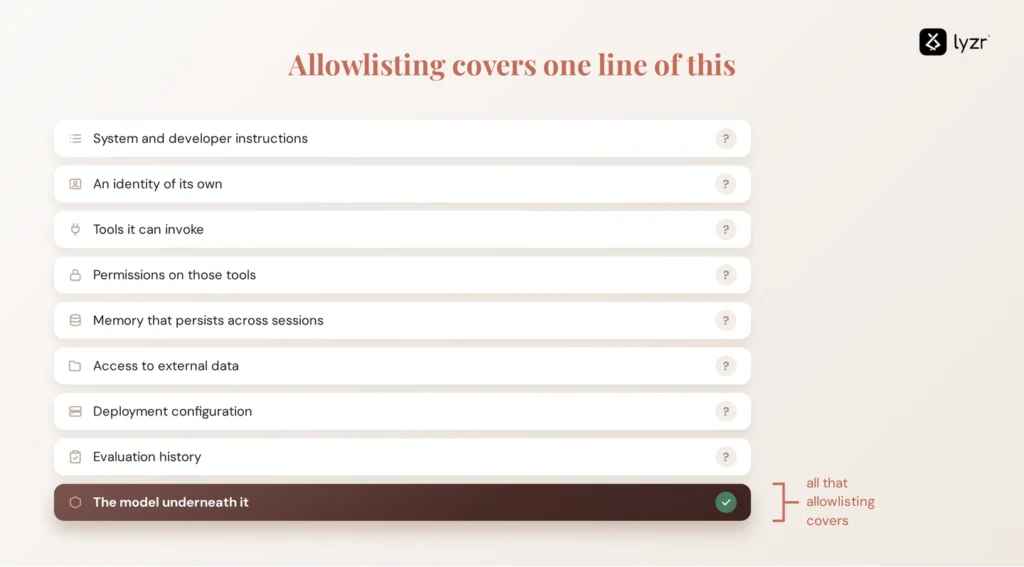
An enterprise agent is rarely just a model call. It typically has its own system and developer instructions, an identity, a set of tools it can invoke, defined permissions, memory that persists across sessions, access to external data, a deployment configuration, and an evaluation history. Allowlisting addresses exactly one piece of that stack: which model sits underneath it.
Which leaves a set of questions allowlisting was never built to answer. Which agent is actually using the approved model? What tools can that agent access once it’s running? What data can it retrieve, and should it be able to? Was the agent itself evaluated before deployment, not just the model inside it? Who approved its specific configuration? What changed after that approval was granted? Is the agent behaving as intended right now, and can the organization actually trace what it’s done?
Model Allowlisting vs AI Control Plane: What’s the Difference?
| Model Allowlisting | AI Control Plane | |
| Primary focus | Approved AI models | AI agents and their lifecycle |
| Main question | Which models can be used? | Which agents can operate, and how are they behaving? |
| Controls | Model access | Identity, evaluation, deployment, configuration, observability, governance |
| Scope | Model-level | Agent and system-level |
| Versioning | Approved model/version | Agent and configuration lifecycle |
| Audit | Model approval and usage where supported | Agent lifecycle and activity |
These aren’t competing controls. Model allowlisting can be one input into a broader AI governance program. A Control Plane provides the layer needed to govern the agents and applications actually using those approved models once they’re live.
How Does an AI Control Plane Build on Model Allowlisting?
Once an organization has established which models are approved, the next governance challenge is controlling how those models are used by applications and agents in production.
Lyzr’s OpenController operates at that next layer, giving visibility and governance across agent identity, the model and configuration an agent is actually running, its evaluation history, its deployment and promotion path, its observability, the policies it operates under, and its audit history. Allowlisting tells you which models are permitted. A Control Plane gives you the operational context around the agents actually using them, including the fact that an agent running an approved model can still need its own approval, evaluation, and monitoring independent of the model underneath it.
None of this replaces network controls, API gateways, identity and access policies, or the model allowlist itself. It sits alongside them, at the layer those controls were never designed to cover.
Explore Lyzr’s OpenController to see how agent governance builds on an approved model inventory, or book a demo to walk through it against your own environment.
Where This Leaves the Enterprise AI Stack
Model allowlisting exists because enterprises can’t govern AI usage without first knowing which models are actually permitted. But as AI use shifts from individual model calls toward autonomous agents, governing the model alone is no longer enough. The fuller progression runs: approve the model, control access to it, evaluate the agent built on top of it, govern its deployment, observe its behavior in production, and maintain an auditable record of its lifecycle throughout.
Model allowlisting controls which models an organization permits. Agent governance controls what those models are actually allowed to do once they’re running in production.
Frequently Asked Questions
Model allowlisting is a security and governance practice where an organization explicitly approves specific AI or ML models for use, blocking access to any model outside that approved set by default.
Application allowlisting controls which software can execute on a system. Model allowlisting controls which AI models can be accessed. They’re the same default-deny pattern applied to different layers, and are often used alongside each other.
They describe the same default-deny concept. Allowlisting is the more current term used across most security contexts today, while whitelisting is the older term for the same practice.
Allowlisting defaults to deny, permitting only explicitly approved items. Blocklisting defaults to allow, permitting everything except items explicitly prohibited. Allowlisting is more restrictive; blocklisting is more permissive but harder to maintain as new items constantly appear.
To protect sensitive data from unapproved models, control shadow AI usage before it becomes an incident, support compliance requirements around which models have been reviewed, manage risk by restricting applications to evaluated models, and avoid uncontrolled provider costs.
Organizations identify models in use, define approval criteria, evaluate candidates, build an approved inventory, and enforce it through network controls, API gateways, internal AI platforms, or identity and access policies, depending on the architecture.
Start by identifying every model currently requested or in use, define clear criteria a model must meet for approval, evaluate each candidate against those criteria, and document the result with enough metadata to know exactly what was approved and why.
At minimum: provider, model name and version, deployment type, approved use case, data classification, an owner, current approval status, an evaluation record, and a review date so approvals don’t become permanent by default.
No. It controls which models are permitted but doesn’t govern how an approved model is actually used, including what data reaches it, what tools an agent built on it can access, or whether that agent was evaluated and is behaving as intended.
Book A Demo: Click Here
Join our Slack: Click Here
Link to our GitHub: Click Here