As a company grows and more people join in, it becomes difficult to answer questions around governance without a proper system in place. If you ask a platform team how many MCP servers their AI agents are actually connected to, they won’t be sure.
That’s not a knock on an individual or a team; it’s just what happens when wiring an agent to a new tool takes fifteen minutes and involves nobody outside the person doing it. Multiply that across a few hundred engineers and you get an enterprise with no real idea what its own agents can touch. Let’s understand this gap.
Key Takeaways
- Governing MCP servers means controlling four things together: which servers get approved, what each one can access, whether a risky call actually gets stopped the moment it happens, and whether every call gets logged.
- MCP’s frictionless design is exactly what makes it hard to govern. Anyone can connect an agent to a new server in minutes with no central review, which is why OWASP’s MCP Top 10 has a dedicated Shadow MCP Servers risk category.
- Approval isn’t a one-time check. A server can start exposing new tools or reaching new data long after it passed its initial review, so approval has to account for that drift, not just the day-one version.
- Real scoping binds access to an agent’s identity, not a shared credential, with read and write treated as separate permissions rather than a package deal.
- Scoping alone doesn’t stop misuse. A perfectly scoped agent can still be abused within its own permissions, which is why enforcement has to actively check and act on each call live, blocking, masking, or rate-limiting it before it reaches the server.
- An MCP gateway is a useful layer, but it isn’t governance on its own. Most gateways apply one policy across an entire server rather than per tool, and don’t handle approval before a server goes live.
What does it mean to govern MCP servers in an enterprise?
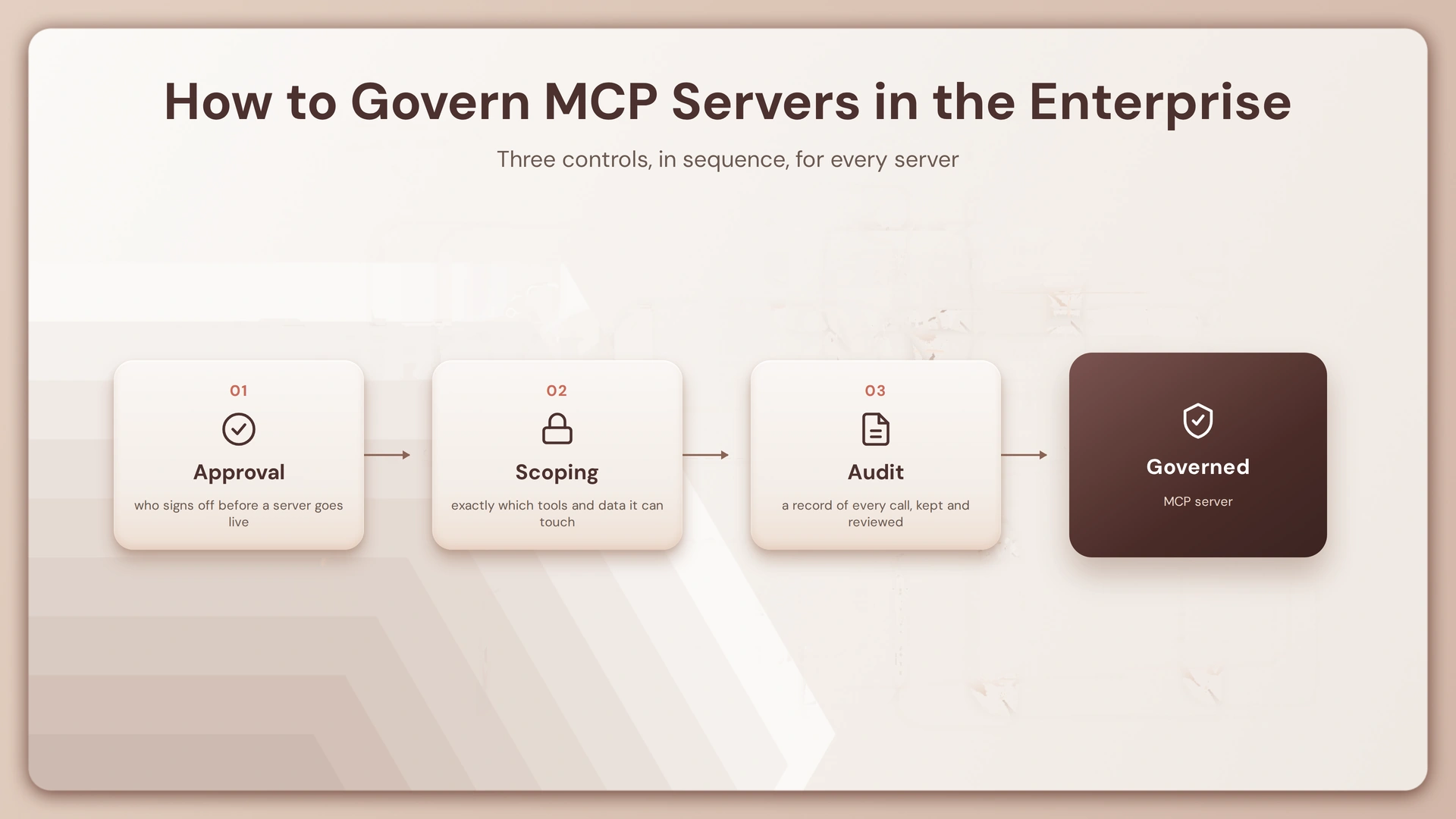
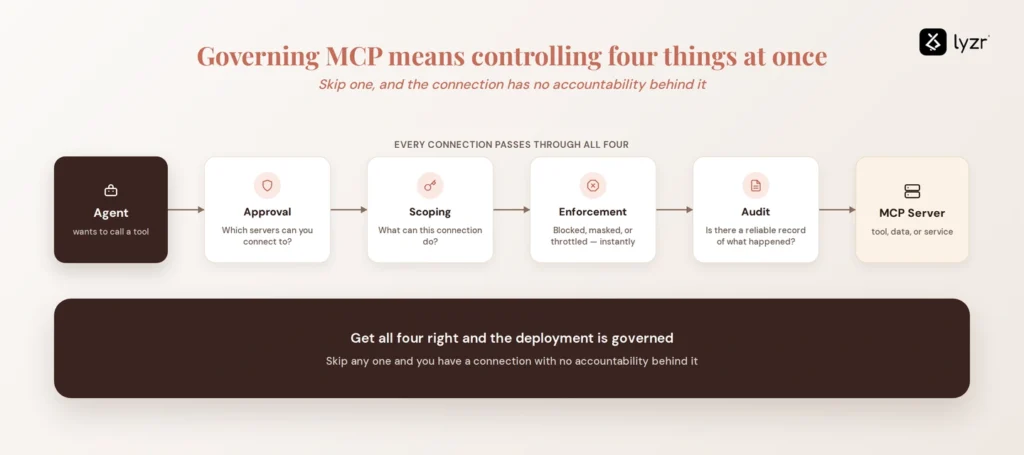
Governing MCP servers in an enterprise means controlling four things at once: which MCP servers your AI agents are allowed to connect to, what each connection can do once it’s approved, whether a risky call actually gets blocked, masked, or throttled the moment it happens, and whether there’s a reliable record of what it actually did. Get all four right and an MCP deployment is governed. Skip any one, and you have a connection with no accountability behind it.
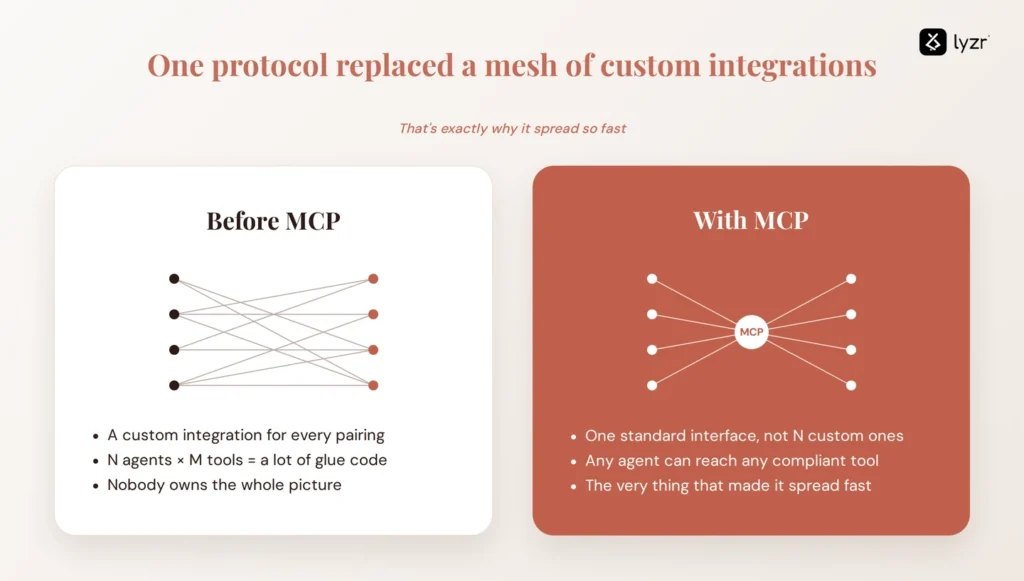
Model Context Protocol (MCP) is the open specification. Anthropic introduced it in late 2024 for connecting AI models to external tools, data, and services through one standard interface, instead of a custom integration for every pairing. That standardization is why it spread so fast, and why it created a governance problem.
Why MCP servers are a governance blind spot
Most security teams haven’t formally approved a single MCP server this year, and that is precisely the problem. Anyone with API credentials and twenty minutes can wire an agent to a new one: a support agent gets hooked into the CRM, a finance copilot gets pointed at a spreadsheet-to-ledger tool, someone’s weekend project quietly becomes a production dependency.
None of it goes through the request process a new SaaS tool would normally trigger, because MCP was built to make that connection frictionless. “Frictionless” for the developer becomes invisible for security. OWASP’s MCP Top 10 gives this its own category, Shadow MCP Servers, which tells us it shows up often enough to earn its own name.
The deeper issue isn’t only visibility. An AI agent doesn’t behave like a person clicking through a UI. It calls tools autonomously, chains them in sequences nobody explicitly wrote, and can be steered off its intended path by content it reads along the way, not just by whoever started it. Governing that means deciding what’s allowed before the agent gets the chance to try it.
Four pillars of MCP server governance
Each pillar of MCP server governance catches a different failure mode. Let’s dive deeper into the four pillars:
1. Approval
Approval is the gate an MCP server has to pass before an agent can reach it. In practice, that means three things: a central catalog of every server in use, a registration step for anything new, and a review that happens before the server goes live, not after. That review itself has to go beyond confirming that a server works. It needs to check what the server actually exposes: whether its tool catalog matches what it claims to do, whether a tool’s description is hiding instructions meant to manipulate the calling agent rather than inform it, and whether the server comes from a source you can actually vouch for.
That review isn’t a one-time stamp, either. A server that passed cleanly at registration can start exposing a new tool six months later, and approval has to cover that drift too. Most enterprises get half of this right: they vet the first version of a server carefully, but never look at it again.
2. Scoping
Scoping stops an approved server from becoming a blank check. The failure mode is common: one shared credential with full read and write access, handed to every agent that connects, because scoping each one individually takes longer than scoping none of them.
Real scoping ties access to identity instead of a shared key. Each agent can call only the specific tools its task requires, acting on behalf of a specific person or process, and nothing beyond that. Read access and write access are granted separately, not bundled together. MCP’s own maintainers addressed the identity side in June 2026 with Enterprise-Managed Authorization: an identity provider grants access once at sign-in, and every server it has approved for that role becomes available automatically, no shared credential left waiting to leak.
3. Enforcement
Enforcement is what makes approval and scoping mean anything at the moment a call actually happens. A server can be perfectly approved and perfectly scoped, and an agent can still misuse that scope: calling an allowed tool thousands of times in a loop, passing a customer’s full record to a tool that only needed an ID, or making a call at three in the morning that no legitimate workflow would ever trigger.
None of that is a scoping failure. The permission itself was correct. What’s missing is something actively watching the call as it happens and able to act on it: block it outright, mask the sensitive fields before they leave, or throttle the rate.
That’s a different job from audit, and it’s easy to confuse the two. Audit tells you what happened after the fact, which matters but is too late to stop the call itself. Enforcement happens in the request path, before the tool executes, which is also why it can’t be bolted on as an afterthought. It has to sit between the agent and the server, not beside either one.
4. Audit
Audit is what makes the other pillars provable instead of assumed. If approval and scoping are policy, audit is evidence that the policy held. A log worth trusting captures more than the fact that a call happened. It records the caller’s identity, the server and tool invoked, the parameters passed, and the policy decision behind it, along with why. Ideally, it also captures what the agent was actually trying to accomplish, not just the individual calls it made along the way. Skip this pillar and the first two collapse the moment someone asks you to prove it.
Approval, scoping, and audit aren’t four checklists, they’re one lifecycle. They cannot be treated as separate workstreams. A server gets requested, reviewed, and approved, connected with scoped, identity-bound access, and every call it makes from there is checked against that policy live, and gets logged against the policy set at approval. Scoping without approval has nothing to enforce, since nobody decided what “allowed” means.
Enforcement without scoping has no boundary to hold; it’s just blocking calls at random. Audit without enforcement just records what already went wrong instead of stopping it. Run all four as one system, and each pillar strengthens the other three.
Ad hoc oversight vs. an MCP gateway vs. full governance
Not every enterprise starts from the same place, so it’s worth being honest about where ad hoc oversight stops working.
| Ad hoc oversight | MCP gateway alone | Full MCP governance | |
| Server inventory | Tribal knowledge and spreadsheets, if you’re lucky | Whatever’s routed through the gateway; anything else stays invisible | Centralized catalog, every server registered before use |
| Access control | Shared credentials, broad by default | Often one policy applied across an entire server, not per tool | Identity-bound, scoped per tool and per role |
| Approval | Informal, or skipped under deadline pressure | Not covered; a gateway routes traffic, it doesn’t vet a server | Structured review before go-live, revisited on change |
| Real-time enforcement | None; a technically in-scope call still goes through unchecked | Basic rate limiting at most, not policy-aware | Every call checked against policy live: blocked, masked, or throttled before it executes |
| Audit trail | Whatever’s in application logs, if anything | Request-level logs at the gateway | Full call-level record: caller, tool, parameters, policy decision |
A gateway is a real step up from nothing, and most enterprises need one. But a gateway alone isn’t governance. Plenty of enterprise API gateways added MCP support quickly and handle the tools primitive well, yet they typically apply one policy to an entire server rather than to each tool individually. Governance is what decides what that gateway should actually be enforcing in the first place.
Where to start with MCP governance
Don’t try to build all four pillars at once if none of this exists yet. Start with inventory: you can’t approve, scope or audit a server you don’t know exists, so the first real step is finding every MCP server currently in use, not writing the policy that will eventually govern them. A short internal amnesty period helps: ask teams to register what they’ve already built before enforcement starts, rather than spending the first month playing whack-a-mole with servers going dark and reappearing under a different name.
Then pick one high-risk server, the one touching customer data or with write access to production, and run it through approval, scoping, enforcement and audit end-to-end before rolling the process out everywhere else. A framework that has only ever worked on paper isn’t ready yet. If you want a structured way to see where your organization actually stands first, Lyzr’s agent governance maturity assessment is a reasonable place to start.
How Lyzr OpenController governs MCP servers end-to-end
OpenController is built around the same four pillars instead of treating them as separate products bolted together.
Find maps every MCP server, agent and credential actually in use across clouds and SaaS environments, so the shadow MCP problem stops being a guess and becomes a list you can act on.
Ship is where approval and scoping get decided, before a server ever reaches a production agent. A server goes through registration and review there, and the access it’s granted gets defined at the same time: identity-bound, scoped per tool, read and write treated separately. Nothing reaches an agent that hasn’t cleared that gate.
Run is where enforcement and audit both happen, live, on every single call. Access isn’t just checked against the scope set at Ship, it’s actively enforced in the request path: a call that falls outside policy gets blocked, masked, or throttled before it ever reaches the server, not flagged afterward in a report nobody reads until it’s too late. Every one of those calls, allowed or refused, gets logged with the caller, the policy decision, and the reasoning behind it, built to hold up under a compliance review, not just a debugging session.
Improve closes the loop, turning what Run observes, cost, risk, drift from approved behavior, back into policy changes at Ship, instead of leaving that record in a dashboard nobody revisits.
If you’d rather see it than read about it, book a demo and we’ll walk through governing an actual MCP server end to end.
FAQ
Controlling four things: which MCP servers your AI agents can connect to (approval), what each connection can do (scoping), whether a risky call actually gets stopped as it happens (enforcement), and whether there’s a reliable record of what it did (audit).
The review a server goes through before an agent can reach it: who built it, what it exposes, and whether its tool descriptions are trustworthy rather than a vector for tool poisoning. It needs revisiting when a server changes, since its scope can quietly expand over time.
Access tied to a specific agent’s identity, not a shared credential, with read and write as separate permissions and each agent limited to the exact tools its task requires. Credentials pulled from a secrets store at call time and discarded afterward is part of the same discipline.
Monitoring tells you a server is running; audit logging proves what it did and whether that matched policy. OWASP’s MCP Top 10 lists insufficient audit and telemetry as a top risk category precisely because it’s the pillar teams plan to add later and often never do.
A gateway routes and authenticates traffic, and it’s genuinely useful, but most apply one policy across an entire server rather than per tool, don’t handle approval before go-live, and rate-limit at best rather than enforcing policy per call. Governance is the decision layer that tells the gateway what to enforce.
It maps every MCP server and agent in use (Find), decides approval and scope before anything goes live (Ship), enforces that policy live on every call while logging it for audit (Run), and turns what it observes into policy updates (Improve), covering all four pillars as one connected system.
Book A Demo: Click Here
Join our Slack: Click Here
Link to our GitHub: Click Here