Your security team has approved ChatGPT.
Your developers have approved Claude.
Your company has an enterprise Copilot license.
So how many AI tools are actually being used inside your organization?
The answer is probably not three.
An employee may be using a personal ChatGPT account. A developer may have Claude Code installed locally. Someone in finance may have enabled an AI feature inside a SaaS application. A team may be calling an LLM API directly from a script. And somewhere, an AI agent may be running on a laptop that nobody in IT knows exists.
That is shadow AI.
And in 2026, discovering it means looking far beyond a list of AI websites.
What Is Shadow AI Discovery?
Shadow AI is AI software, services, agents, or model access being used without the organization’s knowledge, approval, or governance.
The important part is “without visibility.”
An employee using an approved AI application under an approved corporate account is not necessarily shadow AI.
The same employee copying customer data into a personal AI account is a very different situation.
And now there is a third category: AI that can act.
Agents can access systems, call APIs, retrieve data, execute code, and perform tasks without waiting for a human at every step.
That changes the discovery problem.
A useful shadow AI discovery program therefore needs to answer five questions:
| Question | What you need to discover |
|---|---|
| What AI is being used? | AI apps, APIs, coding assistants, agents, MCP servers |
| Who is using it? | Employees, teams, service accounts, developers |
| Where is it running? | Browser, endpoint, cloud, SaaS, IDE, infrastructure |
| What is it accessing? | Prompts, files, APIs, enterprise data, credentials |
| What happens next? | Monitor, approve, restrict, block, or govern |
This is why the best shadow AI discovery tool in 2026 isn’t necessarily the one with the biggest AI application database.
It is the one that can see your particular AI estate.
Why Shadow AI Discovery Has Changed in 2026
A few years ago, shadow IT discovery was mostly about finding unauthorized SaaS.
Shadow AI started the same way.
Security teams wanted to know:
“Is anyone using ChatGPT?”
Now the question sounds more like:
“What AI is running anywhere in our organization, who owns it, what can it access, and can we control it?”
That shift matters.
Microsoft’s 2026 shadow AI capabilities, for example, extend discovery into AI applications, model-provider APIs, SaaS MCP servers, and local AI agents. Netskope has also introduced endpoint discovery for locally running AI agents, LLMs, MCP servers, and AI extensions. :contentReference[oaicite:1]{index=1}
Meanwhile, Netskope’s 2026 research reports that SaaS generative AI usage has continued to accelerate, with personal AI applications remaining a significant part of enterprise usage. :contentReference[oaicite:2]{index=2}
So the old approach, “Find unauthorized AI websites.” is no longer enough.
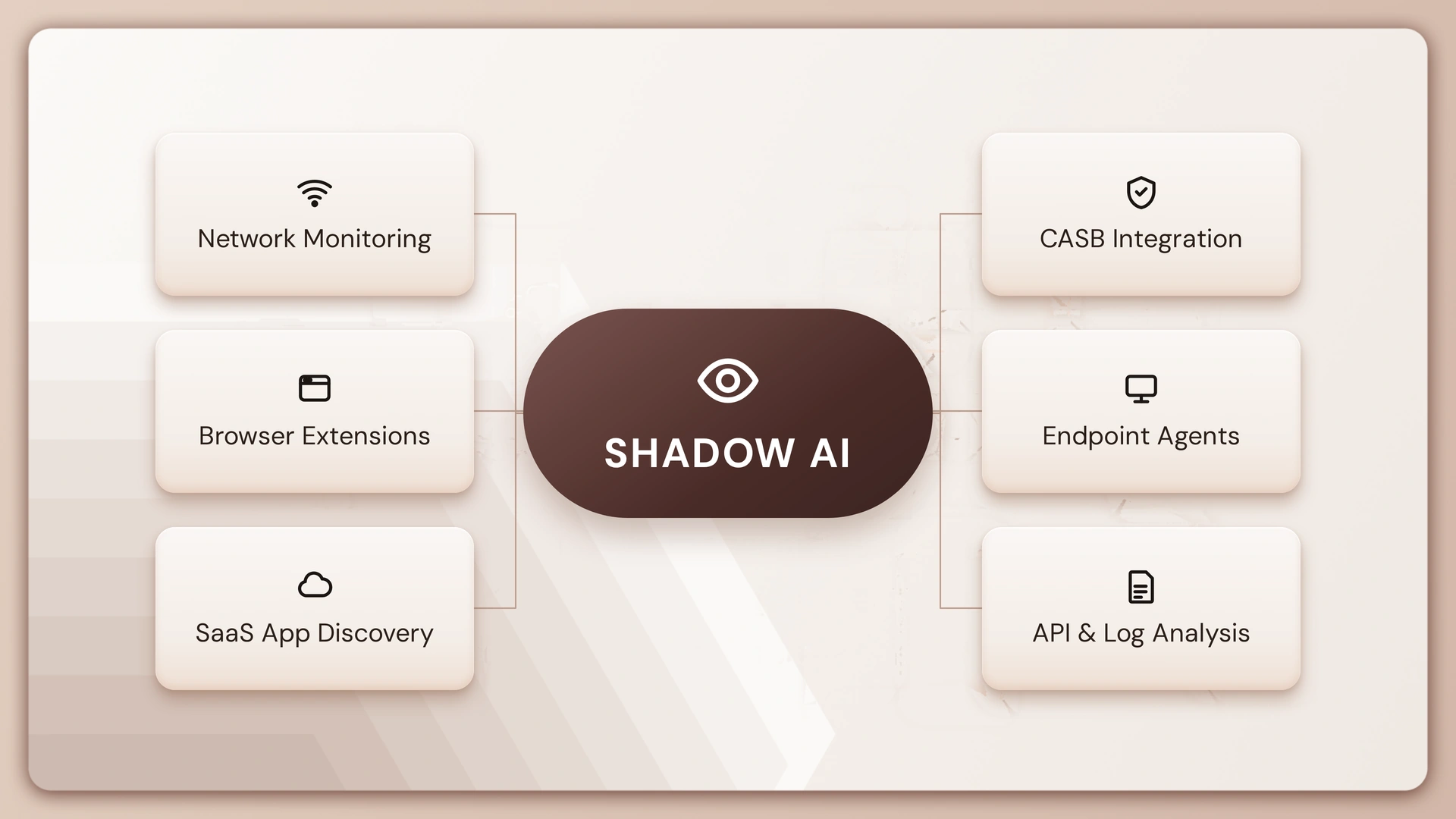
The 5 Layers of Shadow AI Discovery
Before comparing tools, it helps to understand where shadow AI can hide.
| Discovery layer | What it can reveal | Example |
|---|---|---|
| Network | AI services employees connect to | ChatGPT, Gemini, Claude |
| Browser | AI websites, extensions, prompts | Personal AI accounts |
| Endpoint | Locally installed AI software | Claude Code, local LLMs |
| Identity & SaaS | AI apps connected to corporate accounts | OAuth-connected AI tools |
| Agent & infrastructure | Agents, MCP servers, model APIs | Autonomous enterprise agents |
No single discovery method sees everything.
A network-based solution can see traffic but may miss an agent running entirely on an endpoint.
An endpoint solution can find locally installed software but may not know about an AI application accessed from an unmanaged device.
An identity-based platform can reveal OAuth connections but may not see an employee simply visiting an AI website.
That is the central problem when comparing shadow AI discovery tools.
Shadow AI Discovery Tools Compared for 2026
Here are the major approaches enterprises should consider.
| Tool | Primary discovery layer | Best for | AI discovery strength | Key limitation |
|---|---|---|---|---|
| Microsoft Defender for Cloud Apps | SaaS / network | Microsoft-centric enterprises | AI app discovery + risk | Strongest inside Microsoft ecosystem |
| Microsoft Global Secure Access | Network | Microsoft environments | AI apps, APIs, MCP traffic | Network visibility has coverage boundaries |
| Netskope One | Network / SSE / endpoint | Large enterprises | AI apps + GenAI controls + endpoint discovery | Best value when Netskope is already part of the stack |
| Nudge Security | Identity / SaaS | SaaS and OAuth discovery | Finds AI apps connected to identities | Less visibility into local endpoint activity |
| LayerX | Browser | Browser-based AI usage | AI websites and browser activity | Browser-centric rather than infrastructure-wide |
| Cyberhaven | Endpoint / data | Data exposure | AI prompts and sensitive data movement | More data-security focused than pure inventory |
| Cloudflare CASB | Network / SaaS | Cloudflare environments | Shadow AI and SaaS discovery | Most useful when integrated with Cloudflare’s broader stack |
| Dedicated agent governance platforms | Agent / infrastructure | Enterprise agent estates | Agents, ownership, runtime and governance | Different category from traditional shadow IT discovery |
The important takeaway?
These tools aren’t really interchangeable.
They are looking at different parts of the problem.
1. Microsoft Defender for Cloud Apps
If your organization already runs heavily on Microsoft security infrastructure, Defender for Cloud Apps is a natural place to start.
Microsoft says Defender for Cloud Apps provides visibility into more than 1,000 generative AI applications and can assess AI applications alongside its broader SaaS discovery capabilities. :contentReference[oaicite:3]{index=3}
That makes it useful for answering:
“Which AI applications are people accessing?”
It becomes particularly powerful when combined with Microsoft’s newer AI discovery capabilities, which extend visibility into AI model APIs, MCP servers, and other AI services. :contentReference[oaicite:4]{index=4}
Best fit: Enterprises already invested in Microsoft security.
Watch out for: If your AI estate spans multiple clouds, local agents, developer environments, and independent infrastructure, application discovery alone won’t give you the complete picture.
2. Microsoft Global Secure Access
Global Secure Access takes a more network-centric approach.
It analyzes network traffic to identify generative AI applications and tools, including AI model-provider frameworks and SaaS MCP servers. It can then surface users, usage patterns, risk scores, and data-transfer information. :contentReference[oaicite:5]{index=5}
That makes it particularly useful for organizations asking:
“What AI services are employees actually connecting to?”
The advantage is visibility without requiring every AI application to voluntarily register itself.
The limitation is equally important: network visibility is still network visibility.
If an AI workload lives locally or outside the traffic path you’re monitoring, you need another discovery layer.
3. Netskope One
Netskope sits firmly in the SSE/security layer, but its AI capabilities have expanded significantly.
Its 2026 AI Discovery capability can scan Windows and macOS endpoints for AI agents, locally running LLMs, MCP servers, and AI extensions installed in browsers and IDEs. :contentReference[oaicite:6]{index=6}
That is an important shift.
Instead of only asking:
“Which AI websites are employees visiting?”
you can start asking:
“What AI software is actually running on company devices?”
For enterprises already using Netskope, this makes it a strong option for combining network and endpoint visibility.
4. Nudge Security
Nudge approaches shadow AI from the identity side.
Instead of watching network traffic, it focuses on discovering SaaS applications and services connected to employee identities.
This matters because many shadow applications don’t require IT approval anymore.
An employee can sign up with a company email address, authorize an application through OAuth, and start using it in minutes.
The network may tell you that an application was accessed.
Identity discovery can tell you something more useful:
“This application is connected to this employee’s corporate identity.”
That makes Nudge particularly relevant for SaaS-heavy environments where OAuth and unauthorized application connections are major concerns. Its own 2026 comparison highlights identity, email metadata, network, financial, and browser discovery as complementary approaches rather than one universal method. :contentReference[oaicite:7]{index=7}
5. LayerX
LayerX takes the browser route.
That makes sense because a huge amount of employee AI usage still starts in a browser.
Someone opens ChatGPT.
Someone tries a new AI research platform.
Someone installs an AI browser extension.
Someone pastes internal information into an AI assistant.
Browser-level visibility can catch activity that traditional SaaS inventories miss.
The trade-off?
The browser is only one layer.
It can tell you a lot about how people interact with AI, but it won’t necessarily give you a complete inventory of locally running agents or infrastructure-level AI workloads.
6. Cyberhaven
Cyberhaven approaches the problem from a different direction: data.
Instead of asking only:
“Which AI tools are being used?”
the bigger question becomes:
“What information is being sent to them?”
That distinction is crucial.
Knowing that an employee accessed an AI application is useful.
Knowing that the employee pasted source code, customer information, credentials, or confidential documents into it is much more actionable.
For organizations primarily worried about sensitive-data exposure, a data-security platform can therefore complement application discovery rather than replace it.
7. Cloudflare CASB
Cloudflare’s CASB capabilities include shadow AI and IT discovery, application categorization, inline DLP, and GenAI prompt protection. :contentReference[oaicite:8]{index=8}
This makes it a strong consideration for organizations already using Cloudflare’s security stack.
The advantage is consolidation:
discover → inspect → apply policy
can happen inside the same broader security environment.
Again, however, the question is coverage.
If your problem includes locally installed agents, developer tooling, MCP servers, and AI workloads spread across clouds, you may need additional discovery and governance layers.
The Bigger Problem: Finding an Agent Is Not the Same as Controlling It
This is where many shadow AI comparisons stop too early.
Imagine your security team discovers this:
Agent: Invoice Assistant
Owner: Unknown
Location: Developer laptop
Model: Claude
Data access: Finance database
Status: Active
Great.
You found it.
Now what?
Can you determine who owns it?
Can you see what systems it can access?
Can you stop it?
Can you move it into an approved environment?
Can you track its activity after it becomes sanctioned?
Discovery answers “what exists.” Governance answers “what happens next.”
This distinction becomes even more important as organizations move from AI applications toward autonomous agents.
Lyzr’s research on AI agent governance breaks this down into identity, registry, least-privilege access, human oversight, and runtime monitoring.
And its AI agent sprawl analysis makes the operational problem clear: organizations can accumulate agents faster than they can build a reliable inventory of them.
Shadow AI Discovery vs. AI Agent Governance
| Capability | Shadow AI discovery | AI agent governance |
|---|---|---|
| Find AI applications | ✓ | ✓ |
| Find local AI software | ✓ | ✓ |
| Identify agents | Increasingly | ✓ |
| Assign ownership | Limited | ✓ |
| Register agents | Limited | ✓ |
| Control permissions | Sometimes | ✓ |
| Evaluate before production | Rarely | ✓ |
| Monitor runtime behavior | Limited | ✓ |
| Enforce deployment policies | Limited | ✓ |
| Retire unmanaged agents | Limited | ✓ |
This is why enterprises should stop treating shadow AI discovery as a standalone project.
Discovery is the first layer of an AI control system.
So, Which Shadow AI Discovery Tool Should You Choose?
There isn’t one universal winner.
The better question is:
Where does your organization’s shadow AI actually live?
| If your biggest problem is… | Start with… |
|---|---|
| Unauthorized AI SaaS | Microsoft Defender, Netskope |
| Personal AI accounts | SSE / CASB + browser visibility |
| OAuth-connected AI apps | Nudge Security |
| Browser-based AI usage | LayerX |
| Sensitive data entering AI tools | Cyberhaven / DLP |
| Local AI agents | Netskope endpoint discovery / Microsoft endpoint capabilities |
| AI agents across clouds and frameworks | Agent governance / control-plane layer |
| Large Microsoft environment | Microsoft security stack |
| Large Netskope environment | Netskope AI Discovery |
| Heterogeneous agent estate | Open, framework-agnostic governance layer |
And that last category is becoming increasingly important.
What Enterprises Should Look for Beyond Discovery
If you’re evaluating a shadow AI discovery platform in 2026, don’t stop at:
“How many AI applications can you detect?”
Ask these instead:
Can it discover agents, not just applications?
An AI agent may not look like a traditional SaaS application.
It could be code running in a container, an IDE extension, a local process, an MCP server, or an agent embedded inside another enterprise application.
Can it identify ownership?
An inventory with 700 unnamed AI systems isn’t governance.
You need:
Agent → owner → purpose → permissions → environment → status
Can you act on what you discover?
Finding an unauthorized agent is only useful if you can decide what happens next.
Approve it. Restrict it. Move it. Monitor it. Shut it down.
Does it work across your existing infrastructure?
Your agents probably don’t all live in one cloud.
They may run across AWS, Azure, GCP, Kubernetes, SaaS platforms, developer machines, and internal infrastructure.
Your governance layer shouldn’t force you to rebuild everything just to get visibility.
Book A Demo: Click Here
Join our Slack: Click Here
Link to our GitHub: Click Here