An AI system can give a confident answer its source data doesn’t support. It can retrieve the wrong document and summarize it fluently, pick the wrong tool, or return an answer that passes every basic application check and is still factually wrong. Better prompts help, but they don’t close the gap.
Reducing hallucinations in production takes grounding, validation, evaluation and runtime controls that catch unsupported behavior before it reaches users or downstream systems. This guide compares the leading tools and architectures for preventing AI hallucinations in production, and shows which layer of the problem each one covers.
TL;DR: Which Tool for Which Job
- Lyzr Opencontroller: best for connecting agent evaluation, runtime controls, governance and continuous improvement around hallucination-prone workflows. It is a control plane, not a detector.
- Amazon Bedrock Guardrails: best for managed runtime guardrails and contextual grounding checks inside AWS.
- Neo4j / GraphRAG: best for knowledge-intensive applications where relationships between facts matter.
- Guardrails AI / NVIDIA NeMo Guardrails: best for open-source or programmable runtime guardrails.
- DeepEval / Promptfoo: best for testing hallucination risk before and during deployment.
- Langfuse: best for tracing and spotting hallucination patterns in production.
Not every tool here prevents hallucinations. Some prevent, some detect, some validate, some monitor, and one governs. The sections below keep those apart.
What is an AI Hallucination?
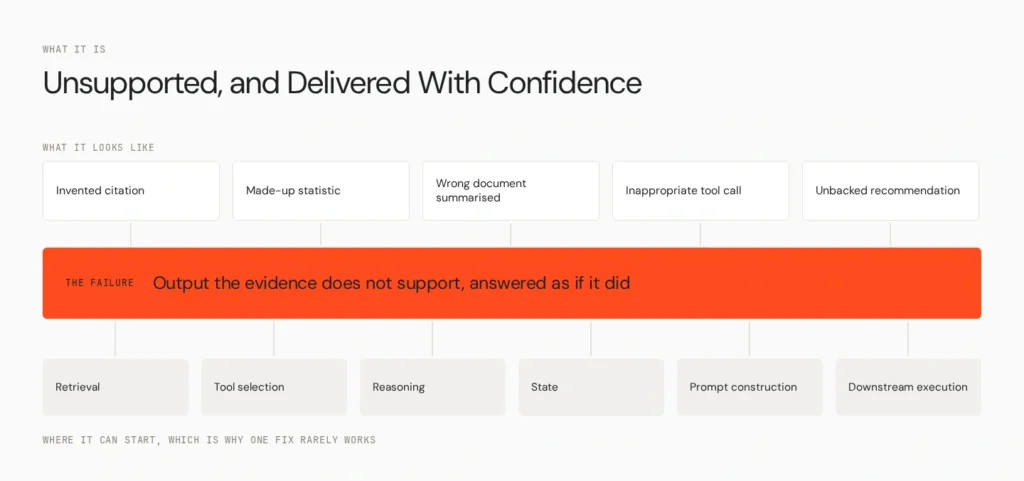
An AI hallucination is output that is unsupported, fabricated, misleading or inconsistent with the available evidence, delivered as if it were a valid answer. In production that looks like an invented citation, a made-up customer statistic, a confident summary of the wrong retrieved document, an inappropriate tool call, or a business recommendation the source data doesn’t back.
It isn’t always a simple wrong answer. In agentic systems the failure can start in retrieval, tool selection, reasoning, state, prompt construction or downstream execution. That is why one fix rarely works.
Can AI Hallucinations be Prevented?
Not completely, today. Production systems can substantially reduce, detect and contain hallucinations through grounding, constrained generation, validation, evaluation and runtime controls. Promising “zero hallucinations” isn’t honest.
Four terms recur through this guide:
- Prevention: lower the probability of unsupported output.
- Detection: identify an unsupported answer after generation.
- Containment: stop a bad output or action from reaching a user or system.
- Remediation: learn from the failure so it doesn’t recur.
The Four Layers of Hallucination Prevention
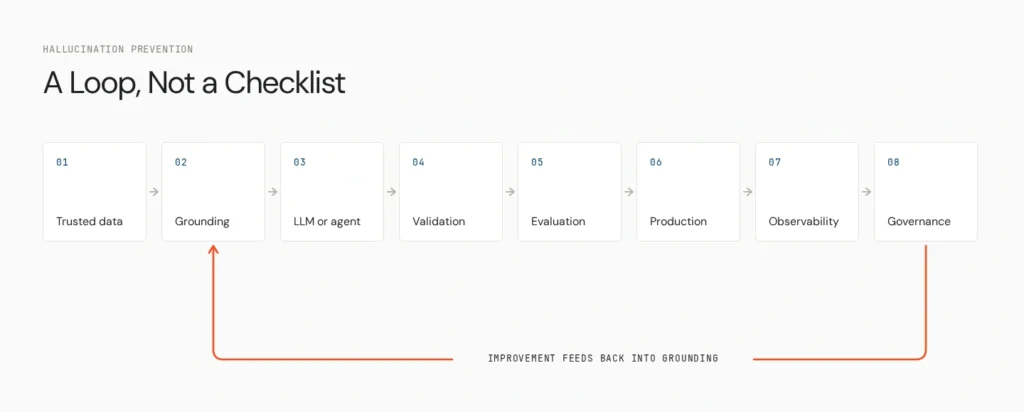
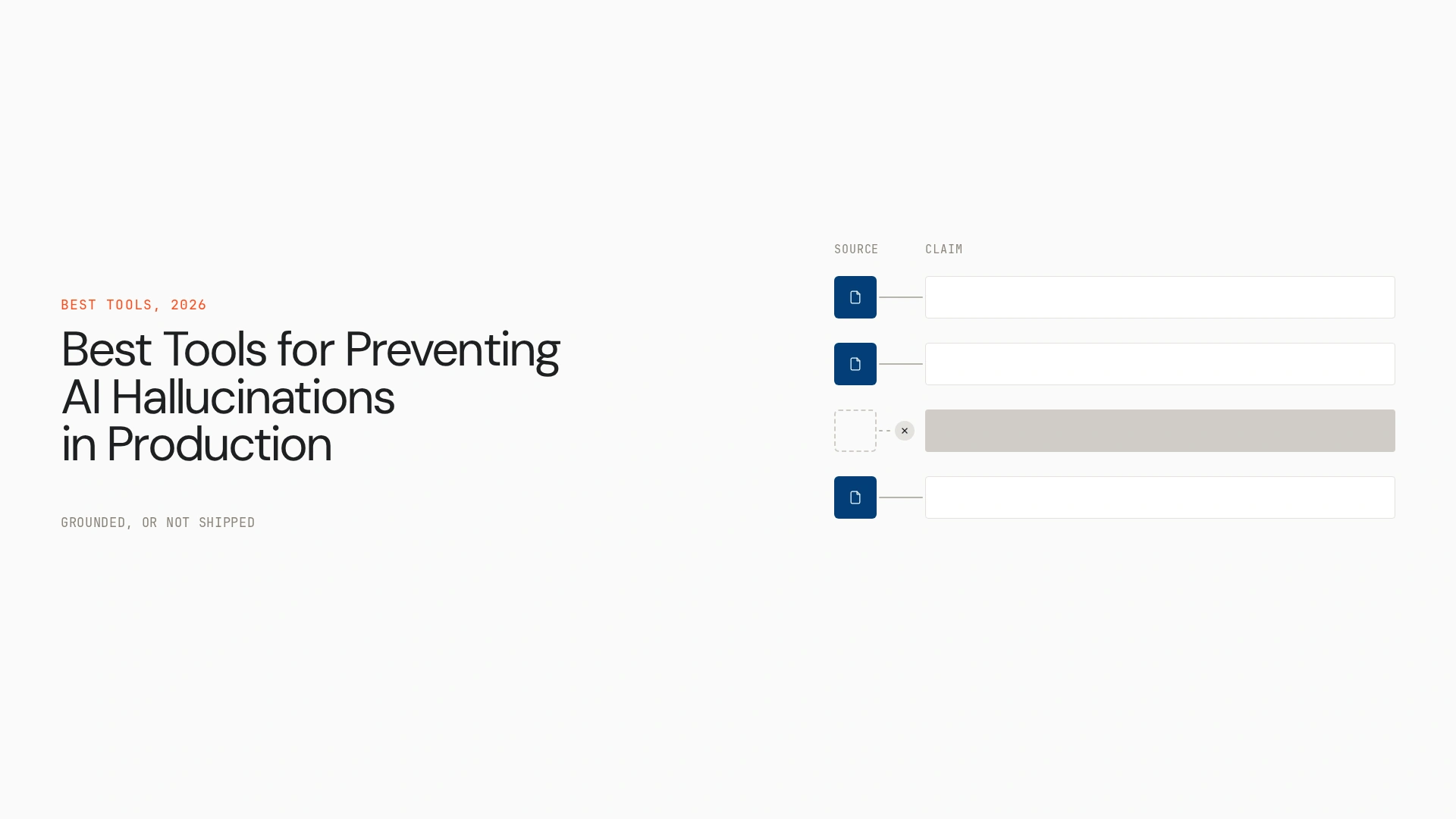
Layer 1: Ground the model. Trusted retrieval, RAG, GraphRAG, citations and constrained context. Goal: give the model evidence to answer from.
Layer 2: Constrain and validate generation. Structured outputs, schemas, prompt constraints, guardrails, content filters and business rules. Goal: stop unacceptable responses from passing downstream. See LLM input and output validation tools.
Layer 3: Evaluate and verify. Automated evaluations, LLM-as-a-judge, grounding checks and verifier patterns. Goal: decide whether the response is actually supported. See AI agent evaluation.
Layer 4: Monitor and govern in production. Traces, evaluation results, recurring failure patterns, agent versions, deployment state and runtime actions. Goal: understand what is failing and control what happens next. This is where an AI control plane sits.
How We Compared the Tools
We compared each tool on hallucination prevention or detection capability, grounding support, validation and guardrails, evaluation, runtime intervention, observability, deployment and self-hosting options, agent support, and governance and remediation. These are different categories of tool, so we didn’t collapse them into a single score. The best choice depends on where hallucination risk enters your pipeline.
The 8 Best Tools for Preventing AI Hallucinations in Production
1. Lyzr Opencontroller

Opencontroller is Lyzr’s AI control plane for production agents. It doesn’t detect hallucinations and it isn’t a RAG framework. Its job is the lifecycle around them. Hallucination prevention doesn’t end when an evaluation passes. A production team still needs to know which agent was evaluated, which version was promoted, what happened afterward, whether failures recur, and what should happen next.
That framing matters because the failure mode most teams hit isn’t the first hallucination. It’s the fifth, in an agent nobody can account for. A grounding tool lowers the chance of a bad answer. An evaluation tool tells you whether an output was acceptable. OpenController governs what happens to the agent based on those results.
The sequence it supports looks like this. An evaluation detects a problem. The workflow governs promotion or remediation. Production traces reveal recurring failures. Those failures become regression inputs. The updated agent is evaluated again before it is promoted. That closed loop is the difference between catching a hallucination and learning from it.
Key features:
- Evaluation before promotion: a version moves to production only when required checks pass, including results from the evaluation tools you already use.
- Agent registry and identity: every agent is known, owned and traceable, so a failure points to a specific agent and version through an agent registry.
- Production trace analysis: runtime activity and evaluation results sit together, so recurring failure patterns become visible. See AI agent observability.
- Governance and runtime controls: policy, spend limits and approvals apply across agents, with an audit trail. This is AI agent governance in practice.
- Continuous improvement: resolved failures feed back as regression tests before the next promotion.
Strengths
- Connects evaluation results to deployment decisions
- Governs the whole agent lifecycle, not one call
- Suits organizations running several agents across teams
Weaknesses
- It isn’t a replacement for RAG or knowledge-grounding infrastructure
- It isn’t a specialized factuality detector
- Teams wanting only an open-source hallucination evaluation library may need a narrower tool
Best for: Enterprise teams that need to govern and continuously improve agents after prevention checks are in place, rather than relying on one validation layer. Skip it for now if you run a single agent and only need grounding checks. Lyzr also offers a separate Hallucination Manager module for built-in detection, and its Responsible AI work covers guardrails. For the staging model, see the Agents to Production playbook.
2. Amazon Bedrock Guardrails
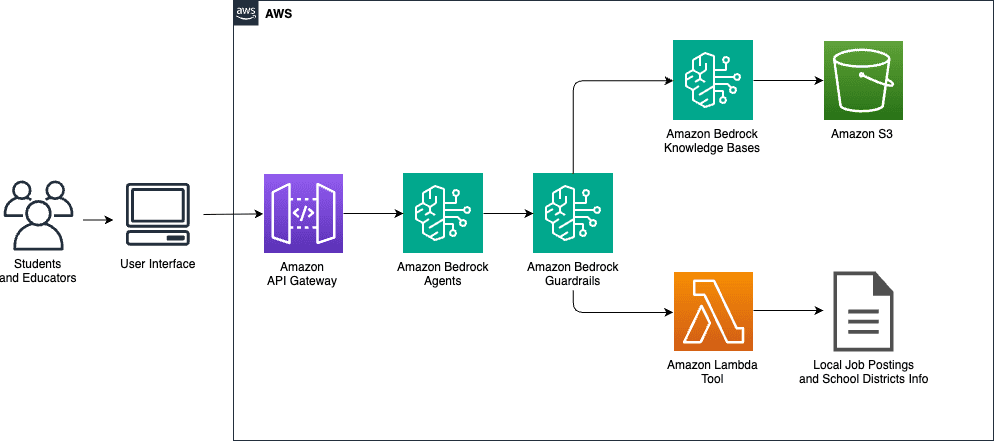
Bedrock Guardrails is AWS’s managed guardrail layer. Its contextual grounding check detects and filters hallucinations in model responses when a reference source and user query are provided, so it checks an answer against evidence you supply. AWS says it helps filter over 75% of hallucinated responses in RAG and summarization use cases. That is a vendor figure for specific workloads, not a guarantee. Treat it as a starting point and test on your own data.
Key features: Contextual grounding and relevance checks, Content filters, Denied topics, Sensitive information handling
Strengths: Managed enforcement at runtime, no assembly required, Works with Bedrock, and is also available as a standalone API per AWS announcements, Configurable thresholds for grounding
Weaknesses: Needs a grounding source and query to check against, Strongest inside the AWS ecosystem, Detects unsupported answers but doesn’t eliminate them
Best for: AWS teams already building on Bedrock that want managed guardrails without building the layer themselves.
Where Opencontroller fits: Bedrock blocks a response. Opencontroller records which agent produced it and decides whether that version stays promoted.
3. Neo4j / GraphRAG
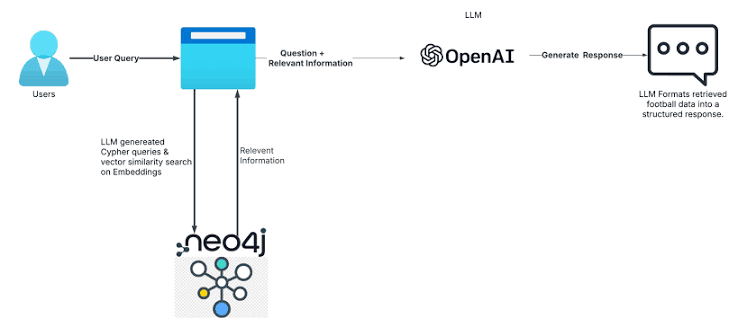
GraphRAG is a grounding architecture, not a monitoring platform. Using a knowledge graph with Neo4j gives retrieval explicit entities and relationships, which helps when questions need multi-hop reasoning. A study by the National Innovation Centre for Data tested this on 510 complex questions from a benchmark dataset. GraphRAG scored 63 on a truthfulness measure against 35 for vector-only RAG. Read it with its limits in mind: Neo4j sponsored the research, though NICD ran it independently, and it used one benchmark dataset and one model. Another paper notes graph retrieval reduces hallucinations without eliminating them.
Key features: Knowledge graphs, Entity relationships, Graph-based retrieval, Multi-hop queries
Strengths: Makes retrieval more precise on relationship-heavy questions, Errors become easier to trace to a source fact, Strong fit for structured enterprise knowledge
Weaknesses: Building and maintaining the graph takes effort, Gains depend on data and question type, Doesn’t validate or monitor outputs on its own
Best for: Knowledge-intensive applications where hallucination risk comes from weak retrieval or wrong relationships between facts.
Where Opencontroller fits: Better grounding lowers risk. Opencontroller checks that the agent built on it still passes evaluation before each promotion.
4. Guardrails AI

Guardrails AI is an open-source framework that wraps LLM calls with validators. It sits at the validation and runtime guardrail layer, covering structure, content safety and PII, with retry and repair when a check fails.
Key features: Validators · Structured output, PII and content checks, Custom checks with retry or repair
Strengths: Customizable and open source, Broad validator coverage, Self-hostable
Weaknesses: Not a grounding or retrieval tool, Validators add latency, Thin monitoring and governance
Best for: Teams wanting customizable open-source validation logic.
Where Opencontroller fits: Guardrails AI blocks a bad response. Opencontroller ties that event to an agent, a version and a policy.
5. NVIDIA NeMo Guardrails
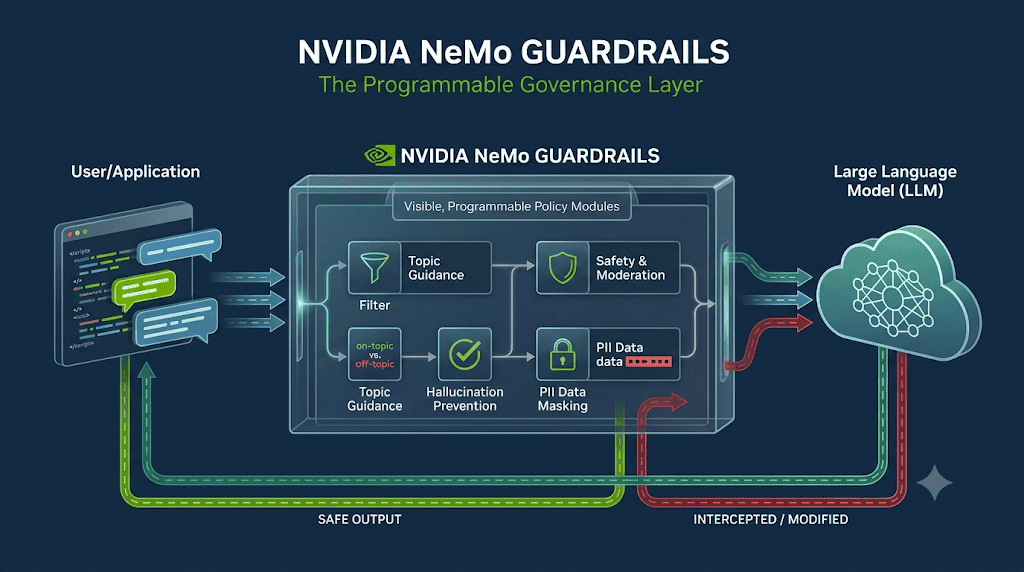
NeMo Guardrails provides programmable rails for conversational systems: topical boundaries, dialogue flows and safety controls, across input and output. Unlike Guardrails AI, which centres on validators, NeMo centres on controlling conversation behavior.
Key features: Topical rails, Dialogue flows, Input and output rails, Safety controls
Strengths: Strong control over conversation design, Open source, Fits the NVIDIA ecosystem
Weaknesses: Colang learning curve, Less focused on strict schema validation, Controls one conversation, not a fleet
Best for: Conversational systems needing programmable behavior and safety boundaries.
Where Opencontroller fits: NeMo shapes one conversation. Opencontroller governs the agents running many of them.
6. DeepEval

DeepEval is primarily a testing and evaluation framework, not a runtime prevention tool. It scores outputs on metrics such as faithfulness and hallucination, including LLM-as-a-judge. It can tell you an output is likely problematic. It doesn’t provide the governance around what happens afterward.
Key features: Hallucination and factuality metrics, LLM-as-a-judge, Regression tests in CI/CD, Agent evaluation
Strengths: Fits naturally into development workflows, Rich metric library, Open source
Weaknesses: Judge scores are probabilistic and cost tokens, Doesn’t block live outputs, Approvals and rollout control need other tools
Best for: Teams wanting automated hallucination testing and regression evaluation in development and CI/CD.
Where Opencontroller fits: DeepEval produces the score. Opencontroller turns it into a promotion gate.
7. Promptfoo

Promptfoo covers testing, red teaming and adversarial evaluation. Testing whether a model can hallucinate under pressure is different from controlling hallucinations in a live agent, and Promptfoo does the first.
Key features: Prompt testing, Adversarial and jailbreak tests, Model comparisons, Regression runs in CI/CD
Strengths: Strong pre-deployment stress testing, Quick, config-based setup, Useful for comparing models
Weaknesses: Pre-release only, not live enforcement, Little production monitoring, Large suites need maintenance
Best for: Teams proactively testing hallucination and security failure modes before deployment. See agent simulation and testing tools.
Where Opencontroller fits: Promptfoo finds the weakness. Opencontroller holds the release until it is cleared.
8. Langfuse
Langfuse is an open-source observability and evaluation platform. It shows where hallucinations happen and under what conditions through traces, prompts, datasets and production feedback. Tracing itself doesn’t prevent a hallucination.
Key features: Traces, Prompt management, Datasets and evaluation, Cost and latency tracking
Strengths: Open source and self-hostable, Production feedback loops, Good for finding recurring patterns
Weaknesses: Doesn’t block or constrain output, Alerts are Cloud only, Self-hosting adds operational load
Best for: Teams needing production traces and evaluation data to identify recurring hallucination patterns. See real-time agent monitoring tools.
Where Opencontroller fits: Langfuse records the pattern. Opencontroller decides what the pattern triggers.
Compare All Eight Tools Side by Side
| Tool / approach | Grounding | Validation | Hallucination detection | Runtime intervention | Evaluation | Production monitoring | Governance |
|---|---|---|---|---|---|---|---|
| Lyzr Opencontroller (control plane) | — | Partial | Partial (consumes eval results) | ✓ | ✓ (gates) | ✓ | ✓ |
| Amazon Bedrock Guardrails | Partial | ✓ | ✓ (grounding checks) | ✓ | — | Partial | Partial |
| Neo4j / GraphRAG | ✓ | — | — | — | — | — | — |
| Guardrails AI | — | ✓ | Partial | ✓ | — | Partial | — |
| NVIDIA NeMo Guardrails | Partial | ✓ | Partial | ✓ | — | Partial | — |
| DeepEval | — | — | ✓ (evaluation) | — | ✓ | Partial | — |
| Promptfoo | — | Partial | Partial | — | ✓ | — | — |
| Langfuse | — | — | Partial (via evals) | — | ✓ | ✓ | — |
✓ built in · Partial · — not a focus.
Reduce Hallucinations with Better prompts, but don’t Stop There
Prompt engineering helps. Useful techniques include telling the model to say when evidence is insufficient, requiring source references, restricting answers to supplied context, asking for structured output, keeping retrieved evidence separate from instructions, and defining fallback behavior for uncertainty. No single “magic prompt” exists, and prompts alone don’t enforce anything. Treat the prompt as one control inside a larger architecture.
How to Choose the Right Tool
- Opencontroller if you need evaluation, runtime visibility, agent identity, deployment decisions, governance and continuous improvement across multiple agents.
- Bedrock Guardrails if you build mainly on AWS Bedrock and want managed guardrails and grounding checks.
- Neo4j / GraphRAG if hallucination risk comes from retrieval quality, entity relationships or multi-hop knowledge.
- Guardrails AI if you want open-source, customizable runtime validation.
- NeMo Guardrails if you need programmable conversational rails and accept the NVIDIA ecosystem.
- DeepEval if your main need is testing hallucination risk before deployment or in CI/CD.
- Promptfoo if you want adversarial testing, red teaming and regression testing.
- Langfuse if you need production traces to see where hallucinations occur.
Most production systems combine several of these layers.
A Practical Production Checklist

Before the model call
- Validate and sanitize inputs
- Detect prompt injection where relevant
- Retrieve trusted context
- Restrict tool availability and enforce permissions
During generation
- Answer from grounded context
- Constrain output format
- Use model parameters appropriate to the task
- Apply runtime guardrails
After generation
- Validate the schema
- Check grounding and factuality
- Run automated evaluations
- Reject or retry failed responses, and escalate high-risk cases
After deployment
- Trace production behavior
- Monitor evaluation scores
- Cluster recurring failures
- Update regression tests
- Control promotion and rollback, and audit agent behavior
Prevention vs Detection vs Governance
| Layer | Primary question | Example tools |
|---|---|---|
| Grounding | What evidence does the model have? | RAG, GraphRAG (Neo4j) |
| Generation constraints | Can the model produce an invalid structure? | Schemas, Outlines |
| Validation | Does this input or output pass the rules? | Guardrails AI, NeMo Guardrails, Bedrock Guardrails |
| Evaluation | Is the response actually good or correct? | DeepEval, Promptfoo |
| Observability | What happened in production? | Langfuse |
| Governance | What should happen based on the result? | Opencontroller |
Where does an AI Control Plane Fit into Hallucination Prevention?
Grounding gives the model better evidence. Validation checks whether a response meets a defined requirement. Evaluation measures whether the agent performs acceptably. Observability shows what happened in production. An AI control plane governs what happens next.
In practice, a production agent may fail an evaluation, be blocked from promotion, enter a controlled rollout, generate problematic traces, have those failures clustered into recurring patterns, get updated, need regression testing, and be re-evaluated before it is promoted again. Someone has to hold that sequence together, and with several agents across teams, nobody does it by hand for long.
That is the job Opencontroller is built for. Hallucination prevention is a loop, not a single filter, and Opencontroller manages that loop across the agent lifecycle. It doesn’t replace RAG, validation libraries or evaluation frameworks. It sits above them and gives their signals one place to become decisions, alongside the identity, policy and audit trail that AI agent governance requires.
Close the Loop on Hallucination Prevention
Validation catches failures. Opencontroller governs the production loop around those failures, from evaluation gates to agent identity to remediation. The best tools for preventing AI hallucinations in production work as a stack, and a control layer is what keeps that stack accountable. To see how it sits above your own grounding, guardrail and evaluation tools, explore Opencontroller or book a demo .
FAQs
Output that is unsupported, fabricated or inconsistent with the available evidence, presented as a valid answer. Examples include invented citations, made-up statistics and confident summaries of the wrong retrieved document.
Ground the model in trusted data, constrain and validate its output, evaluate responses automatically, and monitor production behavior. No single technique is enough, so teams combine them and add controls for what happens when a check fails.
It depends on the layer. GraphRAG for grounding, Bedrock Guardrails, Guardrails AI or NeMo Guardrails for runtime checks, DeepEval or Promptfoo for testing, Langfuse for observability, and OpenController for governing the loop.
No, not currently. Production systems can reduce, detect and contain them. Because generation is probabilistic, teams still need grounding, validation, evaluation and runtime controls rather than expecting zero hallucinations.
Yes, partly. Instructions to cite sources, stay within supplied context and admit uncertainty help. Prompts don’t enforce behavior, so they work best as one control alongside grounding, validation and evaluation.
RAG gives the model retrieved evidence to answer from, which lowers its reliance on unsupported internal knowledge. It doesn’t eliminate hallucinations, because poor retrieval can still lead to confident wrong answers.
Check structure against a schema, test grounding against source material, apply content and policy rules, and retry or block failures. Log results so recurring problems show up in monitoring.
Require source references for every claim, restrict the model to supplied data, and have a person verify figures and citations before circulation. Treat the draft as unreviewed until those checks pass.
Nobody can say for certain. Model reliability is improving, but generation stays probabilistic, so production systems still need grounding, evaluation, validation and controls.
Lower temperature reduces variation in generation. It doesn’t guarantee factual accuracy, because a model can confidently repeat a wrong answer every time. The right setting depends on the model, provider and task, so we don’t recommend a universal range.
Book A Demo: Click Here
Join our Slack: Click Here
Link to our GitHub: Click Here