An LLM can return valid JSON that your application still can’t use. It can accept a malicious prompt without complaint, break a schema on the third retry, leak a customer’s email address, or write a polite answer that violates a business rule. The model is probabilistic. Your application expects predictable inputs and outputs. Validation tools sit in the gap between the two.
This guide compares the best tools for LLM input and output validation across input checks, schema enforcement, content and semantic validation, and runtime guardrails. It also covers where broader AI governance fits once validation results need to drive production decisions.
TL;DR
- Best for enterprise governance: Opencontroller. It is an AI control plane that sits above validation tools, not a validation library.
- Best for type-safe Python: Pydantic AI.
- Best for structured LLM outputs: Instructor.
- Best for constrained generation: Outlines.
- Best for open-source runtime guardrails: Guardrails AI or NVIDIA NeMo Guardrails.
- Best for testing and production evaluation: DeepEval, Promptfoo or Langfuse, depending on whether you need CI tests, red teaming or traces.
What is LLM Input and Output Validation?
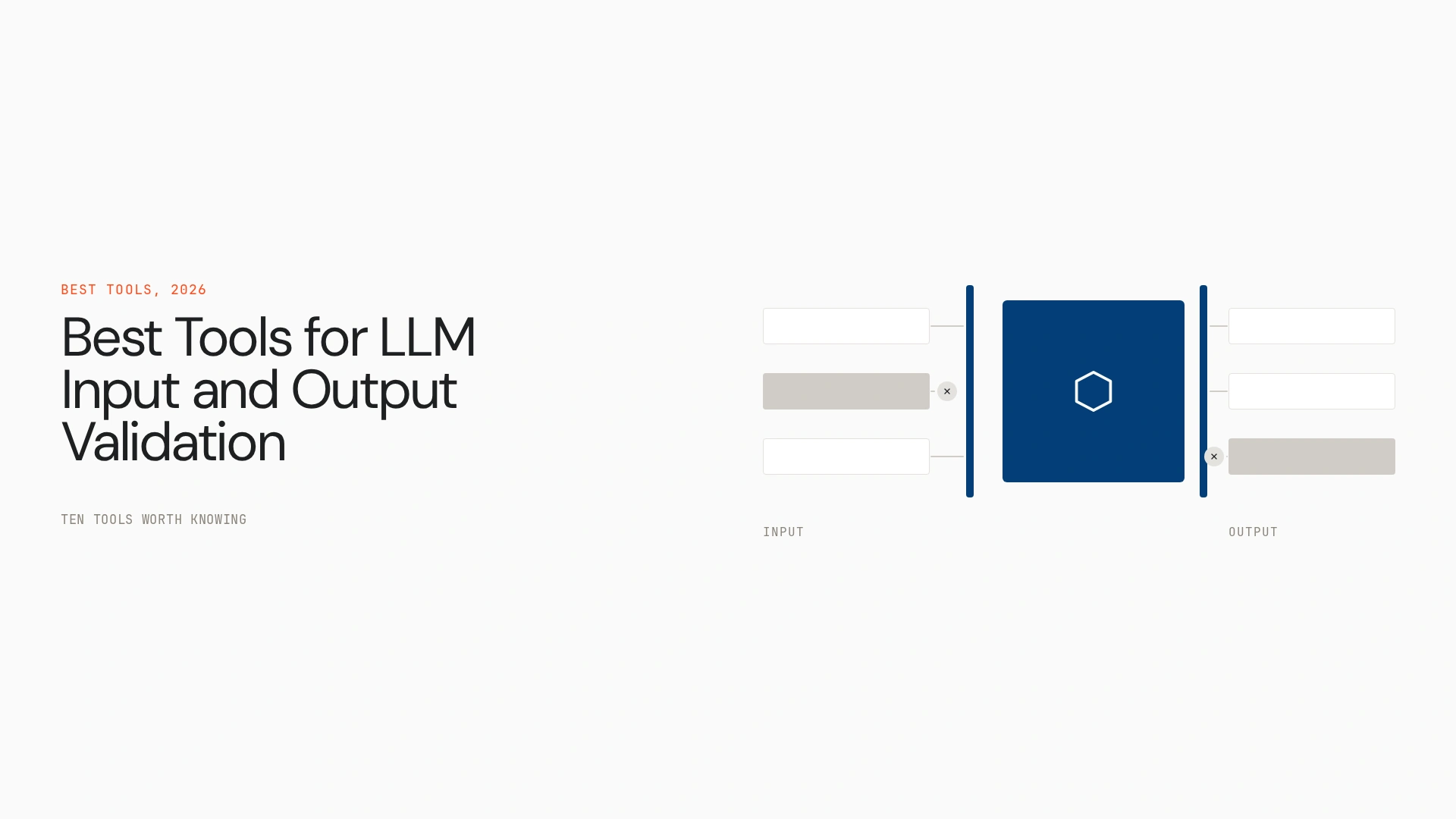
LLM validation is checking what goes into a model and what comes out before either one reaches something that acts on it. Input validation runs before the model processes a request. Output validation runs after generation and before downstream code, a tool or a user sees the result.
Checks can be structural (does it match the schema?), semantic (is it grounded and relevant?), security-focused (is this a prompt injection?) or policy-focused (is it allowed?). Most production systems need more than one layer, so no single tool covers everything.
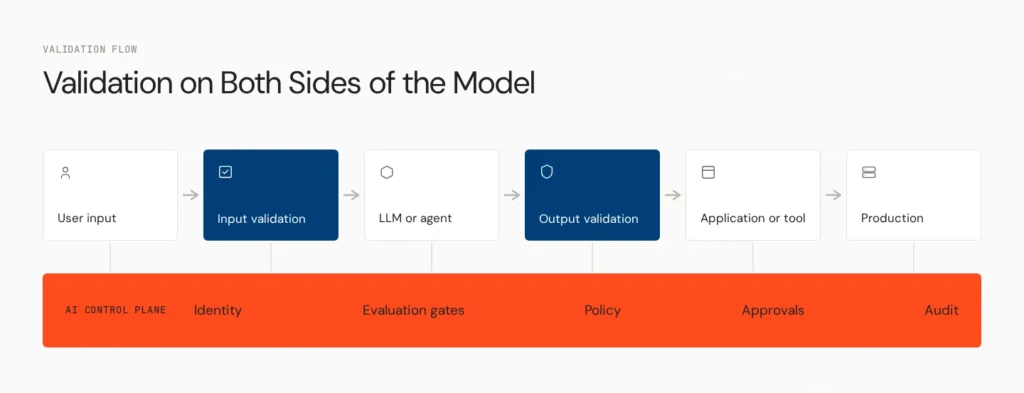
The Three Validation Layers
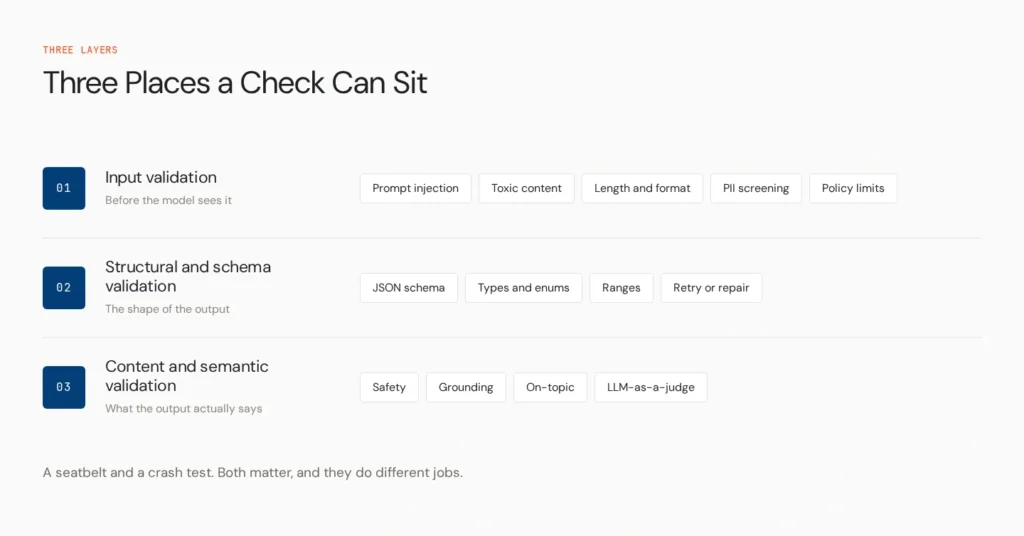
1. Input validation. Checks prompts and incoming data before the model sees them. This covers prompt injection patterns, toxic content, length and format limits, PII or sensitive-data screening, and policy constraints.
2. Structural and schema validation. Ensures outputs match expected JSON schemas, types, enums, ranges and structured formats. Many tools add automatic retry or repair when the output fails.
3. Content and semantic validation. Asks whether the output is safe, grounded, factually acceptable, on-topic and policy-compliant. Methods include LLM-as-a-judge, semantic similarity and grounding checks against source documents.
The tools below sit in different layers. Comparing a decoder-level constraint tool to an evaluation platform is like comparing a seatbelt to a crash test. Both matter, and they do different jobs.
The 10 Best Tools for LLM Input and Output Validation
1. Opencontroller

Opencontroller is Lyzr’s AI control plane. It isn’t a schema library or a guardrail package, and it doesn’t try to be one. Validation tools decide whether a specific input or output passes a check. Opencontroller governs what happens to the agent and the workflow around that decision.
That matters because a failed validation is rarely the end of the story. Someone has to decide whether the agent keeps running, whether this version should have been promoted, who owns the fix, and whether the same failure is happening in other agents. A validation library returns a pass or fail. A control plane turns that result into a decision with a record behind it.
What Opencontroller covers
- Evaluation gates before promotion. A version moves to production only when the required checks pass, including results from the validation and evaluation tools you already use.
- Agent identity and registry. Every agent is known, owned and accountable through an agent registry, so a validation failure points to a specific agent and owner.
- Runtime governance. Policy and spend limits apply in the request path, so a non-compliant call can be refused instead of only logged.
- Auditability. Activity, evaluation results and approvals sit in one place, which is the evidence enterprise reviews ask for.
- Lifecycle control. Governance follows the agent from development to promotion to retirement, across frameworks and clouds.
Where it sits relative to validation tools
Think of Opencontroller as the layer above Pydantic AI, Guardrails AI, DeepEval or Promptfoo. Those tools produce signals: this output broke the schema, this response failed a grounding check, this prompt was an injection attempt. OpenController consumes those signals and ties them to policy. Which agent produced the failure? Is it allowed to keep serving traffic? Does the next version clear the gate? This is the practical meaning of AI agent governance, and it is why agent observability alone doesn’t answer the question.
Strengths
- Connects validation and evaluation results to deployment and runtime decisions
- Built for many agents across frameworks, with identity and audit trail
- Complements existing tools rather than asking you to replace them
Weaknesses
- Doesn’t validate schemas or inputs itself, so you still need a validation layer
- More than a single-agent team needs
- Commercial, not an open-source library
Best for: Enterprises running several agents across teams that need validation results tied to promotion, ownership and enforcement. Skip it for now if you have one application and only need typed outputs. Pydantic AI or Instructor will cover that, and you can add a control layer later. See the Agents to Production playbook for how teams stage that move.
2. Pydantic AI

Pydantic AI is a Python agent framework from the team behind Pydantic. It uses type hints and Pydantic models to define inputs, dependencies and outputs, so invalid structure fails early. It solves the schema layer for developers who want validation to feel like normal Python.
Key features: Typed inputs and outputs, Pydantic model schemas, Output validators with retry on failure, Model-agnostic agent framework
Strengths: Python-native workflow that engineers pick up quickly, Strong schema enforcement with clear error messages, Open source (MIT) with an active repository
Weaknesses: Python only, Limited content and semantic validation out of the box, No runtime governance across agents
Best for: Python teams building typed agents. Not the right fit if you need safety, grounding or policy checks beyond structure.
Where Opencontroller fits: Keep Pydantic AI for typed contracts inside your code. Add Opencontroller when many such agents need shared promotion rules and ownership.
3. Instructor

Instructor extracts structured data from LLM responses using Pydantic models. It wraps provider SDKs, validates the response and retries with the error message when validation fails. It is a lightweight way to get reliable JSON from many providers.
Key features: Structured extraction into Pydantic models, Validation and retry loops, Support for many LLM providers, Minimal changes to existing code
Strengths: Very easy to integrate, Provider flexibility, Open source with a large user base
Weaknesses: Focused on structure, not safety or grounding, Retries add cost and latency, No visibility or governance beyond the call
Best for: Teams that need structured extraction fast. Not ideal when you need input screening or policy enforcement.
Where Opencontroller fits: Instructor makes each call well-formed. Opencontroller governs which agents are allowed to make it, and what happens when retries keep failing.
4. Outlines

Outlines by dottxt.ai constrains generation so the model can only produce tokens that fit a schema, regex or grammar. Because it works at decode time, invalid output is prevented instead of caught afterward. That is a different mechanism from post-generation validation.
Key features: JSON schema constraints, Regex and grammar control, Decode-time enforcement, Works with local and self-hosted models
Strengths: Prevents malformed output at generation, Fine-grained control over format, Open source
Weaknesses: Best suited to models you host or serve yourself, Guarantees format, not truth or safety, Limited usefulness with closed API models
Best for: Teams running their own models who need guaranteed structure. Not for checking whether an answer is correct.
Where Opencontroller fits: Outlines controls how tokens are generated. Opencontroller controls whether the agent using it may ship.
5. Guardrails AI

Guardrails AI wraps LLM calls with validators for inputs and outputs. A hub of prebuilt validators covers areas like PII, toxicity and structure, and you can add your own. It is the broadest open-source option across all three validation layers.
Key features: Validator ecosystem, Structured output validation, Content safety and PII checks, Retry and repair flows
Strengths: Covers input, schema and content checks in one framework, Open source and self-hostable, Large set of reusable validators
Weaknesses: Some validators add latency or model calls, Configuration takes effort at scale, Less depth in monitoring and governance
Best for: Teams wanting open-source runtime guardrails across layers. Not ideal if you want a managed, governed rollout across many agents.
Where Opencontroller fits: Guardrails AI blocks a bad response. Opencontroller records which agent hit the rail, applies policy and feeds the result into promotion gates.
6. NVIDIA NeMo Guardrails
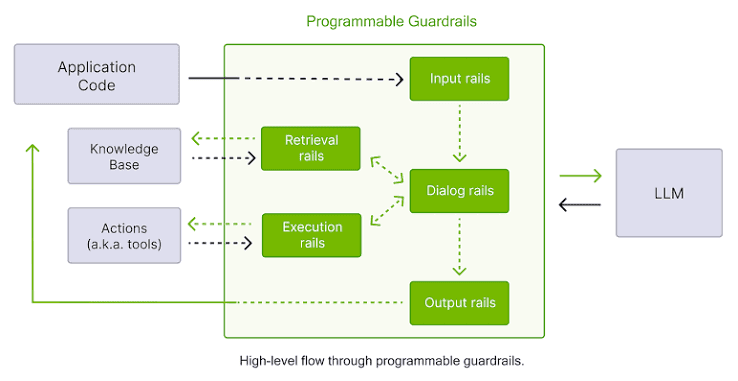
NeMo Guardrails is NVIDIA’s toolkit for programmable rails around conversational systems. It controls topics, dialogue flow and safety behavior using its Colang language, and supports input, output and dialog rails.
Key features: Topical boundaries, Conversation flows, Safety rails, Multi-turn support
Strengths: Strong for conversation design and topic control, Open source, Good fit with NVIDIA tooling
Weaknesses: Colang adds a learning curve, Less focused on strict schema validation, Works best inside the NVIDIA ecosystem
Best for: Conversational apps that need topic and safety boundaries. Not the first pick for structured extraction.
Where Opencontroller fits: NeMo Guardrails shapes one conversation. Opencontroller governs the fleet of agents running them.
7. DeepEval

DeepEval is an open-source evaluation framework that runs LLM tests like unit tests. It is evaluation-first rather than a pure runtime validation layer. Its metrics, including LLM-as-a-judge, check relevance, faithfulness and task completion. Its GitHub repository is widely referenced.
Key features: Evaluation metrics, LLM-as-a-judge, CI/CD and regression testing, Agent evaluation
Strengths: Fits naturally into pytest and CI, Rich metric library, Open source with an optional cloud platform
Weaknesses: Not a runtime blocker, Judge metrics cost tokens and vary run to run, Dashboards and approvals need extra tooling
Best for: Developer teams that want quality checks in CI. Not for blocking bad outputs live. See agent evaluation tools.
Where Opencontroller fits: DeepEval produces the score. Opencontroller turns that score into a promotion gate.
8. Promptfoo
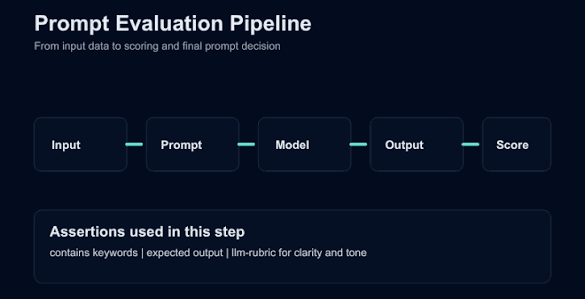
Promptfoo is a testing and red-teaming tool. Teams define prompts, test cases and assertions in config files, then run them locally or in CI. It is known for adversarial testing against prompt injection and jailbreaks.
Key features: Prompt and output testing, Security and red-team scans, Regression suites, CI/CD workflows
Strengths: Strong adversarial and security testing, Quick to start with config-based tests, Open source core
Weaknesses: Tests before release, not live enforcement, Little tracing or production monitoring, Config files can sprawl on large suites
Best for: Security-minded teams validating prompts against attacks. Not ideal as a runtime guardrail.
Where Opencontroller fits: Promptfoo finds the weakness. Opencontroller holds the release until it is cleared. See agent simulation and testing tools.
9. Langfuse
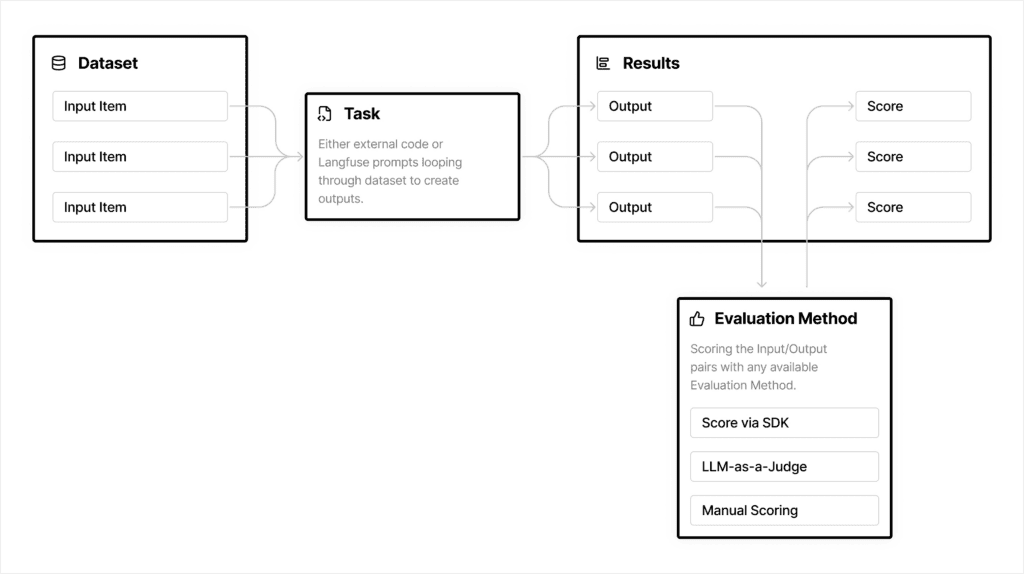
Langfuse is an open-source observability platform covering traces, prompt management, evaluation and production feedback. It is now part of ClickHouse. It records and scores what happened rather than blocking anything, so it complements validation tooling.
Key features: Traces, Prompt management, Evaluation and LLM-as-a-judge on traces, Self-hosting
Strengths: Strong open-source observability, Production feedback loops, MIT-licensed core, self-hostable
Weaknesses: No input or schema enforcement, Alerts are Cloud only, Self-hosting adds operational load
Best for: Teams wanting an open-source record of validation results in production. Not ideal if you need blocking. See open-source LLM observability platforms.
Where Opencontroller fits: Keep Langfuse as your record. Add Opencontroller when failures should trigger policy, not only a dashboard entry.
10. Braintrust and LangSmith


Both platforms centre on evaluation and tracing for production LLM apps. Braintrust links production traces to eval datasets and scoring. LangSmith offers tracing, datasets and online evaluation, and is deepest for LangChain and LangGraph. Neither is a schema or input validation tool.
Key features: Trace-to-dataset workflows, Online evaluation, Regression testing, Alerts and monitoring
Strengths: Tight loop between production data and evals, Good for iterating on quality, Strong team workflows
Weaknesses: Not designed for decode-time or input blocking, Commercial platforms with usage-based pricing, Strongest inside their own ecosystems
Best for: Teams scoring live behavior and building regression suites. See real-time agent monitoring tools.
Where Opencontroller fits: Keep LangSmith for debugging LangGraph code. Add Opencontroller once agents span several frameworks and need spend limits. See Lyzr vs LangGraph.
Compare All Ten Tools Side by Side
| Tool | Input validation | Schema / structured output | Content / semantic | Runtime guardrails | Open source / self-host | Production monitoring / eval | Best for |
|---|---|---|---|---|---|---|---|
| Opencontroller (AI control plane) | ! | ✗ | ! | ✓ | ✗ | ✓ | Governing agents and promotion decisions |
| Pydantic AI | ! | ✓ | ✗ | ! | ✓ | ! | Type-safe Python agents |
| Instructor | ✗ | ✓ | ! | ! | ✓ | ✗ | Structured extraction |
| Outlines | ✗ | ✓ | ✗ | ✓ | ✓ | ✗ | Constrained generation |
| Guardrails AI | ✓ | ✓ | ✓ | ✓ | ✓ | ! | Open-source validators |
| NeMo Guardrails | ✓ | ✗ | ✓ | ✓ | ✓ | ! | Conversational guardrails |
| DeepEval | ! | ✗ | ✓ | ✗ | ✓ | ✓ | CI evaluation |
| Promptfoo | ! | ! | ✓ | ✗ | ✓ | ! | Red teaming |
| Langfuse | ✗ | ✗ | ! | ✗ | ✓ | ✓ | Traces and feedback |
| Braintrust / LangSmith | ✗ | ! | ✓ | ✗ | ! | ✓ | Evaluation workflows |
✓ built in · ! partial or via add-on · ✗ not a focus.
How to Choose an LLM Validation Tool
Answer these in order:
- Input, output or both? Guardrails AI and NeMo Guardrails cover inputs. Pydantic AI, Instructor and Outlines focus on outputs.
- Strict schemas or semantic checks? Schemas point to Pydantic AI, Instructor or Outlines. Semantic checks point to Guardrails AI or DeepEval.
- Runtime blocking or offline testing? Blocking needs a guardrail layer. Offline testing suits DeepEval or Promptfoo.
- Open source or self-hosted? Most tools here qualify. Opencontroller and the evaluation platforms are commercial.
- CI/CD regression testing? DeepEval and Promptfoo.
- Production tracing and evaluation? Langfuse, Braintrust or LangSmith.
- Governance across several agents and environments? That is the control-plane question.
Enterprises usually end up with a stack: a schema tool for structure, a guardrail tool for safety, an evaluation tool for quality, and a control layer to govern all of it.
Where the Tools Differ
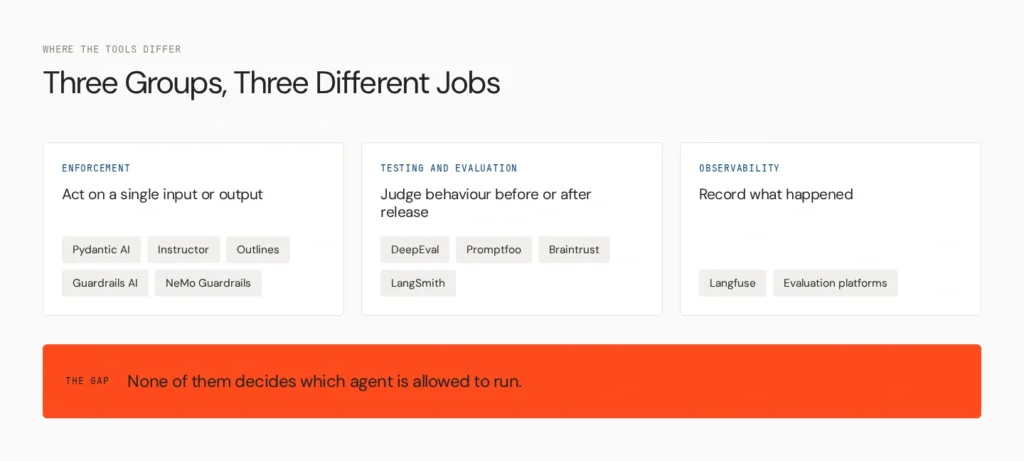
Three groups emerge.
- Enforcement tools (Pydantic AI, Instructor, Outlines, Guardrails AI, NeMo Guardrails) act on a single input or output.
- Testing and evaluation tools (DeepEval, Promptfoo, Braintrust, LangSmith) judge behavior before or after release.
- Observability tools (Langfuse and the evaluation platforms) record what happened.
None of the three groups decides which agent is allowed to run, which version is promoted, or what happens after a failure. That fourth job is where a control plane sits.
Where does an AI Control Plane Fit into LLM Validation?
Validation checks the response. Evaluation judges the behavior. Governance controls what happens next.
The progression runs: input and output validation, then evaluation, then a deployment decision, then runtime governance, then continuous improvement.
A validation library can confirm an output passes a schema. An evaluation framework can confirm an agent meets quality criteria. An AI control plane governs what follows:
- Is the agent promoted or held back?
- Which identity does it run under?
- What may it access?
- What happens when evaluation fails?
- How is production activity tracked and audited?
Without that layer, each team wires its own answers together. One team blocks releases on a DeepEval score, another trusts a Guardrails AI pass, and a third has no gate at all. Opencontroller gives those signals one policy home across the agent lifecycle, and works alongside the tools above. It is the same argument Lyzr makes in its guide to taking agents to production: validation, evaluation and governance are connected lifecycle concerns, not separate purchases.
Validation tools help enforce what enters and leaves an LLM. Opencontroller governs what happens around those decisions across the agent lifecycle, from evaluation gates to identity to runtime policy. If you want to see how it sits above your current mix of Pydantic AI, Guardrails AI, DeepEval or Langfuse, explore Opencontroller or book a demo and bring your own agent stack.
FAQs
Checking prompts and incoming data before they reach the model. Typical checks cover prompt injection, toxic content, length and format, PII and policy rules.
Checking a model’s response before downstream code or users act on it. This includes schema conformance, safety, grounding and policy compliance.
It depends on the layer. Pydantic AI or Instructor for schemas, Outlines for constrained generation, Guardrails AI for content and safety checks, and DeepEval for quality evaluation.
Define the expected structure, check it with a schema tool, add semantic or safety checks for content, and retry or block on failure. Log results so you can track failures over time.
Define a schema, such as a Pydantic model or JSON schema. Validate every response against it, retry with the error message on failure, or constrain generation so invalid output can’t occur.
Screen prompts for injection patterns, sensitive data, length and format before the model call. Guardrails AI and NeMo Guardrails both offer input rails.
Validation checks a single input or output against a rule, often at runtime. Evaluation scores behavior across many cases against quality criteria, often before release.
Pydantic AI, Instructor, Outlines, Guardrails AI, NeMo Guardrails, DeepEval and Promptfoo all have open-source offerings, and Langfuse’s core is open source. Check each GitHub repository for current licence and activity.
Partly. Input validation can catch known patterns, and red-teaming tools like Promptfoo find weaknesses. No filter is complete, so combine screening with least-privilege access and runtime policy.
Often yes, because they do different jobs. A validation tool checks each input and output. A control plane like OpenController decides which agents are promoted, what they may access and what happens when checks fail.
Book A Demo: Click Here
Join our Slack: Click Here
Link to our GitHub: Click Here