Testing an AI agent once isn’t enough. An agent can pass a few happy-path checks and still fail when a user changes direction, a tool returns something unexpected, or a multi-step workflow takes a different path. Real coverage needs simulation, AI agent evaluation, regression testing, multi-turn and adversarial testing, and CI/CD integration.
This guide compares nine tools for AI agent simulation and testing in 2026: open-source frameworks, developer-first evaluation libraries, conversational simulation platforms, and the governance layer that sits above all of them. You’ll get what each one actually does, who it fits, its honest tradeoffs, and where it breaks.
Get the Short Answer First
- Lyzr Opencontroller: best when test and simulation results need to become release decisions, not just reports. It’s a control plane, not a standalone library.
- MLflow: best if you’re already running MLflow for traditional ML and want evaluation tracking in the same place.
- DeepEval: best for developers who want agent tests written as pytest and gated in CI.
- Promptfoo: best for red-teaming and adversarial security testing, now backed by OpenAI’s engineering resources.
- LangSmith: best for teams deep in LangChain or LangGraph who want tracing and evaluation in one workflow.
- Langfuse: best open-source, self-hostable alternative when you want tracing and evals without vendor lock-in.
- Okareo: best for developer-first synthetic scenario generation across voice and text, wired into CI.
- Cekura: best for voice and chat agent QA teams that think in call-center terms.
- Maxim AI: best for cross-functional teams that want a managed UI covering simulation, evaluation, and observability without self-hosting.
What Is AI Agent Simulation and Testing?
AI agent testing goes beyond checking a final answer. Agents take multiple steps, choose tools dynamically, call APIs, retrieve data, keep conversational state and hand off to other agents. Simulation reproduces realistic users, tool responses or failure conditions before real users meet the agent.
Simulation, Testing, Evaluation, Observability, and Governance

Most buyers conflate these five terms, and that’s where tool selection goes wrong. Each one answers a different question, and a mature stack needs all five working together, not one tool trying to do everything.
- Simulation creates the scenario: a synthetic user, an adversarial prompt, a tool that times out.
- Testing checks whether the agent behaved correctly inside that scenario. Pass or fail.
- Evaluation scores the agent against defined criteria such as helpfulness, faithfulness, or tool accuracy.
- AI agent observability and AI agent tracing show what happened during and after execution, so you can debug the failure.
- Governance decides what ships. It takes signals from the other four and enforces a promotion or rollback.
Confusing these stages is how teams end up buying a tracing tool when they needed a release gate, or a red-teaming CLI when they needed three governed planes, deploy, govern, and refine, in a single pipeline where nothing ships without clearing the gate.
Why Testing Stopped Being Optional
The cost of skipping this layer is no longer theoretical.
Gartner predicts that over 40% of agentic AI projects will be scrapped by 2027, and the reason tracks back to the same root cause every time.
This high failure rate is rooted in a fundamental clash between the unpredictable nature of autonomous AI and the rigid requirements of the enterprise: stability, compliance, and control.
A prompt that passed last month’s test suite can silently regress after a model update, a new tool integration, or a one-line system prompt edit. Without a permanent regression gate, nobody notices until a customer does.
That’s the gap a dedicated simulation and testing layer closes, and it’s why this category has split into open-source test runners, conversational simulators, and governance platforms rather than staying one generic “LLM eval” bucket.
See How We Scored Every Tool
Enterprise teams we talk to rarely ask “does it have evaluation metrics.” They ask whether a failing test can actually stop a deployment, whether the tool works across the five frameworks their teams already use, and whether self-hosting is even possible under their data policy. Our scoring reflects those four questions:
Our Scoring Framework
| Criterion | What We Checked |
|---|---|
| Core function | Does it simulate, test, evaluate, trace, or govern, and how deep does that one job go |
| CI/CD gate | Can a failing score actually block a merge or a promotion |
| Framework reach | Does it work across LangChain, CrewAI, custom code, or just one ecosystem |
| Deployment control | Self-hosted, open-core, or cloud-only, and what that means for audit and data residency |
The Best Tools for AI Agent Simulation and Testing
1. Govern the Full Agent Lifecycle with Lyzr Opencontroller
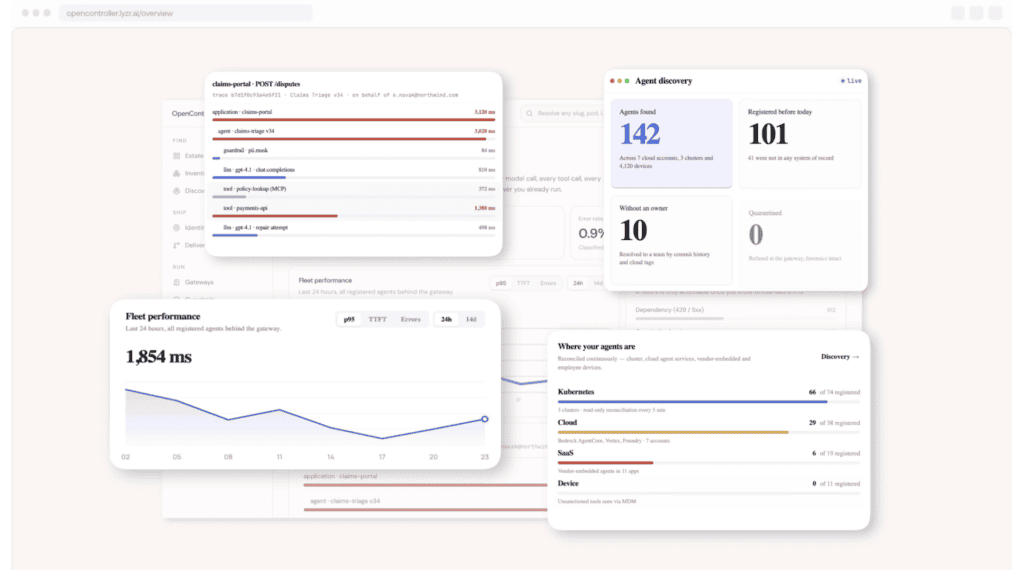
Lyzr Opencontroller is not a test runner competing with DeepEval or a tracer competing with Langfuse.
Opencontroller isn’t trying to replace the platforms below, you can still use LangSmith, Langfuse, Phoenix, Braintrust, or Datadog for tracing, evaluation, and debugging. OpenController sits above that stack to give you visibility and control across the agents themselves.
That distinction matters because most teams in this guide already run two or three of the other nine tools side by side. The question isn’t which evaluation framework to pick in isolation, it’s what happens after a test fails.
Best for:
- Enterprises running agents across multiple clouds, frameworks, or vendors who need one inventory and one policy layer
- Teams that need a failing AI agent evaluation score or regression to actually block a promotion, not just log it
- Organizations that need AI agent governance tied to identity, cost, and runtime enforcement, not a reporting dashboard
How it works in practice:
- Agent discovery across AWS, Azure, GCP, and on-prem, plus LangChain, CrewAI, AutoGen, and custom runtimes, automatically discovering agents, models, tools, data, and workflows across the entire AI estate, then evaluating, validating, and governing every agent and workflow before it reaches production, and monitoring agents, applications, APIs, and infrastructure in real time from one control plane.
- A pipeline where a code push triggers security and vulnerability scanning, a container build and scan, deployment to a supported cloud runtime, a health check, identity registration, and an automated evaluation suite.
- Multi-turn scenario coverage feeding directly into the same gate that decides promotion, via Lyzr’s Agent Simulation Engine, which ships an open-source SDK Deployment options spanning SaaS, VPC, on-prem, and air-gapped environments, which matters once compliance teams get involved.
- A scoring layer that separates deterministic checks from LLM-judge scoring; see Lyzr’s guide to deterministic vs LLM-judge evaluation for how that split is scored.
One 2026 security survey found that 82 percent of executives were confident their policies protected against unauthorized agent actions, while only 14.4 percent of organizations were actually sending agents to production with full security or IT approval.
That gap between confidence and control is the exact problem Opencontroller is built to close, and it’s why the comparisons later in this guide keep circling back to the same question: what happens the moment a test fails at 2am.
Testing frameworks tell you how an agent scored. An AI control plane decides what happens next. See Lyzr’s playbook on taking agents to production.
Not ideal if: you’re a solo developer with one agent and a laptop. For that, a pytest-native library like DeepEval gets you running in ten minutes with none of the setup a fleet-wide control plane requires.
2. MLflow

MLflow extends a well-established ML lifecycle platform into agent evaluation and tracing.
Backed by the Linux Foundation, it is 100% open source under the Apache 2.0 license, with 28.2k GitHub stars and a release cadence that ships Databricks scorer versioning and Google ADK LLM judge scorers for hallucination and safety as recently as this year.
Key features
- Conversation simulation
- Multi-turn scorers
- Custom LLM judges
- Version comparison on shared datasets
Best for: data science teams already standardized on MLflow who want agent evals in the same tracking server as their classic ML experiments.
- Apache 2.0, fully self-hostable, no vendor lock-in
- Framework-agnostic autologging across LangChain and 100+ libraries
- CI/CD requires wiring your own gate; MLflow logs the score, it doesn’t enforce a policy
Not ideal if: you need agent-native concepts like persona simulation or multi-turn conversation scoring out of the box. MLflow’s roots are in classic ML tracking, so agent-specific workflows take more setup than a purpose-built tool.
3. DeepEval

DeepEval turns LLM evaluation into something that looks and runs like a normal unit test.
DeepEval is an open-source project, released under the Apache-2.0 license, and has grown to 17.5k stars on GitHub with active weekly commits.
Key features
- ConversationSimulator with personas
- 50+ metrics
- Trajectory and component evals
- deepeval test run for CI
Best for: Python developers who want agent tests living in the same repo and CI pipeline as their application code.
- Task Completion, Tool Correctness, Goal Accuracy, Step Efficiency, and Plan Adherence metrics built in for agentic workflows
- Pytest-native, so a failing metric fails the build the same way a broken unit test does
- Red-team coverage for 40+ safety vulnerabilities including toxicity, bias, and SQL injection using 10+ attack strategies
Not ideal if: you need a fleet-wide view across dozens of agents or a promotion gate tied to identity and policy. DeepEval scores one test run at a time; it has no concept of an agent registry.
4. Promptfoo

Promptfoo built its reputation on YAML-configured red-teaming before OpenAI acquired the company.
OpenAI acquired the company in March 2026, terms undisclosed, and it stays MIT licensed and open source, with the repository continuing to accept community contributions.
Key features
- Prompt injection and jailbreak tests
- Declarative YAML configs
- Automated evaluations
- CI/CD support
Best for: teams that want adversarial and regression testing as a CI step without standing up a server.
- Tests for prompt injection, jailbreaks, and 50+ vulnerability types via YAML config
- Compares prompt performance across multiple models with CI/CD integration via GitHub Actions
- Now part of OpenAI but remains MIT-licensed and community-maintained
Not ideal if: you want dynamic, persona-driven multi-turn simulation rather than discrete input and output test cases, or you’re uneasy about long-term roadmap independence now that it sits inside OpenAI.
5. LangSmith
LangSmith is the native observability and evaluation layer for LangChain and LangGraph. It carries a 4.8/5 rating on G2 for its debugging depth, though reviewers also note reliability gaps outside enterprise SLA tiers.
Key features
- Datasets and experiments
- Simulated-user conversations
- 30+ evaluator templates
- Production traces as datasets
Best for: teams building primarily on LangChain or LangGraph who want tracing, datasets, and evaluation in one workflow.
- Deep step-by-step trace visualization purpose-built for chain and graph execution
- The Plus tier at $39/seat/month includes 10,000 traces with overage billed per 1,000 beyond that
- Evaluation exists but is secondary to its core tracing and debugging strength
Not ideal if: your agents aren’t built on LangChain or LangGraph. Value drops fast outside that ecosystem, and per-seat trace pricing scales quickly for larger teams.
6. Langfuse

Langfuse is the open-source, framework-agnostic alternative to LangSmith, now under new ownership.
Acquired by ClickHouse in January 2026, it has grown to 35,089 GitHub stars with 65M+ SDK installs per month, and follows an open-core model where tracing, integrations, API, and data model are MIT-licensed, while some periphery features like model-based evaluation are commercial.
Key features
- Self-hosting
- Dataset experiments
- LLM-as-judge on traces
- Prompt management
Best for: teams that want self-hosted tracing and evaluation without being tied to one framework.
- MIT core, runs the identical codebase self-hosted or in Langfuse Cloud
- Works across any LLM stack via OpenTelemetry, not locked to one orchestration framework
- CI/CD evaluation gates shipped as first-class features through 2026
Not ideal if: you need the evaluation and prompt playground features that sit behind the commercial Enterprise Edition license, or you need a governance layer that can refuse a deployment, not just flag it.
7. Okareo

Okareo built its name on synthetic “Drivers,” simulated users with personality and goals that stress-test both voice and text agents.
Okareo is open-core with open SDKs, with pricing starting at $199/month for the Pro tier including 125 agent simulations, or $799/month for Team with 300 simulations.
Key features:
- Multi-turn agent simulation
- Synthetic scenario and persona generation
- Evaluation checks, including LLM-as-judge
- CI/CD test runs for regression testing
Best for: developer-first teams that want synthetic scenario generation defined in code and wired directly into a build pipeline.
- Voice agent testing in 120+ languages with noise, crosstalk, and clipping simulation
- Can block PR merges when synthetic simulations or eval scorecards regress
- OWASP LLM Top 10 and Agentic Top 10 red-teaming built in
Not ideal if: you need a free, permanently self-hosted tier. Okareo runs a 14-day trial with no permanent free plan, and the platform itself is closed source even though SDKs are open.
Not ideal if: you’re testing general-purpose task agents rather than conversational support bots, or you need deeper stateful workflow testing and human review queues, which a competitor like Coval covers but Cekura does not.
8. Cekura

Cekura, formerly known as Vocera, specializes in conversational QA for voice and chat support agents.
Cekura raised $2.4 million in seed funding in July 2025 led by Y Combinator, and operates as a YC F24-backed automated QA and observability platform for voice and chat AI agents.
Key features
- Branching scenarios and personas
- Voice, chat and SMS testing
- Regression suites
- GitHub Actions integration
Best for: contact-center and support teams who think in call-center QA terms and need conversation-quality scoring across thousands of simulated calls.
- Simulates thousands of edge cases with real-time production monitoring, working with Vapi, Retell, and Bland
- Conditional Actions, a rule-based testing engine designed to reduce LLM judge flakiness, plus an MCP server for IDE integration
- Credit-based pricing starting around $30/month for a Developer tier, usage-metered by call minutes
9. Maxim AI

Maxim AI pairs a prompt engineering studio with multi-turn agent simulation in a single managed dashboard.
Funded by a $3M seed round from Elevation Capital, it holds a 4.8/5 G2 rating, though that score currently rests on just 3 reviews, worth weighing before treating it as a settled signal.
Key features
- Persona-based simulation
- Multi-turn scenarios
- Online evaluation
- In-VPC deployment
Best for: cross-functional teams, including non-engineers, who want simulation, evaluation, and observability without self-hosting anything.
- Playground++ for prompt engineering, versioning, and chain editing alongside persona-based agent simulation
- Custom evaluators spanning AI, programmatic, and statistical methods, plus human-in-the-loop review
- Polished UI that onboards non-engineers quickly, at the cost of deep self-hosting control
Not ideal if: you need an open-source core you can audit and self-host, or you need policy enforcement and agent ownership across a large fleet; policy enforcement and agent ownership sit outside its scope.
Compare All Nine Tools Side by Side
| Tool | Core Function | Open Source | CI/CD Gate | Governance |
|---|---|---|---|---|
| Lyzr Opencontroller | Lifecycle governance | SDK only | ✅ | ✅ |
| MLflow | Eval tracking | ✅ Apache 2.0 | ⚠️ manual wiring | ❌ |
| DeepEval | Developer CI testing | ✅ Apache 2.0 | ✅ | ❌ |
| Promptfoo | Red teaming | ✅ MIT | ✅ | ❌ |
| LangSmith | Tracing + eval | ❌ | ✅ | ⚠️ data only |
| Langfuse | Tracing + eval | ✅ MIT core | ✅ | ⚠️ data only |
| Okareo | Synthetic simulation | ⚠️ open-core | ✅ | ❌ |
| Cekura | Voice/chat QA | ❌ | ✅ | ❌ |
| Maxim AI | Managed sim + eval | ❌ | ⚠️ limited | ❌ |
✅ native support · ⚠️ partial or requires setup · ❌ not a focus
Choose the Right Tool for Your Testing Requirement
- Does a failing test need to stop a deployment, not just get logged? Start with Lyzr Opencontroller.
- Are you testing voice or chat support agents specifically? Cekura or Okareo cover that channel natively.
- Do you want tests written as code in your existing CI? DeepEval for Python-native testing, Promptfoo for YAML-based red-teaming.
- Are you committed to LangChain or LangGraph? LangSmith fits natively; Langfuse works just as well and stays framework-agnostic.
- Do you need a managed UI non-engineers can use? Maxim AI trades self-hosting control for a polished shared interface.
Check Enterprise Deployment and Compliance Requirements
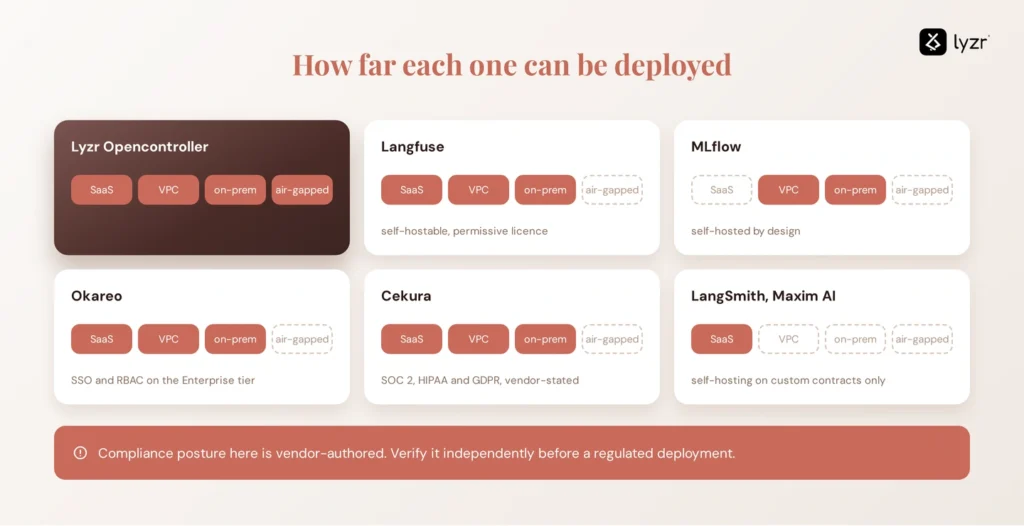
Deployment model changes fast once legal or security gets a seat at the table.
Lyzr Opencontroller supports SaaS, VPC, on-prem, and air-gapped deployment, which matters for regulated industries that can’t send trace data to a third-party cloud.
Langfuse and MLflow offer the same guarantee by virtue of being fully self-hostable under permissive licenses. Okareo’s Enterprise tier adds SSO, RBAC, and VPC or on-prem deployment above its self-serve plans, and Cekura claims SOC 2, HIPAA, and GDPR posture with in-VPC and on-prem observability options, though that compliance language is vendor-authored and worth independent verification before a regulated deployment. LangSmith and Maxim AI remain primarily cloud-hosted, with self-hosting reserved for custom enterprise contracts.
Pick Your Next Move
A tool that scores an agent and a tool that stops a bad agent from shipping are not the same category, no matter how similar their dashboards look. Pick a testing framework for the job in front of you today. Then ask the harder question: what happens six months from now when you have thirty agents across four teams and nobody remembers which one failed last Tuesday’s regression suite.
That’s the question Lyzr Opencontroller was built to answer.
See how Opencontroller connects evaluation, improvement, and production governance, or book a demo to see how it fits into your agent stack.
If you’re still running evaluation and tracing separately and want to see what a release gate actually looks like in practice, that’s the fastest way to find out.
FAQs
Opencontroller, MLflow, DeepEval, Maxim AI, Cekura, Promptfoo, LangSmith and Langfuse cover the main categories: lifecycle gates, open-source frameworks, conversational simulation and red teaming.
There is no single best tool; it depends on your constraint. DeepEval suits developer CI, Cekura suits voice agents, Promptfoo suits security testing, and Opencontroller suits governed release gates across many agents.
DeepEval, MLflow and Promptfoo are free open-source options; Langfuse’s core is too. Free tools still cost LLM-judge tokens.
MLflow, DeepEval, Promptfoo and Langfuse’s core are open source. Lyzr’s Agent Simulation Engine SDK is on GitHub; Opencontroller itself is commercial.
Define scenarios, run the agent against simulated users and tool responses, score task completion and tool calls, and rerun after every change.
Simulation generates the conditions, such as users, conversations and failures. Evaluation scores how the agent performed under them.
Evaluate the full trajectory and each handoff, not just the final answer, and simulate tool or peer-agent failures.
Run a fixed scenario suite on every pull request using a tool like DeepEval or Promptfoo, set tolerance bands rather than exact scores to absorb LLM variance, and fail the build when a metric drops below its band.
Task completion, tool selection and arguments, multi-turn behavior, prompt injection resistance, error recovery and regressions against the live version.
Yes. Simulated users, LLM judges and CI pipelines automate most of it, with human review reserved for ambiguous or high-stakes cases.
Book A Demo: Click Here
Join our Slack: Click Here
Link to our GitHub: Click Here