On April 17, 2026, the Federal Reserve, OCC and FDIC replaced SR 11-7, the model risk guidance US banks had lived by for fifteen years. The new guidance, SR 26-2, explicitly excludes generative and agentic AI from its scope because the technology is “novel and rapidly evolving.” Examiners will still ask how you control your agents. You just no longer get a rulebook for the answer.
Most firms don’t have one yet. In a Gartner survey of 360 IT application leaders, only 13% strongly agreed they had the right governance structures for AI agents, and 74% saw agents as a new attack vector.
Below are the best tools for governing AI agents in regulated industries, judged on what an examiner will ask to see.

Get the short answer
Short on time? Find your situation below, then jump to that tool’s review further down.
- Agents touch money, records or patient data and nothing can leave your cloud? Pick Lyzr Opencontroller. It refuses non-compliant calls in the request path and runs inside your own cloud account.
- You’re a bank or insurer with a model risk team? Pick ValidMind, which already maps its controls to SR 26-2.
- Your regulated estate is already on IBM, cloud and on-premises? Pick IBM watsonx.governance.
- Most of your agents live in Microsoft 365 and Copilot Studio? Pick Microsoft Agent 365.
- Security owns agent risk and you need to block attacks inline? Pick Zenity.
- Risk, IT and audit already run on ServiceNow? Pick ServiceNow AI Control Tower.
- Compliance writes the policies and needs ready-made packs? Pick Credo AI, which ships packs for the EU AI Act and NAIC guidance.
Know what regulators expect from an agent in 2026
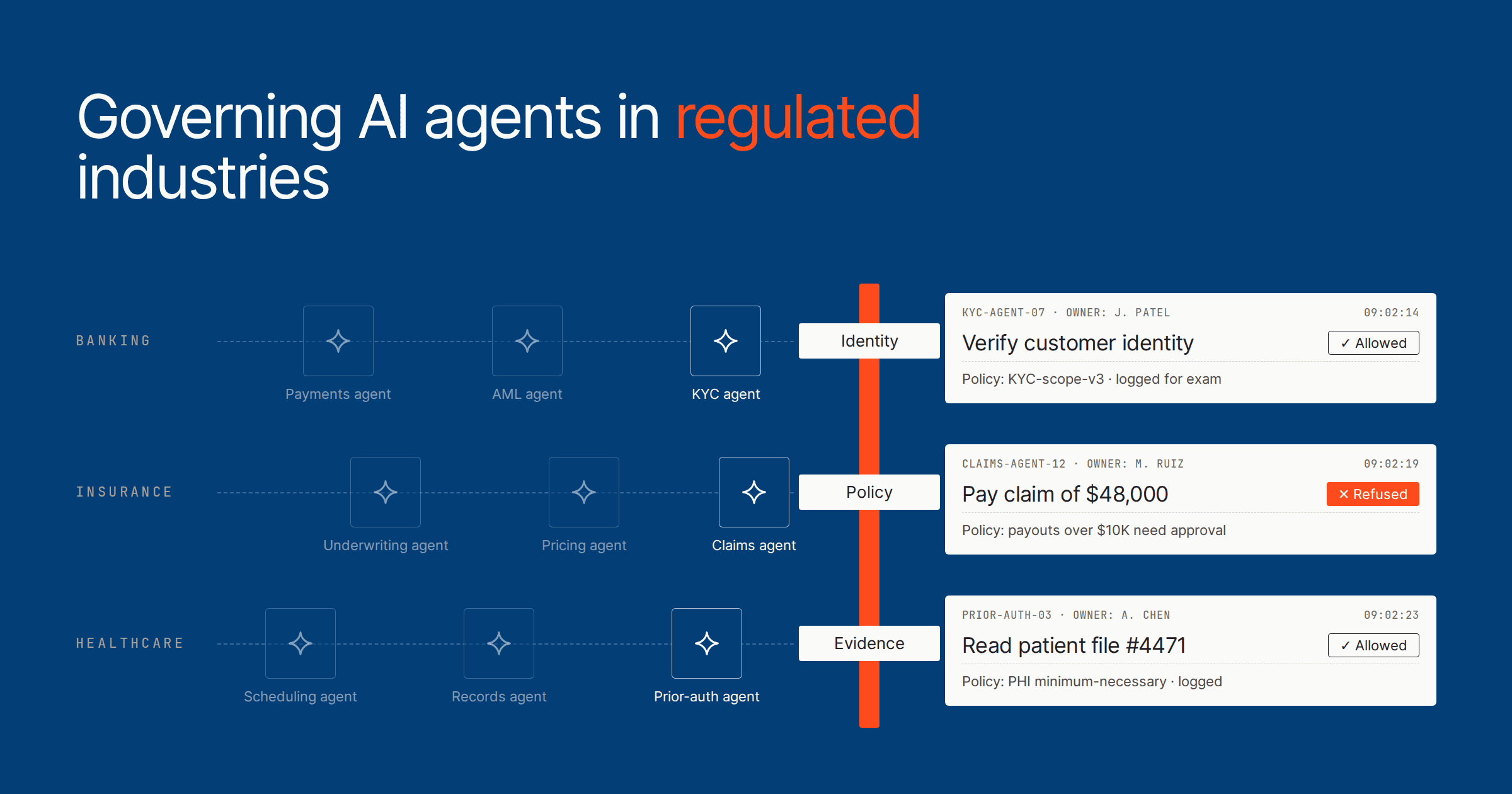
Every sector asks a version of the same thing: who is the agent, what was it allowed to do, and what did it do?
| Sector | Rule in play | What it means for your agents |
|---|---|---|
| US banking | SR 26-2 / OCC Bulletin 2026-13 (April 2026) | Agents sit outside the guidance, so your own governance must cover them and hold up in an exam |
| Broker-dealers | FINRA 2026 Regulatory Oversight Report (December 2025) | Supervise agent access and data handling, decide where humans review, track actions |
| US insurance | NAIC AI Model Bulletin | A written AI program with third-party oversight, adopted in more than 20 jurisdictions |
| EU, all sectors | EU AI Act (Digital Omnibus, 2026) | Credit scoring and life and health insurance pricing are high-risk; obligations start December 2, 2027 |
| Colorado | SB 26-189 (signed May 2026) | Notices, human review on request and three years of records for automated decisions, from January 1, 2027 |
FINRA was the most specific about agents. Its 2026 report named autonomy, scope creep and auditability as the core risks and said firms stay responsible for anything an agent influences. Colorado went the other way: it repealed its original AI Act and dropped annual impact assessments, but the record-keeping duty survived.
Healthcare gets no agent-specific rule yet, though it carries the highest bill when controls fail. IBM’s 2025 breach study put the average healthcare breach at $7.42 million, the costliest of any industry.

See how we scored every tool
We reviewed public documentation and announcements as of October 2026. Lyzr publishes this guide and is listed first. Where another tool fits better, we say so.
| Dimension | What we checked |
|---|---|
| Agent inventory | Finds registered and unregistered agents, with owners |
| Enforcement before action | Can refuse or pause a live call, not only alert on it |
| Exam-ready evidence | Logs and documentation an examiner can replay |
| Regulatory mapping | SR 26-2, EU AI Act, NAIC and similar frameworks |
| Data residency | Runs in your own cloud or on-premises |
| Framework coverage | Governs agents from any vendor or framework |
Seven tools for governing AI agents in regulated industries
1. Lyzr Opencontroller: policy enforced before the agent acts
Firms rarely fail an exam for lacking a policy. They fail because nobody can show it was applied to a specific action. Opencontroller closes that gap by sitting in the request path. Two gateways, one for agent invocations and one for model calls, check identity, permissions and spend on every call, and refuse the call when policy says no. Lyzr measures the added latency at about 11 ms.
It discovers agents, models, tools and data across your estate, including unregistered ones, and lets the team stop, restrict or isolate any of them. It runs in your own AWS, GCP or Azure account, or on-premises and air-gapped, so logs and traffic stay under your keys. It governs agents built on LangGraph, CrewAI, Google ADK, the OpenAI Agents SDK or plain code, and maps controls to the EU AI Act.
Pick it if you are
- Running agents that move money, change records or handle patient or customer data.
- Required to keep agent traffic and logs inside your own cloud or data center.
Skip it if you are
- Mainly documenting and validating predictive models for a model risk team. ValidMind or IBM go deeper there.
- Looking for a vendor placed in Gartner’s 2026 Magic Quadrant for AI Governance Platforms. Lyzr wasn’t evaluated.
Not sure where your program stands? The free Agent Governance Maturity Assessment scores it in a few minutes.

2. ValidMind: built for banks that never stopped doing model risk
ValidMind grew out of model risk management for financial services. It supports SR 26-2, SR 11-7, the EU AI Act, the UK’s SS1/23 and Canada’s OSFI E-23, and automates validation testing and documentation. In June 2026 it launched Atryum, an open-source layer that intercepts agent tool calls, checks them against the agent’s authority and routes decisions to a human when needed. Agent Authority, the enterprise version, is in early access.
Best for: banks and insurers whose second line already validates models.
Not ideal if: you need mature, production-proven runtime control today.
3. IBM watsonx.governance: the conservative choice for hybrid estates
A Leader in Gartner’s 2026 Magic Quadrant, watsonx.governance links AI systems to their risks, controls and policies, and detects unapproved AI use. Its Compliance Accelerators add-on maps controls to the EU AI Act, ISO/IEC 42001, NIST AI RMF and SR 11-7. Ask how quickly that SR 11-7 content moves to SR 26-2.
Deployment: SaaS or on-premises.
Best for: large regulated firms with mixed cloud and on-premises infrastructure.
Not ideal if: you want to refuse agent actions in real time.
4. Microsoft Agent 365: identity and data controls for Microsoft-built agents
Generally available since May 1, 2026, Agent 365 gives agents identities in Entra, applies Purview data loss prevention, insider risk and eDiscovery to them, and runs Defender protection. It costs $15 per user per month on its own or comes inside Microsoft 365 E7 at $99 per user per month.
Best for: organizations whose agents mostly run on Copilot and Copilot Studio.
Not ideal if: most of your agents run outside Microsoft’s stack and you want one policy layer for all of them.
5. Zenity: security-led governance that blocks in line
Zenity allows, modifies or blocks an agent’s action before it happens by reading the agent’s intent. It covers Copilot, ChatGPT Enterprise, Gemini, coding agents and custom agents on Bedrock, Foundry and Vertex AI, with customers in financial services, healthcare and pharma. It raised a $125 million Series C in August 2026.
Best for: CISOs who own agent risk.
Not ideal if: you need model validation records or regulatory mapping.
6. ServiceNow AI Control Tower: governance where audit tickets already live
A Gartner Leader, Control Tower added 30 integrations across AWS, Azure, Google Cloud, SAP, Oracle and Workday, five risk frameworks aligned to NIST and the EU AI Act, and real-time detection of agents acting beyond their permissions in a May 2026 update. ServiceNow said the update would reach general availability in August 2026, so ask for production references.

Best for: firms whose risk, IT and audit teams already work in ServiceNow.
Not ideal if: ServiceNow isn’t your system of record.
7. Credo AI: policy packs for compliance-led programs
Credo AI, a Visionary in Gartner’s 2026 Magic Quadrant, is built for people who write policy, not code. Its packs cover the EU AI Act, NIST AI RMF, ISO/IEC 42001, Colorado’s ADMT rules and NAIC guidance, and a vendor registry handles third-party AI reviews that the NAIC bulletin expects. Agent Governor, its agent layer, is still a research preview.
Best for: insurers and lenders whose compliance team owns AI.
Not ideal if: you need enforcement on live agent traffic.
Comparing all seven tools for governing AI agents in regulated industries
| Capability | Lyzr | ValidMind | IBM | Agent 365 | Zenity | ServiceNow | Credo AI |
|---|---|---|---|---|---|---|---|
| Agent discovery, including unregistered agents | ✅ | ◐ | ✅ | ✅ | ✅ | ✅ | ✅ |
| Refuses a non-compliant call before it executes | ✅ | ◐ | ❗ | ◐ | ✅ | ◐ | ❗ |
| Stop, restrict or isolate a live agent | ✅ | ❗ | ❗ | ◐ | ◐ | ✅ | ❗ |
| Regulatory framework mapping | ◐ | ✅ | ✅ | ◐ | ❗ | ✅ | ✅ |
| Runs in your own cloud, on-premises or air-gapped | ✅ | ◐ | ◐ | ❗ | ❗ | ❗ | ❗ |
| Governs agents from any framework, no proprietary SDK | ✅ | ✅ | ◐ | ◐ | ✅ | ◐ | ◐ |
Key: • full support · ◐ partial or early access · ○ not documented publicly. Editorial assessment from public documentation, October 2026. ValidMind’s runtime controls (Atryum, Agent Authority) are new or in early access; ValidMind and IBM lead on model validation, which this table doesn’t score.
Our take: tools born in model risk and compliance produce excellent paperwork and rarely stop anything. Tools born in security stop things and produce little an examiner wants. Most regulated firms will run two, a system of record for evidence and a control plane for live agents. For options outside regulated sectors, see our guide to AI agent governance tools.
Run the examiner test before you sign

Skip the feature tour. Take one real agent, say a claims or KYC agent, and ask each vendor to do this live:
- Show where the agent appears in inventory, with its owner.
- Have it attempt something outside its scope, such as exporting more records than its role allows.
- Show what happened in that second: refused, paused for approval, or merely logged.
- Hand over the record an examiner would see, with timestamp, policy and decision.
A vendor that can’t finish step 3 is selling documentation. Useful, but know what you’re buying. To settle owners and controls before procurement, The CIO Guide to AI Agent Governance is a useful companion.
See Opencontroller pass the examiner test
A rule that only shows up in a report hasn’t been enforced. Opencontroller applies yours on the live call, inside your own cloud, for agents built on Lyzr or any other framework, and keeps the record your examiner will ask for.
Book a demo of Opencontroller →
FAQ
No. It removes agentic AI from the model risk guidance, but says a bank’s own risk management should set controls for tools the guidance doesn’t cover. The agencies also plan a request for information on banks’ use of AI.
It depends on the use, not the technology. An agent that scores credit or prices life or health insurance falls under Annex III. Those obligations now start December 2, 2027.
Not always. HIPAA doesn’t name agents, so the job is keeping patient data inside approved scopes and logging access. Agent 365 with Purview or a self-hosted control plane can cover that.
Book A Demo: Click Here
Join our Slack: Click Here
Link to our GitHub: Click Here