Ask a judge model the same pairwise question 50 times and you’d expect 50 identical verdicts. In a 2026 study of GPT-4o-mini and GPT-4.1-mini as judges, pairwise preferences flipped 13.6% of the time on average, and on one question the flip rate hit 56%. Same answers, same prompt, different winner.
That’s the problem the best tools for LLM-as-a-judge evaluation exist to solve. A judge is another model with its own blind spots. This guide, a companion to our roundup of LLM evaluation platforms, compares seven tools on what makes a judge worth trusting: the rubric, bias controls, alignment with human labels, cost at production scale, and what happens to the verdict.

Get the short answer
- Need a failing verdict to stop an agent? Pick Lyzr. It scores agents with built-in LLM-as-judge metrics, then enforces policy in the request path and keeps the audit trail.
- Want rubric and decision-tree judges in CI? Pick DeepEval. Open source, with judges that run as pytest-style tests.
- Need to align a judge with your team’s labels? Pick LangSmith. Align Evals shows every case where the judge and your reviewers disagree.
- Already on MLflow or Databricks? Pick MLflow. Its judges can be tuned from human feedback.
- Need to judge every production call cheaply? Pick Galileo. Its small Luna-2 models are built for volume.
- Want to audit the judge’s reasoning, self-hosted? Pick Arize Phoenix.
- Want an MIT-licensed stack that judges live traces? Pick Langfuse.
What is LLM-as-a-judge evaluation?
LLM-as-a-judge evaluation is the practice of using a language model, prompted with a rubric, to score or compare the outputs of another model or agent. The judge either grades one output at a time (single-output scoring) or picks the better of two (pairwise), with or without a reference answer to check against.
It’s now routine. In LangChain’s State of Agent Engineering survey of 1,340 practitioners, 53.3% used LLM-as-judge, slightly more than the 52.4% running offline evals. Human review still led at 59.8%. Teams have adopted the judge but haven’t given it the final word.
Still deciding whether a rule or a judge should score a given check? That has its own guide. This one assumes you’ve picked the judge.

Why your judge needs its own evaluation
Recent research agrees on one uncomfortable point: a judge can be consistent and still be wrong.
A June 2026 study ran 21 judges through roughly 541,000 judgments. Raw agreement overstated chance-corrected agreement (Cohen’s kappa) by 33.8 to 41.2 percentage points on MT-Bench. Two production-deployed judges, Gemini 2.5 Flash and Qwen 3 8B, scored 0.95 or higher on test-retest reliability while showing position bias above 0.10. Judge rankings also moved by up to 14 places between benchmarks, so a leaderboard pick says little about your task.
Which bias hurts most varies. An April 2026 test of nine debiasing strategies across five judges found style bias, mostly a taste for markdown over plain prose, ranged from 0.10 to 0.76, far above position bias in that setup. And a debiased Gemini 2.5 Flash reached 71.0% agreement at about $0.001 per evaluation, edging out the best frontier setup (Claude Sonnet 4, 69.5%) at roughly 15 times less cost.
Self-preference is the other trap. An EMNLP 2025 paper found pre-trained and post-trained models both favor their own responses, reasoning models included.
So a judge tool earns its place by helping with five jobs: sharper rubrics, bias controls, alignment with human labels, judging cheap enough for production, and a verdict that leads somewhere.

See how we scored every tool
We assessed each tool on seven dimensions using public documentation as of October 2026. Lyzr publishes this guide and is listed first; where a leaner tool is the better call, we say so.
| Dimension | What we checked | Why it matters |
|---|---|---|
| Built-in judge metrics | Ready-made judges for faithfulness, hallucination, relevance | Most teams start from a library, not a blank prompt |
| Custom rubric judges | Natural-language rubrics, decision-tree judges, score types | A vague rubric produces a vague score |
| Human alignment | Label sets, alignment scores, prompt optimization | A judge you haven’t checked against people is a guess |
| Production scoring | Judges on live traffic, not just test sets | Most failures show up on real traffic |
| Verdict to action | Can a failing score block or restrict in the request path | A verdict nobody acts on is a dashboard |
| Audit and identity | Is each verdict and action tied to a named agent | Compliance asks which agent acted, not just what scored low |
| Estate coverage | Can it find agents, models and tools across teams | You can’t judge an agent nobody knows exists |
Seven more tools for building judges you can trust
1. Lyzr: what happens after the judge rules
Lyzr covers both ends of the judge’s job. Before launch, Lyzr Studio scores agents on task completion, hallucination rate, bias, toxicity, faithfulness and an LLM-as-judge metric. Its Simulation Engine generates multi-turn conversations from scenarios and personas you can add yourself, with room for human review between rounds. Agent Hardening then analyzes failed cases and recommends better agent configurations.
After launch, Opencontroller takes over. It’s a control plane built to “evaluate, validate, and govern every agent and workflow before it reaches production,” it discovers agents, models and tools across your estate, and it enforces identity, permissions, spend limits and access in the request path. In Lyzr’s words: “An alert can’t stop an agent. Control has to happen in the path.” Pair it with any judge below, and a failing faithfulness score on a customer-facing agent can restrict or refuse its next action. Every decision is traceable, so the decision is on record when risk asks.
| Capability | Judge tools provide this | Lyzr adds this |
|---|---|---|
| Verdict | A score, label or pairwise winner | Its own judge metrics, plus your judge’s verdict as a policy input |
| Record | Scores and judge reasoning, usually in a dashboard | Every decision tied to an agent identity and traceable |
| Consequence | Usually an alert | The call can be refused or restricted in the request path |

Pick it if you are
- Running agents that move money, change records or talk to customers.
- Asked by compliance to prove what happened after a failing score.
Skip it if you are
- Mainly tuning a judge prompt against human labels. LangSmith or MLflow do that more directly.
- Committed to a free, open-source-only stack.
Not sure how exposed your agents are? The free Hallucination Risk Assessment shows where a judge would catch the most.
2. DeepEval: judges you can unit-test
DeepEval, from Confident AI, offers two ways to build a judge. G-Eval turns a written rubric into evaluation steps, then scores. The DAG metric builds the judge as a decision tree with fixed scores at each end point, which DeepEval says gives “more deterministic control over scoring than GEval”. Arena G-Eval handles pairwise comparisons. Everything runs as pytest-style tests, so a failing judge breaks the build like any other agent evaluation check.

License: Apache 2.0; Confident AI is the optional hosted platform.
Best for: engineers who want judges as tests in CI.
Not ideal if: you need production tracing without the hosted layer.
3. LangSmith: closing the gap between judge and team
Align Evals, launched in July 2025, targets the most common complaint about judges: they don’t score like your team. You hand-grade a golden set, then iterate on the evaluator prompt while LangSmith shows an alignment score and lists every disagreement. Judges run on offline experiments and online on sampled production runs.

One caution: the alignment score is percent agreement. Check kappa alongside it.
License: Commercial; self-hosting needs an Enterprise license.
Best for: LangChain or LangGraph teams who want judge calibration in a UI.
Not ideal if: you need a fully open-source stack.
4. MLflow: judges that learn from feedback
MLflow supports custom judges written in natural language alongside built-in ones such as Correctness and RetrievalGroundedness. The standout is alignment: collect human assessments on traces, then call the judge’s align() method with an optimizer such as SIMBA or MemAlign, an experimental option that learns from written feedback and, per MLflow, improves “with just a handful of examples.”

License: Apache 2.0.
Best for: teams already on MLflow or Databricks.
Not ideal if: you aren’t on MLflow and want a lighter setup.
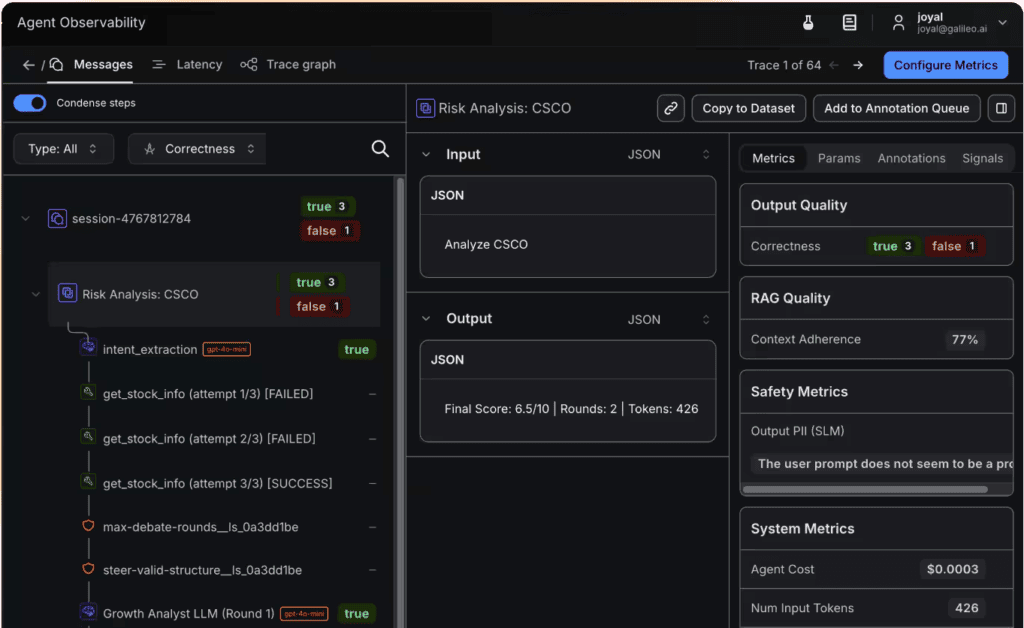
5. Galileo: small judges for big traffic
Galileo’s answer to judge cost is Luna-2, small evaluation models at 3B and 8B parameters. Galileo’s Luna-2 documentation puts them at $0.02 per million tokens against $2.50 for GPT-4o, with 152 ms average latency against 3,200 ms. Those are vendor figures, but they point the same way as the independent research above. You can fine-tune Luna-2 on your own labels, though it’s Enterprise-tier only, and Galileo Protect can intercept requests and responses in real time when a metric fails. Cisco has completed its acquisition of Galileo and is folding it into Splunk Observability Cloud.
License: Commercial.
Best for: high-volume traffic where a frontier judge on every call is too slow or costly.
Not ideal if: you want independence from a large observability suite.
6. Arize Phoenix: a judge you can audit
Phoenix treats the judge as something to observe. It pulls structured judgments through function calling, attaches an explanation to every LLM evaluation by default, and traces each evaluator run through OpenTelemetry, so the judge’s prompt and reasoning are as inspectable as the agent’s. Pre-built evaluators cover RAG and tool calling. Dynatrace announced on August 17, 2026 that it’s acquiring Arize in a deal valued at about $915 million.

License: Elastic License 2.0; self-hosting is free.
Best for: teams that want to inspect the judge as closely as the agent.
Not ideal if: you need a guided human-alignment workflow.
7. Langfuse: judges on your own infrastructure
Langfuse runs LLM-as-a-judge on individual observations inside live traces and on experiments against datasets. You write the judge prompt with {{input}} and {{output}} variables, pick a numeric, categorical or boolean score, test it on samples, then deploy it by rule. ClickHouse acquired Langfuse in January 2026 and committed to keeping the core open source.

License: MIT (core); self-host or Langfuse Cloud.
Best for: data-sovereign teams that want judges on their own servers.
Not ideal if: you want judge alignment handled for you.
Comparing seven LLM-as-a-judge evaluation tools side by side
| Capability | Lyzr | DeepEval | LangSmith | MLflow | Galileo | Arize Phoenix | Langfuse |
|---|---|---|---|---|---|---|---|
| Built-in LLM-as-judge metrics | • | • | • | • | • | • | • |
| Custom rubric judges | ◐ | • | • | • | • | • | • |
| Human-alignment workflow | ◐ | ◐ | • | • | ◐ | ◐ | ◐ |
| Judges on production traffic | • | ◐ | • | ◐ | • | • | • |
| Verdict triggers enforcement in the request path | • | ○ | ○ | ○ | • | ○ | ○ |
| Audit trail tied to agent identity | • | ○ | ○ | ○ | ○ | ○ | ○ |
| Agent discovery across the AI estate | • | ○ | ○ | ○ | ○ | ○ | ○ |
| License | Commercial | Apache 2.0 | Commercial | Apache 2.0 | Commercial | Elastic License 2.0 | MIT (core) |
Key: • full support · ◐ partial support · ○ not the focus. Editorial assessment, October 2026, based on public documentation.
Match your scenario to a tool
| If your situation is… | Pick… | Why… |
|---|---|---|
| A failing verdict has to stop the agent, on the record | Lyzr | Verdict becomes policy in the request path |
| You want judges to fail the build | DeepEval | G-Eval and DAG in pytest-style tests |
| Your judge disagrees with your team | LangSmith | Align Evals lists each disagreement |
| You’re on MLflow or Databricks | MLflow | align() tunes the judge from feedback |
| You must judge every production call | Galileo | Small Luna-2 judges |
| You need to audit the judge itself | Arize Phoenix | Judge runs traced, with explanations |
| Judge data can’t leave your servers | Langfuse | MIT core, self-hosted |
Run four tests before you trust any judge
Vendor demos won’t run these for you.
- The swap test. Score every pair as AB and again as BA. If the winner changes, you have position bias, and highly repeatable judges aren’t exempt.
- The repeat test. Run the same comparison at least ten times. The 2026 flip-rate study needed 11 trials for a majority vote to match its reference verdict with 95% probability. One run is an anecdote.
- The kappa test. Label real outputs, failures included, as your ground truth. Report Cohen’s kappa. Percent agreement flatters every judge.
- The family test. If the judge and the graded model share a family, swap in a judge from another and watch the scores. Self-preference is a bias you can’t see from inside one family, and it shows up in reasoning models too.
See Opencontroller act on your judge’s verdict
If your judge only feeds a dashboard, any tool above will do. Once agents act on customers, money or records, a failing verdict needs a consequence you can show an auditor. Opencontroller adds that, for agents built in Lyzr or on any other framework.
Book a demo of Opencontroller →
FAQ
DeepEval for judges in CI, LangSmith and MLflow for aligning judges with human labels, Galileo for cheap judging at scale, and Arize Phoenix or Langfuse for self-hosted production judging. Lyzr pairs built-in judge metrics with enforcement, so a failing verdict can stop an agent.
Useful, not infallible. The best setup in an April 2026 debiasing study reached 71.0% agreement with reference labels (kappa 0.549), and two judges in a 2026 flip-rate study agreed with each other only 76% of the time (kappa 0.51). Measure against your own labels.
It can, but it tends to favor them. EMNLP 2025 research found self-preference in both pre-trained and post-trained models, reasoning models included. Use a judge from a different model family when the stakes are high.
Yes. People build and refresh the labeled set the judge is aligned against, and LangChain’s survey found 59.8% of teams still use human review, more than the 53.3% using LLM judges. The judge scales human judgment rather than replacing it.
A judge scores an output and records why. A guardrail blocks or rewrites a response in the request path, before it reaches the user. Only the guardrail can stop something on its own.
Book A Demo: Click Here
Join our Slack: Click Here
Link to our GitHub: Click Here