Picking the best tools for LLM evaluation in enterprise settings has stopped being a research exercise. It’s now a line item a buying committee has to defend before the next budget review.
Over 40% of agentic AI projects will be canceled by the end of 2027, due to escalating costs, unclear business value or inadequate risk controls, according to Gartner. Evaluation is where most of those risk controls either get built or quietly skipped.
A model that invents a policy number in a demo is embarrassing. The same failure inside a claims-processing agent that already touched 40,000 records is a different kind of conversation, the kind that ends up in front of legal.
This comparison covers seven tools your team has probably already shortlisted: DeepEval, Braintrust, Arize Phoenix, LangSmith, Langfuse, Ragas, and Lyzr. Each one solves a real, narrow problem well. None of them solve it the same way, and that difference is what should decide your shortlist.
TL;DR
- Lyzr: evaluation embedded inside agent governance, with Opencontroller audit trails and Responsible AI guardrails, rather than sold as a standalone eval tool.
- DeepEval: open-source, pytest-style framework built for CI/CD regression testing of RAG and agent outputs.
- Braintrust: dataset-centric platform for regression testing, prompt comparison, and production-to-eval feedback loops.
- Arize Phoenix: OpenTelemetry-native tracing with embedding-based drift detection for production monitoring.
- LangSmith: the deepest debugging and trace visibility for teams built on LangChain or LangGraph.
- Langfuse: MIT-licensed, fully self-hostable observability and prompt management for data-sovereign teams.
- Ragas: fast, largely reference-free scoring of RAG retrieval and generation quality, as a library, not a platform.
What is LLM evaluation in enterprise AI?
Enterprise LLM evaluation is the structured testing of an LLM or AI agent’s outputs against defined accuracy, safety, and compliance criteria, using automated metrics, human review, or LLM-as-a-judge scoring, both before deployment and continuously once the system is live.
Although this definition covers the mechanics, it doesn’t cover where evaluation actually has to happen, which is the part that trips up most rollouts.
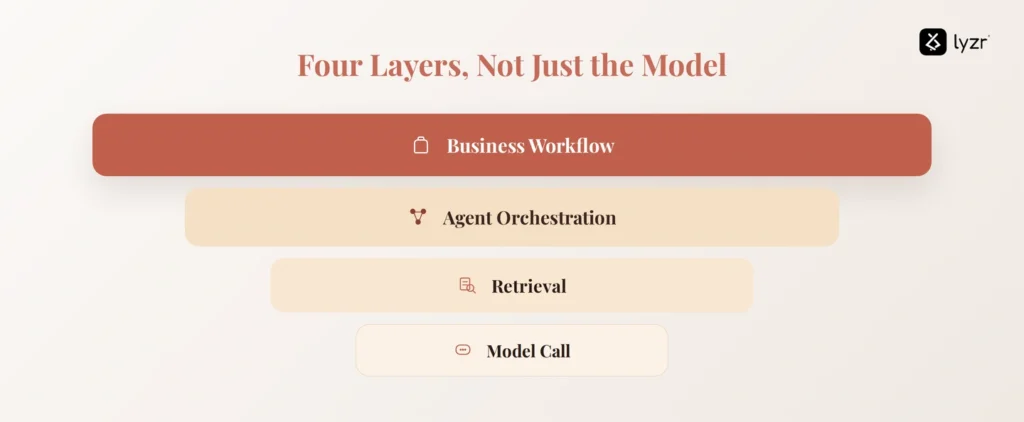
A single model call is just the bottom (one) layer. If the system uses RAG, retrieval comes next. Above that is agent orchestration, the reasoning and tool-calling logic that decides what the model even sees. And above all of it is the business workflow the whole system was actually built to run. A tool that only scores the model layer misses most of the actual risk surface, which is exactly why several of the tools below started as narrow point solutions and have spent the past year adding layers.
Master comparison: 7 tools for LLM evaluation in enterprise compared side by side
This table lines up the seven tools against the capabilities a buying committee actually asks about: tracing depth, judge support, RAG evaluation, CI/CD fit, multi-agent coverage, security posture, deployment model, and dataset management.
LLM evaluation tool capability comparison
| Capability | Lyzr | DeepEval | Braintrust | Arize Phoenix | LangSmith | Langfuse | Ragas |
| Tracing & debugging | Agent-level activity logs via Opencontroller | Test-run logs only | Full trace + tool-call inspection | Deep, OTel-native | Deepest, LangChain-native | Strong, OTel-based | None (metrics only) |
| LLM-as-a-judge | Yes (Reflection, AgentEval) | Yes, native (G-Eval) | Yes (autoevals + custom) | Yes, built-in | Yes, built-in evaluators | Yes, layered on tracing | Yes, core mechanism |
| RAG-specific eval | Yes, at system/outcome level | Yes, built on core metrics | Via custom scorers | Yes, plus embedding drift | Via evaluators | Via evaluators, not specialized | Core specialty |
| CI/CD & regression | Checkpoints built into deploy workflow | Core strength (pytest-style) | Core strength (Eval(), GitHub Action) | Via API | Via API/SDK | Via SDK, dataset loops | Via pytest/DeepEval integration |
| Multi-agent / multi-turn | Core strength (Agent Simulation Engine) | Growing, component-level | Trace-level via Loop agent | Trace-level only | Strong for LangGraph agents | Trace-level only | No |
| Security / OWASP LLM Top 10 | Guardrails mapped to prompt injection, PII, hallucination | Via companion tool (red teaming) | SOC 2, HIPAA, GDPR (not OWASP-specific) | PII/toxicity in paid tier | SSO/RBAC (not OWASP-specific) | Self-managed SSO/RBAC | Not applicable |
| Self-hosted vs. managed | Managed cloud + VPC/on-prem | Open source; optional hosted layer | Managed + hybrid for regulated teams | Free self-host; managed AX tier | Managed; self-host enterprise-only | MIT, self-hostable on every tier | Open-source library only |
| Dataset & prompt mgmt | Responsible AI Facts, not deep prompt experimentation | Basic, code-defined | Core strength | Basic curation | Strong (Prompt Hub) | Integrated, built-in | Minimal, bring your own |
If dataset and prompt experimentation is your gap, it’s worth also checking a dedicated prompt management tools comparison since Braintrust and Langfuse only cover part of that job.
1. Lyzr: evaluation as part of the governance layer, not a bolt-on
Lyzr doesn’t sell evaluation as a separate purchase. Agents built in Lyzr Studio carry Reflection and Groundedness controls directly in the UI, letting a model self-evaluate its outputs before returning a response. Once an agent ships, the Lyzr Opencontroller governs it regardless of framework: it runs alongside existing infrastructure and provides centralized visibility, policy enforcement, and operational control while agents stay in your own containers. Before release, its Agent Simulation Engine simulates realistic conversations across personas, workflows, interruptions, and edge cases instead of a fixed test script.
Key features
- Agent Simulation Engine for pre-production, multi-persona, multi-turn testing
- Reflection, groundedness scoring, and Responsible AI Facts configured in Lyzr Studio’s UI
- Deployment workflow with security validation, versioning, evaluation checkpoints, and rollback built into the Opencontroller
- Manages agents built on any stack, LangChain, CrewAI, AWS, Azure, or custom, without migration
Strengths and weaknesses
- Evaluates the agent and the workflow, not just a single model call
- Audit trail, RBAC, and evaluation live in one system instead of stitched-together vendor bills
- Framework-agnostic, so existing agent code doesn’t need to be rebuilt
- Less useful as a lightweight, standalone metric library for a solo developer who just wants a pytest-style check
- Fewer granular, published retrieval-only metrics than a dedicated tool like Ragas, since Lyzr scores RAG at the business-outcome level rather than isolating retrieval statistics
Best for: enterprises that need evaluation, security guardrails, and audit trails in one governed system, particularly in banking, financial services, insurance, and healthcare, where reliability and operational control are essential.
2. DeepEval: the pytest of LLM testing
DeepEval is the closest thing the LLM eval world has to pytest, a Python unit-testing framework purpose-built for LLM outputs. It ships as an open-source library with a wide metric catalog and plugs into a CI pipeline so a regression in RAG faithfulness or tool-calling fails the build instead of shipping.
Key features
- 50+ built-in metrics including G-Eval, a customizable LLM-as-judge framework, hallucination detection, and faithfulness
- Pytest-style assertions inside existing test suites
- Optional commercial layer, Confident AI, for a hosted UI and regression tracking
- Custom metrics written in plain-English templates via G-Eval
Strengths and weaknesses
- Fastest path from “we need eval” to a working CI gate
- Broadest open-source metric coverage across RAG, agents, chatbots, and safety use cases
- No production dashboard without adding a separate paid layer
- Scores lean on LLM-as-judge, so results are only as stable as the judge model configured
- No native security or compliance layer for regulated workflows
Best for: engineering teams that want LLM regression tests inside an existing CI/CD pipeline without buying a platform.
3. Braintrust: dataset-first regression testing
Braintrust treats every prompt or model change as an experiment. You hand it a dataset, a task function, and scorers, and it produces a comparable experiment run. Production traces can be turned into eval datasets with one click, closing the loop between monitoring and testing.
Key features
- Eval() experiment loop comparing prompts, models, and datasets side by side
- One-click promotion of production failures into regression datasets
- A dedicated GitHub Action for native CI/CD integration
- SOC 2 Type II, HIPAA, and GDPR coverage with hybrid deployment
Strengths and weaknesses
- Strongest dataset-to-regression workflow in this comparison
- The same scorers can run in CI/CD and score live production traffic
- Enterprise compliance certifications already built in
- Overhead is real for teams with no existing eval dataset or scorer design experience
- Retrieval quality is scored through custom scorers, not native RAG metrics
Best for: product and engineering teams shipping frequent prompt or model changes who need a repeatable release gate.
4. Arize Phoenix: production tracing built on OpenTelemetry
Phoenix grew out of Arize’s ML observability heritage as a local-first, notebook-friendly tool built tightly around OpenTelemetry. It traces any application emitting OTel spans and adds embedding-based drift detection that catches quiet data quality problems standard tracing misses. For teams weighing this against other open-source options, our open-source LLM observability platforms comparison breaks down where Phoenix sits relative to the rest of the field.
Key features
- OpenTelemetry and OpenInference-native tracing, no proprietary SDK required
- Embedding drift and outlier detection for production data quality
- Free, uncapped self-hosting since it’s an app, not a metered service
- Optional Arize AX for managed scale and enterprise dashboards
Strengths and weaknesses
- No event caps on the self-hosted version
- Vendor-neutral OTel instrumentation keeps you portable across backends
- Strong drift-detection heritage carried over from classic ML observability
- Primarily an observability tool, not a CI/CD-native testing framework
- Phoenix OSS is free, but the AX graduation path bills on spans, not requests. Arize’s own docs note that “a single agent might chain five LLM calls,” and each of those, plus every tool call, retrieval, and embedding step underneath them, is its own span, so a free-tier span budget disappears faster than the request count alone would suggest.
Best for: teams already emitting OpenTelemetry data who need production drift detection more than pre-release testing.
5. LangSmith: the native choice for LangChain and LangGraph
If your stack is LangChain or LangGraph, LangSmith fits like a glove. Every chain, tool call, and agent step traces automatically, and LangGraph Studio adds a visual debugger for setting breakpoints mid-run.
Key features
- Automatic tracing for any LangChain or LangGraph application
- LangGraph Studio for visualizing the graph, setting breakpoints, and modifying state mid-run
- Prompt Hub for versioning and sharing prompts
- Dataset creation directly from production traces
Strengths and weaknesses
- Deepest framework-native tracing available for LangChain-based stacks
- Managed deployment with checkpointing and memory built in
- Fast iteration loop between trace, dataset, and prompt
- Value drops sharply outside the LangChain ecosystem
- Seat-based pricing scales expensively as teams grow
Best for: teams standardized on LangChain or LangGraph who want tracing and evaluation without leaving the framework’s own tooling.
6. Langfuse: self-hosted observability for teams that want the infrastructure
Langfuse is an open-source observability-first platform built around OpenTelemetry-style tracing, with evals layered on top and a fully self-hostable stack. It’s one MIT-licensed codebase on ClickHouse, identical on Cloud and self-hosted.
Key features
- MIT-licensed core (tracing, evals, prompts, experiments) self-hostable on every tier
- OpenTelemetry-based tracing with an observations-first data model
- Integrated prompt management and versioning
- LLM-as-judge and code-based evaluators layered on top of tracing
Strengths and weaknesses
- Full data sovereignty for regulated or security-conscious teams
- Unlimited-user model instead of per-seat pricing
- Active open-source community, now backed by ClickHouse
- Self-hosting means standing up Postgres, ClickHouse, Redis, and object storage yourself
- Not RAG-specialized out of the box
Best for: teams with the infrastructure appetite to self-host and a hard requirement to keep trace data in-house.
7. Ragas: the fastest way to score a RAG pipeline
Ragas does one job well. It’s the open-source RAG evaluation framework that pioneered the four-metric pattern: faithfulness, answer relevance, context precision, and context recall, using LLM-as-judge scoring. That separation matters. If faithfulness is low but context precision is high, the retriever is fine and the generator is hallucinating.
Key features
- Four core RAG metrics scored independently
- Largely reference-free scoring using LLM-as-judge
- Wraps any LangChain-compatible chat model and embeddings model
- Integrates into CI pipelines alongside DeepEval or Promptfoo
Strengths and weaknesses
- Pinpoints whether a failure came from retrieval or generation
- No hosted platform to buy or manage, runs as a pip install
- The de facto standard vocabulary for RAG quality
- A metric library, not a hosted platform, you bring your own dataset, judge model, and dashboard
- No agent, chatbot, or production monitoring support
Best for: teams whose main open question is whether a RAG pipeline’s retrieval or generation is the weak link.
Evaluation without governance is half a system

Every tool above answers a version of the same question: did the output pass? Most of them stop there. A regulated enterprise running dozens of agents needs more than a pass or fail score. It needs to answer who approved the agent, what data it touched, and whether it stayed inside policy on the day it mattered.
That’s not a knock on DeepEval’s metrics or Ragas’s retrieval math, both are genuinely strong at the narrow job they do. It’s a reframe of the decision. If your evaluation results live in one dashboard and your deployment record lives in another, you don’t have governance, you have two systems nobody reconciles until an auditor asks. For a fuller checklist on what that reconciliation actually requires, our CIO playbook to AI agent governance is worth a read alongside this comparison.
That’s the gap Lyzr Opencontroller is built to close: evaluation as one input into a governed production system, not the whole system on its own. Every tool above is a solid choice for the specific job it’s built for, but none of the other six ship evaluation, guardrails, and an audit trail as one governed system, which is usually the actual question a compliance review asks. If your security team is separately evaluating dedicated guardrail vendors, our AI guardrail platforms comparison shows where that layer typically sits relative to an evaluation stack.
Check where your current setup has coverage gaps with the Hallucination Risk Assessment:
Then, book a demo to see how Opencontroller audit trails hold up against your compliance team’s actual questions.
FAQ
It’s the structured testing of an LLM or agent’s outputs against accuracy, safety, and compliance criteria, using automated metrics, human review, or LLM-as-a-judge scoring, both before deployment and continuously once the system is live.
It depends on the job: DeepEval and Ragas for open-source metric coverage, Braintrust and LangSmith for dataset-driven regression testing, Langfuse and Arize Phoenix for production tracing, and Lyzr for evaluation embedded inside a governed deployment and audit system.
Traditional QA checks for deterministic pass/fail outcomes against fixed expected results. LLM evaluation scores probabilistic, open-ended outputs for qualities like faithfulness and relevance, which is why most tools rely on LLM-as-a-judge scoring instead of exact-match assertions.
A secondary LLM reviews the primary model’s output to determine whether it’s grounded in the source material. It scales well but inherits the judge model’s own biases, so most enterprise teams pair it with human review on high-stakes decisions.
Yes. A RAG pipeline can fail at retrieval, generation, or both, and single-turn metrics can’t tell you which. Tools like Ragas score context precision, context recall, and faithfulness separately, so a team knows exactly which layer to fix.
It’s a ranked list of critical LLM application risks led by prompt injection, sensitive information disclosure, and supply chain vulnerabilities. It matters because a tool that only scores output quality misses these security failure modes entirely.
Most can. DeepEval and Ragas run inside pytest suites natively, Braintrust ships a dedicated GitHub Action, and Langfuse and LangSmith expose APIs for custom gating. Lyzr builds evaluation checkpoints directly into its own deployment workflow.
Offline evaluation runs against known datasets before deployment, catching regressions in a controlled setting. Online evaluation scores live production traffic continuously, catching drift and edge cases the offline dataset never anticipated. Enterprise teams need both running together.
On its own, no. Ragas and Langfuse score quality and retrieval well, but neither ships the audit trails, RBAC, or policy enforcement a compliance team needs to prove an agent’s decision was governed, not just accurate. That layer has to come from elsewhere in the stack.
Most tools log which tools were called and in what order, but don’t score whether the agent made the right decisions, which is the difference between tracing and evaluation. Real multi-agent evaluation means simulating realistic scenarios pre-production and auditing decisions after deployment.
Book A Demo: Click Here
Join our Slack: Click Here
Link to our GitHub: Click Here