TL;DR
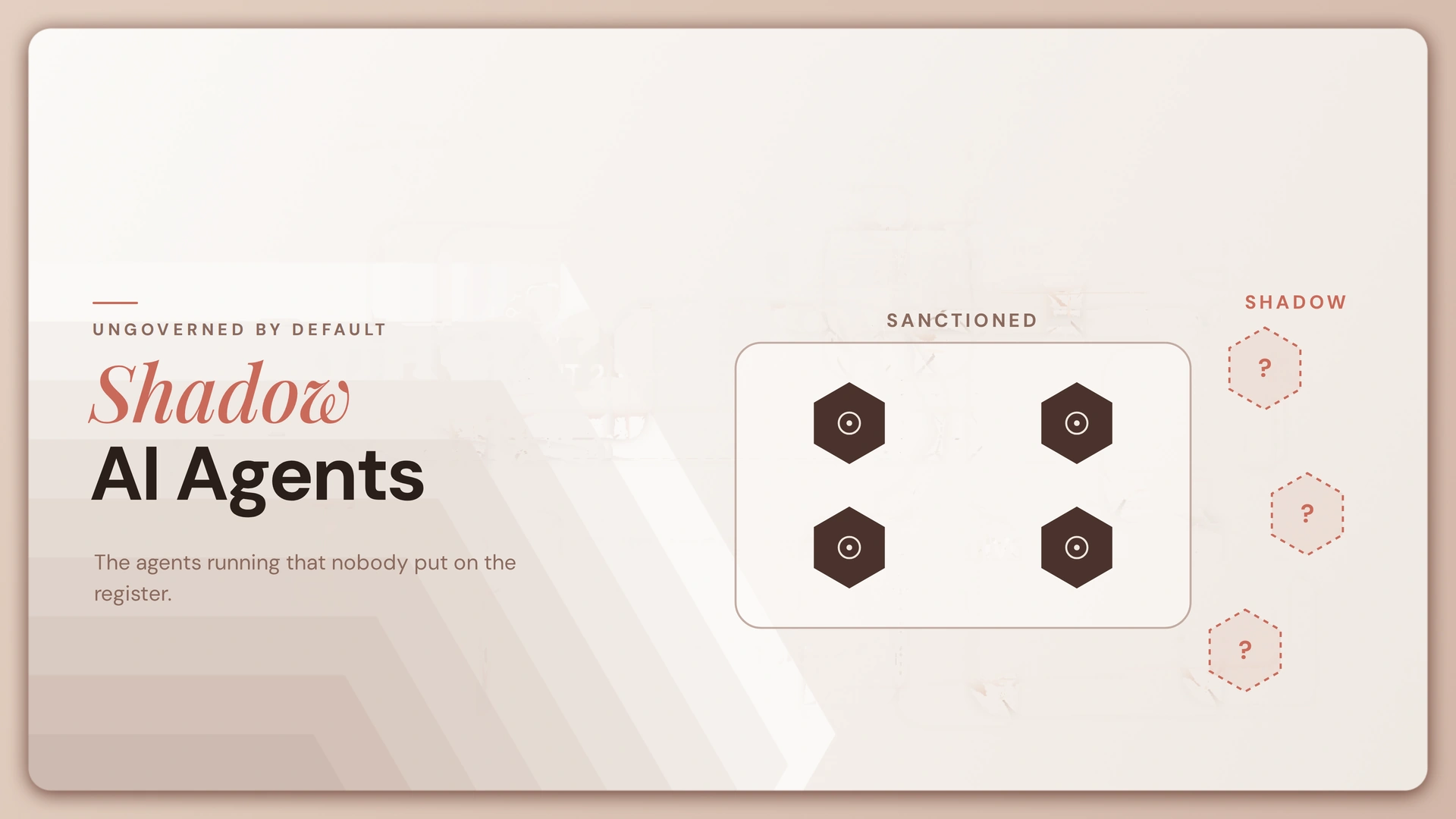
A shadow AI agent is an autonomous system built and run inside your company without IT or security approval. It executes workflows, holds credentials, and calls APIs on its own, not just a single unsanctioned chat session.
The risk moved from disclosure (someone pasting data into a chatbot) to action (a system doing things to your data and systems, unattended).
Detection tools from Microsoft, CrowdStrike, and Okta can now find these agents. That’s necessary. It is not sufficient.
The durable fix looks a lot like how enterprises finally solved shadow IT: a registry of every agent, a named owner for each one, and a sanctioned build path that’s actually faster than going around it.
An AI agent built by a marketing manager automates a tedious reporting task.
It runs every Monday. Pulls data from three systems. Summarizes it in Slack.
Productivity is up. The team is happy.
Six months later, the manager leaves the company. The AI agent, running on her personal API keys and a script nobody else has ever opened, keeps running. Nobody knows it exists, who owns it, or what it can still touch.
This is a shadow AI agent. And the tools to build one are now sitting in every browser tab in your company.
What Is a Shadow AI Agent?
A shadow AI agent is an autonomous system deployed inside an organization without the knowledge, approval, or oversight of IT and security. It doesn’t just answer a prompt the way a chatbot does. Autonomous AI agents execute multi-step workflows, query internal systems, and call APIs on their own initiative to get a job done.
That definition matters because “shadow AI” already meant something else, and the two get confused constantly.
Shadow AI, in its original sense, is an employee pasting company data into a public chatbot.
It ranges from an individual pasting proprietary source code into ChatGPT to entire departments deploying unapproved AI plugins that process sensitive customer data.
It’s a disclosure problem. It’s bounded by whatever got typed or pasted, and it mostly stops when the tab closes.
A shadow AI agent is a different animal entirely.
Shadow AI agents take this a step further. Once deployed, they don’t wait for instructions. They operate independently, interacting with applications, accessing data, and executing tasks across systems.
It’s persistent. It holds credentials. It keeps working after the person who built it has stopped paying attention to it, or left the building entirely.
That shift, from disclosure to action, is the whole reason the category needed its own name.
Shadow AI vs. Shadow AI Agent
| Shadow AI | Shadow AI agent | |
|---|---|---|
| What it does | Processes a single prompt | Executes multi-step workflows |
| Persistence | Ends with the session | Runs continuously or on a schedule |
| Credentials | The person’s login | Often personal API keys, stored |
| Systems touched | Whatever was pasted in | Databases, CRMs, APIs it can reach |
| Failure mode | Data disclosure | Unauthorized system action |

The category is also invisible in a specific way.
They lack visibility and identity. Since they are not provisioned through official IT systems, they don’t appear in identity directories or audit logs. From a governance standpoint, they are invisible, even though they are actively interacting with enterprise data.
That’s not a hypothetical risk. It’s the current baseline state of most enterprise environments running agentic workflows. The enterprise AI estate is growing faster than most organizations can track it, and that’s exactly the gap shadow agents live in.
The Marketing Agent Nobody Knew About
Go back to the marketing manager. She had a real problem: a weekly report that took four hours to assemble by hand across Google Analytics, Salesforce, and a proprietary CMS.
She found an open-source agent framework, wired it to her own API keys for all three systems, and had it running inside an afternoon. It worked. Every Monday, the report showed up in Slack, done.
Nobody built anything malicious here. An employee had friction, found a tool, and removed the friction. The sanctioned path, a formal IT request, would have taken months. The shadow path took a few hours.
Six months later, she leaves. Her laptop gets wiped. Her primary accounts get deactivated on schedule. But the service credentials she generated for the agent were long-lived tokens tied to her user profile, not her login session, and the leaver checklist never asked about them because it wasn’t built to.
The agent, running on a small cloud instance she paid for and forgot about, keeps querying customer data, performance metrics, and internal content. No owner. No oversight. No one who remembers it’s there.
From Shadow IT to Shadow AI Agents
Enterprises have run this exact experiment before, just with a different technology.
For two decades, IT departments fought “shadow IT”: employees using Dropbox, personal email, or unapproved project management tools because the sanctioned versions were too slow or too limited. The first instinct was always to block. It never worked.
Shadow IT refers to all unauthorized or unsanctioned use of software, hardware, or services by employees without the knowledge or approval of the IT department. The main risk is that these tools often lack the robust security controls and integration needed for enterprise applications.
What actually solved it wasn’t a better firewall. It was a better sanctioned alternative, tools like enterprise file sharing that were good enough that going around IT stopped being worth the effort.
Shadow IT vs. Shadow AI Agents
| Shadow IT | Shadow AI agents | |
|---|---|---|
| Technology | SaaS, cloud storage, mobile apps | Agent frameworks, LLMs, vector databases |
| Driver | Convenience, collaboration | Automation, workflow speed |
| First response | Block at the network level | Detect and block agent platforms |
| What actually worked | Sanctioned alternatives, easy to adopt | Sanctioned agent platform plus a registry |
The lesson from shadow IT isn’t “blocking is bad.” It’s that blocking without a viable alternative just changes where the demand shows up, not whether it exists. That’s the exact dynamic playing out with agent adoption using development with low-code platforms today, and it’s a lesson that gets tested again in the next section.
Why AI Agents Change the Rules
An unapproved file-sharing account risks a data leak. An unapproved AI agent risks autonomous, unmonitored action across every system it can reach, and the difference in blast radius is not small.
Autonomous action. Agents work at machine speed, without a human confirming each step. An unauthorized data transfer or a bad decision can happen before anyone is positioned to catch it.
Credential misuse. This is the mechanic that turned the opening story into more than a hypothetical.
Agentic workflows create de facto NHIs when they operate using embedded credentials, API tokens, or delegated access without formal identity registration. For example, an employee might connect a custom AI agent to internal analytics or CRM systems using a long-lived API key to automate reporting. That agent then operates as an NHI with persistent access, outside standard provisioning, review, or revocation processes.
Security blind spots. A locally running script making ordinary-looking API calls with valid credentials doesn’t trip the alarms built for large exfiltration events or malware signatures. It looks like a normal user, because in the eyes of the system, it is one.
Non-human identity sprawl. Every agent authenticates and acts, which makes it an identity.
Shadow AI agents are NHIs by definition: they authenticate with credentials and act on data without a logged-in user. A non-human identity (NHI) is any identity used by software rather than a person.
Most companies have no joiner-mover-leaver process for that kind of identity at all.
The scale of the exposure is growing fast.
Gartner predicts that 40% of enterprise applications will feature task-specific AI agents by end of 2026, up from under 5% in 2025, significantly expanding the surface area for agentic shadow AI.
And readiness isn’t keeping pace:
80% of organizations say they’ve already encountered agentic AI risks, while only 21% of IT leaders say they have a mature agentic AI governance program in place.
None of this is confined to one department. Sales and marketing teams are often the earliest adopters of these shortcuts, since deal velocity depends on speed.
Shadow Agent Risk by Department
| Department | Common shadow agent use case | Associated risk |
|---|---|---|
| Marketing | Content generation, resume screening automation | Credential leak, brand risk |
| Sales | Auto-drafted outreach, CRM updates | Customer data misuse |
| Finance | Report consolidation, expense tracking | Reporting integrity |
| HR | Resume screening, interview scheduling | Bias, PII exposure |
| Engineering | Code review bots, CI/CD automation | Insecure production access |
For a deeper look at how ungoverned models compound this exposure, see risks of public LLMs and the broader case for AI agent governance.
Five Questions Most Enterprises Cannot Answer
Before writing a policy, most leaders should try answering five questions about their own organization. Platform teams and IT are usually the ones left answering these questions after the fact, once something has already gone wrong. The inability to answer them is the real signal.
- How many AI agents are running right now? Almost nobody knows. The real number is rarely zero.
- Who built each one? Without a registry, there’s no path back from an agent to its creator.
- What can they access? An agent running on someone’s personal API key inherits every permission that person has.
- Who’s accountable if one fails? An unowned agent that deletes records or sends a bad report has no one assigned to the cleanup.
- What happens when the builder leaves? Without a formal handoff process, agents become orphaned: still running, still credentialed, no longer anyone’s responsibility.
For most companies, the honest answer to all five is “we don’t know.” That gap is exactly what shadow AI detection tools are built to close.
How Shadow AI Agents Get Detected
Finding agents that were never registered requires tooling built specifically for the job, and four distinct approaches have emerged.
Admin-console discovery. Microsoft has built shadow AI discovery directly into its ecosystem.
The Shadow AI page in the Microsoft 365 admin center helps IT administrators discover, monitor, and govern unmanaged AI agents used within their organization. This preview capability provides a dedicated view for detecting and governing unapproved local AI agents such as OpenClaw, and enables administrators to take governance actions to maintain security and compliance.
It runs on Microsoft Defender and Microsoft Intune and is currently in public preview under the Frontier program, which is the mechanism behind what most people search for as Agent 365 shadow AI. The catch:
Detection and blocking through Agent 365 currently applies only to managed Windows devices enrolled with Microsoft Intune. A user on a Mac, on a personal laptop, on a contractor device, or on any Windows device not enrolled in Intune sits entirely outside this detection boundary.
Endpoint telemetry. CrowdStrike’s newly launched Falcon Guardian takes a different angle, arguing that the endpoint is where an agent actually does its work.
The Falcon sensor discovers known and shadow AI agents across Windows and macOS, providing a live inventory of every running and dormant agent across the enterprise, who deployed it, and its security status.
It then
Connects AI agent behavior directly to Falcon endpoint telemetry, establishing a causal chain from user prompt, identity, tool call, and skill use to every downstream system action, revealing the full agent execution graph.
Identity and non-human governance. Okta frames the whole problem as an identity gap rather than a monitoring gap. Every agent should be enrolled, scoped, and eventually deprovisioned, the same way a human employee’s access is. Strong for credential-related risk. Weaker at finding agents that never authenticate against anything managed at all.
Network and SaaS traffic analysis. CASB and secure web gateway tools flag calls to known agent platforms and model APIs. Broad coverage, but noisy, and easily blind to an agent that runs against an already-approved endpoint in an unapproved way.

Each of these finds something real. None of them prevents the next agent from getting built the same way tomorrow. Detection is a lagging indicator. It tells you what already happened.
Why Detection Alone Will Not Fix This
Three things are true at once, and none of the vendors selling detection have much incentive to say all three out loud.
Blocking moves the behavior, it doesn’t remove it.
You can’t block your way out. Bans push usage underground. Effective programs shift from “block” to “manage.”
The demand that created the agent, someone trying to finish a task faster, doesn’t go away when the tool gets blocked. It relocates to a personal device or a platform the blocklist hasn’t heard of yet.
The path of least resistance decides the outcome. If the sanctioned route to an agent is a six-week security review and the unsanctioned route is a browser tab and an afternoon, the second route wins, every time. That’s not an employee discipline problem. It’s a friction-design problem.
You cannot govern what you haven’t inventoried. Alerts tell you an event happened. A registry tells you what exists.
Exception-based governance depends on agents being known and bounded. When visibility is incomplete, the safeguards may not engage at all.
Detection can feed a registry. It cannot replace one.
Deploy the detection tooling. It tells you where you actually stand. Then build the registry and the sanctioned path, because that’s what changes where you end up.
What an Agent Registry Actually Looks Like
Just as every company eventually needed visibility into its employees, applications, and cloud infrastructure, they’ll need systems to manage AI agents tomorrow the same way. That’s the argument, and it holds up because the alternative, chasing agents one detection alert at a time, doesn’t scale.
A working registry has specific layers, not just a spreadsheet:
Agent registry. Every agent inventoried, including the ones discovery tools surfaced after the fact. Detection feeds the registry rather than replacing it.
Agent identity. A named human owner and an accountable team for every agent. Ownership transfers on departure, the same way any other company asset does.
Permission scoping. Per-agent credentials instead of a person’s personal keys. This single control would have stopped the opening scenario before it started.
Tracing. A retrievable record of what the agent looked up, decided, and did.
Versioning. Change management, so a shift in behavior is attributable to a specific update.
Audit trails. Evidence ready for compliance review and, if something goes wrong, for investigation. This is where AI in risk and compliance work actually gets done.
Human approval gates. Defined thresholds where the agent stops and waits for a person to decide.
The gap almost nobody talks about is deprovisioning. Most organizations have a clean leaver process for accounts. Almost none have one for agents, which is precisely where the opening story fell apart.

This registry-and-path approach is the operational backbone behind AI governance for enterprises more broadly, and it’s the layer most detection-first vendors don’t sell because it isn’t their product.
Where to Start
This doesn’t require a multi-year program. It starts with four sequenced moves, and it holds regardless of whether you’re a CIO, a CTO, a head of AI, or you run a digital transformation team.
- Inventory before policy. Ask teams what they’ve already built. Asking is faster than detecting, and most organizations find more than they expected.
- Assign an owner to every agent found. Ownership is the one control that makes everything else enforceable.
- Scope credentials off individuals. Replace personal API keys with per-agent credentials that can be revoked independently of a person’s employment status.
- Make the sanctioned path fast. If the approved way to build an agent is slower than the unapproved way, the inventory goes stale the week it’s finished.
This is the layer Lyzr’s platform is built for: a registry and a sanctioned build path, not another detection tool competing with the ones already named above. Lyzr helps enterprises build, deploy, monitor, and govern AI agents from a centralized platform. Teams get Agent Studio to build agents fast, while every agent registers, scopes its own credentials, and reports into one system of record automatically.
If your team is further along, the agent types in production breakdown and the next playbook below are the logical next stops.
Frequently Asked Questions
What are shadow AI agents?
Autonomous AI systems deployed inside an organization without IT or security approval. They run workflows and call systems independently, usually invisible to existing monitoring.
What is shadow AI?
The broader category: unapproved AI tool use, most commonly employees pasting company data into consumer chatbots. Shadow AI agents are the autonomous, acting version of the same problem.
What is the difference between shadow AI and a shadow AI agent?
Shadow AI discloses data during a session and ends when the session ends. A shadow AI agent holds credentials, takes actions across systems, and keeps running unattended.
Why is shadow AI a problem?
It creates unmonitored data exposure, credentials sitting outside identity governance, actions with no audit trail, and compliance obligations that apply whether or not IT knew the agent existed.
Can you give an example of shadow AI?
A marketing team building a content agent with personal API keys and CMS access is a common case. It keeps running after the person who built it leaves the company.
How do you detect shadow AI agents?
Admin-console discovery, endpoint telemetry, non-human identity governance, and network traffic analysis. Each catches a different subset of agents; none catch everything on its own.
What tools detect shadow AI?
Microsoft’s admin center discovery for Agent 365, endpoint platforms such as CrowdStrike Falcon Guardian, identity providers such as Okta, and CASB or secure web gateway tooling.
Is ChatGPT an AI agent?
The interface itself sits on top of a language model. It becomes agentic once it’s connected to tools and given autonomous execution, which is when shadow-agent risk starts to apply.
What are the five types of AI agents?
Simple reflex, model-based reflex, goal-based, utility-based, and learning agents. Shadow-agent risk rises with how much autonomy an agent has and how many systems it can reach.
How do you prevent shadow AI agents?
Inventory what already exists, assign a named owner to each agent, scope credentials per agent rather than per person, and make the approved build path faster than the unapproved one.
Where This Leaves You
Detection tooling from Microsoft, CrowdStrike, and Okta will keep improving, and every enterprise running agents at scale should have some version of it running. But detection was never going to be the whole answer, because the demand that creates shadow AI agents doesn’t originate in a security gap. It originates in a speed gap between what employees need and what the sanctioned process delivers.
Run the five questions from earlier in this piece against your own organization this week. If you can’t answer them, that’s not a security failure yet. It’s a visibility gap with a known fix: an agent registry with a named owner for every agent, and a sanctioned AI agent platform fast enough that going around it stops being worth the trouble.
That’s the actual choice in front of most enterprises right now, not whether to adopt agents, but whether to know about the ones already running. The organizations that solve this early will scale AI with confidence.
AI Agent Governance: The Framework for Managing Autonomous Systems
Lyzr Enterprise AI White Paper
How Infosys Prototyped Enterprise Agents with Lyzr
Book A Demo: Click Here
Join our Slack: Click Here
Link to our GitHub: Click Here