If you’re evaluating top open source agentic frameworks like CrewAI, AutoGen, LangGraph, LangChain, or any other open-source agentic toolkit, you’re likely trying to answer one question:
“Which framework should we use to actually build and scale our agents?”
This guide gives you a clear, executive-friendly breakdown of:
- What each major open-source agentic framework is best suited for
- Their architectural philosophy
- Strengths, limitations, and ideal use cases
- The hidden operational costs teams discover only after the prototype
- How companies bridge the gap from experiments → production with orchestration platforms like Lyzr
Here’s the part most teams miss:
Open-source agentic frameworks are fantastic for prototyping but they don’t solve reliability, governance, or production deployment.
What is an open source agentic framework?
An open source agentic framework is a publicly licensed toolkit that gives developers the building blocks to create, run, and scale autonomous AI agents: systems that reason over a task, call tools, and carry a multi-step process through to completion without a human writing out every intermediate step.
You could build all of this from raw API calls. Most teams don’t, for the same reason nobody hand-rolls HTTP servers anymore. The framework handles the repetitive scaffolding, parsing model output, managing conversation state, wiring up tool calls, so you write the parts specific to your problem.
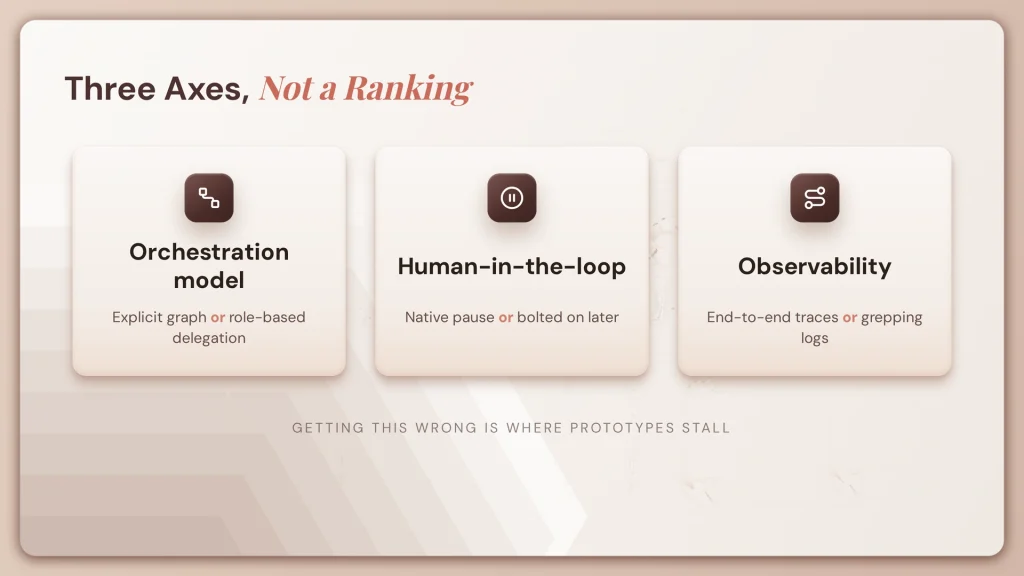
Three architectural choices separate one framework from another, and they’re the axes this whole comparison runs on:
Orchestration model. Some frameworks use an explicit graph where you define every state and transition. Others use role-based delegation, where agents negotiate the next step through conversation. Neither is objectively better. They fit different problems, and getting this wrong is the single most common reason agent orchestration projects stall out at the prototype stage.
Human-in-the-loop (HITL) support. Whether the framework has a native way to pause execution and wait for a person to approve a risky action before it happens, rather than you bolting that logic on yourself.
Observability. Whether you can trace a multi-step reasoning chain end to end, or you’re left grepping logs to figure out why an agent looped four times before giving up.
The 10 frameworks at a glance
For the wider field including commercial and vendor-native options, see our list of the best AI agent frameworks.
| Framework | Best for | Orchestration model | Language | License | HITL native | Observability |
|---|---|---|---|---|---|---|
| LangChain | Tool integration and RAG breadth | Chain composition | Python, JS | MIT | Limited | Via LangSmith |
| LangGraph | Stateful, deterministic control | Explicit state graph | Python, JS | MIT | Yes | Via LangSmith |
| CrewAI | Fast role-based prototyping | Role delegation | Python | MIT | Limited | Basic |
| AutoGen | Conversational multi-agent (maintenance mode) | Conversation loops | Python | MIT | Yes | Basic |
| LlamaIndex | Document retrieval and indexing | Query and workflow pipelines | Python, TS | MIT | Limited | Via callbacks |
| Haystack | Production search and RAG | Pipeline DAG | Python | Apache 2.0 | Limited | Built in |
| Semantic Kernel / MS Agent Framework | .NET and Microsoft stacks | Planner and plugins | C#, Python, Java | MIT | Yes | Via OpenTelemetry |
| PydanticAI | Type-safe agent logic | Typed agent runs | Python | MIT | Yes | Via Logfire |
| Smolagents | Minimal code-writing agents | Code execution loop | Python | Apache 2.0 | Limited | Basic |
| Flowise / Langflow | Visual, low-code assembly | Visual canvas | n/a | Apache 2.0 / MIT | Limited | Basic |
Verify license terms against each project’s current documentation before you build a compliance case on this table. Licenses and maintenance status both move, and one of the ten just did.

The frameworks in depth
Orchestration and general purpose
LangChain is the framework most teams meet first. Launched in 2022, it is one of the most widely adopted frameworks due to its broad ecosystem of integrations, serving as an accessible interface for nearly any LLM. Its strength is breadth: swap model providers, chain together retrieval and tools, and lean on an integration library few competitors match. The limitation shows up when something breaks three layers deep in a chain; tracing the failure means reading framework internals instead of your own code, which is why teams researching a LangChain alternative usually land here first. Pick it for fast prototyping across model providers and RAG-heavy applications. LangChain documentation has the full API reference.
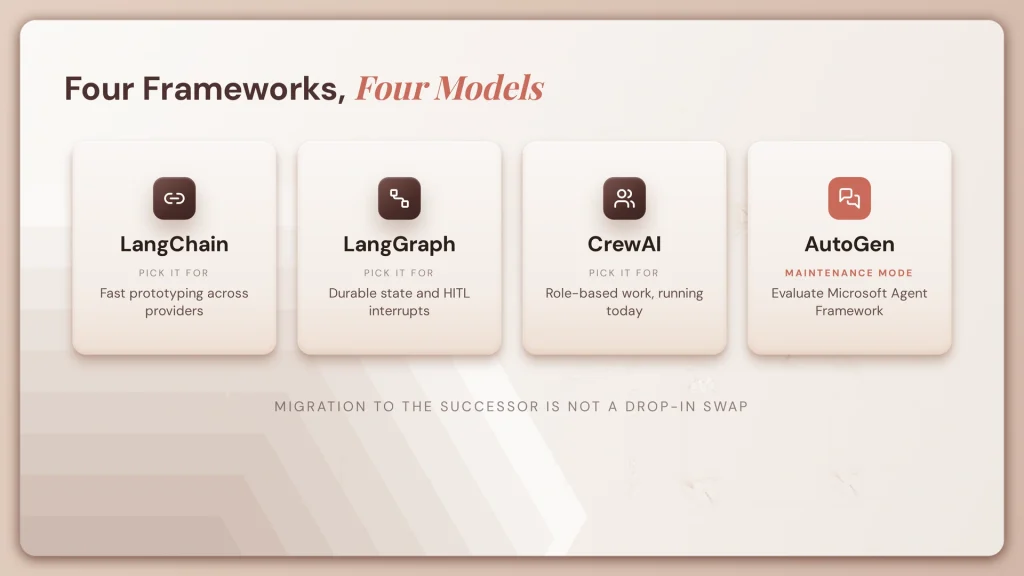
LangGraph, built by the same team, exists because chains alone couldn’t handle loops, branching, or long-running state. It models an agent’s execution as an explicit graph, and it’s the framework production teams reach for when a workflow needs to pause, checkpoint, and resume without losing context. The tradeoff is verbosity: simple tasks take more code than they would in LangChain or CrewAI. Pick it when you need durable state, checkpointed execution, and first-class human-in-the-loop interrupts. See how it stacks up in our Lyzr vs CrewAI comparison.
CrewAI took a different bet: skip the graph, model the problem as a team of specialists with roles, goals, and tools. Developers consistently report that the abstractions are intuitive enough to get a working multi-agent prototype running faster than with most alternatives, and CrewAI explicitly avoids dependencies on LangChain or other external agent frameworks, positioning itself as a self-contained alternative. The cost of that speed is control: complex branching needs workarounds, and observability stays basic out of the box. Pick it when the work splits naturally into roles, researcher, writer, reviewer, and you want something running this afternoon.
AutoGen popularized conversational multi-agent design, where agents talk to each other rather than following a fixed path. That made it a favorite for research and exploratory multi-agent work. The status has changed for 2026: Microsoft AutoGen was placed into maintenance mode in 2026 and replaced by Microsoft Agent Framework, which merges AutoGen’s multi-agent abstractions with Semantic Kernel’s enterprise tooling into a single SDK. Teams starting fresh should evaluate Microsoft Agent Framework directly rather than building new production systems on a framework in maintenance mode. If you’re already on AutoGen, know that the conversable-agent pattern maps to a fundamentally different graph-based model in the successor, so migration isn’t a drop-in swap.
Retrieval and data
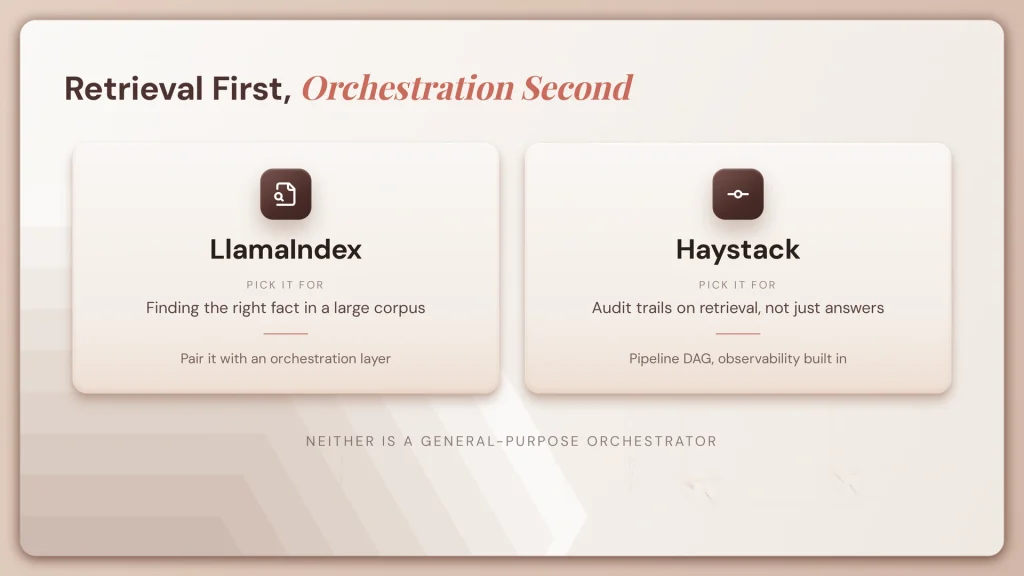
LlamaIndex started as a data framework, not an orchestrator, and that lineage is exactly why it’s the strongest option here for retrieval. Its agent capabilities are strong but secondary to its data framework roots. If you’re building an agent that primarily needs document retrieval and reasoning, it’s excellent. If you need complex multi-agent orchestration, you’ll likely pair it with LangGraph or use another orchestration layer. That pairing pattern isn’t a workaround, it’s how most teams actually use it in production: LlamaIndex handles the agentic RAG layer while LangGraph or CrewAI handles the control flow around it. Pick it when your agent’s hardest job is finding the right fact in a large corpus, not deciding what to do next.
Haystack, from deepset, takes retrieval a step further into production search infrastructure. It uses a pipeline DAG (directed acyclic graph, a fixed sequence of processing steps with no cycles) and ships observability built in rather than bolted on, which is why teams in regulated environments favor its explicitness. The limitation is scope: it’s a search and RAG framework first, and general-purpose multi-agent orchestration isn’t the design center. Pick it for enterprise document intelligence, knowledge base agents, and any workload where audit trails on retrieval matter as much as the answer. If you’re deciding between Haystack and a hand-rolled pipeline, our guide on how to build a state-of-the-art RAG engine covers the tradeoffs.
Type-safe and stack-specific

Semantic Kernel, Microsoft’s original enterprise SDK, offered first-class C# and Java support when almost nothing else in this space did. As of 2026 it’s converging with AutoGen into Microsoft Agent Framework, which reached 1.0 GA with graph-based workflows, responsible AI guardrails available through Azure AI Foundry, and Python plus .NET runtimes. The remaining limitation is ecosystem depth outside Azure: most Python developers still default to LangChain or LlamaIndex. Pick it if your application is C# or Java, or you’re deep in the Azure ecosystem and want Microsoft-native governance.
PydanticAI solves a narrower problem well: type-safe, validated agent outputs using the same Pydantic patterns FastAPI developers already know. It’s not a general-purpose orchestrator and won’t try to be. Pick it when structured, validated output matters more than orchestration complexity, particularly for single-purpose agents feeding downstream systems that expect a strict schema.
Minimal and visual
Smolagents, from Hugging Face, bets on radical simplicity. The entire core is about 1,000 lines of code, and the key innovation is code agents: instead of generating actions as JSON blobs like most frameworks, Smolagents agents write and execute Python code snippets directly. The tradeoff is exactly what you’d expect from that minimalism: it’s not built for complex multi-agent coordination. Pick it for fast experimentation and code-generation-heavy tasks where a heavier framework would just add ceremony.
Flowise and Langflow are visual, drag-and-drop builders that let you assemble an agentic flow without writing much code, often composing LangChain components under the hood for AI prototyping. They’re genuinely useful for demos and for handing a flow to a less technical teammate to adjust. The limitation is the one every low-code tool eventually hits: version control, testing, and production deployment get harder once the visual canvas grows past a certain complexity. Pick either for rapid visual prototyping, not for the system you plan to run at scale.
What every framework leaves you to build
Here’s the part that gets glossed over in most roundups. Open source is free to download and expensive to operate. Whichever framework wins your bake-off, you still own six categories of work before that agent is trustworthy in production.

Deployment and scaling. Someone has to containerize the agent, handle autoscaling under load, manage a queue for asynchronous tasks, and implement retry logic when an external API rate-limits you mid-task. For anything beyond a single-user demo, that usually means you build Kubernetes infrastructure yourself, complete with logging and autoscaling you’re now responsible for maintaining.
Observability. Basic logging tells you an agent ran. It doesn’t tell you why it looped four times before giving up, which tool call added 800ms of latency, or where a multi-agent handoff silently dropped context. Building real tracing across agent-to-agent handoffs is its own project, one that orchestration as a service exists specifically to shortcut.
Evaluation. A framework doesn’t come with a way to know if your last prompt change made things worse. You need a held-out evaluation set, regression tests that run on every model or prompt change, and drift detection as your data grows. Agent evals done properly for production, not for a demo, is a discipline of its own, covered in depth in our guide to enterprise agent evaluation.
Governance. Who can run which agent, on what data, with what permissions? None of the ten frameworks above ship an agent registry, permission scoping, or an immutable decision trail out of the box. Building real AI agent governance means an approval gate before any consequential action and an audit log a compliance team can actually read.
Secrets and access. Shared API keys across every agent in an environment is how one compromised agent becomes an incident affecting all of them. Production systems need per-agent credential scoping, not a shared .env file.
Model flexibility. Build your application logic tightly coupled to one provider’s API shape and you’ll rewrite it the day a better or cheaper model ships. Avoiding that vendor lock-in means an abstraction layer between your agent logic and the model call, and building that layer well is harder than it looks from the outside.
None of this is impossible to build. Plenty of capable engineering teams do it, and do it well. But it’s typically several engineer-months of upfront work plus ongoing maintenance, not a weekend project, and that’s the real cost of “free and open source.”
How to Take Agents to Production
Teams that skip this step and ship straight from a framework demo tend to discover it the hard way, usually during their first serious incident. Our breakdown of common enterprise AI agent challenges walks through exactly what that looks like in practice.
Lyzr as the production layer
Lyzr is not an open source framework, and it doesn’t compete with anything on the table above for that title. It’s the layer teams add around whichever framework they already picked.
That distinction matters because of the strongest single argument for adding it: you don’t have to abandon LangChain, CrewAI, or AutoGen to get production infrastructure. Agents built on any of those frameworks register and run under central governance without a rewrite. That’s a meaningfully different pitch than “switch platforms,” and it’s the reason this comparison can recommend a specific tool without asking anyone to throw away the work they’ve already done.
Governance in the runtime. Decision traces, permission scoping, approval gates, and audit trails exist as platform features, not code you write yourself, through the Control Plane and Responsible AI as a Service.
Evaluation and reliability. AgentEval handles regression testing across model and prompt changes, and the Hallucination Manager catches unreliable output before it reaches a user.
Deployment control. Run in your own VPC, on-premise, or in a sovereign environment, with any model behind it, through Agents as a Service.
What’s actually open at Lyzr. The platform itself is commercial, and that’s worth stating plainly on a page about open source frameworks. Lyzr does maintain open source SDKs and tooling on GitHub, and being explicit about that line is the price of being taken seriously on this topic.
Nothing about the LangChain agent changed. What changed is what happens around it once it runs: a trace, a permission check, and an audit entry that didn’t exist a moment ago. Full setup and API details live in the Lyzr documentation, and the Agent Studio is where that registration and monitoring happens visually if you’d rather not touch the SDK directly.
When to pick a framework and when to add a platform
Building a prototype, side project, or doing research? Pick a framework, full stop. A platform is overhead you do not need at this stage. CrewAI or PydanticAI will get you there fastest.
Want full low-level control and have the engineering capacity to own it? LangGraph, and budget the engineer-months for the operational layer described above. This is a legitimate path, not a lesser one.
Retrieval is the core problem? LlamaIndex if you’re building custom RAG into an agent, Haystack if production search is the actual product you’re shipping.
Stack isn’t Python? Semantic Kernel and Microsoft Agent Framework cover .NET and Java natively. Otherwise, call a platform over a standard HTTP API instead of forcing a Python-first framework onto a stack it wasn’t built for.
Running agents in production, under governance, with audit and deployment control non-negotiable? That’s the scenario a platform layer earns its place, and it’s worth reading our 20 best AI agent platforms roundup alongside this one if you’re at that decision point.
Notice which scenario came first on this list. A page that can’t name where its own recommendation is the wrong call isn’t giving you a comparison, it’s giving you an advertisement. The honest version costs almost nothing to write and it’s the reason the rest of this comparison is worth trusting.
Frequently asked questions
What are the most popular open source agentic AI frameworks?
LangChain and LangGraph, CrewAI, AutoGen (now succeeded by Microsoft Agent Framework), LlamaIndex, Haystack, Semantic Kernel, PydanticAI, and Smolagents are the most widely adopted as of 2026.
What is the best open source agentic framework?
It depends on the job. LangGraph for stateful control, CrewAI for quick multi-agent prototypes, LlamaIndex for retrieval, and Haystack for production search pipelines each win their own category.
What are the top 10 AI agent frameworks?
The ten compared in the table above, spanning general-purpose orchestration, retrieval and data, type-safe and stack-specific, and visual builder categories.
Which is the best free agentic AI framework?
All the frameworks listed here are free and open source under permissive licenses. Model inference is billed separately by whichever provider you connect, regardless of framework choice.
Is ChatGPT open source?
No. Both the ChatGPT product and its underlying models are proprietary. OpenAI has released some open-weight models separately, but that’s a different release track from the ChatGPT service itself.
What is the strongest open source AI model?
Model choice and framework choice are separate decisions. Leading open-weight model families include Llama, Mistral, Qwen, and DeepSeek, and rankings shift with nearly every release cycle.
Which AI is fully open source?
Very few systems are open in code, weights, and training data all at once. Most projects labeled “open source” release model weights under a permissive license without releasing the training data behind them.
What are some open source AI frameworks?
Beyond agent frameworks: PyTorch and TensorFlow for model training, Hugging Face Transformers for pretrained models, vLLM for serving, and the ten agentic frameworks compared in this article.
What is the difference between an agentic framework and an agent platform?
A framework gives you code libraries to build an agent. A platform provides the deployment, observability, evaluation, and governance infrastructure around what you’ve already built, without requiring a rewrite.
Can I use an open source framework with an enterprise platform?
Yes. Agents built on LangChain, CrewAI, or AutoGen typically register under a platform like Lyzr for central governance without any rewrite of the underlying agent code.
Does Lyzr support importing agents built on other frameworks?
Yes, framework-agnostic import is a core design principle. The code example above shows a LangChain agent registered under Lyzr with no changes to its original logic.
Can Lyzr be self-hosted?
Lyzr supports deployment to your own VPC, on-premise infrastructure, or a sovereign cloud environment, depending on your data residency and compliance requirements.
The framework you pick this week will shape how fast your team ships for the next year. It won’t determine whether what you ship survives its first production incident. That’s a separate decision, made separately, and it’s worth making on purpose instead of by default. If you’ve already chosen a framework and want to see what changes when you wrap it in governance, book a demo and bring the agent you’ve already built.
Book A Demo: Click Here
Join our Slack: Click Here
Link to our GitHub: Click Here