TL;DR
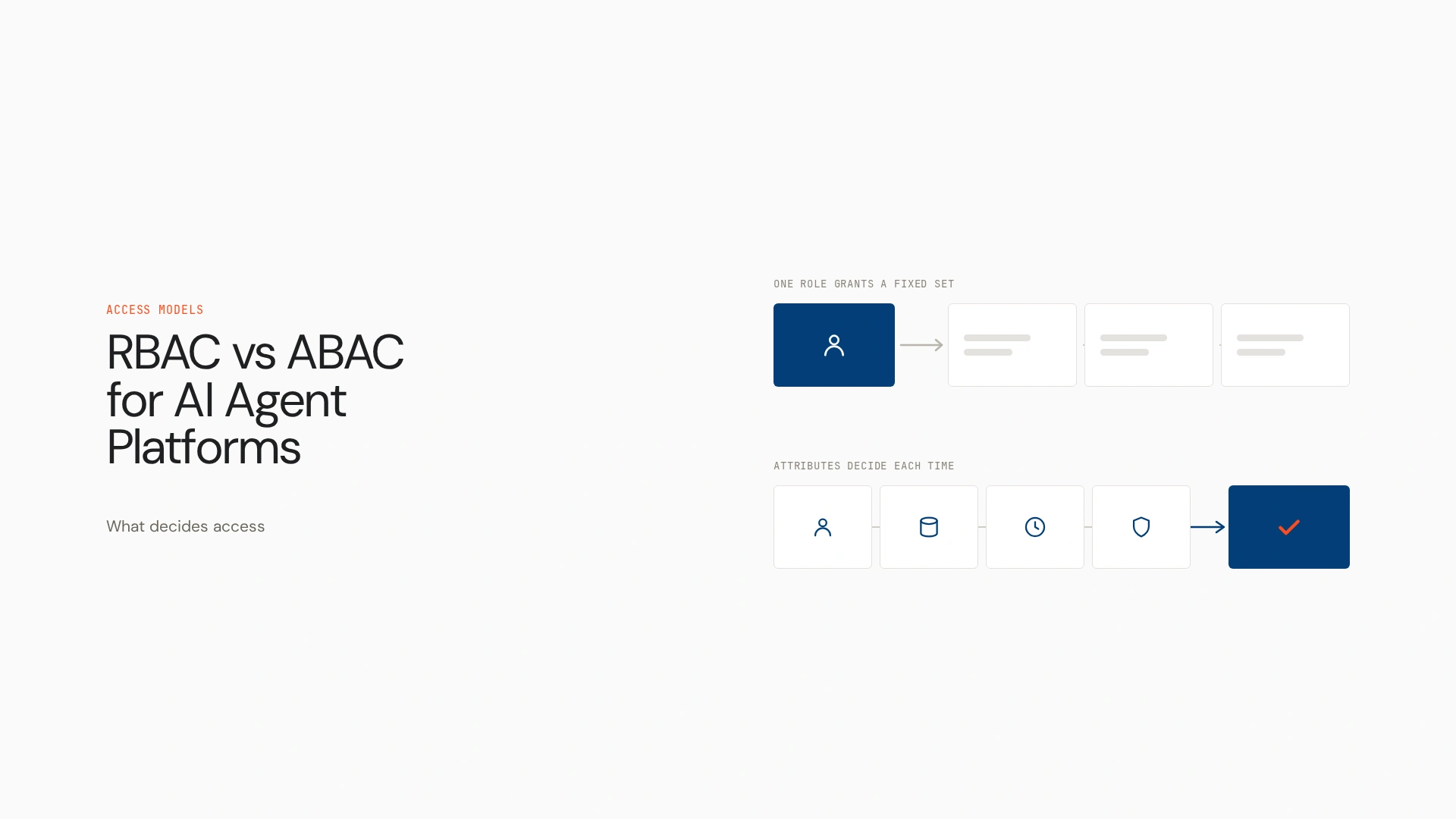
- RBAC (Role-Based Access Control) grants permissions through roles. ABAC (Attribute-Based Access Control) evaluates attributes of the subject, resource, action and environment against policies.
- RBAC is easier to administer and audit when access is stable. ABAC handles dynamic, tenant-aware or delegated access.
- Agents complicate both: one agent performs many tasks, uses many tools and acts for users with different permissions.
- Resource-scoped RBAC is often enough for predictable, narrow agents.
- ABAC or a hybrid is worth the added complexity when context changes the answer.
- An AI control plane governs agents around authorisation. It doesn’t replace your IAM or policy engines.
An enterprise support agent can read customer records and initiate refunds. Give it one broad role and it holds more access than most tasks need. Give it a rich policy engine and the team inherits new implementation and operational overhead. Meanwhile the agent acts for different users, touches several systems and runs without anyone watching each call.
The question behind RBAC vs ABAC for AI agent platforms is how to authorise agents that act on behalf of different users and resources. Predictable, auditable roles pull one way, and context-sensitive permissions pull the other. The right answer depends on the agent’s autonomy, data sensitivity, access patterns and risk. This guide compares the two models and offers a practical way to decide.
What is the difference between RBAC and ABAC?
RBAC assigns permissions to roles, then associates users, services or other identities with those roles. Access depends on the role and its permitted actions within a scope. A reporting agent might have read-only access to one analytics database, while a transaction agent can initiate approved updates.
ABAC evaluates policies using attributes of the subject, the resource, the requested action and the environment. An agent might read a customer record only when the record belongs to its authorised tenant, the delegated user has the needed access and policy permits the action.
RBAC can be scoped to specific resources, and ABAC isn’t automatically more granular in every implementation. The real difference is how authorisation decisions are expressed and evaluated.
RBAC vs ABAC at a glance
| Dimension | RBAC | ABAC |
|---|---|---|
| Authorisation basis | Assigned roles and their permissions | Attributes evaluated against policies |
| Administration | Straightforward when roles and scopes are stable | Needs attribute definitions and policy management |
| Context sensitivity | Needs extra mechanisms for contextual conditions | Designed to evaluate context |
| Auditability | Role assignments are relatively easy to inspect | Requires understanding the policy, attributes and result |
| Granularity | Depends on role design and resource scoping | Supports fine-grained, attribute-based decisions |
| Main challenge | Role proliferation or overly broad permissions | Policy complexity, attribute quality, evaluation dependencies |
| Suits | Stable permissions, predictable access | Dynamic, tenant-aware, context-dependent access |
These are tendencies, not guarantees. A well-designed RBAC system can be granular, and a poorly designed ABAC system can be hard to audit.
Why AI agents complicate access control
An agent is a non-human actor that invokes tools, retrieves data and acts for a user or another system. One agent identity doesn’t capture the authorisation context of every task. Four problems recur.
Delegated authority. An agent may act for users with different permissions. A junior analyst’s request shouldn’t unlock executive-only data because both users call the same agent. Authorisation has to preserve the link between the agent identity, the person it acts for and the requested action.
Broad tool permissions. An agent that reads support tickets may receive access to a whole ticketing system, including refund and deletion tools. If it’s manipulated or wrong, excess permission raises the impact. Least privilege shrinks what it can do.
Multi-tenant access. Being able to query a database isn’t authorisation to fetch any tenant’s records. Resource scoping, ownership and tenant boundaries prevent cross-tenant access.
Changing context. The same agent may do a low-risk read in one task and a high-impact write in the next. A model’s decision to call a tool is separate from the decision about whether that call is permitted.
When does RBAC work well for AI agents?
RBAC is a sensible start for read-only reporting agents, internal assistants limited to a small stable toolset, agents in clearly separated environments, and teams with established roles and predictable ownership. Permissions are easy to inspect and review, and teams can run access through existing IAM processes.
The limits are real. A DatabaseReader role may still be too broad if it spans tenants, projects or sensitivity levels, and a role for every user, tenant and task leads to role proliferation. Resource scoping and least privilege matter as much as the model you choose.
When does ABAC make more sense?
Consider ABAC when agents access data across tenants, when permissions depend on the delegated user’s entitlements, when access turns on ownership, sensitivity, project or region, or when resources appear faster than anyone can assign roles.
A finance agent might read an invoice when it belongs to the right business unit and the delegated user has access to that unit, yet be blocked from exporting it without approval. AWS describes ABAC as defining permissions from attributes, which it calls tags, attached to principals and resources, and says it generally requires fewer policies than traditional role-based setups.
ABAC needs current, reliable attributes, clear policy ownership and testing, consistent enforcement, a way to see why a request was allowed or denied, and handling for missing or conflicting attributes. It isn’t automatically safer. Wrong attributes or sloppy policy can still grant unauthorised access.
Is a hybrid RBAC and ABAC model better for production?
A hybrid is a useful pattern, not a universal rule. It works in three layers:
- Baseline roles: give each agent a narrow role defining the resources and actions it can reach.
- Contextual authorisation: evaluate attributes such as tenant ownership, delegated user permissions, resource sensitivity or environment where the decision depends on them.
- High-risk action controls: require extra checks or approval for destructive operations, sensitive exports or financial transactions. This is a complementary enforcement pattern, and neither model owns it.
Take an employee-support agent that can read approved employee records but can change payroll data only when authorisation conditions and approval requirements are met. The trade-off is that layers need clear precedence rules and testing, so they don’t leave gaps or contradict each other. Not every organisation needs all three layers.
How should teams enforce access for AI agents?
- Identify the principal: the agent’s identity and, where relevant, the person or service it acts for.
- Inventory tools and resources: APIs, databases, MCP servers, models and business systems.
- Define permitted actions: separate read, write, administrative and destructive operations.
- Choose the baseline model: RBAC for stable roles and scopes, with attribute policies where context matters.
- Enforce at a trusted boundary: the protected resource or an enforcement layer, never only instructions in a prompt.
- Test denials as well as allows: tenant isolation, delegated access, missing attributes, expired permissions and out-of-scope tool calls.
- Monitor and review: record relevant decisions, review grants and revoke access when agents retire.
Authentication establishes identity, and authorisation decides what that identity may do. Delegated authority needs the user’s context passed as trusted, enforced information, not as untrusted metadata. Authorisation alone doesn’t stop prompt injection or unsafe tool arguments.
RBAC vs ABAC vs PBAC vs CBAC vs ACL vs DAC
- PBAC (Policy-Based Access Control): decisions are expressed as policies. Usage varies and it overlaps with ABAC.
- CBAC (Context-Based Access Control): access depends on context. The acronym means different things across domains, so define it before comparing.
- ACL (Access Control List): each resource lists identities and their permissions.
- DAC (Discretionary Access Control): resource owners can grant access within system rules.
These aren’t always exclusive. An organisation can combine roles, attributes, policies and resource-level lists.
How does ABAC vs RBAC work in AWS?
AWS IAM supports role-based patterns, defining permissions by job function, and tag-based ABAC. Policy conditions compare tags on the principal with tags on the resource using keys such as aws:PrincipalTag and aws:ResourceTag. A principal tagged with a project can then access resources with the same project tag. Securing ABAC means requiring tags and protecting who can change them. Check current AWS documentation, since the same configuration won’t transfer unchanged to every agent platform.
Access control vs agent governance
Authentication establishes the identity making a request. Authorisation decides whether it may act. Guardrails inspect inputs, outputs or tool arguments. Observability and audit show what happened. Agent governance connects identity, permissions, evaluation, deployment, monitoring, policy and lifecycle across the agent estate.
An agent may be authorised to call a database tool. That alone doesn’t show whether the agent version was approved, whether its behaviour was evaluated or whether an execution can be investigated afterwards. These controls aren’t interchangeable.
Where Opencontroller fits
RBAC and ABAC define how authorisation decisions are made. IAM systems, policy engines, gateways and protected resources enforce them. Opencontroller is Lyzr’s AI control plane, a governance layer across agents, models, tools and environments.
It speaks to the operational questions around access: which agents exist and who owns them, what identity and permissions apply, whether an agent was evaluated before production, how agents move through deployment, and how to investigate what happened in an execution. Lyzr positions it around an agent registry, identity, evaluation gates, staged promotion, runtime policy and observability. See AI agent identity management and AI agent governance.
Opencontroller complements existing IAM and authorisation mechanisms and doesn’t replace AWS IAM, your identity provider or your policy engine. The enforcement point and integration design still matter.
How to choose the right model
Choose RBAC with resource scoping when access patterns are stable, agents use predictable tools and data, resource boundaries can enforce least privilege and simple administration and audit are priorities.
Choose ABAC when access depends on several dynamic attributes, when tenant, ownership, sensitivity or delegation changes the answer, when equivalent roles for every combination would be unmanageable and when the team can support policy management, attribute quality and testing.
Consider a hybrid when most permissions fit roles and only certain resources or high-risk actions need contextual checks.
Select the simplest model that can enforce the boundaries you need, and add complexity only where your threat model and business requirements justify it. Don’t pick ABAC just because you run agents, or RBAC just because it’s easier to explain. The Agents to Production playbook covers staging.
Choose the model, then govern the agents
Access control for agents needs a clear identity, least-privilege permissions and reliable enforcement. RBAC, ABAC and hybrids are different ways to structure authorisation. Choosing the access model is one part of the job. Teams also need to govern agent identity, evaluate changes before production and keep visibility into how agents behave across environments. See how Opencontroller brings these controls together across your agent estate, or book a demo to explore how it fits your existing architecture.
FAQs
RBAC grants access through roles. ABAC evaluates attributes of the agent, user, resource, action and environment. Agents often need both.
Not always. ABAC handles dynamic context but needs more policy work. RBAC is simpler to administer and audit when access is stable.
Assigning agents narrow roles that define which tools, data and actions they may use.
Yes. A common pattern uses roles for baseline access and attribute checks where context matters.
Give each agent only the tools, data and actions its task needs, and enforce those limits outside the prompt.
RBAC uses roles, ABAC uses attributes and PBAC expresses decisions as policies. The terms overlap and vary by system.
AWS RBAC attaches permissions to roles by job function. AWS ABAC compares tags on principals and resources in policy conditions.
Access control decides what an identity may do. Governance adds evaluation, deployment, monitoring, policy and lifecycle control across agents.
It coordinates identity, evaluation, policy and visibility across agents around the authorisation decisions your IAM and policy systems enforce.
Book A Demo: Click Here
Join our Slack: Click Here
Link to our GitHub: Click Here