TL;DR
- AI agent identity is the verifiable set of credentials, attributes, and lifecycle records that tell an enterprise system exactly which agent is acting, not just which human or app built it.
- Agents fall inside the broader category of non-human identities, but their autonomy, delegation chains, and short lifespans strain identity models built for people and static service accounts.
- Microsoft, Google, Okta, SailPoint, and Cloudflare are each shipping identity primitives for agents right now, but the category has no single agreed-upon standard yet, only competing drafts and vendor implementations.
- Identity answers “who is this.” It does not answer “should we trust what it just did,” which is why the conversation moves next toward governance and an agent control plane.
What Is AI Agent Identity?
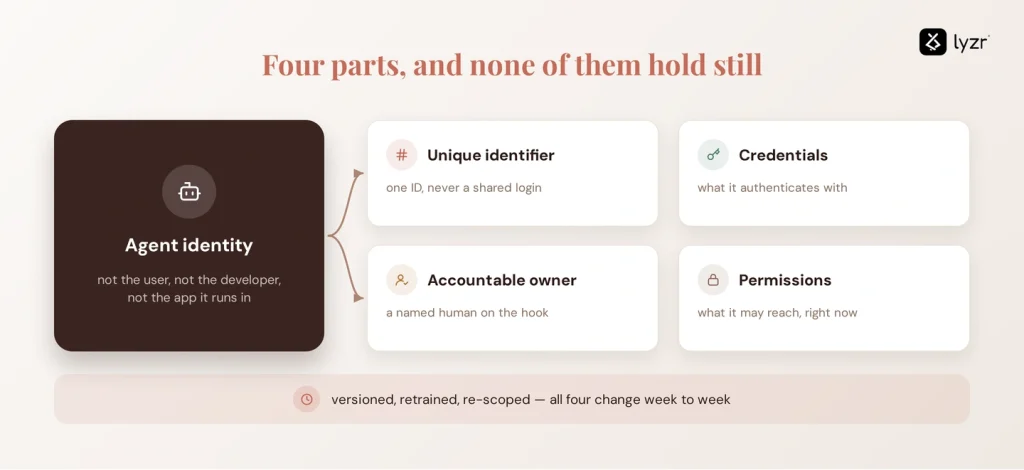
AI agent identity is the verifiable, machine-readable record of who or what an AI agent is, distinct from the human user, the developer who built it, or the application it runs inside. It includes a unique identifier, the credentials it authenticates with, the owner accountable for it, and the permissions attached to it at any given moment.
Okta’s own definition leans on the same idea, describing agent identity as something tied to specific privileges, contextual awareness, and “continuous governance across its lifecycle”. That last phrase, continuous governance across a lifecycle, is the part that separates agent identity from a static login. A human employee’s identity barely changes month to month. An agent’s identity has to account for versioning, retraining, tool access changing weekly, and the fact that it might delegate part of its task to a second agent mid-run.
Are AI Agents Just Another Non-Human Identity?
Mostly yes, with a catch. AI agents sit inside the same broad category as service accounts, API keys, and IoT devices: non-human identities (NHIs), meaning any digital identity that isn’t tied to a person logging in. Ping Identity doesn’t hedge on this: AI agents executing tasks and making decisions on behalf of users must be treated as “first-class non-human identities” rather than an afterthought bolted onto existing app accounts.
The catch is that older NHI models assumed a service account stayed put. It ran the same job, with the same scope, for years.
Agents break that assumption in three specific ways:
- Lifespan. They can be spun up and destroyed in seconds, not provisioned for years.
- Behavior. They reason about which tool to call next rather than following a fixed script.
- Delegation. They can hand a task to another agent without a human in the loop.
That third point is where most legacy IAM tooling simply has no concept to reach for.
Human Identity vs Machine Identity vs AI Agent Identity
| Attribute | Human identity | Machine identity (traditional) | AI agent identity |
| Lifespan | Years, tied to employment | Long-lived, rarely rotated | Often minutes to days |
| Behavior | Interactive, session-based | Fixed, scripted | Reasoning, adaptive |
| Delegation | Manager-approved, rare | Essentially none | Can delegate to other agents |
| Credential model | Password/MFA, human-verified | Static keys, certificates | Short-lived tokens, workload identity |
| Accountability | Direct, one person | Tied to an app owner | Owner plus agent plus invoking user |
Why Doesn’t Traditional IAM Handle AI Agent Identity?
Traditional identity and access management was built to answer one question well: does this login belong to who it claims to belong to. It was not built to answer “is this the approved version of this agent, and can it still be trusted to hold the access it was given six weeks ago.”
The clearest evidence of the gap sits inside the tools agents actually use to work. Research cited in an IETF draft on agent-to-agent delegation found that orchestrators increasingly decompose tasks across specialist agents, and that connectivity protocols like the Model Context Protocol and the Agent-to-Agent Protocol “solve the connectivity problem but do not solve the identity problem.” That same research noted a scan of roughly 2,000 MCP servers found every one of them lacking authentication.
NIST’s own read on the problem is direct. The National Cybersecurity Center of Excellence frames the stakes as a matter of accountability, arguing that AI agents should be treated as “identifiable entities within enterprise identity systems” rather than anonymous automation running under shared credentials. Shared credentials are exactly how most agent pilots start today, which is precisely what makes them hard to unwind later.
How Do AI Agents Authenticate?
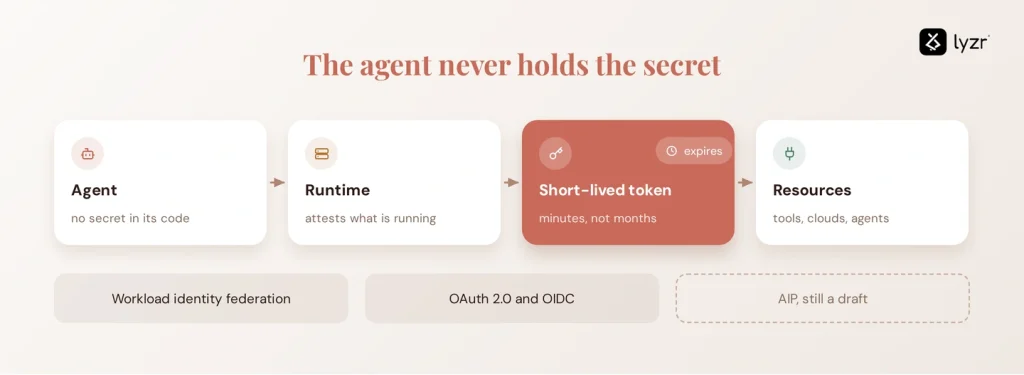
Agents authenticate through short-lived, cryptographically verifiable credentials rather than passwords or static API keys. The dominant pattern in 2026 is workload identity: instead of storing a secret inside the agent’s code, the agent’s execution environment issues it a token that expires in minutes.
A few mechanisms show up repeatedly across implementations.
Workload Identity Federation
Cloud platforms mint short-lived tokens tied to the agent’s runtime rather than a stored key. Google’s approach for agents on Vertex AI is explicit about this, describing Agent Identity as providing a “strongly attested, cryptographic identity for each agent” based on the SPIFFE standard, so the agent can securely authenticate to MCP servers, cloud resources, and other agents. Unlike a shared service account, Google notes that agent identities are not shared by multiple workloads by default and “can’t be impersonated”.
OAuth 2.0 and OpenID Connect
Agents acting on a user’s behalf typically request scoped, delegated tokens rather than inheriting the user’s full session. Microsoft’s Entra Agent ID platform builds directly on this: an agent identity there is described as “a special service principal in Microsoft Entra ID” that represents an identity the agent is authorized to impersonate, and it doesn’t hold credentials on its own. It borrows tokens rather than holding its own permanent secret, which limits what a compromised agent can actually do.
Emerging agent-specific protocols (AIP)
A newer layer, sometimes called the Agent Identity Protocol (AIP), tries to give every agent a signed identifier independent of any single cloud provider. One IETF draft describes the goal as solving cases where agents run with unbounded permissions and inherit full API key access, with “no verifiable identity boundary between human and non-human actors”. AIP is not one settled standard. At least three separate IETF drafts currently use the same name with different technical approaches, and the documents themselves note that “this I-D is not endorsed by the IETF and has no formal standing in the IETF standards process”. Treat it as a promising direction, not a shipped standard to build a compliance program around yet.
How Are Microsoft, Google, and Okta Approaching AI Agent Identity?
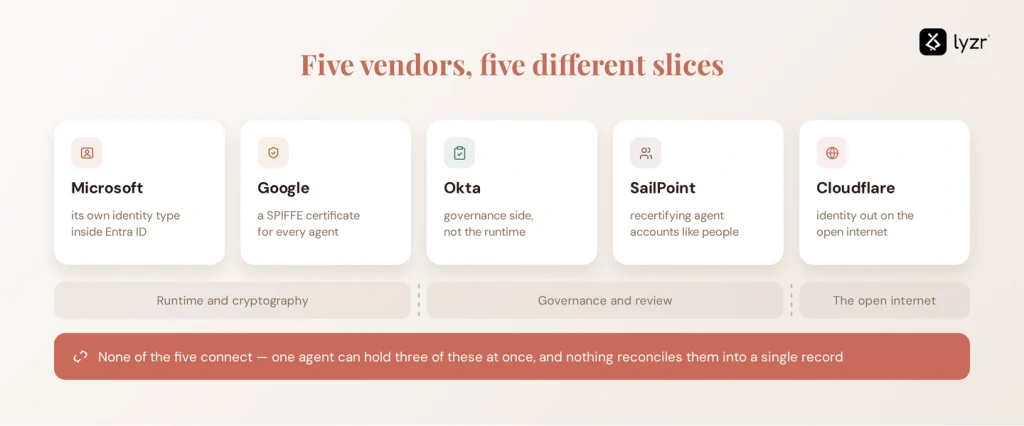
Each vendor is solving a different slice of the same problem, and together they show where the category is heading rather than where it has already settled.
Microsoft’s answer is the most structurally ambitious: a dedicated identity object type inside Entra ID, separate from a regular app registration. Microsoft describes it as a platform that extends Entra capabilities to AI agents, providing “purpose-built identity constructs to authenticate, authorize, govern, and protect” these nonhuman identities. As of its general availability update, the platform brings first-class identity and access management to agents at enterprise scale, “extending Zero Trust principles to AI workloads”.
Google’s implementation on Vertex AI focuses on cryptographic isolation rather than a new governance layer, giving every deployed agent its own SPIFFE-based certificate so a compromised agent can’t quietly borrow another agent’s access.
Okta and SailPoint are approaching it from the governance side rather than the runtime side. SailPoint’s framing centers on the accountability gap that shows up once agents multiply past a handful: “96% of technology professionals identify AI agents as a growing security threat”, which is the pressure behind extending certification and ownership reviews, the same processes used for human access recertification, to agent accounts.
Cloudflare is tackling a different edge of the problem entirely: agents acting on the open internet rather than inside enterprise walls. Its CEO framed the gap bluntly, noting that when an agent shows up at a business’s door, “you need to know who sent it”, so that trust, accountability, and real commerce can follow.
None of these five approaches talk to each other natively. None of these five approaches talk to each other. An agent could hold a Microsoft Entra identity, a Vertex AI certificate, and a Cloudflare wallet at once, and nothing connects those three into a single record of who this agent actually is. That reconciliation problem is exactly where identity stops being enough on its own.
Identity vs. Governance: What’s the Difference?
An identity answers one question: is this the agent it claims to be. Authentication confirms that claim is genuine. Authorization decides what that verified agent may touch. None of the three tells you whether the agent’s behavior, that specific run, on that specific day, was actually safe.
What Is an AI Agent Control Plane, and How Does It Relate to Identity?
Once identity, authentication, and authorization are handled, a harder set of questions remains open: who owns this agent, has this version been evaluated, and what did it actually do during execution. That set of questions is what an agent control plane is built to answer.
Lyzr does not issue identities, replace Okta, or compete with Entra ID. It sits above whatever identity provider already governs the agent and turns that identity into an operational record. The Lyzr Control Plane organizes governance around five control points: “a registry that tracks every agent an enterprise owns, identity, evaluation, staged promotion, and observability”, so that the identity Okta or Entra already issued to an agent is linked to a version history, an evaluation record, and a full execution trace rather than sitting in isolation.
That distinction matters for how a security team actually structures its stack: identity providers answer “is this agent genuine and what can it touch.” The control plane answers “is this the version we approved, what did it just do, and can we prove it if asked.” Identity issues the passport. Governance is the customs record of every border it crossed.
Lyzr Agent Control Plane: The Vercel for AI Agents
For security and platform leaders building this out, the operational questions extend beyond a single agent to how an entire agent estate is orchestrated, governed, and connected to the rest of the enterprise stack. That’s the same territory covered in the CIO Playbook to AI Agent Governance, which walks through how governance leaders should think about policy, oversight, and accountability once agents move from pilot to production.
Do You Actually Know Which Agent Did What?
Every enterprise running agents today already has an answer, even if nobody’s written it down, to “which agent did this.” The honest test is whether that answer takes seconds or takes two days and three logs to reconstruct.
Identity is the floor, not the ceiling. It tells you an agent is genuine and confirms what it’s allowed to touch. It does not tell you whether the version running right now was ever evaluated, whether its access still makes sense six weeks after it was granted, or whether you could produce a clean audit trail if a regulator asked tomorrow.
Before adding another AI agent to production, ask a narrower question than “does it have an identity”: can you currently name its owner, its evaluation status, and its last audited action, without opening three different systems to find out.
Frequently Asked Questions
AI agent identity is the unique, verifiable digital identity assigned to an autonomous AI system, distinct from the human or application that created it. It includes an identifier, authentication credentials, an accountable owner, and the permissions the agent currently holds, allowing enterprises to know exactly which agent performed a given action.
Yes. AI agents fall within the broader category of non-human identities (NHIs), alongside service accounts, API keys, and IoT devices. What sets them apart is autonomy, the ability to reason about next steps rather than follow a fixed script, dynamic delegation to other agents, and short, unpredictable lifespans, all of which push past what legacy NHI models were designed to handle.
Identity management gives enterprises accountability, least-privilege enforcement, and the ability to revoke access when something goes wrong. Without a managed identity, an agent operates as anonymous automation: nobody can prove which system took an action, scope down what it can touch, or shut off its access cleanly if it’s compromised.
AI agent identity management is the combined set of processes and technologies used to provision, authenticate, authorize, monitor, and eventually revoke an agent’s identity across its full lifecycle. It extends the same principles applied to human identity management, provisioning, access review, deprovisioning, to entities that can be created and destroyed far faster than a human account ever would be.
Agents typically authenticate through workload identity rather than stored passwords or long-lived API keys. Common mechanisms include cryptographic certificates issued by the runtime environment, short-lived OAuth tokens scoped to a specific task, and SPIFFE-based identities that bind a token to the agent’s specific execution instance rather than a shared credential.
Identity establishes and verifies who the acting agent is. Security is the broader discipline protecting everything around that agent, its underlying model, the data it can reach, the tools it calls, and the infrastructure it runs on, from misuse or attack. Identity is one input into a security program, not the whole of it.
Identity establishes who the agent is and what it can access, through authentication and authorization. Identity governance adds a layer of policy, oversight, and lifecycle management, answering questions like who approved this access, whether it’s still needed, and whether it’s appropriate for this agent’s role.
An identity provider authenticates the agent and enforces what it’s authorized to access at the moment of a request. A control plane consumes that identity and adds what identity alone can’t provide: which version is running, whether it passed evaluation, a full trace of what it did during execution, and the ability to revoke or roll it back if something goes wrong.
Book A Demo: Click Here
Join our Slack: Click Here
Link to our GitHub: Click Here
Got a use case in mind?
8 weeks from use case to agents running in production.
Platform, people and FDEs, all in. Bring your environment. We'll co-build and stay until it's live.
Talk to UsFree resource
101 AI Agents Use Cases
100+ production-ready AI agent use cases across Marketing, Sales, HR, Banking, Insurance, Operations and a lot more
Download now