TL;DR
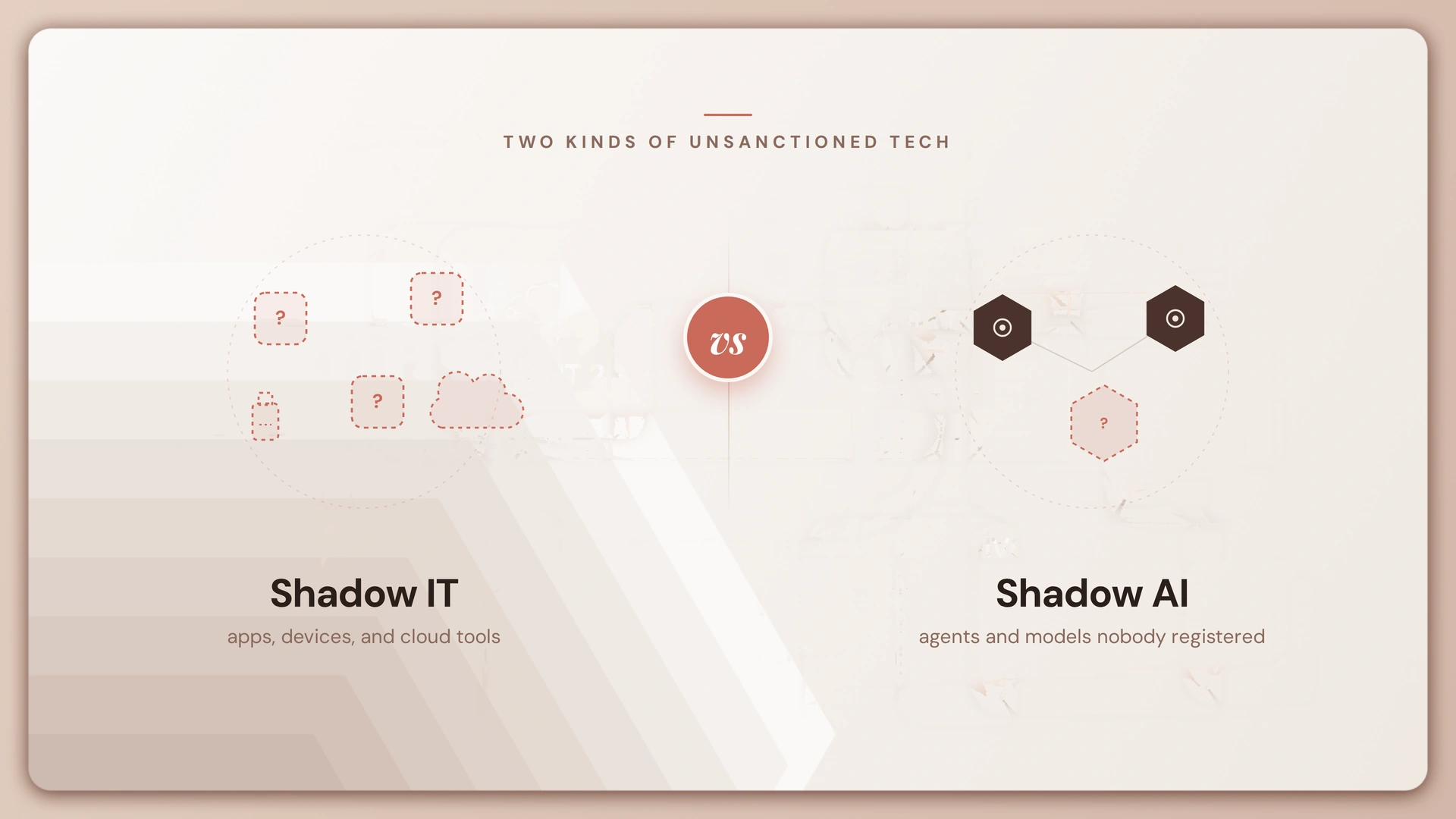
- Shadow IT is the umbrella: any unapproved hardware, software, or cloud service running inside your company.
- Shadow AI is the subset: unauthorized models, chatbots, plugins, and agents, and it behaves differently enough to need its own response.
- Three differences separate them: detection surface (a separate app vs. a feature embedded in a sanctioned tool), nature of risk (data storage vs. active leakage), and accountability (audit logs vs. frequently none).
- The classic shadow IT playbook, discover it and offer a better alternative, fails on both counts. Discovery misses embedded AI, and the gap driving adoption is capability, not convenience.
Your CASB dashboard is clean. Your SaaS inventory hasn’t flagged a new vendor in weeks. By every metric your shadow IT program tracks, nothing changed this quarter.
Meanwhile, a product manager pasted your unreleased roadmap into a browser extension that summarizes long documents. A support rep fed three customer contracts into a “helpful” AI feature bundled into your ticketing platform, a feature nobody in security signed off on because nobody in security knew it existed. Neither event shows up as a new application. Both happened inside tools you already approved.
That’s the problem with treating shadow AI vs shadow IT as the same fight. They share a root cause, employees solving a problem faster than procurement can move, but they don’t share a detection method, a risk profile, or a fix. Security teams that respond to shadow AI with the shadow IT playbook are optimizing for a threat that already evolved past that playbook. This piece breaks down exactly where the two diverge, and what a CISO or IT leadership team needs to do differently as a result.
Shadow AI vs Shadow IT: What Each Term Means
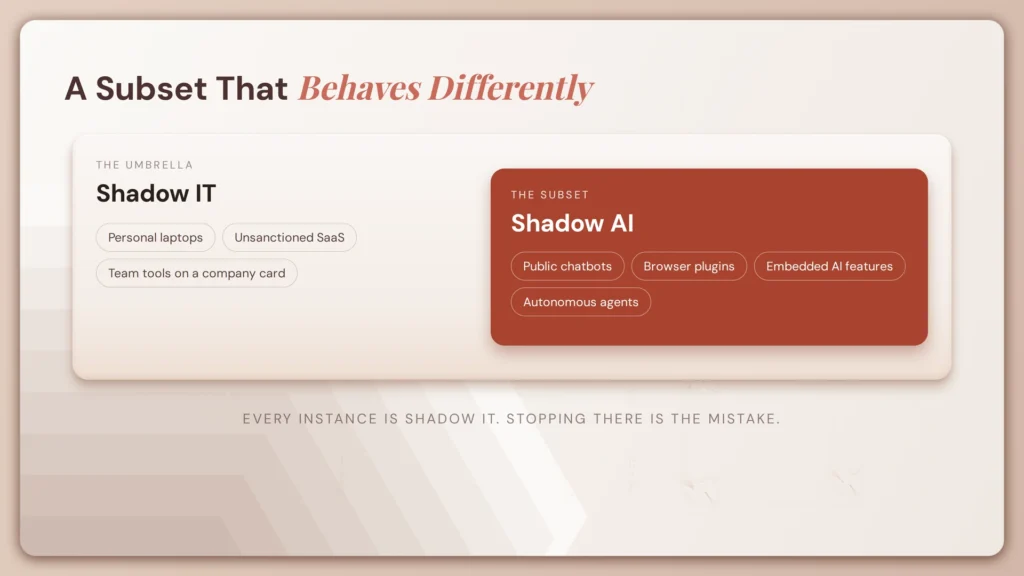
Shadow IT is the umbrella term. It covers any hardware, software, or cloud service running inside your organization without IT’s knowledge or approval, personal laptops, an unsanctioned Dropbox account, a marketing team’s Trello board bought on a company card.
Shadow AI sits inside that umbrella as a specific, faster-moving subset: unauthorized AI models, public chatbots, browser plugins, AI features embedded in tools you already licensed, and autonomous agents running with their own credentials and tool access. Every instance of shadow AI is technically an instance of shadow IT. But calling it that and stopping there is where most security programs go wrong.
The subset behaves differently enough from the rest of the category that it needs its own detection method, its own risk model, and its own response, which is the argument the rest of this article makes. For a broader grounding in the terminology and the controls that apply to AI systems specifically, our AI governance glossary is a useful reference point before you build a response plan.
One clarification worth making early: when shadow AI evolves into autonomous agents holding their own credentials and taking independent action, it becomes a distinct escalation with its own failure modes. We cover that specific subset, and why detection alone doesn’t fix it, in a dedicated look at shadow AI agents. This article stays focused on the full category compared against shadow IT.
The Three Differences Between Shadow AI and Shadow IT
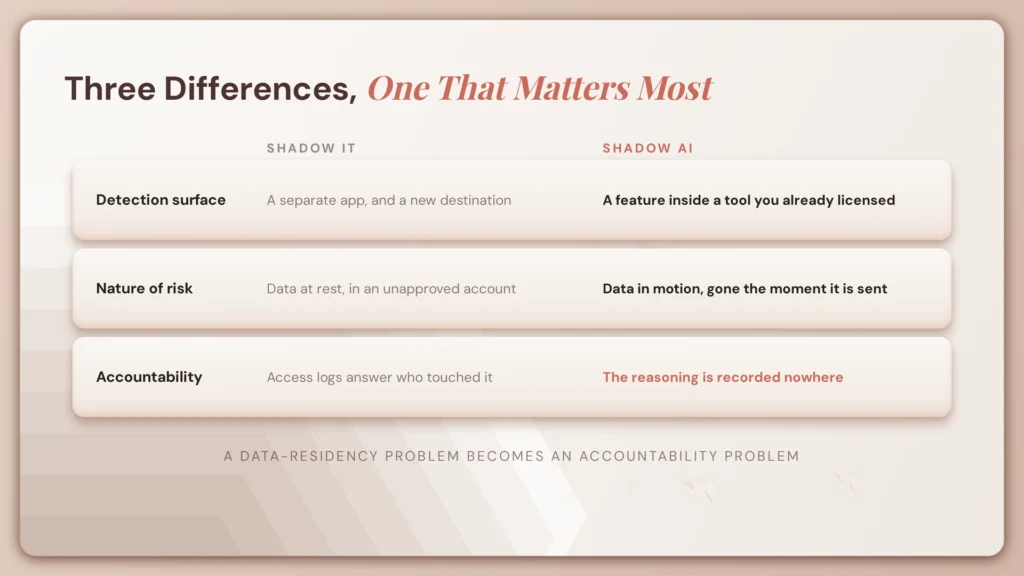
Detection surface: a separate app vs. a feature that’s already there
Shadow IT was, comparatively, easy to spot. A rogue file-sharing account generated distinct network traffic to an unfamiliar domain. Network monitoring and SaaS inventory tools could flag the destination because it was a destination, a separate application sitting outside your approved list.
Shadow AI doesn’t announce itself that way. It shows up as a summarize button inside a tool you already licensed, a browser extension, a Copilot feature toggled on by default inside Office, or a local model running on a developer’s laptop. The traffic looks like normal use of an approved tool because it is normal use of an approved tool. Your discovery tooling was built to ask “is this app on the approved list.” It was never built to ask “did this approved app just call out to a third-party model.”
Nature of risk: data at rest vs. data in motion
Shadow IT created a storage problem. A sensitive file sitting in an unapproved cloud account is exposed if that account is breached, but the data itself stays put until someone acts on it.
Shadow AI creates an active leakage problem. Employees paste source code, customer records, and internal financials directly into prompts, trying to move faster, and that input can be logged, retained, or absorbed by a model outside your control the moment it’s submitted. There’s no second window to catch it before it leaves the building. We go deeper on this specific exposure in the hidden security risks of using ChatGPT at work and in a broader look at the risks of public LLMs.
Accountability: file logs vs. no audit trail
A rogue file-sharing service holds a document. Access logs tell you who touched it and when. Shadow AI is different: a tool with OAuth access can read that same document, interpret its intent, make a decision, and call an API, and in a lot of environments today, none of that reasoning gets recorded anywhere. This is the difference that matters most, because it reframes the entire category from a data-residency problem into an accountability problem. When something goes wrong, “who approved this” is a solvable question with shadow IT. With unmonitored shadow AI, it frequently isn’t.
Shadow IT vs. Shadow AI: A Comparison
| Shadow IT | Shadow AI | |
|---|---|---|
| What it is | Unapproved hardware, SaaS, cloud storage | Unauthorized models, chatbots, plugins, agents |
| Where it lives | A separate application | Often inside an approved tool |
| Detection | Network traffic, SaaS inventory | Looks like normal use of sanctioned software |
| Primary risk | Infrastructure sprawl, storage exposure | Active data leakage into third-party prompts |
| Data behavior | Stores | Interprets, decides, acts |
| Audit trail | File access logs | Frequently none |
| Why employees use it | Approved tool is clunkier | Approved tool is less capable |
Why the Shadow IT Playbook Doesn’t Transfer
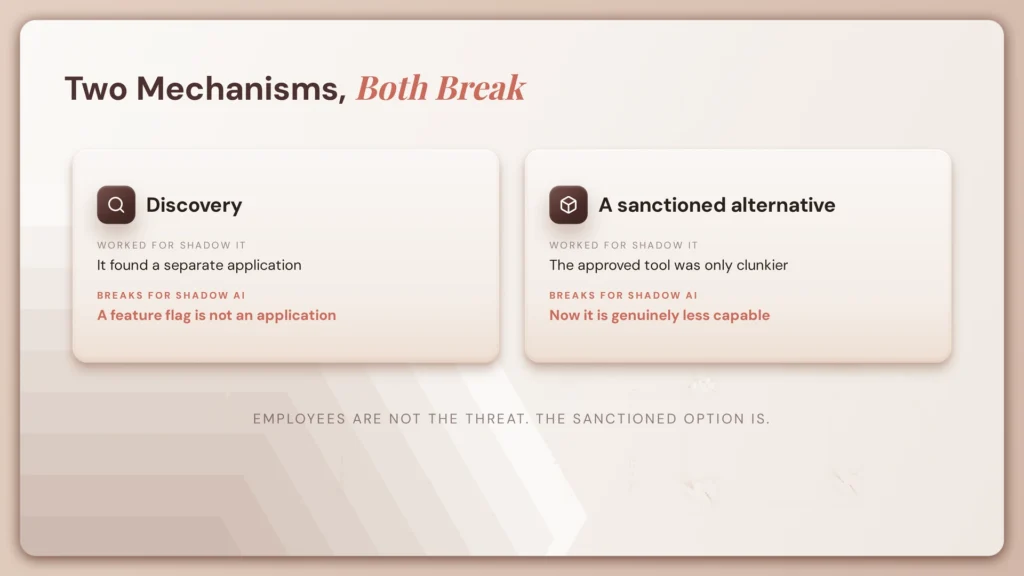
Shadow IT was solved, to the extent it was solved, by two mechanisms working together. Discovery tools found the unapproved app. Then IT shipped a sanctioned alternative good enough that going around the process stopped being worth the hassle.
Both mechanisms break when you point them at shadow AI.
Discovery breaks first. It’s built to find separate applications, and shadow AI, as covered above, usually isn’t one. It’s a feature flag inside a product you already pay for. Pointing your CASB at the problem tells you almost nothing.
Sanctioned alternatives break for a subtler reason. Shadow IT happened because the approved tool was clunkier than the unapproved one. Employees weren’t chasing capability, they were chasing convenience, and a better-designed sanctioned tool usually won them back. Shadow AI happens because the approved tool is less capable. An employee reaching for a consumer-grade model isn’t frustrated by a clumsy interface. They’re doing it because the sanctioned option genuinely cannot do the task they need done. No amount of UX polish moves someone off a tool that actually works better. This capability gap is also why AI rollouts stall in ways old software rollouts didn’t; our piece on enterprise AI agent challenges covers the adoption side of that same problem.
Worth stating plainly here: employees reaching for shadow AI are not the threat. They’re solving a real problem with the tools available to them, and the fact that they’re doing it in the shadows says more about the sanctioned option than it does about their intent.
Where Shadow AI Becomes Shadow Agents
The escalation point is action. A shadow chatbot leaks whatever an employee typed into it, a bounded, if serious, exposure. A shadow agent holding real credentials doesn’t just leak a prompt, it can read a system, decide something, and execute an API call on its own, with no human in that loop and often no record of why. That’s a different blast radius, and it compounds fast when the input triggering the action is one an attacker controls, which is the core mechanic behind prompt injection attacks against autonomous systems. If your organization already has agents with tool access running anywhere, that specific risk deserves its own read: see our full breakdown of shadow AI agents and why detection alone doesn’t close the gap once an agent can act.
What to Do Instead
Five controls, in order of how fast they pay off.
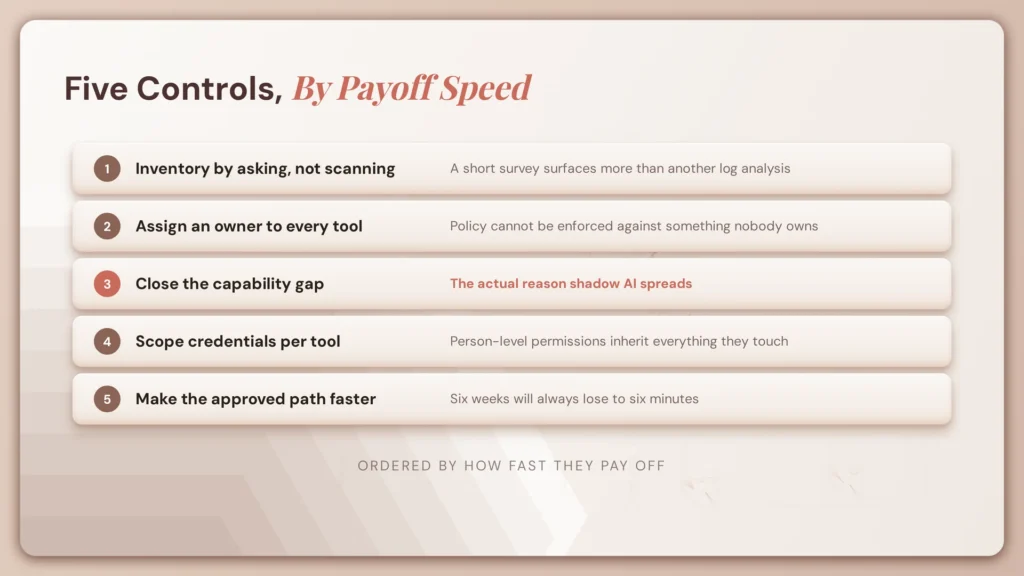
Inventory by asking, not only scanning. Scanners miss embedded features and personal accounts. A short survey to engineering, marketing, and support teams about what AI tools they actually use surfaces more, faster, than another round of network log analysis.
Assign an owner to every AI tool and agent you find. No AI tool or agent should exist without a named human accountable for its behavior, its permissions, and its lifecycle. Compliance teams can’t enforce a policy against a tool nobody owns.
Close the capability gap, not the convenience gap. If employees are routing around your sanctioned AI tool, find out what task it can’t do and fix that, rather than redesigning its interface. This is the single highest-leverage move, because it’s the actual reason shadow AI spreads.
Scope credentials per tool, rather than per person. Broad, person-level permissions mean a single compromised AI tool inherits everything that person can touch. Tight, tool-specific scoping limits what any one shadow AI incident can reach.
Make the approved path faster than the unapproved one. If getting a new AI tool cleared takes six weeks, employees will use the one that takes six minutes. A workable AI compliance checklist and a clear approval lane, paired with real AI agent governance, turns the sanctioned option into the fast option instead of the slow one.
Where Governance Sits
None of the five controls above work without a place to enforce them. That’s the function a control plane is built for: a live registry of every AI tool and agent in use, ownership assigned by default rather than by chase-down, permissions scoped per tool, and a decision trace attached to every action an agent takes, not just the ones that go wrong.
That last piece is what actually closes the accountability gap described earlier. A registry tells you what exists. A decision trace tells you why it acted the way it did. Lyzr’s approach to Responsible AI as a Service builds both into the platform layer, so governance isn’t a quarterly audit bolted on after the fact, it’s running alongside the agents themselves. For CISOs building the AI oversight function that this problem now requires, that’s the difference between reacting to shadow AI and actually seeing it.
Frequently Asked Questions
What exactly is shadow AI?
Shadow AI is any AI model, chatbot, plugin, or agent used inside an organization without security or IT approval, including features embedded in tools that were already sanctioned for other purposes.
What is the difference between shadow AI and shadow IT?
Shadow IT is the broader category of any unapproved technology; shadow AI is the AI-specific subset. The practical differences are detection (a separate app vs. an embedded feature), risk (stored data vs. actively processed and potentially leaked data), and accountability (file logs vs. frequently no audit trail at all).
What are some examples of shadow AI?
A browser extension that summarizes documents by sending them to a third-party model, an AI feature toggled on by default inside a licensed SaaS product, a developer running an open-source model locally, and an employee pasting a customer contract into a public chatbot to draft a summary.
Why is shadow AI a problem?
The core shadow AI risks are active data leakage from prompts and uploads, compliance exposure when regulated data crosses into ungoverned models, and unaccountable action when an AI tool has enough access to interpret data and execute a task on its own.
How do you identify shadow AI?
Start by asking, not just scanning. Surveying teams about the AI tools they already use surfaces more than network monitoring alone, because embedded AI features generate traffic that looks identical to normal use of an approved application.
How do you avoid shadow AI?
You reduce it, more than eliminate it, by closing the capability gap between sanctioned and unsanctioned tools, assigning an owner to every AI tool found, scoping credentials per tool, and making the approved path faster to use than the unapproved one.
Is shadow IT an insider threat?
No. Shadow IT is usually an employee solving a real problem with the tools available, not malicious behavior. Treating it as an attack tends to drive the activity further underground, which makes it harder to see, not easier.
Are there benefits to shadow IT?
Yes. Shadow IT is a signal that sanctioned tooling isn’t meeting a real need. The signal is genuinely useful for deciding what to fix next; the unmanaged exposure it creates in the meantime is not.
The uncomfortable part of this comparison isn’t the definitions, most security teams already sense that shadow AI is different. It’s that fixing it means admitting your sanctioned tools might not be good enough yet, and that closing a capability gap is a harder, slower fix than shipping a better login page ever was.
Start with one question in your next security review: for every AI tool your team has already flagged as “shadow,” what specific task made it worth the risk to the employee who reached for it? That answer is your actual roadmap.
See how a governed alternative closes that gap at Lyzr.
Book A Demo: Click Here
Join our Slack: Click Here
Link to our GitHub: Click Here