An LLM can return a fluent, confident answer that contains unsupported claims, contradicts the retrieved context, or invents facts. Traditional application monitoring won’t catch any of it, because the response looks like a normal 200 with sensible latency. For RAG applications and agents, where a wrong answer can trigger a downstream action, that has become a production quality problem.
The tools in this guide detect hallucinations in different ways. Some compare answers against trusted context, some use evaluation metrics or LLM judges, some use purpose-built models, and some block or monitor at runtime. This comparison covers offline hallucination testing, RAG faithfulness, purpose-built detection models, runtime guardrails, production evaluation, and where broader AI governance fits.
Get the Short Answer
- Best for enterprise governance: Opencontroller. It is an AI control plane, not a hallucination detection model.
- Best for hallucination testing: DeepEval. It has a dedicated HallucinationMetric for evaluation workflows.
- Best for RAG faithfulness: Ragas. It checks whether response claims are supported by retrieved context.
- Best purpose-built detector: Patronus Lynx. A dedicated model rather than a general-purpose LLM judge.
- Best open factual-consistency model: Vectara HHEM. An open-weights model plus a commercial scoring API.
- Best for runtime guardrails: NVIDIA NeMo Guardrails. Output rails that can warn or block.
None of these guarantees a hallucination-free system. Detection finds the problem. What you do next is a separate question.
What is Hallucination Detection in LLMs?
Hallucination detection evaluates a generated response to decide whether it is grounded, faithful, factually consistent or otherwise acceptable. A hallucination is output that is unsupported, factually wrong or inconsistent with the available evidence.
In RAG systems, detection usually means comparing the response against retrieved context. Without a reference source, teams use LLM judges, self-consistency checks or specialized classifiers. Detection can run offline in testing, during evaluation before deployment, or at runtime after generation.
Detection identifies a potential hallucination. Prevention changes the system so it is less likely to occur. This guide is about detection, and about what detection feeds into. For prevention, see the companion guide on preventing AI hallucinations in production.
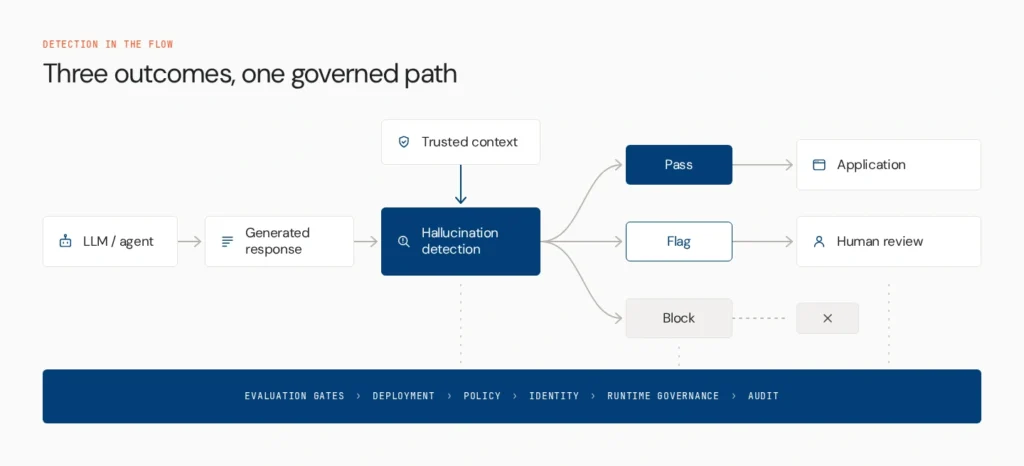
How Hallucination Detection Techniques Differ
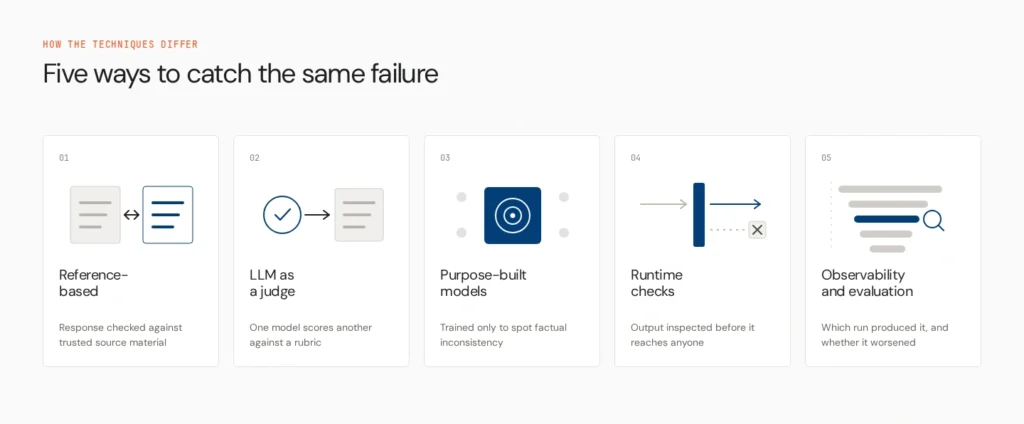
1. Reference-based or groundedness detection. Compares the response against trusted source material or retrieved context. Faithfulness, groundedness, factual consistency and claim-level support are related, but they aren’t identical metrics.
2. LLM-as-a-judge. One model evaluates another against a rubric or context. It’s flexible, easy to customize and useful for regression testing. The costs are extra inference, added latency, judge bias and inconsistency, and the judge can be wrong too. That makes it a tool with trade-offs, not an unreliable one.
3. Purpose-built detection models. Specialized models, such as Patronus Lynx and Vectara HHEM, are trained specifically to spot factual inconsistency. They can be cheaper and faster than a general-purpose judge, though how well they transfer to your data needs testing.
4. Runtime checks. Guardrail tools inspect output before it reaches a user or downstream system, then warn, block or modify.
5. Production observability and evaluation. Teams also need to know when hallucinations occur, which model, prompt, context and agent produced them, and whether a new deployment raised the rate. Observability alone isn’t detection: the platform has to include relevant evaluation capabilities.
Hallucination Detection Benchmarks: What they Show
Benchmarks show how detectors are tested, not which one will win on your workload. Common ones include HaluEval, RAGTruth, FinanceBench, AggreFact, TruthfulQA and Patronus’s HaluBench, a collection of 15,000 samples drawn from real-world domains.
Read any number with three questions: which benchmark, which model version and which metric. For example, Patronus reports Lynx v2.0 (8B) at 82.56% average accuracy across an extended HaluBench set, against 79.15% for Lynx v1.1. That is a vendor-reported figure on Patronus’s own benchmark. It doesn’t prove the same result on your documents, and results across different benchmarks aren’t comparable.
How We Compared the Tools
We looked at direct relevance to hallucination detection, the detection mechanism, RAG grounding support, offline versus runtime use, purpose-built versus general evaluation, production readiness, open-source availability, observability, agent integration and governance relevance. We didn’t include a tool only because it is popular in LLM observability, and we didn’t pad the list. These are different categories of tool, so the right choice depends on where unreliable behavior enters your pipeline.
The 7 Best Tools for Hallucination Detection in LLMs
1. Lyzr Opencontroller

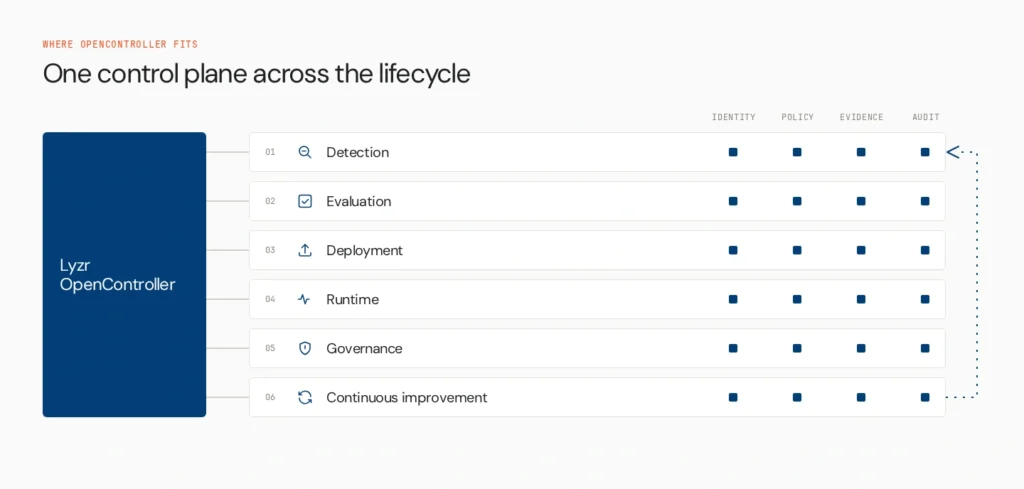
Opencontroller is Lyzr’s AI control plane for production agents. It doesn’t detect hallucinations, and it isn’t a factuality model. It governs the lifecycle around the tools that do. A detector can flag a response, and an evaluation framework can score an agent. Opencontroller governs what happens around those results.
Think about what a team faces once detection is running. A response gets flagged. Then the questions start. Which agent produced it? Which version is live, and in which environment? What policy applies? Should this version have been promoted? Can the agent keep operating? Who approved the deployment, and how is that recorded for audit? A detector returns a verdict. Someone still has to answer all of that, and in an estate of many agents, nobody does it consistently by hand.
This is the central distinction. Detection tells you there may be a problem. Evaluation measures the problem. Governance determines what happens next. Opencontroller sits in that last layer, above your existing detection, evaluation, observability and guardrail tools. It doesn’t replace any of them.
What it covers
- Evaluation and quality gates before promotion. A version moves forward only when required checks pass, including results from evaluation tools you already run. See AI agent evaluation.
- Agent identity and registry. Every agent is known and owned through an agent registry, so a failed check points to a specific agent, version and environment.
- Approval and promotion workflows. Deployment decisions are recorded, with approvers, rather than made in chat threads.
- Runtime activity and policy context. Production activity sits next to identity and policy, so a flagged response is traceable. See AI agent observability.
- Lifecycle governance and audit. Agents are governed from development through promotion to retirement, across frameworks, clouds and models. This is AI agent governance in practice.
A worked example. An evaluation framework scores a new agent version and its hallucination rate exceeds your threshold. The promotion gate holds the release. The owner is identified through the registry. Production traces from the live version show where failures cluster. The fix is made, the agent is re-evaluated, and only then is it promoted. The detector did its job at every step. The control plane is what connected the steps.
Strengths
- Connects evaluation results to deployment and governance decisions
- Tracks agent identity, version and environment across the lifecycle
- More valuable as you move from one application to a fleet of agents across models and clouds
Weaknesses
- It doesn’t detect hallucinations. You still need a detector or evaluation layer
- It isn’t a replacement for RAG or grounding infrastructure
- More than a single-application team needs
Best for: Enterprise teams moving from individual hallucination checks to governed production agents that need approvals, identity, policy and audit across several agents. Skip it for now if you run one RAG app and only need a faithfulness metric in CI. See the Agents to Production playbook for how teams stage that move. For built-in checks inside Lyzr’s own platform, there is a separate Hallucination Manager module.
2. DeepEval

DeepEval is an open-source evaluation framework with a dedicated HallucinationMetric. The metric uses an LLM as a judge to compare the actual output against the context you provide. It checks each context item for contradictions with the output. The docs note it resembles the FaithfulnessMetric but treats the supplied contexts as the source of truth, so it is calculated differently. Use it for testing and regression, not as a runtime blocker.
Key features: HallucinationMetric, Faithfulness for RAG, LLM-as-a-judge, CI/CD, component-level and agent evaluation
Strengths: Fits naturally into development and CI workflows, Clear distinction between hallucination and RAG faithfulness metrics, Open source
Weaknesses: Judge scores are probabilistic and cost tokens, Doesn’t block live responses, The hallucination threshold is a maximum rather than a minimum
Best for: Teams wanting automated hallucination tests in development. Not a governance layer.
Where Opencontroller fits: DeepEval produces the score. Opencontroller turns the score into a promotion gate.
3. Ragas

Ragas is an open-source RAG evaluation framework. Its Faithfulness metric measures whether claims in a response can be inferred from the retrieved context. It is broader than hallucination detection, covering context precision, context recall and factual correctness, so don’t treat it as a dedicated detector.
Key features: Faithfulness, Context precision and recall, Factual correctness, Evaluation datasets
Strengths: Strong fit when the question is “did the answer follow the retrieved context?”, Open source, widely used for RAG, Separates retrieval quality from generation quality
Weaknesses: Not a purpose-built hallucination model, LLM-based metrics carry cost and variance, Offline evaluation, not runtime blocking
Best for: RAG teams diagnosing whether failures come from retrieval or generation.
Where Opencontroller fits: Ragas measures faithfulness on a test set. Opencontroller decides whether the agent behind it ships.
4. Patronus Lynx

Lynx is a purpose-built hallucination detection model for RAG. Patronus describes Lynx v2.0 as an 8B model, and says Lynx was the first open-source model to outperform GPT-4o and Claude-3-Sonnet on hallucination tasks. The 2.0 guide claims it beats Claude-3.5-Sonnet as a judge on HaluBench by 2.2%. It covers eight hallucination types, including predicate, entity and circumstance errors and unfaithful chain-of-thought. These are vendor-reported results on Patronus’s own benchmark.
Key features: Dedicated RAG detection model, Hallucination taxonomy, HaluBench, API and open-source access
Strengths: Trained specifically for detection, not repurposed, Open model, with a published benchmark and evaluation code, Granular hallucination categories
Weaknesses: Benchmark results come from the vendor, Needs a reference context to check against, A model you must host or call, with its own cost
Best for: Teams that want a dedicated detector rather than a general LLM judge. Not a fit without source context.
Where Opencontroller fits: Lynx classifies the response. Opencontroller governs what the flag triggers.
5. Vectara HHEM
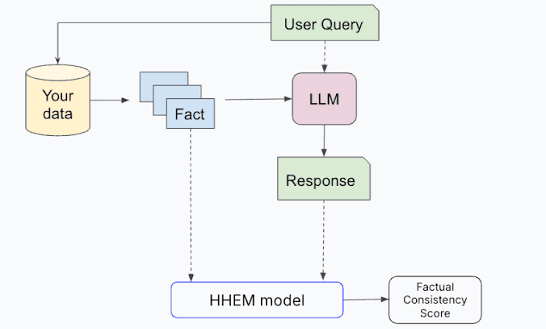
HHEM is Vectara’s hallucination evaluation model. It compares the facts in the RAG context to the generated response and outputs a factual consistency score between 0 and 1. Vectara offers an open-weights version, HHEM-2.1-Open, on Hugging Face and Kaggle, while the commercial HHEM-2.3 is available through its API. Vectara’s own tests show the commercial version outperforming the open one, so don’t assume the open model matches published results.
Key features: Factual consistency scoring, Source-based detection, Open-weights model, API scoring
Strengths: Purpose-built for source-grounded consistency, Open model for self-hosted pipelines, Cheaper than judging with a large LLM, in principle
Weaknesses: Strongest commercial version is closed, Scores factual consistency against a source, not truth in general, Less flexible than rubric-based judging
Best for: RAG and summarization teams wanting a lightweight consistency scorer. Not ideal for open-domain fact-checking.
Where Opencontroller fits: HHEM gives a score. Opencontroller ties it to an agent, a version and a decision.
6. NVIDIA NeMo Guardrails
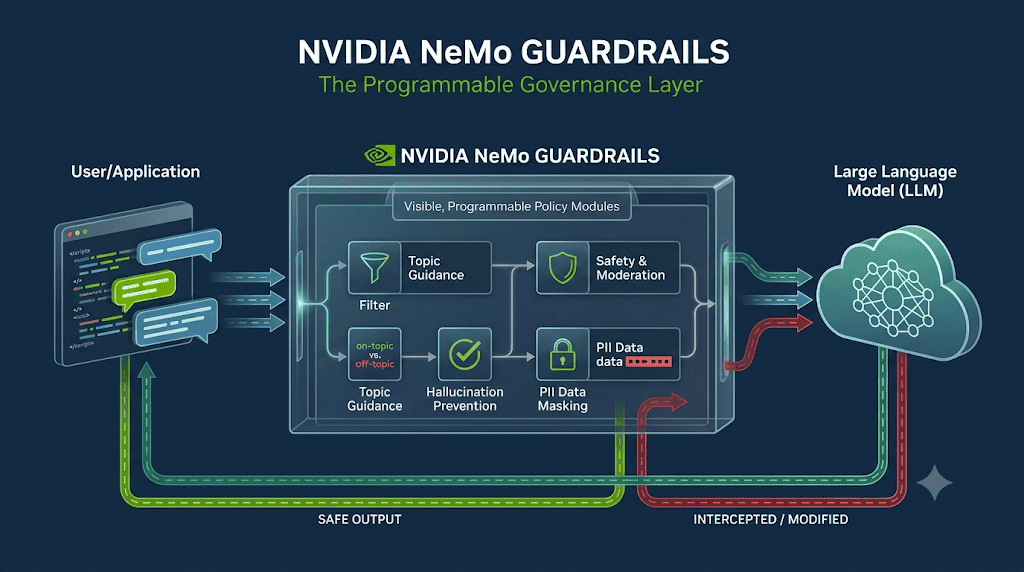
NeMo Guardrails adds programmable rails to LLM applications. Its output rails include hallucination and fact-checking checks that can warn or block. It separates detection (spotting a likely hallucination) from the guardrail decision (what the application does with it).
Key features: Self-check hallucination and facts, Output rails with block or warn, Input, output and retrieval rails, Programmable flows
Strengths: Enforces at runtime, not only in testing, Open source, Configurable response when a check fails
Weaknesses: Colang learning curve, Self-check approaches use extra model calls, Controls a conversation, not a fleet of agents
Best for: Teams needing runtime blocking in conversational applications.
Where Opencontroller fits: NeMo acts on one response. Opencontroller governs the agents producing them.
7. Galileo AI

Galileo provides evaluation and observability for LLM, RAG and agent workflows, and is the observability-side pick here. Only use its hallucination and faithfulness features after checking current documentation. It isn’t a purpose-built hallucination model.
Key features: RAG and agent evaluation, Production monitoring, Quality signals, Runtime feedback
Strengths: Connects evaluation to production data, Covers agents as well as RAG, Commercial support
Weaknesses: Commercial platform, Detection depth depends on configured evaluators, Doesn’t govern agent promotion by itself
Best for: Teams wanting production evaluation and monitoring in one place.
Where Opencontroller fits: Galileo shows quality trends. Opencontroller decides what the trend means for deployment.
Compare All Seven Tools Side by Side
| Tool | Hallucination detection | RAG faithfulness / grounding | LLM-judge / evaluation | Purpose-built detector | Runtime blocking | Open source | Production observability | Best for |
|---|---|---|---|---|---|---|---|---|
| Opencontroller (AI control plane) | — | — | Partial (gates on eval results) | — | Partial (policy) | — | ✓ | Governing agents around detection |
| DeepEval | ✓ | ✓ | ✓ | — | — | ✓ | Partial | Hallucination testing in CI |
| Ragas | Partial | ✓ | ✓ | — | — | ✓ | — | RAG faithfulness |
| Patronus Lynx | ✓ | ✓ | — | ✓ | Partial | ✓ (model) | Partial | Dedicated RAG detection |
| Vectara HHEM | ✓ | ✓ | — | ✓ | Partial | ✓ (open model) | — | Factual-consistency scoring |
| NeMo Guardrails | ✓ | Partial | Partial | — | ✓ | ✓ | — | Runtime rails |
| Galileo AI | Partial [VERIFY] | ✓ [VERIFY] | ✓ | — | Partial | — | ✓ | Production evaluation |
✓ built in · Partial · — not a focus.
Hallucination Detection vs Prevention vs Observability
| Capability | Primary question | Example tool type |
|---|---|---|
| Hallucination detection | Is this response potentially unsupported or incorrect? | Patronus Lynx, Vectara HHEM |
| RAG faithfulness evaluation | Are the claims supported by retrieved context? | Ragas, DeepEval |
| Guardrails | Should this response be blocked, warned or modified? | NeMo Guardrails |
| Observability | What happened in production, and where did quality degrade? | Galileo, Langfuse, Phoenix |
| AI control plane | What should happen to the agent and workflow around these decisions? | OpenController |
How to Choose a Hallucination Detection Tool
Work through these questions:
- Offline or runtime? DeepEval and Ragas suit offline evaluation. NeMo Guardrails suits runtime.
- Do you have trusted reference context? Lynx, HHEM, Ragas and DeepEval’s HallucinationMetric all depend on it.
- Is the workload RAG? If so, start with faithfulness metrics or a purpose-built detector.
- LLM judge or purpose-built model? Judges are flexible. Dedicated models can be faster and cheaper.
- Low latency needed? Favor a lightweight detector over a large judge.
- Open source or self-hosted? DeepEval, Ragas, Lynx, HHEM-Open and NeMo qualify.
- CI regression tests? DeepEval and Ragas.
- Production observability? Galileo or a tracing platform.
- Agent identity and governance across many agents? That is the control-plane question.
Enterprises usually combine layers: Ragas or DeepEval to evaluate, Lynx or HHEM for specialized detection, NeMo for runtime action, an observability platform to monitor, and Opencontroller to govern the lifecycle around all of them. Most teams won’t need every layer.
A Practical Hallucination Detection Checklist
- Define what counts as a hallucination for your application
- Identify the source of truth
- Choose a metric that matches it
- Build a representative test set, including adversarial and ambiguous cases
- Cover both common and high-risk workflows
- Track false positives as well as false negatives
- Test across models and model versions
- Monitor hallucination rates after deployment
- Connect evaluation results to promotion decisions
- Keep audit trails for high-risk agents
Where does an AI Control Plane Fit into Hallucination Detection?
Detection identifies the problem. Evaluation measures it. Guardrails act on the response. Governance controls what happens next.
A detector can flag a response as potentially unsupported. An evaluation framework can measure hallucination rates across test cases or production traces. A guardrail can block or warn. An observability platform can show where and when quality degraded. An AI control plane governs the agent across all of it: evaluation gates before promotion, agent identity, version and environment, policy, approval, deployment state and audit.
The value grows with scale. One RAG app can be managed by its team. A fleet of agents across frameworks, models and clouds can’t, because each team will wire detection to decisions differently. Opencontroller connects hallucination detection and evaluation signals to the operational decisions that determine how agents are deployed and governed. It doesn’t detect hallucinations itself.
Decide What Happens After Detection
Hallucination detection tells you when an LLM response may be wrong. The bigger production challenge is deciding what happens next. For teams moving from individual checks to governed production agents, Lyzr’s Opencontroller connects evaluation signals with identity, deployment decisions, runtime governance and auditability across the agent lifecycle. See how it fits your existing stack, or book a demo to assess how the control layer could work across your production agent estate.
FAQs
Evaluating a response to decide whether it is grounded, faithful or factually consistent with available evidence. It can run offline, before deployment or at runtime.
Compare the response against trusted context, score it with an LLM judge, run a purpose-built detection model, or apply runtime guardrails. Most teams combine a few of these and monitor results in production.
It depends on the layer. DeepEval for evaluation, Ragas for RAG faithfulness, Lynx or HHEM for dedicated detection, NeMo Guardrails for runtime blocking, and Opencontroller to govern what happens next.
Partly. Automated methods catch many unsupported claims, but scores are probabilistic. Pair them with sampling and human review for high-stakes cases.
Check whether each claim in the response is supported by the retrieved context, using faithfulness metrics, an LLM judge or a model like Lynx or HHEM. Separate retrieval failures from generation failures.
Detection flags whether a response may be unsupported. Evaluation measures behavior across many cases against defined criteria, often producing rates and trends rather than single verdicts.
Free open-source options include DeepEval, Ragas, the Lynx model and HHEM-2.1-Open. Free software still costs compute and judge tokens, and open versions may trail commercial ones.
Often useful, not infallible. Judges add cost, latency and bias, and can err themselves. Validate them against labeled examples from your own data.
Common ones include HaluEval, HaluBench, RAGTruth, FinanceBench and AggreFact. Results aren’t comparable across benchmarks and may not carry over to your workload.
Often yes, because the jobs differ. A detector checks a response. A control plane like Opencontroller governs which agents are promoted, how they’re identified and what happens when checks fail.
Book A Demo: Click Here
Join our Slack: Click Here
Link to our GitHub: Click Here