If you asked five colleagues at your office about what their AI agents accomplished last week, you’d probably end up with five different responses, and two might not even be correct. This is quite common in larger startups and enterprises, where numerous AI agents are utilized, which they created out of enthusiasm or need, and nobody has a consistent, reliable understanding of each agent’s activities, who approved them, or whether they are still functioning within their original parameters. Fortunately, we now have a solution!
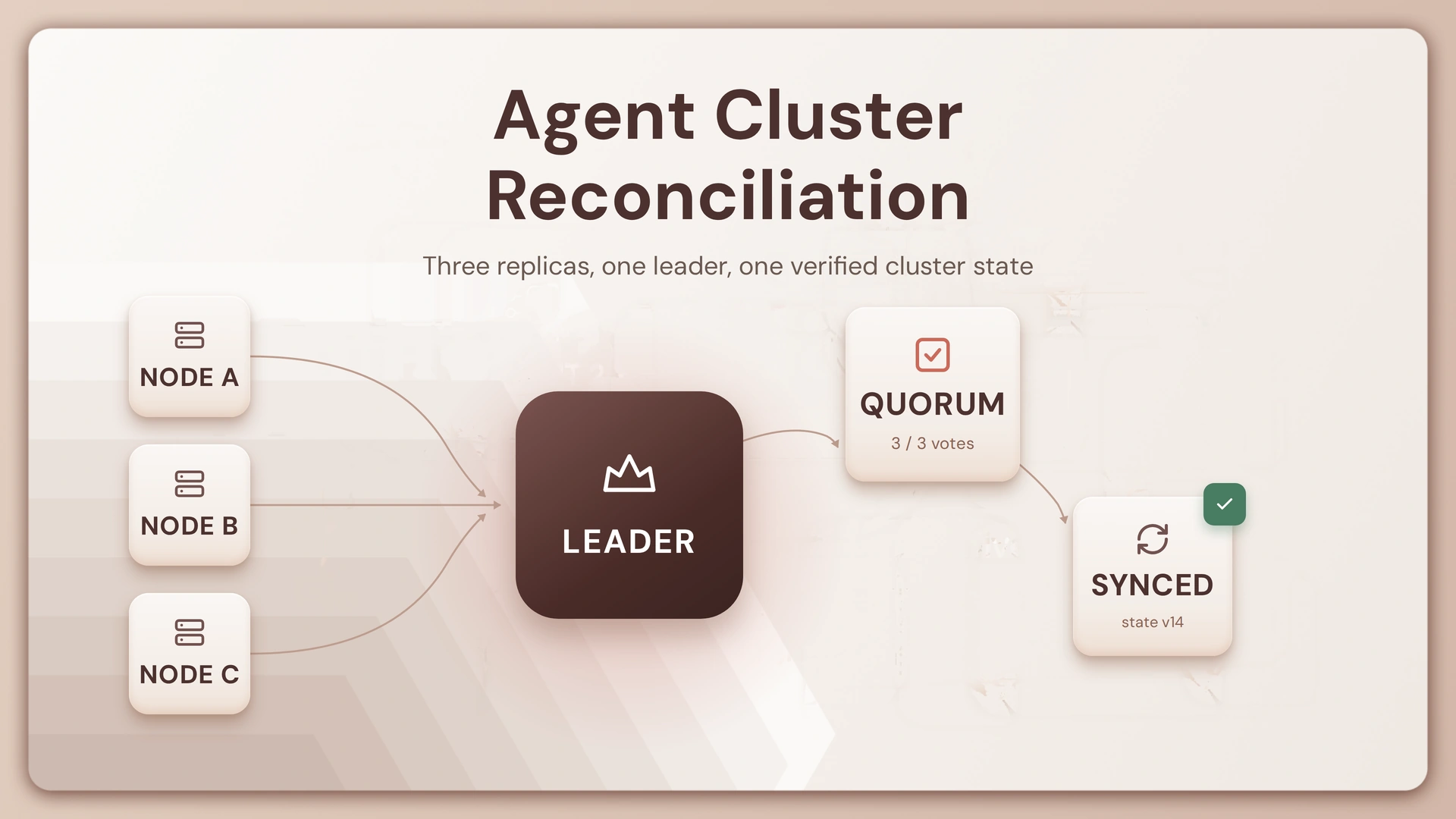
Agent cluster reconciliation is designed to bridge this gap by continuously monitoring what a cluster of AI agents is doing in comparison to the policies they’re supposed to follow and correcting any discrepancies before they escalate into issues.
Key Takeaways
- Agent cluster reconciliation continuously compares what an AI agent cluster is actually doing against the state it was approved for, and corrects any drift automatically. The same control-loop pattern that runs underneath Kubernetes, pointed at AI agents instead of compute nodes.
- The cycle has four stages: desired state (the approved plan), actual state (live behavior), drift (the gap between them), and correction (closing that gap and verifying it actually held, not just logging that it should have).
- It isn’t the same as an agent registry, observability, orchestration, or an LLM/MCP gateway. Each of those answers a narrower question about one agent or one call; reconciliation is the layer that asks whether the whole cluster is still inside policy right now.
- Most drift isn’t malicious; it’s incremental. IBM’s 2026 CxO study found 77% of organizations say AI adoption is already outpacing their governance capabilities, and the average org logged 54 AI agent incidents last year.
- Reconciliation and governance are complementary, not interchangeable: governance sets the rules, reconciliation is the technical loop that checks whether those rules are actually being followed and fixes it when they’re not.
What is agent cluster reconciliation?
Agent cluster reconciliation involves continuously verifying that each agent in a cluster is performing tasks it was authorized for. This is done by comparing its actions, permissions, and outputs against its original policy, flagging any deviations, and maintaining a record robust enough to withstand an audit six months later.
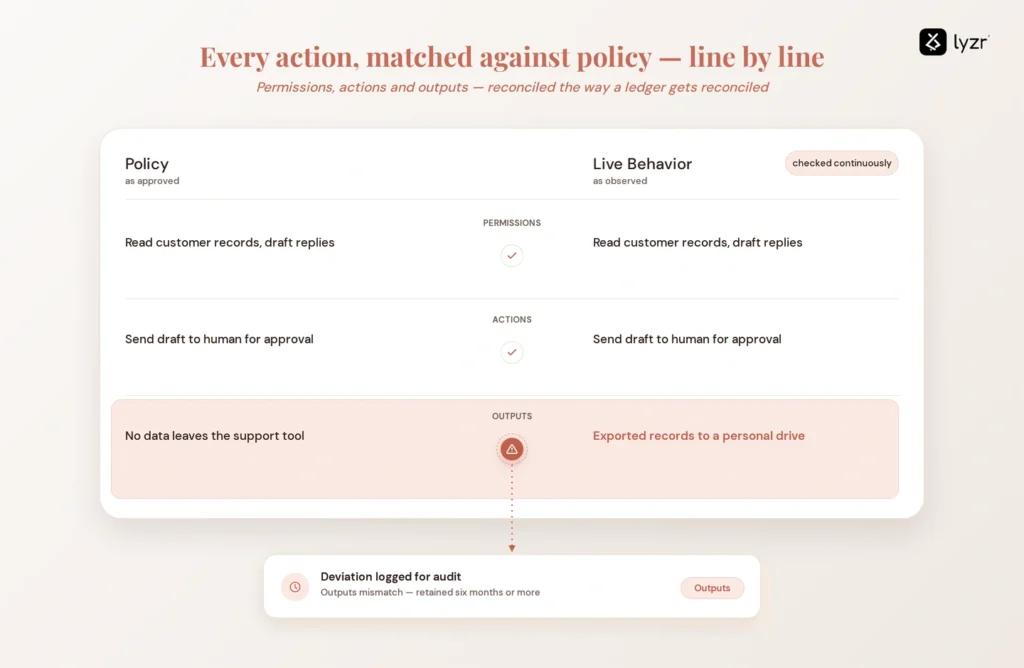
This pattern is not new. It’s the same reconcile loop that powers Kubernetes, where a controller continuously compares the live state of a cluster to a desired configuration and automatically corrects the gap, restarting a crashed pod or scaling replicas back to the number a manifest specifies. Agent cluster reconciliation takes that loop and points it at AI agents, not compute nodes. Same mechanism, different thing being reconciled.
Multi-agent systems research has separately used “reconciliation” for something adjacent: the conflict problem of deciding who owns a shared resource when several autonomous agents can act on it at once. TFSF Ventures calls this “the reconciliation problem in multi-agent systems” and frames it mostly as a protocol design question, leases, event sequencing, and conflict resolution. Agent cluster reconciliation narrows down the question enterprise governance teams actually ask day-to-day: not who owns a disputed write, but whether every agent in the cluster is still inside the state it was approved for.
The reconciliation cycle
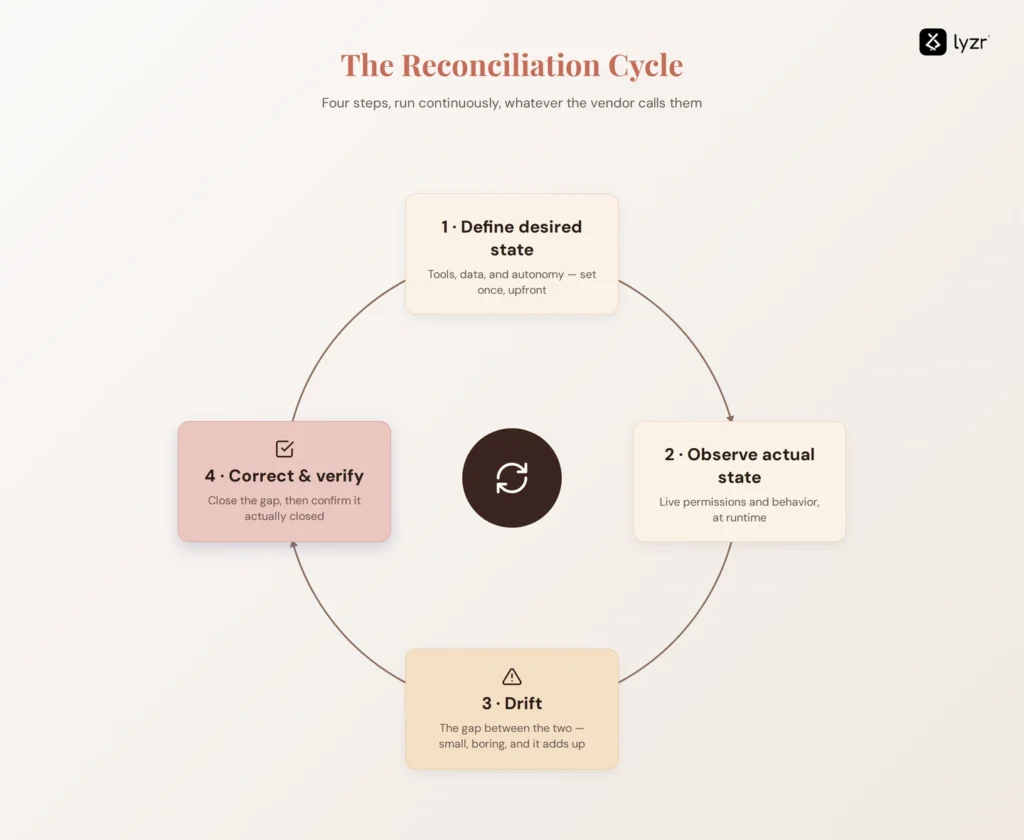
Every working implementation of this process comes down to the same four-part loop, whether the vendor calls it reconciliation, drift correction, or something else entirely.
Defining the desired state
Before an agent ever runs, someone has to decide what it’s actually allowed to do: which tools it can call, what data it can touch, which actions it can take on its own, and which ones need a human to sign off first. That decision gets made once, upfront, by whoever owns that agent’s governance, and it becomes the baseline everything else gets checked against.
Observing the actual state
A log tells you what happened yesterday. Runtime monitoring shows what it is actually doing right now, today, in production: its live permissions, the tools it is really calling, and the data it is really touching. It tracks an agent’s behavior as it happens, at the execution layer, the only place you can catch a deviation early enough to matter.
Drift
Drift is the gap between the two, and it is rarely dramatic. Nobody usually sets out to break the rules. A deployment quietly widens an agent’s access. An integration gets bolted on for one task, and nobody scopes it back down afterward. A permission gets granted temporarily, and nobody remembers to take it away. Small, boring changes, and they add up.
Correction
Correction is closing that gap. Revoke the access that should not be there, roll back the change, block the next action, or bring in a human to decide, then check whether the agent actually landed back where it was supposed to be, not just whether a log says it should have.
That last step is significant. A system that detects drift and stops there has built an alerting tool, not a reconciliation system. Reconciliation is not simply flagging a problem, it is the loop that drives the system back to the state it was supposed to be in and proves that it got there.
Let’s see what that looks like end-to-end with an example. A refund agent is approved to access the order database and the payment system, with one hard rule: no refund over $500 without human sign-off. A routine deployment change, meant to fix something unrelated, quietly grants the agent direct access to the CRM and drops the $500 approval threshold entirely. Nobody flagged it, because nobody happened to be looking at that agent that day. Reconciliation catches this anyway. It detects that the agent’s runtime configuration no longer matches its approved state, identifies exactly which agent and version drifted, revokes the unauthorized CRM access, restores the $500 approval rule, records what changed and when, and verifies the agent is back inside its approved state before moving on. Nobody had to notice. The system did.
Where reconciliation fits: registries, observability, orchestration, and gateways
Agent cluster reconciliation sits inside a stack of adjacent layers, and it gets confused with several of them, partly because vendors in each layer describe themselves using the same governance language. None of them are interchangeable. Here is roughly where each one sits, in the order a cluster actually needs them.
Agent registry is the starting point: an inventory of every agent, who owns it, what version is live, and what it was approved for. Without a registry, nothing below it has anything reliable to check against.
Observability tells you what an agent did after it did it: traces, logs, token counts, and tool calls. A genuinely useful step and passive by design. A dashboard can show that an agent emailed the wrong customer’s data to the wrong recipient, but it cannot stop that email from being sent.
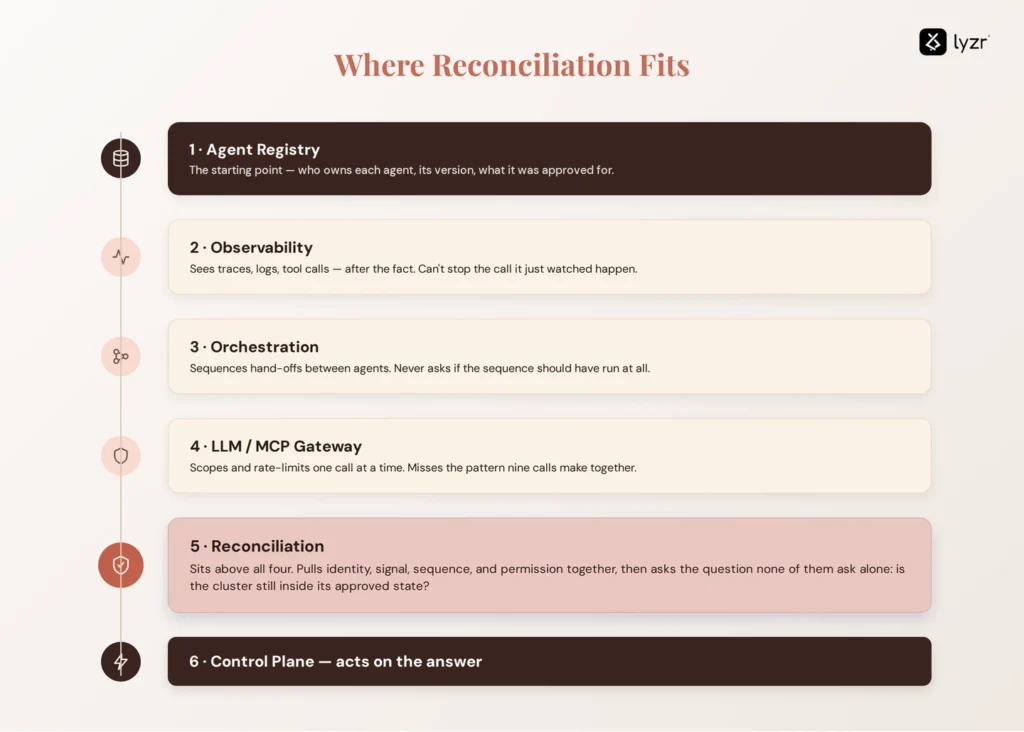
Orchestration decides the order agents work in and how they hand off tasks. It is a sequencing layer, not a policy layer. A pipeline can route a vendor invoice through the right agents every time and still miss that one of them just approved a $50,000 payment that needed two sign-offs and got none. Orchestration got the sequence right; it was never built to ask whether that sequence should have happened at all.
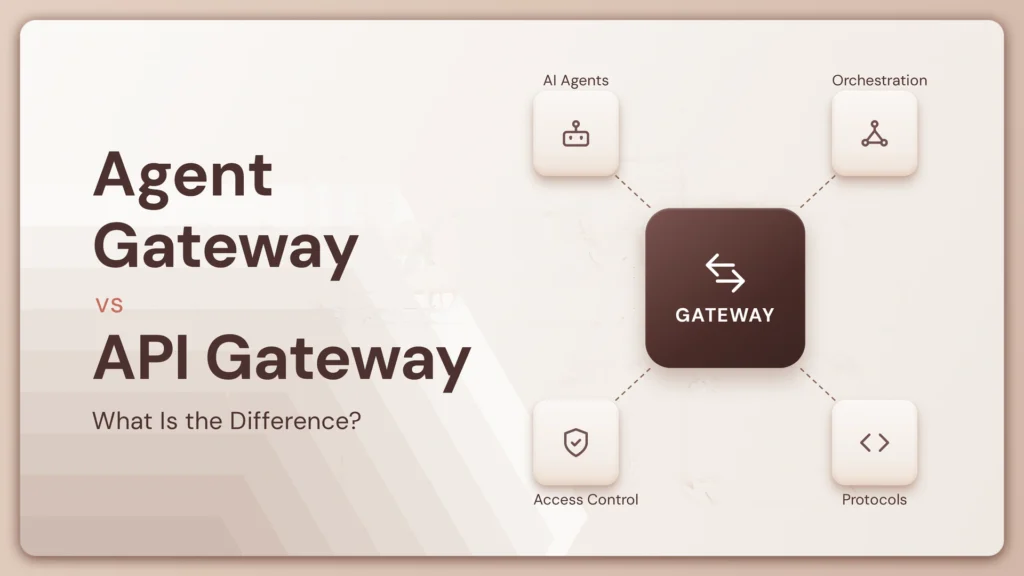
LLM or MCP gateway sits between an agent and one specific resource, a model endpoint or an MCP server, and decides whether a single call gets through. A gateway can enforce scope and even a rate limit, say forty calls an hour to a customer database, and still miss that nine of those calls pulled the exact same record: it counts and scopes calls, not reason about what they add up to. Catching a pattern like that needs something that looks across calls, not a layer built to check them one at a time.
Agent cluster reconciliation sits above all four and does not replace any of them. It pulls identity from the agent registry, signal from observability, respects what orchestration decided, and checks gateway-level permissions, then asks a question none of the others ask on their own.
Taken together, is this cluster still inside the state it was approved for, not just at one call.
A control plane is what acts on the answer. Reconciliation is the judgment; the control plane carries out the correction, like enforcing the block, routing the escalation, revoking the access, and keeping the record. The last section of this piece goes deep on what that looks like in practice.
Why agent clusters drift out of policy
Gartner expects more than 40% of agentic AI projects to be shelved by the end of 2027, and inadequate risk controls are one of three reasons the firm names, alongside runaway costs and unclear return on investment. As per Anushree Verma, Senior Director Analyst, Gartner, most of what is running today is a proof of concept that got promoted into production before anyone built the controls for it. IBM’s 2026 CxO study puts a number on the gap: 77% of organizations say AI adoption is already outpacing their governance capabilities, and 70% say teams across the business are deploying agents faster than IT can track. Drift is the everyday symptom of that gap: an agent quietly operating a little outside its original scope, long before anyone notices it at the board level.
Agents accumulate scope and access faster than reviews can track
An agent ships with three tools and read access to one system. Six weeks later, it has nine tools, write access to two more systems, and nobody scheduled a re-review because nobody scheduled anything. Each change looked reasonable on its own. The sum of them was never reviewed as a whole.
Multi-framework, multi-vendor deployments create blind spots
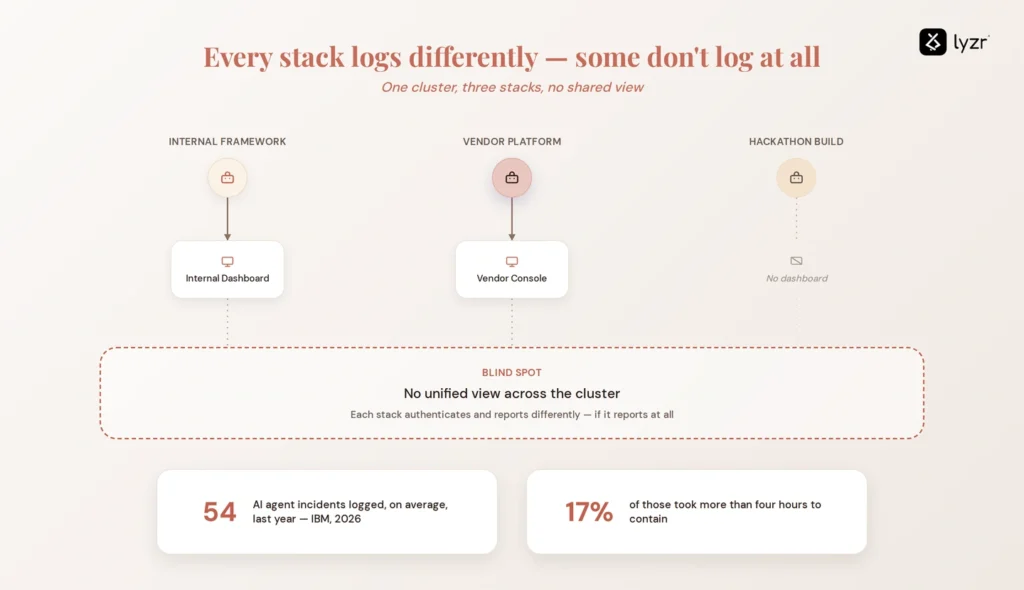
Even a single enterprise agent cluster is rarely built on one stack. Some agents run on an internal framework, some on a vendor platform, some got built fast during a hackathon and never migrated off it. Each one logs and authenticates differently and reports up through a different dashboard, if it reports at all. IBM’s same study found organizations logged an average of 54 AI agent incidents last year, 17% severe enough to take more than four hours to contain.
Most teams do not find out an agent drifted until something breaks: a refund issued twice, a support agent quoting a policy that changed eight weeks ago, an integration quietly pulling data it was never meant to touch.
Agent cluster reconciliation vs. agent governance
It is worth being precise, since the two get used as if they were synonyms.
Governance is the policy layer: the rules and accountability structures that decide what an agent should be allowed to do, usually set by security, compliance, and business stakeholders. Reconciliation is the technical enforcement loop that checks whether those rules are actually being followed in the live system, and corrects it when they are not. Governance without reconciliation is a policy nobody is checking against reality. Reconciliation without governance has nothing to reconcile against. Most of the drift described above happens in the gap between them: the policy existed, but nothing was continuously checking that the running system still matched it.
From periodic audits to continuous reconciliation: How does Lyzr’s OpenController help?
Earlier, the control plane came up as the layer that acts on what reconciliation finds: revoking access, enforcing a block, escalating to a human. Lyzr’s OpenController is that layer, built specifically for continuous agent cluster reconciliation rather than periodic review.
Most organizations start with the version of this that is easiest to build: a quarterly access review, a spreadsheet somebody updates when they remember to, a Slack message where someone flags “did we mean for this agent to do that?” That works for three or four agents. It stops working for a cluster of fifteen or twenty.
OpenController is built for the stage after that, where reconciliation runs continuously instead of on a calendar. It watches the actual behavior of every agent in the cluster against the state it was approved to run in, in real time. As soon as an agent’s behavior starts drifting, whether that is scope creep, an unexpected data access pattern, or an action outside its approved envelope, OpenController flags it immediately, then blocks the action, routes it to a human for approval, or lets it through and logs exactly why, depending on how the policy is configured. Every one of those decisions gets written to an audit trail built to hold up under a compliance review, not just to look tidy in a dashboard.
That is the actual shift agent cluster reconciliation represents: from checking your agent cluster’s behavior every quarter and hoping nothing slipped through to knowing, continuously, that it did not. The gain is not marginal either: IBM’s same 2026 study found organizations embedding continuous control report 25% fewer incidents than those relying on manual, periodic governance. OpenController is designed to reconcile agents regardless of which framework or vendor built them, which matters since the multi-framework blind spot covered earlier is usually where the biggest gaps live, not inside any single agent, but in the space between agents nobody owns end-to-end.
Book a demo of Lyzr’s OpenController and bring your actual agent cluster to the conversation.
FAQ
Agent cluster reconciliation is the continuous practice of comparing an AI agent cluster’s desired state, what it was approved to do, against its actual state, what it’s really doing, and automatically correcting any drift before it becomes a compliance or security problem. It borrows the same control-loop pattern Kubernetes uses for infrastructure, applied to AI agents instead of compute nodes.
No. Observability tells you what an agent did after it did it, through traces, logs, and tool calls, but it doesn’t act on what it finds. Reconciliation goes further: it continuously checks whether the cluster is still inside its approved state and corrects it automatically when it isn’t.
No, the two are complementary. Governance is the policy layer that decides what an agent should be allowed to do. Reconciliation is the technical enforcement loop that checks whether those rules are actually being followed in the live system, and corrects it when they’re not.
OpenController runs reconciliation continuously instead of on a quarterly cycle. It watches every agent’s live behavior against its approved state, flags or blocks drift in real time, and writes every decision to an audit trail, regardless of which framework or vendor built the agent.
Book A Demo: Click Here
Join our Slack: Click Here
Link to our GitHub: Click Here