$1 Billion
A billion-dollar bank rolls out an AI for loan approvals.
It promises faster decisions, fewer errors, better customer experience. Everyone celebrates. Then the first wave of rejections comes in, and it turns out the AI had a bias. It was quietly approving certain demographics at a higher rate and rejecting others. The developers who trained it missed it. The executives who signed off missed it. The regulators reviewing the deployment missed it. By the time the pattern surfaced, thousands of applications had already been processed.
This isn’t one bank. AI hiring tools have been caught favoring specific genders. Medical AI has overlooked life-threatening conditions in underrepresented populations. Customer-facing chatbots have confidently spread misinformation to millions of users. And here’s the part that should make you pause: roughly half of enterprises say they’re worried about AI privacy and governance, but only a tiny fraction have actually implemented full safeguards.
We’re trusting AI to make decisions that impact human lives, while we’re barely controlling how it makes them.
This is what responsible AI is for. It’s the operational discipline of making AI fair, accountable, transparent, and safe enough to be trusted with consequential decisions. In 2026, with autonomous AI agents now taking actions instead of just producing text, the stakes are higher than they’ve ever been.
What is responsible AI?
Responsible AI is the practice of designing, developing, and deploying AI systems so they are fair, transparent, accountable, safe, and respectful of privacy. It’s the discipline that sits between “we built an AI” and “we trust this AI to operate in production.”
That definition is the textbook version. The practical version sounds more like this: responsible AI is what stops the loan-approval scandal from happening to your company.
A useful distinction worth getting straight upfront: people sometimes use “responsible AI” and “ethical AI” interchangeably, but the two terms point at different things. Ethical AI is the philosophical layer (what should AI do, what values should it respect, what kinds of decisions should it make). Responsible AI is the tactical layer (how do we actually build, deploy, audit, and govern AI systems so they reflect those values in production). Ethical AI is about principles. Responsible AI is about implementation. You need both. Most enterprises spend too much time on the first and not enough on the second.
There’s also AI governance, which is the institutional layer (the policies, accountability structures, and oversight mechanisms that ensure responsible AI is being practiced consistently across an organization). For the broader definitional terrain, see the AI governance glossary and the AI bias glossary.
The six principles of responsible AI
Across Microsoft, AWS, Google, Anthropic, IBM, and most major frameworks, the same six principles show up. Different organizations name them slightly differently, but the substance is consistent. This is the foundation any responsible AI practice has to address.
1. Fairness. AI systems should treat people equitably and avoid discrimination based on protected characteristics like race, gender, age, religion, or socioeconomic status. In practice, this means actively testing for bias in training data, in model outputs, and in real-world deployment outcomes. It’s the principle the billion-dollar bank failed at.
2. Reliability and safety. AI systems should perform consistently and safely under expected conditions, and degrade gracefully under unexpected ones. This includes handling edge cases without producing harmful outputs, defending against adversarial manipulation, and maintaining performance over time as data distributions shift.
3. Privacy and security. AI systems should protect personal information at every stage: collection, training, inference, logging. They should defend against data leakage (where the model regurgitates training data) and against extraction attacks (where adversaries probe the model to reveal sensitive information). This is the principle that pulls in everything from GDPR compliance to model-level differential privacy.
4. Inclusiveness. AI systems should work for diverse populations and use cases, not just the ones that dominated the training data. This means designing for accessibility, testing across demographic groups, and accounting for languages and contexts that are often underrepresented in AI development.
5. Transparency. Users and stakeholders should be able to understand how an AI system makes its decisions, when AI is being used, and what its limitations are. In practice, this includes model interpretability tools, decision logging, user-facing AI disclosures, and clear documentation of intended use cases.
6. Accountability. Humans, not algorithms, are responsible for AI outcomes. This means clear ownership of AI systems, oversight mechanisms that allow human intervention, audit trails that support post-hoc review, and governance structures that assign responsibility for failures.
These six principles are the consensus framework. Different organizations layer additional principles on top (Microsoft adds “controllability,” AWS adds “veracity and robustness,” Anthropic emphasizes “honesty”), but the core six are the foundation.
The trap most enterprises fall into is treating these as ethical aspirations rather than engineering requirements. The companies that operationalize responsible AI well treat each principle as something with measurable indicators, testing protocols, and accountable owners. The ones that struggle treat them as a slide in a presentation.

What does it mean for Developers?
For developers, Safe and Responsible AI means building systems that are fair, transparent, and accountable. To implement responsible AI, developers must follow key steps including:

- Follow ethical guidelines tailored to AI projects.
- Mitigate bias using tools to detect and reduce unfair outcomes.
- Ensure transparency with interpretability tools.
- Run regular audits to check compliance and address ethical risks.
- Engage stakeholders from legal, ethics, and community domains for diverse input.
Why responsible AI matters more than ever in 2026?

The case for responsible AI used to be mostly about reputation: you didn’t want your AI hiring system on the front page of the Wall Street Journal for the wrong reasons. That case is still true. But three things have changed since 2023, and each one raises the stakes considerably.
The first change: AI agents take actions, not just answers. A chatbot producing a biased response is one problem. An autonomous AI agent executing a biased decision (approving or rejecting loans, screening candidates, processing claims, routing customer escalations) is a categorically different problem. The blast radius of a single bad output is dramatically larger when the AI takes the action instead of suggesting it. Responsible AI is no longer just about output quality. It’s about action governance.
The second change: incidents are accelerating. The AI Incident Database tracks ethical misuse and harm cases. The trendline isn’t subtle. Reported AI incidents have climbed steadily every year since 2013, with year-over-year increases in the 30-40% range as AI deployments have multiplied. Some of that reflects better tracking, but most reflects more deployments going wrong. Every one of those incidents is a story about responsible AI being skipped, underfunded, or applied too late.
The third change: regulation is now real. The EU AI Act is in force. Risk-based AI regulations are being adopted across major economies. Industry-specific rules (in banking, insurance, healthcare, government, education) increasingly require demonstrated responsible AI practices. The compliance cost of getting this wrong is no longer hypothetical. For organizations operating across jurisdictions, see how this connects to AI agent risk management and the broader regulatory landscape.
There’s also a quieter but real fourth change worth naming: trust has become a competitive moat. Customers, employees, and partners increasingly choose to work with organizations whose AI practices they trust. For enterprise patterns on how this is playing out, see the State of AI Agents 2026 report.

The risks of unchecked AI in 2026
If the six principles are the framework, here’s what failing to apply them actually looks like in production. The risk landscape has expanded considerably since 2023, with several new categories of risk emerging specifically from autonomous agent deployments.
Bias and unfair outcomes. The classic risk and still the most common. AI systems can amplify biases present in training data, producing systematically different outcomes for different demographic groups. This shows up in lending, hiring, healthcare diagnostics, criminal justice tools, and increasingly in agent-driven customer service decisions. See the AI bias glossary for the detailed mechanics.
Privacy leakage. Models trained on sensitive data can leak that data through their outputs, sometimes verbatim. This is a particular concern for foundation models trained on internet-scale data that may include personal information, copyrighted material, or proprietary content. Enterprise deployments need to consider both what the model was trained on and what it has access to in production.
Adversarial manipulation. AI systems can be tricked into producing harmful, biased, or off-policy outputs by carefully crafted inputs. This is now a serious enterprise concern, not a research curiosity.
Hallucinations. Generative AI confidently produces information that is plausible but false. In a chatbot context this is a credibility risk. In an agent context (where the AI is taking actions based on its hallucinated information) this becomes an operational risk. Lyzr’s Hallucination Manager is built specifically to bound this failure mode.
Prompt injection. A category of adversarial attack where malicious inputs override an AI system’s instructions. The classic case: a user typing “ignore previous instructions” into a chatbot. The 2026 version is much more sophisticated, with indirect injection attacks embedded in documents, emails, and web pages that AI agents process. Lyzr’s research team published AgentDefender, a benchmark evaluation and neural embedding approach for detecting agent prompt injection attacks. See the broader context in our prompt engineering guide.
Agent autonomy risks. The newest category, and the one that’s growing fastest. When an AI agent has the authority to take actions (send emails, approve transactions, update records, escalate to humans), the consequences of failure scale with the agent’s authority. Responsible AI for agents requires explicit bounds on what the agent is allowed to do, who authorized it, and what audit trail exists.
Cyberattack assistance. As large language models grow more capable, they can be misused for spear-phishing, social engineering, malware generation, and other adversarial work. Closed-source models from OpenAI, Anthropic, and Google undergo internal safety testing, but open-source models often lack standardized evaluation, and enterprise deployments need to think about this for any externally-facing AI surface.
How responsible AI is measured: benchmarks
You can’t manage what you don’t measure. The 2020s have produced a growing set of benchmarks specifically for responsible AI evaluation, separate from the capability benchmarks that measure raw model performance.
TruthfulQA. Evaluates how accurately a model responds to questions where the most natural answer is a common misconception. Useful for measuring hallucination and misinformation tendencies.
RealToxicityPrompts and ToxiGen. Measure the extent to which a model produces toxic, harmful, or biased language when prompted with adversarial inputs.
BOLD and BBQ. Analyze biases in AI outputs across demographic groups. BOLD focuses on open-ended generation; BBQ focuses on multiple-choice question-answering scenarios that probe for stereotyping.
HELM (Holistic Evaluation of Language Models). Stanford’s framework that evaluates models across multiple dimensions including fairness, robustness, and bias alongside capability.
AgentDefender. Lyzr’s own benchmark for evaluating prompt injection defenses in AI agent systems.
These benchmarks are increasingly required in enterprise AI procurement processes. Vendors are expected to report performance not just on capability benchmarks (MMLU, GPQA, GSM8K) but on responsible AI benchmarks too. For an enterprise evaluating AI platforms, asking “how does your system score on TruthfulQA and BOLD” is now a standard due-diligence question.


How leading companies approach responsible AI
The 2026 industry consensus is converging on a similar core framework with vendor-specific implementations. Here’s a refreshed view of how major players approach it.
| Company | Key focus areas | Notable framework |
|---|---|---|
| Microsoft | Fairness, reliability and safety, privacy and security, inclusiveness, transparency, accountability | The Microsoft Responsible AI Standard, the most widely adopted six-principle framework |
| AWS | Fairness, explainability, privacy and security, safety, controllability, veracity and robustness | The AWS Responsible AI dimensions, with strong tooling integration in Bedrock and SageMaker |
| Fairness, accountability, transparency, privacy, safety | Google’s AI Principles plus the Responsible AI Toolkit | |
| Anthropic | Helpfulness, harmlessness, honesty (the “HHH” framing) | Constitutional AI methodology |
| OpenAI | Usage restrictions, AI disclosure requirements, ban on impersonation, sensitive-domain controls | OpenAI usage policies enforced at the API level |
| Salesforce | Accuracy, safety, honesty, empowerment, sustainability | The five guidelines for responsible generative AI |
| Meta | Privacy and security, fairness and inclusion, robustness and safety, transparency and control, accountability and governance | The Responsible AI (RAI) framework |
| Lyzr | Transparency, security, fairness, hallucination bounds, prompt injection defense, agent governance | The Lyzr Agent Control Plane, with Responsible AI as a Service, Hallucination Manager, and AgentDefender |
Two observations worth pulling out from the comparison. First, the principles are converging across vendors, with minor naming differences. Second, the differentiation is now in the implementation tooling and the enterprise integration. Anyone can publish principles. Far fewer can ship the engineering infrastructure that operationalizes them at production scale.
1. Lyzr.ai’s Commitment to Responsible AI
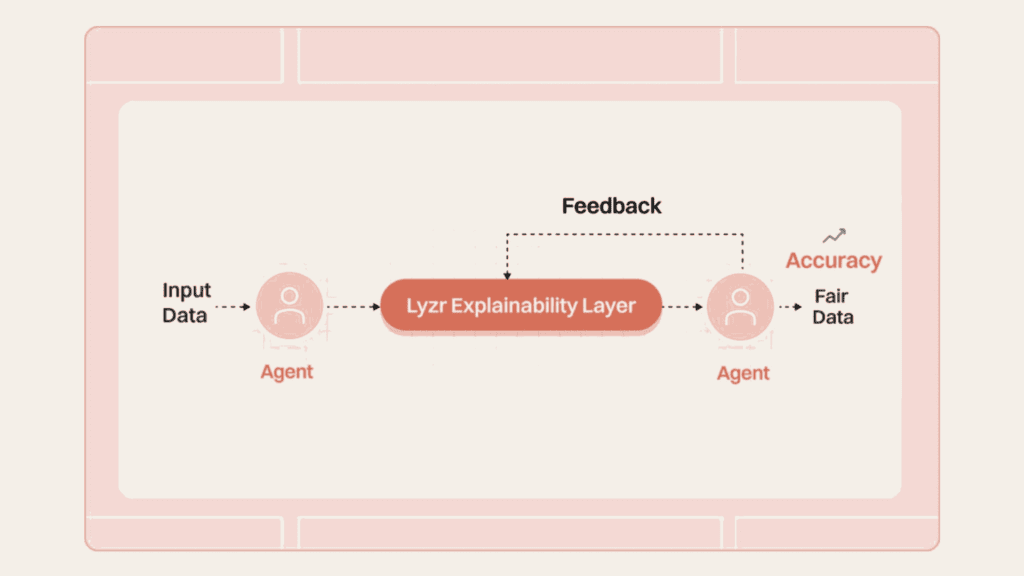
Lyzr.ai is dedicated to building AI agents that prioritize safety, accountability, and transparency. By integrating responsible AI principles into development, Lyzr ensures that AI agents are reliable, ethical, and aligned with enterprise needs.
Key initiatives:
- AI Decision Logs – Maintain transparency by tracking AI decision-making.
- Enterprise-Grade Security – Implement strong compliance measures to safeguard data.
- Bias Detection & Mitigation – Continuously monitor and refine AI models to reduce bias.
- Human-in-the-Loop Oversight – Allow for manual review and intervention when needed.
- Usage Governance & Compliance – Ensure AI is used responsibly across all enterprise applications.
2. Facebook’s Five Pillars of Responsible AI
Facebook applies AI across various functions, from managing News Feeds to combating misinformation. Its Responsible AI (RAI) team collaborates with external experts and regulators to develop AI responsibly.
RAI Framework:
- Privacy & Security – Protecting user data and ensuring secure AI interactions.
- Fairness & Inclusion – Reducing bias and ensuring AI serves diverse communities.
- Robustness & Safety – Making AI systems resilient to errors and misuse.
- Transparency & Control – Providing users with visibility and control over AI decisions.
- Accountability & Governance – Establishing oversight mechanisms for ethical AI deployment.
3. OpenAI’s ChatGPT Usage Policies
OpenAI enforces strict policies to guide ethical AI use, including:
- Responsible Deployment – Ensuring AI is used ethically across industries.
- Usage Restrictions – Prohibiting applications in sensitive areas like law enforcement and medical diagnostics.
- AI Disclosure – Requiring transparency when AI is used in financial, legal, and healthcare-related products.
- Explicit Consent – Mandating user approval for AI-generated real-person simulations.
4. Salesforce’s Five Guidelines for Generative AI
Salesforce emphasizes responsible AI development through five core principles:
- Accuracy – Ensuring verifiable results, using customer data for training, and clearly communicating uncertainties.
- Safety – Minimizing bias, toxicity, and harmful outputs while protecting personal data.
- Honesty – Respecting data provenance, ensuring consent, and maintaining transparency in AI-generated content.
Adopting AI Responsibly: The Data Governance Gap
The Global State of Responsible AI Survey results from the past two years tell a consistent and uncomfortable story. About half of enterprises identify privacy and data governance as critical AI risks. Adoption of safeguards varies sharply by region (Europe and Asia lead at roughly 55-56% awareness, North America trails at around 42%).
But awareness is not implementation. The survey identifies six key data governance measures (regulatory compliance, user consent management, regular audits, bias monitoring, data minimization, access controls). The implementation gap is striking:
- Around 90% of organizations have implemented at least one of the six measures
- Fewer than 1% have fully implemented all six
- About 10% have implemented none
- The average organization has adopted roughly 2.2 of the 6 measures
In other words, almost everyone has started, almost no one has finished, and most organizations are stuck in partial implementation. This is the gap that responsible AI work needs to close.
The data governance gap matters because it’s the place where good intentions meet operational reality. The principles are easy to publish. The investment in implementation is harder. The teams that close this gap typically do so by treating responsible AI as engineering infrastructure rather than policy documentation.

How to implement responsible AI: a six-step framework
For organizations moving from “we should do responsible AI” to “we actually do responsible AI,” the six steps below cover the operational ground.
Step 1. Establish AI governance ownership. Pick an accountable executive (Head of AI, Chief AI Officer, Chief Risk Officer, depending on the organization), a working committee with representation from legal, engineering, product, and the business, and a clear decision-making process. Without ownership, every responsible AI initiative dies in committee.
Step 2. Inventory your AI deployments. Most enterprises don’t actually know what AI they’re running, where it lives, what data it touches, or what authority it has. Step one of governance is visibility. Build the inventory. Update it quarterly.
Step 3. Apply the six principles to each deployment. For every AI deployment in your inventory, walk the six principles: fairness, reliability and safety, privacy and security, inclusiveness, transparency, accountability. Document what’s in place, what’s missing, and what the gap closure plan is.
Step 4. Implement the engineering primitives. Audit logging. Permission enforcement. Hallucination control. Output validation. Bias monitoring. Prompt injection defense. These are engineering systems, not policies. The teams that get responsible AI right build the infrastructure. The ones that don’t, write the policy and hope.
Step 5. Measure and benchmark. Standardize on responsible AI benchmarks (TruthfulQA, RealToxicityPrompts, BOLD, BBQ, plus agent-specific benchmarks like AgentDefender). Report results to the governance committee on a regular cadence. Set thresholds for what’s acceptable to deploy.
Step 6. Train and communicate. Responsible AI competency has to live across the organization, not just in the governance committee. Train developers, product teams, business owners, and end users. Communicate the principles, the practices, and the reasons.
This six-step framework is not exhaustive, but it covers the operational ground that most enterprises miss. The framework that companies actually use in practice is some version of this, regardless of the specific vendor language.
For the broader production discipline behind step 4, see how to take AI agents to production.
Where responsible AI is heading
Three shifts are reshaping the field as we move through 2026.
The first shift: from principles to engineering. The principles phase is largely settled. The frameworks have converged. What’s emerging now is the engineering discipline: the tools, infrastructure, and operational practices that actually deliver on the principles in production. This is where the next decade of work happens.
The second shift: from model-level to system-level responsibility. Early responsible AI focused on the model: train it without bias, evaluate it on fairness benchmarks, ship it with usage guidelines. The 2026 conversation has moved upstream to the full system: model plus memory plus knowledge plus orchestration plus governance plus deployment context. System-level responsibility is harder than model-level responsibility, and it’s where the real risks live.
The third shift: from voluntary to required. Through 2024, most responsible AI work was voluntary. By 2026, regulatory frameworks (EU AI Act, sector-specific rules, state-level laws in the US) have made significant portions of it mandatory. The voluntary phase is ending. The compliance phase is starting.
None of these shifts make responsible AI obsolete. They embed it deeper into the way enterprises build, deploy, and operate AI systems. Teams that develop competency now will be the ones operating credibly in 2027 and beyond.
Start with Lyzr: The Reliable Way to Build Safe & Responsible Workflows
The integration of Safe AI and Responsible AI modules, which emphasize responsible AI practices, brings several benefits to enterprises:
Trustworthy AI ensures that the Lyzr Agent Framework produces safe and reliable outputs, adhering to principles that prevent issues like bias and discrimination.
1. Enhanced Reliability
By embedding modules like reflection and groundedness, the framework ensures that outputs are factual, contextually relevant, and aligned with organizational goals.
2. Improved Safety
Safe AI features like toxicity control and PII redaction minimize risks associated with harmful or inappropriate content, safeguarding organizational reputation.
3. Scalability Across Workflows
The hybrid workflow orchestration model enables the framework to handle diverse and complex workflows, making it suitable for various enterprise functions.

4. Ethical AI and Fair Operations
Bias detection and fairness modules ensure that AI outputs are equitable, which is critical for industries like finance and healthcare.

5. Enterprise-Grade Deployment of AI Systems
The framework supports deployment on an organization’s cloud or on-premise environment, ensuring complete data privacy and sovereignty.

Where to go from here
If you’re building responsible AI capability:
- Responsible AI as a Service, the Lyzr platform module that operationalizes the principles
- Hallucination Manager, the trust primitive for bounding agent hallucinations
- How to take AI agents to production, the operational discipline
If you’re researching the technical foundations:
- AgentDefender paper, Lyzr’s research on agent prompt injection defense
- State of AI Agents 2026 report, enterprise data on agent deployment patterns
- AI agent risk management glossary
If you’re applying responsible AI to specific industries:
- Banking Playbook for regulated financial services
- Insurance agents (Benjie) for regulated insurance workflows
- Healthcare agents for HIPAA-context deployments
- Government deployments for public sector AI
If you’re evaluating vendor approaches:
If you want to talk to our team:
Book a demo to see Lyzr’s responsible AI infrastructure in action
Frequently asked questions
What is responsible AI?
Responsible AI is the practice of designing, developing, and deploying AI systems so they are fair, transparent, accountable, safe, and respectful of privacy. It includes the technical engineering work (bias detection, hallucination control, prompt injection defense, audit logging) and the governance work (policies, accountability structures, oversight processes) that ensure AI systems behave responsibly in production.
What are the principles of responsible AI?
The six consensus principles across major frameworks are: fairness, reliability and safety, privacy and security, inclusiveness, transparency, and accountability. Some frameworks add additional principles (controllability, explainability, honesty) but the core six are the foundation.
How is responsible AI different from ethical AI?
Ethical AI is the philosophical layer (what should AI do, what values should it respect). Responsible AI is the tactical implementation layer (how do we actually build and deploy AI so it reflects those values). Ethical AI is about principles; responsible AI is about engineering and governance. You need both.
What’s the difference between responsible AI and AI governance?
AI governance is the institutional layer: the policies, accountability structures, decision-making processes, and oversight mechanisms that ensure responsible AI is being practiced consistently. Responsible AI is the broader discipline; AI governance is the organizational structure that supports it.
How do you implement responsible AI?
The practical six-step framework: establish governance ownership, inventory your AI deployments, apply the six principles to each deployment, implement the engineering primitives (audit logging, permission enforcement, hallucination control, output validation, bias monitoring, prompt injection defense), measure and benchmark, then train and communicate across the organization.
What are the main risks of unchecked AI?
The major risk categories are bias and unfair outcomes, privacy leakage, adversarial manipulation, hallucinations, prompt injection, agent autonomy risks (when an AI agent takes actions beyond its authority), and cyberattack misuse. The risk landscape has expanded considerably since 2023, with new categories emerging specifically from autonomous agent deployments.
Is responsible AI mandatory?
Increasingly, yes. The EU AI Act is in force as of 2026 with risk-based AI regulations. Sector-specific rules in banking, insurance, healthcare, education, and government require demonstrated responsible AI practices. State-level laws in the US (California, Colorado, others) impose AI-specific requirements. The voluntary phase of responsible AI is ending.
How does responsible AI apply to AI agents specifically?
Responsible AI for AI agents is a harder discipline than responsible AI for chatbots, because agents take actions rather than just producing text. It requires explicit primitives for blast radius management, audit trails for agent reasoning chains, permission enforcement at the tool level, hallucination control before actions are taken, and prompt injection defense for adversarial inputs in agent contexts.
What benchmarks measure responsible AI?
The main ones are TruthfulQA (hallucination), RealToxicityPrompts and ToxiGen (toxicity), BOLD and BBQ (bias), HELM (holistic evaluation), and AgentDefender (prompt injection defense for AI agents). Enterprise procurement increasingly requires vendors to report performance on responsible AI benchmarks alongside capability benchmarks.
How does Lyzr handle responsible AI?
Lyzr implements responsible AI through five architectural primitives that work together as a production trust stack: Agent Studio (reasoning engine with built-in permission and governance), Cognis (memory layer with data governance), Knowledge Base and Knowledge Graph (retrieval with source attribution and audit trails), Orchestration as a Service (multi-agent governance), and Responsible AI as a Service plus Hallucination Manager (the trust layer including AgentDefender for prompt injection defense).
Book A Demo: Click Here
Join our Slack: Click Here
Link to our GitHub: Click Here