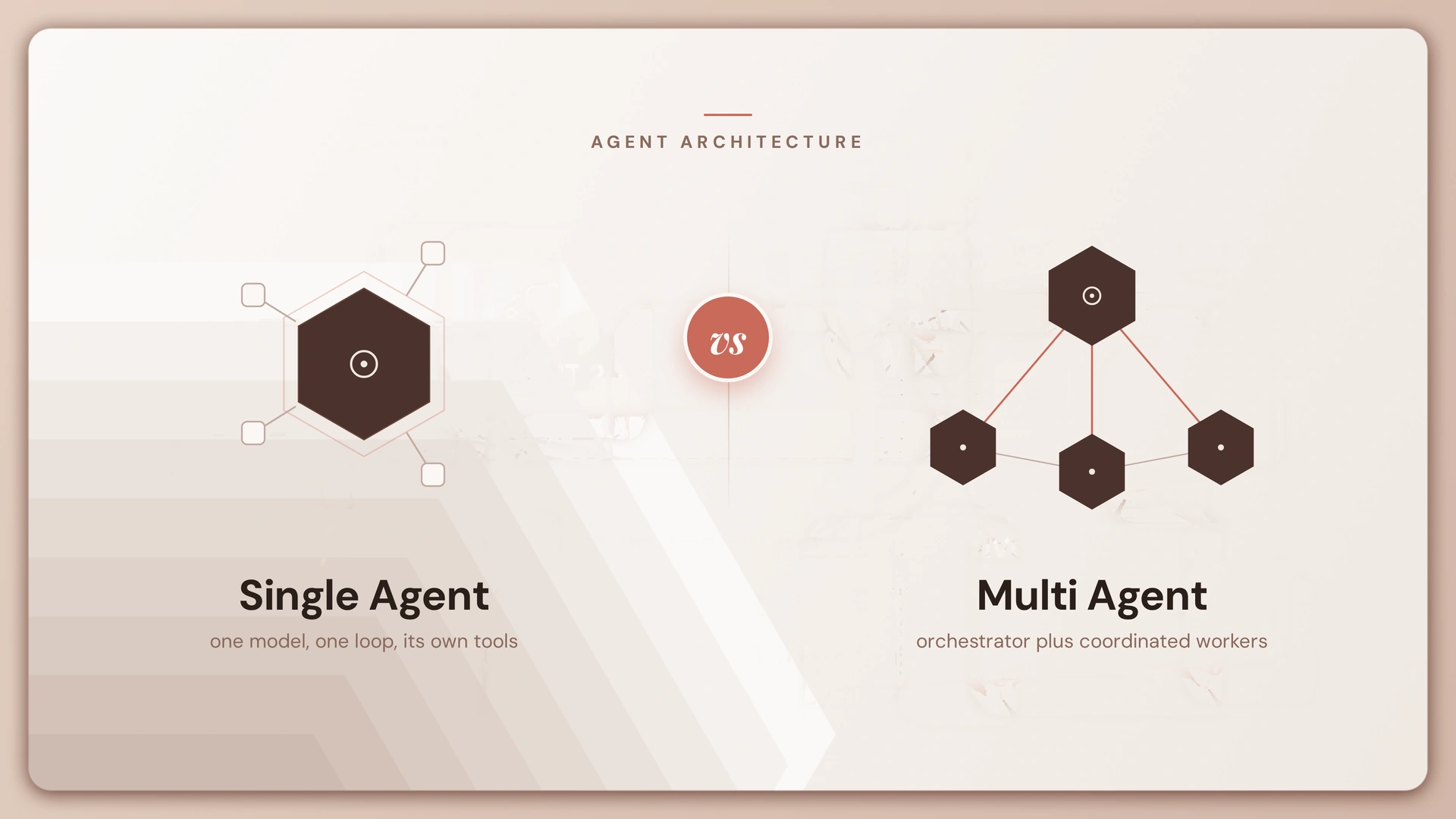
Multi-agent vs single-agent is not a question with one right answer. Neither architecture is universally better: single agents are faster, cheaper, and easier to debug, while multi-agent systems earn their overhead only on problems that are genuinely parallel, multi-role, or too large for one context window.
That verdict runs against a lot of what got published when “add more agents” became the default advice for any workflow that felt too complex for one prompt. The pattern breaks in production more often than it holds. A deeper look at multi-agent architecture shows why: coordination has a cost, and that cost compounds with every agent you add.
This guide is not a pitch for one side. It is a framework for deciding, built on what actually happens when these systems run at scale, not on what a demo video shows.
Single-agent vs multi-agent at a glance
The table below is the fastest way to see the trade-off. Read it before you read anything else in this guide.
Single-agent vs multi-agent architecture comparison
| Dimension | Single-agent system | Multi-agent system |
|---|---|---|
| Architecture | One LLM-driven agent, with or without tools, executing a task end to end | Two or more agents that communicate, hand off, or work in parallel toward a shared goal |
| Cost | Low. One reasoning chain, minimal redundant calls | High. Coordination messages, context duplication, and role overhead multiply LLM calls |
| Latency | Low to moderate. Sequential but direct | Higher. Agents wait on each other, verify each other, and sometimes loop |
| Reliability | One point of failure, but that point is easy to isolate | Errors from one agent can propagate to others before anyone catches them |
| Debuggability | Simple. One trace, one decision path | Hard. Failures hide inside inter-agent handoffs and shared state |
| Control | High. Deterministic, easy to constrain | Lower. Behavior emerges from agent interaction, harder to predict |
| Scalability | Scales by running more parallel instances of the same agent | Scales by adding roles, but each addition adds coordination surface |
| Best fit | Linear workflows, single-domain tasks, tool-augmented automation | Genuinely parallel work, distinct expert roles, tasks exceeding one context window |
What is a single-agent system?
A single-agent system is one LLM-driven agent that perceives an input, reasons over it, and acts, on its own, without handing work to another agent. It might call a tool, query a database, or write a response, but one process owns the whole task from start to finish.
The strengths are structural, not incidental. A single agent runs one reasoning chain, so cost stays close to the price of the underlying model calls. There is no coordination layer to build, monitor, or fail. Autonomy also makes management simpler: the agent operates independently without waiting on input from other processes, which is exactly why it is the easier system to reason about when something goes wrong.
The honest limits show up as the task grows. A single agent starts to struggle when faced with layered workflows or multiple goals running at once, because one reasoning chain can only hold one thread of intent at a time. Context is the other ceiling. An LLM agent is bound by its context window, and a document, dataset, or conversation that exceeds it forces the agent to summarize, truncate, or lose detail it may need later. And because there is only one agent, a failure it cannot self-correct stops the entire task, the same way an agent that routes IT helpdesk tickets works well until the ticket format changes and nobody told it.
What is a multi-agent system?
Think of a multi-agent AI system as a team, not a solo act: multiple agents, each with a defined role, communicating to solve a problem no single one of them could finish alone. A researcher agent gathers information, a critic agent checks it, a writer agent drafts the output, and an orchestrator decides who goes next.
The strengths are real when the problem actually fits the shape. When multiple specialized agents work together, you are not stacking capability, you are unlocking parallel throughput on tasks that can genuinely be split. Specialization lets each agent carry a narrower, better-defined job, which improves output quality on complex, multi-step problems. Need more throughput? Just add more agents without rebuilding the whole system, a genuine advantage over a single agent that has to be re-architected for scale. For patterns on how these roles get structured in practice, orchestrator-worker, debate, hierarchical, the multi-agent architecture guide covers the common designs.
The honest limits are the part most pitches skip. Every message between agents is an LLM call, so cost and latency climb with headcount, not with task difficulty. An error from one agent can be accepted as fact by the next, and by the time it reaches the output, nobody can say which agent introduced it. Emergent behavior, the system doing something none of its designers explicitly programmed, is common enough that governance becomes a requirement, not an afterthought.

The middle ground most teams miss: a single agent with tools
Before reaching for a second agent, give the first one better tools. A single agent wired to a code interpreter, a search API, a database, or internal business logic can handle far more than a bare prompt-and-response loop, and it does it without adding a single coordination problem.
This pattern, often built as a ReAct-style reasoning-and-acting loop, lets one agent look up a customer record, query payroll systems, run a calculation, and synthesize a natural-language answer, all in one continuous trace. It is still a single-agent system in every way that matters: one reasoning chain, one cost profile, one thing to debug when it breaks.
Most workflows that teams assume need a multi-agent rebuild actually need a better toolkit. The jump to multiple agents is worth making only after this ceiling is genuinely tested, not before.
Is multi-agent actually better? A reality check
No, not by default, and the most-cited research on this question backs that up directly. Multi-agent systems win on a narrow set of problems and lose everywhere else, because coordination is expensive in ways that rarely show up in a demo.
UC Berkeley’s MAST taxonomy was developed through rigorous analysis of 150 hand-annotated execution traces, guided by expert human annotators and validated by strong inter-annotator agreement. Researchers then scaled that analysis to over 1,600 execution traces across 7 popular multi-agent frameworks including CrewAI, AutoGen, MetaGPT, LangGraph, and AG2, sorting what they found into 14 unique failure modes clustered into three categories: system design issues, inter-agent misalignment, and task verification. The researchers’ own framing is blunt: “performance gains on popular benchmarks are often minimal”, a gap that highlights a critical need for a principled understanding of why these systems fail in the first place.
Cognition’s widely shared “Don’t Build Multi-Agents” post makes the coordination failure concrete with a Flappy Bird example. Tasked with building a game clone, one subagent mistook its subtask and built a background that looked like Super Mario Bros, while the second built a bird that didn’t resemble a proper game asset and moved nothing like the original. The final agent was “left with the undesirable task of combining these two miscommunications”, a failure Cognition attributes to isolated agents making conflicting implicit decisions rather than any single model limitation.
Anthropic’s own numbers show the other side of the same coin. Their multi-agent research system, running Claude Opus 4 as a lead agent over Claude Sonnet 4 subagents, beat single-agent Claude Opus 4 by 90.2% on their internal research evaluation. But that gain has a price: the cost was roughly 15 times the tokens of a normal chat interaction. That cost is only worth paying because, per Anthropic’s own analysis, “token usage alone explains 80% of performance variance in their BrowseComp evaluation”, meaning the win comes from allocating far more computation to problems that genuinely need it, not from agents being inherently smarter together.
Put those three sources side by side and the pattern is consistent: coordination overhead is real and it scales with agent count, errors propagate faster than any single agent can catch them, and debugging a distributed failure across an agent framework takes far longer than tracing one reasoning chain. Multi-agent wins when the task is genuinely parallel, genuinely multi-role, or genuinely too large for one context window. It loses, reliably, when a single agent with the right tools would have done the job at a fraction of the cost.
When to choose single vs multi: a decision checklist
Work through these questions in order. Stop at the first “yes” and build for that answer.
- Can one agent finish the task in a single continuous reasoning chain? Build a single agent. This covers the majority of business automation.
- Does the task need external data or actions, but not another perspective? Add tools to your single agent. Do not add a second agent for this.
- Does the task exceed one LLM’s context window on its own? This is a legitimate reason to decompose the work across agents with an orchestrator managing the split.
- Can the work be split into genuinely independent, parallel sub-tasks? A multi-agent pattern built for throughput, not deep collaboration, is the right call here.
- Does the task require distinct, even adversarial, expert roles to reach a good answer? This is the clearest legitimate case for a full multi-agent design.
If the honest answer stops at question one or two, resist the pressure to build something more complex than the problem requires.

How Lyzr supports both
The right platform does not force a side. Lyzr Studio builds single agents, manager agents, and workflow agents from the same interface, so the architecture decision stays a design choice, not a platform lock-in.
When a workflow genuinely needs more than one agent, Orchestration as a Service handles the coordination layer, routing, task hand-offs, and real-time monitoring, so agents work as one system instead of a loose collection of processes. The Control Plane adds the governance layer that the MAST findings argue for: identity mapping, observability across every agent regardless of the framework it was built on, and audit trails that let a compliance team answer which agent made a given decision without guessing. Teams building out a formal governance program can also lean on the CIO playbook to AI agent governance for the policy side of that work.
Start with one agent. Add a second only when the checklist above says so. Govern the result from day one, not after the first production incident.

Frequently asked questions
What is the difference between single-agent and multi-agent AI systems?
A single-agent system uses one AI agent to complete a task from start to finish, on its own reasoning chain. A multi-agent system uses two or more agents that communicate, hand off work, or run in parallel, coordinated by an orchestrator, to solve a problem too large or too varied for one agent alone.
Is multi-agent AI actually better than single-agent AI?
Not universally. Multi-agent systems outperform single agents only on tasks that are genuinely parallel, multi-role, or larger than one context window. On most standard business workflows, a single agent is faster, cheaper, and considerably easier to debug and govern.
When should I use a multi-agent system?
Use one when a task exceeds a single context window, requires several distinct expert roles working together, or can be split into independent sub-tasks that genuinely benefit from parallel execution. Outside those cases, the coordination overhead usually costs more than it returns.
What is a single agent with tools?
It is one LLM-driven agent given access to external capabilities, a code interpreter, a database, a search API, or internal business logic, so it can complete complex, multi-step tasks without a second agent. It keeps the cost, latency, and debugging profile of a single-agent system.
What are the disadvantages of multi-agent systems?
The main disadvantages are cost, latency, and control. Coordination between agents multiplies LLM calls, errors from one agent can propagate to others before anyone notices, and emergent behavior across agents makes the system harder to predict, test, and govern than a single reasoning chain.
Can you give an example of each?
A single agent with tools might handle customer support by checking inventory, pulling order history, and answering in one pass. A multi-agent example is a research pipeline where one agent gathers sources, another verifies claims, and a third synthesizes the findings into a report.
Is this the same as multi-agent reinforcement learning?
No. This guide covers multi-agent systems built from LLM agents collaborating on tasks. Multi-agent reinforcement learning (MARL) is a distinct field where multiple agents learn optimal behavior through trial and error in a shared environment, typically for robotics, games, or simulation, not task orchestration.
Related reading
A few additional resources referenced during earlier research on this topic: an overview of AI chatbot development services, a primer on AI agents, and a look at broader AI development services. To talk through which architecture fits your workflow, you can also contact us directly.
Start with one agent, add complexity only when the problem demands it
The teams that get burned by multi-agent AI are not the ones who used it. They are the ones who reached for it before checking whether a single agent, or a single agent with better tools, would have solved the problem at a fraction of the cost and complexity. Book a demo to see how Lyzr Studio, Orchestration as a Service, and the Control Plane let you build the right architecture the first time, and change your mind later without starting over.
Book A Demo: Click Here
Join our Slack: Click Here
Link to our GitHub: Click Here
Got a use case in mind?
8 weeks from use case to agents running in production.
Platform, people and FDEs, all in. Bring your environment. We'll co-build and stay until it's live.
Talk to UsFree resource
101 AI Agents Use Cases
100+ production-ready AI agent use cases across Marketing, Sales, HR, Banking, Insurance, Operations and a lot more
Download now