TL;DR
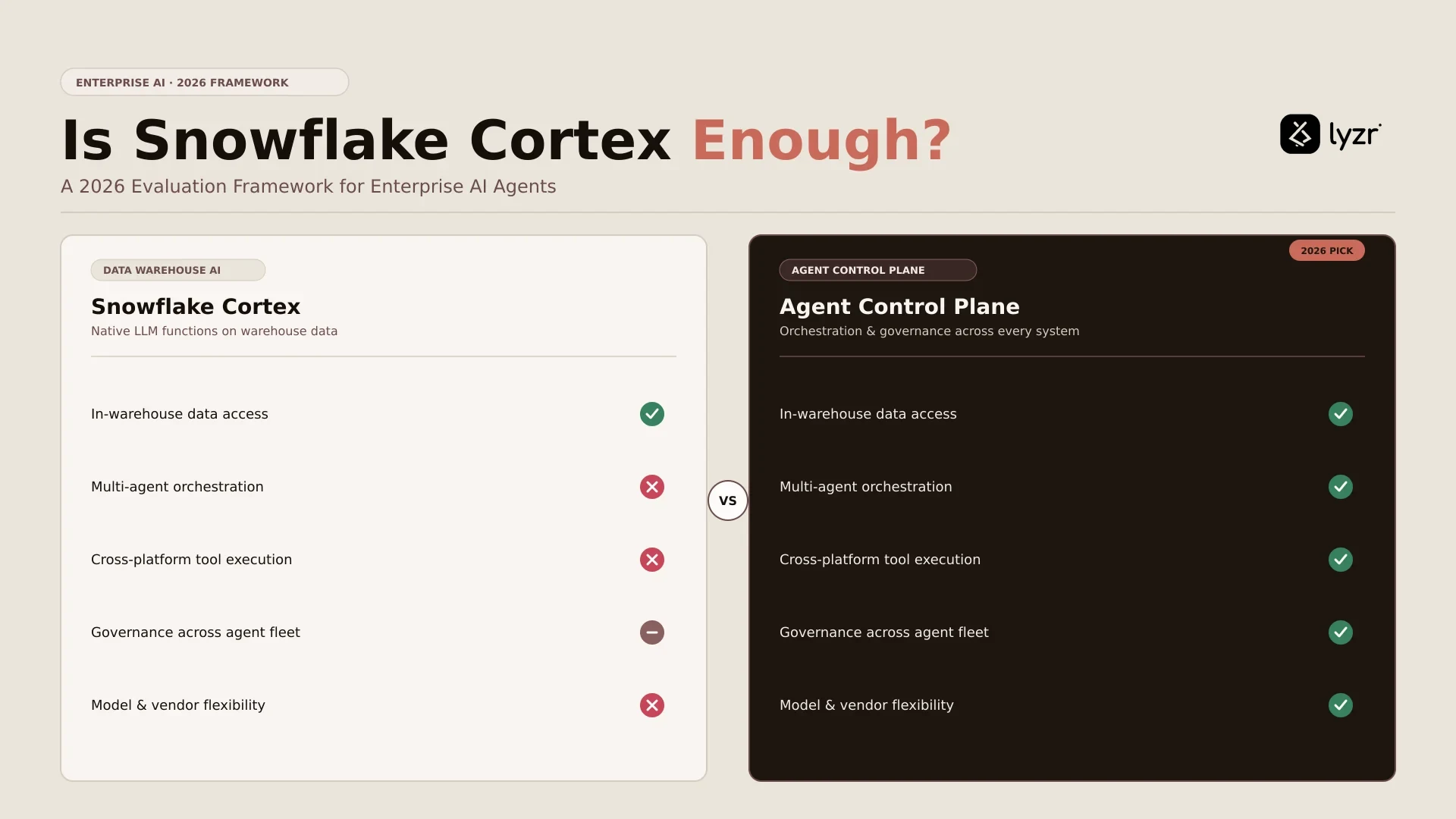
- Snowflake Cortex is excellent at what it was built for: bringing LLMs and search inside the data warehouse for analytics-style workloads.
- Snowflake’s own July 2026 launch of Cortex AI Gateway confirms the company sees agent governance as a gap it still needs to close, not a problem it solved.
- The real evaluation question isn’t “does Cortex have AI functions.” It’s whether your agents need to act across systems Snowflake doesn’t touch: Salesforce, SAP, Slack, internal APIs, other clouds.
- Five pillars separate a data-centric AI layer from an agent-native platform: orchestration and state, governance and observability, extensibility, developer experience, and cost architecture.
- Cortex pricing has shifted to a separate AI Credit meter as of April 2026, and costs can scale unpredictably once agents start chaining multiple tool calls per request.
- A dedicated control plane, like the Lyzr Agent Control Plane, exists specifically to govern agents across frameworks and clouds, not just inside one data platform.
You already know what Snowflake Cortex does.
You’ve run the SQL functions. You’ve built the semantic view. Maybe you’ve stood up a Cortex Agent that answers questions across a few tables.
And now you’re stuck on a harder question.
Is this the foundation you actually want under a fleet of production AI agents, three years from now, when the number of agents has gone from three to three hundred?
That question doesn’t have an obvious answer, and anyone telling you it does is selling something. What it has is a framework. Five pillars that separate “AI feature inside a data platform” from “infrastructure that can govern autonomous agents at enterprise scale.” Run Cortex through them honestly, and the gaps that matter to your specific situation will surface on their own.
The Real Choice Isn’t Cortex vs. No Cortex
Nobody rips Snowflake out of their stack over an agent strategy. That’s not the decision in front of you.
The decision is architectural: does AI orchestration live as a layer on top of your data warehouse, or does it live as independent infrastructure that treats your warehouse as one resource among many?
Snowflake’s own positioning answers this clearly for its own product.
Snowflake is betting on abstraction and governance by design, with an ideal customer being a business analyst who wants to activate AI without needing to understand vector databases or prompt chaining, where Cortex handles orchestration and AISQL hides the complexity.
That’s a legitimate, well-executed bet. It’s also a bet on a specific center of gravity: data, expressed as SQL and Snowpark functions.
An agent-native platform inverts that. The agent, not the query, is the primary unit. Data is something the agent reaches out to, alongside a CRM, a support inbox, a compliance database, and whatever internal API your engineering team stood up last quarter. The distinction sounds academic until you try to build a process that spans five systems and discover your data platform’s AI layer stops at the warehouse wall.
Snowflake Knows This Gap Exists Too
This isn’t a theory Lyzr invented to sell against Cortex. Snowflake said it out loud, in its own product roadmap, within the last two days.
On July 28, 2026, Snowflake introduced Cortex AI Gateway, and the reasoning behind it is worth sitting with.
As AI agents increasingly collaborate across enterprise data, apps, and platforms, they introduce unprecedented security and governance risks, while driving growing AI consumption across models and workloads, and traditional security architectures were not designed for this level of cross-system agent activity.
Read that again. Snowflake is describing the exact problem an agent-native control plane exists to solve, and building a gateway to address it four years into Cortex’s life as a product.
The gateway itself is instructive about where the gaps actually are.
Cortex AI Gateway is a centralized control layer that lets enterprises connect, govern and monitor artificial intelligence agents as they reach into models, tools, Model Context Protocol servers and internal systems.
Notably, it was built partly by acquisition.
Cortex AI Gateway builds on Snowflake’s acquisition of Natoma in May 2026, bringing Natoma’s enterprise MCP platform capabilities directly into the Snowflake platform for secure, enterprise-grade agent interoperability.
Snowflake also isn’t hiding that this is a cost problem, not just a security one.
AI is dynamic, agents can invoke multiple models, call different tools, and execute multi-step workflows, creating consumption patterns that can change from one task to the next, and a simple request that only requires retrieving a document could unintentionally be routed through a more expensive reasoning model or trigger additional searches across multiple systems. At scale, with thousands of employees and hundreds of agents, small inefficiencies become significant line items.
That’s the honest version of the pitch. A gateway bolted onto a data platform, retrofitting governance after the agent sprawl already happened. The alternative is a control plane built for that sprawl from day one.
Pillar 1: Orchestration and State, Not Just Function Calls
Cortex’s own engineering team has started to describe this shift plainly.
The first generation of enterprise AI focused on building agents, the next generation is about operating them at scale, and Cortex Agents have always provided a managed runtime for building AI applications inside Snowflake.
What changes at scale is the shape of the workload.
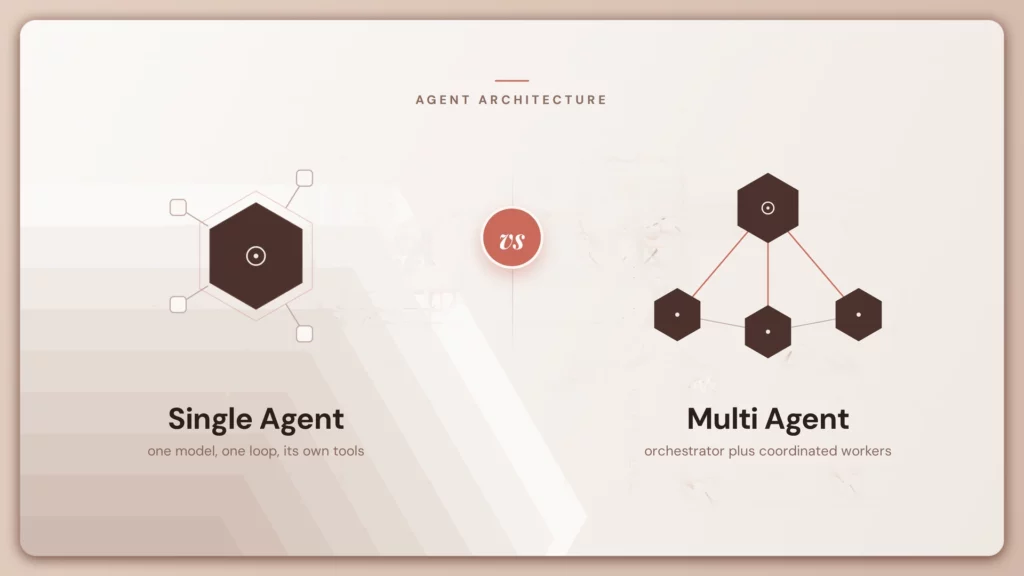
Most deployments start with a single agent, a handful of tools and short tasks, which works fine for a proof of concept, but enterprise production at scale looks different: workflows span multiple specialized agents, tool libraries grow to dozens of integrations, requests run for minutes rather than milliseconds, and governance teams need visibility into exactly what each agent is authorized to do.
That’s a precise description of why a single declarative agent definition, invoked through a REST call, stops being sufficient.
You define a Cortex Agent declaratively that includes its orchestration model, tools and instructions, and applications invoke it through a REST API while Snowflake handles model routing, tool invocation and result assembly.
That’s a clean pattern for a bounded task. It gets harder to reason about once ten agents need to hand work to each other, wait on a human approval, and pick back up hours later.
Evaluation question: does the platform treat a workflow as a request-response cycle, or does it support agents that persist, delegate, and resume across hours and days?
Pillar 2: Governance at the Agent Level, Not Just the Query Level
Cortex AI Gateway is Snowflake’s answer to this pillar, and it’s a real answer.
The gateway keeps an end-to-end record of agent activity, giving teams a single log of which agent did what, which tools and systems it reached and the order of steps it followed, and it also tracks token consumption across models, teams and workloads.
It also brings in identity partners.
Snowflake introduces the first wave of integrations with 1Password, Aembit, Linx Security, Okta, SailPoint, and Saviynt that help organizations consistently govern and audit agents across platforms.
Here’s the part worth reading carefully: Cortex AI Gateway governs agents that reach into Snowflake and a set of named third-party platforms.
Snowflake is unveiling Cortex AI Gateway, a major advancement that enables enterprises to securely control, orchestrate, and govern both first-party AI agents built within Snowflake, such as Snowflake CoWork and Snowflake CoCo, and third-party AI agents developed on external platforms such as Claude Code and Cursor.
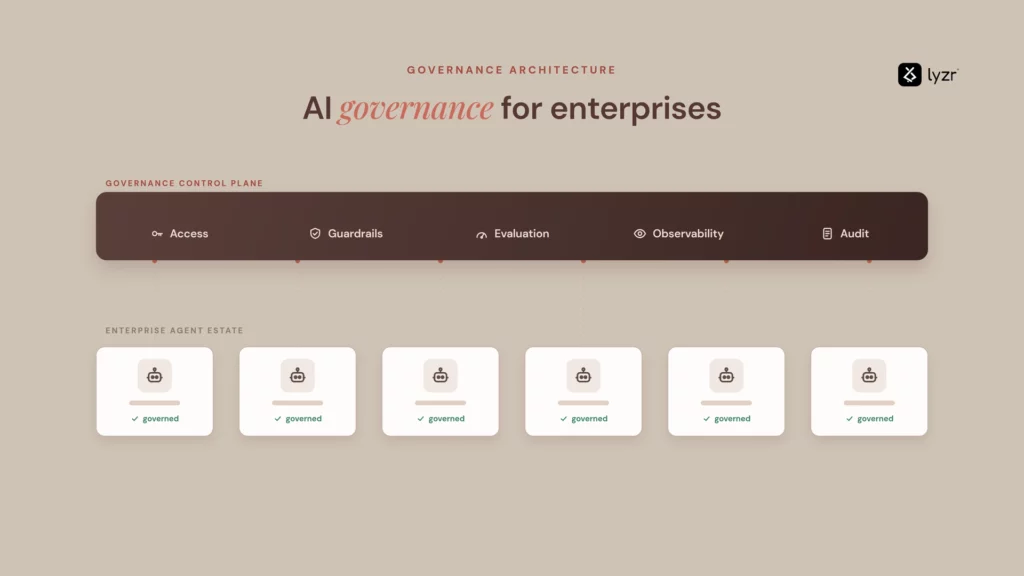
That’s still a governed perimeter, not a neutral one. The same question applies to coding agents built on frameworks like enterprise-grade governance for OpenClaw deployments, which sit entirely outside that named perimeter unless a platform is designed to govern any agent, regardless of who built it. Compare that to what an agent-native control plane treats as table stakes: governance for any agent, regardless of who built it, on any framework, in any cloud. The Lyzr Agent Control Plane frames this as five concrete controls applied uniformly.
Agent governance is not a policy document. It is five concrete control points, applied to every agent, regardless of who built it or where it runs: registry, identity, evaluation, staged promotion, and observability.
The registry piece alone exposes a question most enterprises can’t currently answer.
The registry answers the question most enterprises cannot answer: how many AI agents are running in your organisation right now, with the registry serving as the live source of truth.
The “evaluation” control point deserves its own scrutiny too. Continuous, independent scoring of agent outputs, delivered as an agent evaluation service, is a different capability than a dashboard showing token spend. It answers whether the agent’s decisions were actually correct, not just whether it ran.
If your agents live only in Snowflake, Cortex AI Gateway closes most of that gap. If your agents live in LangChain, CrewAI, an internal Python service, and a vendor tool, you need a layer that sits above all of them, not one that governs its own ecosystem plus a short list of named partners.
Pillar 3: Extensibility Across Systems Cortex Doesn’t Own
Cortex is genuinely strong within its own perimeter.
Cortex inherits Snowflake’s unified security model, roles, row-level policies, lineage, and audit logging, so every prompt, model, and result stays inside the same compliance envelope as your tables.
The friction shows up the moment a process needs to leave that envelope. Independent research on Snowflake’s own context layer makes the boundary explicit:
most enterprise data estates span 15 to 30 systems, and a Snowflake agent asking about “customer churn” needs context from Salesforce, dbt, and Looker, not just Snowflake schemas, a cross-system gap that enrichment inside the warehouse cannot close.
Databricks, Snowflake’s closest competitor in this exact conversation, made the opposite architectural bet, and it’s worth understanding why.
Databricks’ Mosaic AI Agent Framework is a production-grade platform for building, evaluating and managing AI agents at scale, and unlike Snowflake’s more managed approach, it is open, supporting custom models, custom memory and custom evaluators, paired with an AI Gateway that routes and rate-limits LLM calls across providers.
The tradeoff is exactly what you’d expect:
Cortex is ideal for organizations that want to apply Gen AI to their data immediately with minimal engineering overhead, as a low-code solution, though the trade-off is flexibility since you are generally limited to the models and fine-tuning options Snowflake provides.
Neither Cortex nor Mosaic AI, though, is a neutral integration hub built to sit above both of them plus your CRM, your ticketing system, and your homegrown APIs. That’s a different category of infrastructure entirely, one built to be the connective layer regardless of which cloud or framework an agent originated from.
Evaluation question: when your agent needs to touch a system outside the data platform’s owned ecosystem, does the platform make that a first-class capability or a workaround?
Pillar 4: Developer Experience That Doesn’t Lock You Into One Paradigm
SQL-first agent definition is comfortable for the teams who already live in Snowflake. It’s also a real constraint once you need agent logic that goes beyond routing and tool calls into genuine multi-step reasoning with custom evaluators.
This is where the “who builds it” question matters as much as the “who governs it” question. A platform that only knows how to run agents you declared inside its own syntax will always trail a platform that can accept an agent built in whatever framework a given team already knows, and layer standardized deployment, versioning, and rollback on top without demanding a rewrite.
A unified deployment layer standardises how AI agents move through the production lifecycle, supporting deployments across multiple frameworks and cloud infrastructures whilst providing centralised governance, with automated deployment workflows including integrated security validation, deployment versioning, evaluation checkpoints, and rollback capabilities.
Evaluation question: does adopting the platform mean rewriting your existing agents, or does it meet your teams where they already are?
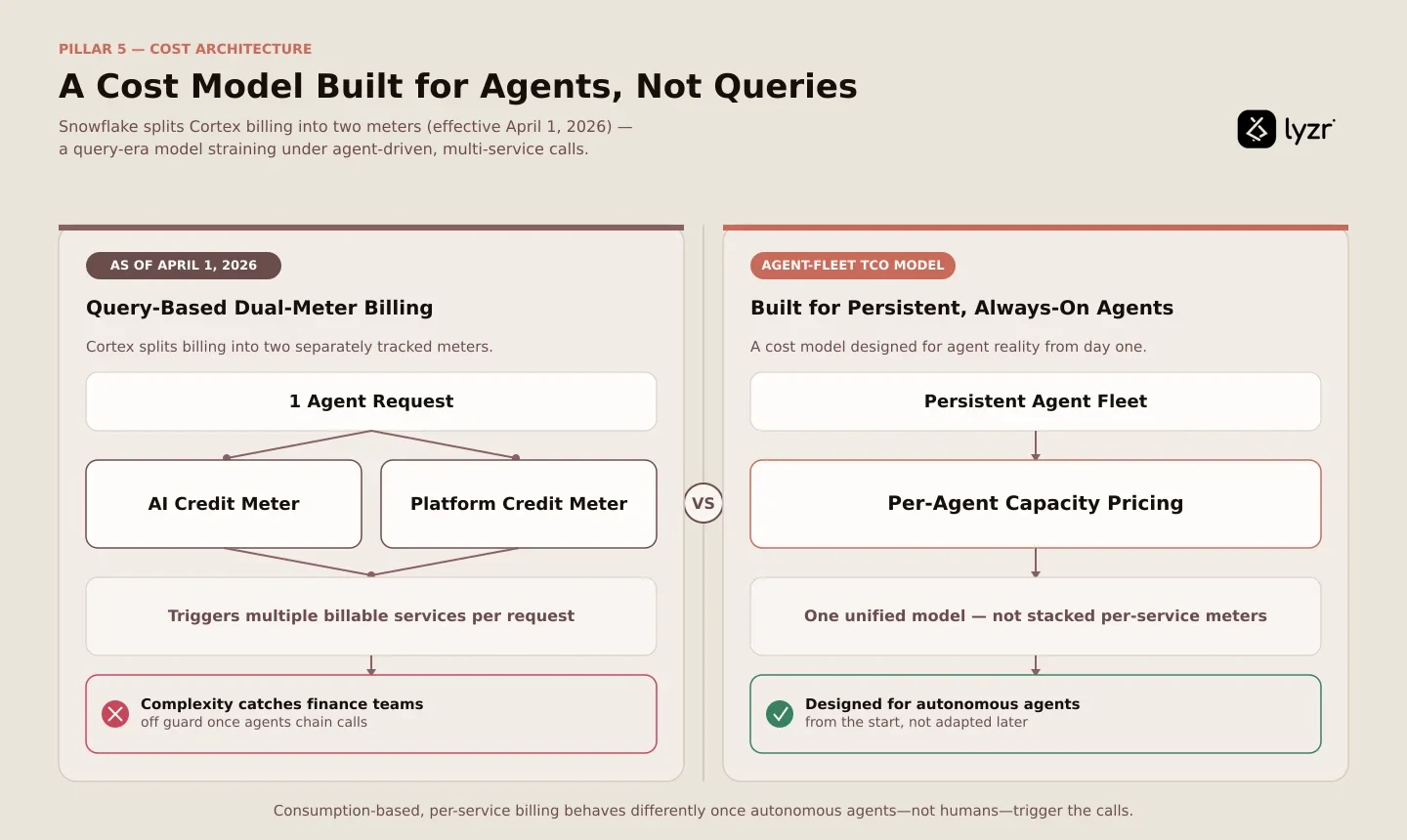
Pillar 5: A Cost Model Built for Agents, Not Queries
This is where the abstraction starts to cost real money, and it’s the pillar Snowflake itself is actively re-architecting right now.
As of April 1, 2026, Cortex split its billing into two meters.
Cortex bills most AI workloads, including Cortex Agents, Cortex Code, and Snowflake Intelligence, in AI Credits at a flat $2.00 per credit for global routing or $2.20 for regional routing, independent of your Snowflake edition, introduced as a separate billing currency decoupled from your Snowflake edition.
Meanwhile:
Cortex AI Functions, the SQL-callable layer like AI_COMPLETE and AI_EMBED, still bill in standard edition-priced Snowflake Credits, not the new AI Credit currency.
Two meters, tracked separately, is exactly the kind of complexity that catches finance teams off guard once agents start chaining calls. Independent cost analysis backs this up at production scale:
a company running Cortex across multiple product lines at heavy production volume lands directionally in the $18,000 to $22,000 a month range post-optimization, and warehouse compute and Cortex Search serving costs start to matter as much as the AI Credit line itself, with model selection, caching, and routing worth 60 to 70% of the Cortex bill.
Agent-driven workloads make this worse before it gets better, because one user request can trigger several billable services.
Since agents orchestrate multiple services, expect a multiplicative cost impact, where one agent request might trigger several underlying billed operations.
That’s not a criticism of Cortex’s pricing logic. It’s a description of what consumption-based, per-service billing does once autonomous agents, not humans, are the ones triggering the calls. A platform built around persistent, always-on agents needs a cost model designed for that reality from the start, not adapted onto it after the fact.
Where This Leaves the Evaluation
Cortex is a strong, fast-to-deploy choice if your AI ambitions stay inside the Snowflake perimeter: analyst-facing chat, SQL-grounded natural language querying, sentiment and classification functions on data that already lives in the warehouse. Snowflake’s July 2026 Cortex AI Gateway launch shows the company taking agent governance seriously, and that matters if your agents are genuinely Snowflake-native.
The moment your ambition shifts from “AI on our data” to “autonomous agents running our processes across CRM, ERP, support, and a dozen internal systems,” the evaluation criteria change. You’re no longer asking whether the data platform has good AI functions. You’re asking whether it can be the control plane for agents it didn’t build, on infrastructure it doesn’t own, at a cost model that scales with impact rather than call volume.
That’s a different product category. Lyzr’s take on enterprise AI infrastructure draws this line explicitly:
the orchestration and governance layer that sits above the agent platforms accepts agents from any framework, including Lyzr, LangChain, CrewAI, Salesforce Agentforce, and Microsoft Copilot, manages the journey from dev through UAT, pre-prod, and production, and provides cross-cloud high availability, identity, observability, and CI/CD for agents.
In practice:
most large enterprises end up with a hybrid model: pre-built agents for common use cases, low-code platforms for custom workflows, OSS frameworks for differentiated builds, and a control plane unifying them all.
The “pre-built agents for common use cases” piece is where teams typically start, drawing from a library of ready-made agent blueprints rather than building every workflow from scratch.
Run the five pillars against your own roadmap honestly. If every answer points back inside the Snowflake perimeter, Cortex plus its new gateway may genuinely be enough. If any answer requires reaching outside it, you’re evaluating infrastructure, not a feature.
Frequently Asked Questions
How much does Snowflake Cortex actually cost?
Cortex now runs on two separate billing meters.
AI Credits are flat priced at $2.00 per credit if you allow global routing (cross-region inference enabled) or $2.20 per credit if you pin requests to your home region for data residency, applying to Cortex Agents, Cortex Code, and Snowflake Intelligence.
Standard SQL-callable functions bill separately at your Snowflake edition’s credit rate, and warehouse compute charges still apply on top of both. At production scale, costs commonly land in the five-figure monthly range once multiple product lines and agent workloads are running.
What is Cortex AI Gateway?
Cortex AI Gateway is a centralized control layer that lets enterprises connect, govern and monitor artificial intelligence agents as they reach into models, tools, Model Context Protocol servers and internal systems.
It launched July 28, 2026, and governs both Snowflake-native agents and a defined set of third-party agent platforms.
What’s the difference between Snowflake Cortex and Databricks Mosaic AI?
The core difference is openness versus managed convenience.
Snowflake is betting on abstraction and governance by design, with Cortex handling orchestration and AISQL hiding the complexity, while Databricks’ Mosaic AI takes the opposite approach, supporting custom models, custom memory and custom evaluators.
Cortex favors speed to value inside the warehouse; Mosaic AI favors flexibility for teams building differentiated, engineering-heavy agent systems.
Can Snowflake Cortex agents work with systems outside Snowflake?
Only to a point. Cortex Agents can call external tools and, as of the July 2026 Cortex AI Gateway launch, can extend governance to named third-party platforms like Claude Code and Cursor. But:
most enterprise data estates span 15 to 30 systems, and an agent asking a cross-functional business question typically needs context from CRM, transformation logic, and BI tools that sit outside the warehouse
which is where a neutral, framework-agnostic orchestration layer becomes necessary.
What are the best alternatives to Snowflake Cortex for enterprise AI agents?
The right alternative depends on whether you need a competing data-and-AI platform (Databricks Mosaic AI, Google’s Gemini Enterprise Agent Platform) or a governance and orchestration layer that sits above whatever data platforms and agent frameworks you already use.
Gemini Enterprise Agent Platform, built as the successor to Vertex AI, unifies model selection, development, and deployment into a single scalable environment
for teams staying inside Google Cloud. For teams running agents across multiple clouds and frameworks, a dedicated control plane designed for that heterogeneity is the more direct fit.
Is Snowflake Cortex worth it for enterprise AI?
It depends entirely on where your agents need to operate.
Choose Cortex if your data already lives in Snowflake and you’re prioritizing governance, compliance, and operational efficiency, since Cortex is about operational control, not AI flash.
It’s a strong, defensible choice for warehouse-bound AI. It’s a narrower fit the moment your roadmap includes agents that need to plan, delegate, and act across the rest of your enterprise stack.
The Question to Actually Ask Your Team
Not “can Cortex do this,” because increasingly, the answer is some version of yes, with a new feature or a recent acquisition backing it up.
The question is: when we have two hundred agents running across twelve systems, will our data platform’s AI layer be the thing governing that fleet, or will we be building a second, unofficial control plane out of scripts and dashboards to compensate for what it can’t reach?
Snowflake is racing to close that gap, and Cortex AI Gateway is proof they see it clearly. Whether you wait for that race to finish, or build on infrastructure designed for agent governance from the ground up, is the actual decision in front of you. Evaluate honestly, run the five pillars against your own three-year roadmap, and let the answer come from where your agents actually need to go, not from where your data already sits.
Book A Demo: Click Here
Join our Slack: Click Here
Link to our GitHub: Click Here