Gartner expects the average Fortune 500 company to have more than 150,000 AI agents in use by 2028. In 2025, the figure was under 15. Salesforce’s Agentic Enterprise Index hints at why the curve is that steep: its customers now create an agent in 1.9 days on average.
So shipping one agent is a two-day job. Changing three hundred of them at once, because a model is being retired or a data rule just tightened, still means a ticket per agent in most stacks. That gap has a name: agent sprawl.
The best platforms for AI agent fleet management close it. They count every agent you run, show which ones are healthy, roll out new versions in stages, price each agent, and push one change to the whole fleet. Here are seven, scored on exactly those jobs.
The shortlist
- Lyzr OpenController: one inventory, budget and policy model for agents on any cloud or framework.
- Microsoft Agent 365: fleets that live inside Microsoft 365, Copilot Studio and Foundry.
- Google Gemini Enterprise Agent Platform: registry, gateway and drift monitoring on Google Cloud.
- Amazon Bedrock AgentCore + AWS Agent Registry: versioned, staged rollouts for engineering teams on AWS.
- Salesforce Agentforce: health dashboards for agents that work in CRM.
- ServiceNow AI Control Tower: a risk register and kill switch across connected platforms.
- CrewAI AMP: deploy and watch fleets of crews, on-prem if you need it.
Five agents fit in your head. Fifty don’t.
Five agents fit in one person’s memory. Salesforce’s index shows that stage passing quickly: across its customer cohort, the average business went from 5 activated agents in February 2025 to 13 by April 2026.
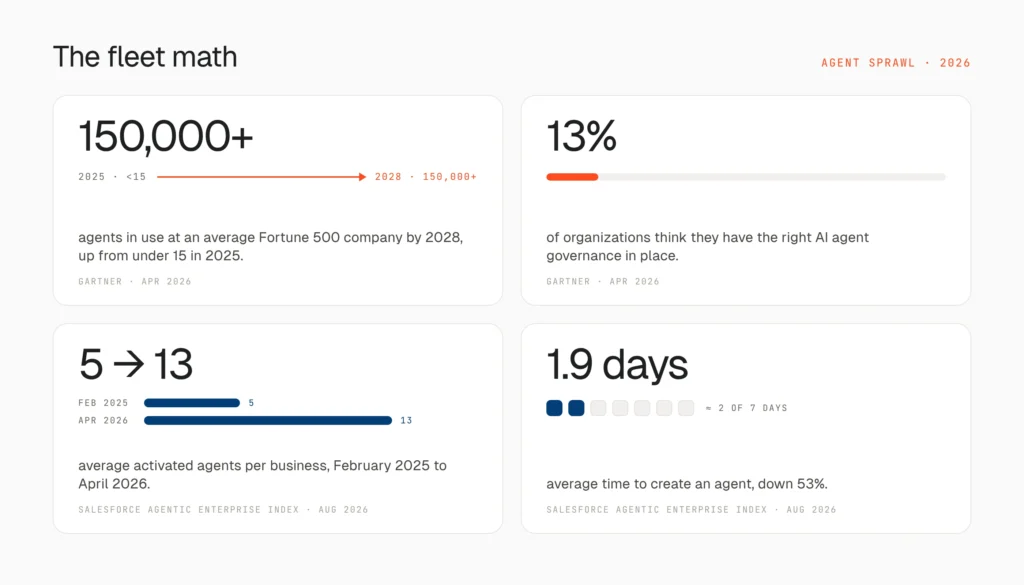
Governance hasn’t kept pace. In the same Gartner release, only 13% of organizations said they have the right AI agent governance in place. Its six-step fix includes a centralized agent inventory and retiring redundant agents: fleet work by definition.
A fleet’s problems arrive all at once. A model retirement or a new PII rule touches every agent at the same moment. If each fix takes one engineer an hour, a 300-agent fleet costs 300 hours, close to two months of one person’s time, for a single change (our arithmetic, not a survey figure).
What a fleet dashboard has to show
Every product here is trying to fill the same five gauges.
- Count: every agent, including the ones this platform didn’t build.
- Health: errors, latency, escalations and quality drift, per agent and rolled up.
- Version: which release runs where, with canaries and one-step rollback.
- Spend: dollars by agent and team, with caps that actually stop spending.
- Reach: one policy or model change that lands on every agent at once.
The first four are table stakes. The fifth is where demos go quiet, and it decides whether you’re running a fleet or babysitting three hundred individuals.
The 7 best platforms for AI agent fleet management
1. Lyzr OpenController
OpenController runs agents like a logistics firm runs trucks: every vehicle registered, every trip through one depot. It sits between agents and the models, tools and APIs they call, so a rule or a model route changed once applies to every agent behind it.
The product page’s sample scan reads like a census. Read-only discovery across AWS, Azure, Google Cloud, Kubernetes and 212 developer laptops turns up 1,284 agents, 145 of them unregistered. Releases pass eval gates, so a version that misses its groundedness threshold never reaches staging, while production runs v14 at 90% beside a 10% canary of v15.1, with one-step rollback. Spend is tracked by agent, version and team, with budgets and model fallback in the LLM gateway.
It deploys in your VPC, on-prem or air-gapped, with adapters for Bedrock AgentCore, Gemini Enterprise Agent Platform and Microsoft Foundry. The honest limit: fleet-wide changes reach agents whose traffic runs through its gateways. A merely registered agent is visible, not steerable.
Good fit when your fleet already spans more than one cloud, framework or vendor, or data residency rules out a SaaS control plane. Think twice when you run a few dozen agents on one platform whose native console covers you.
The Enterprise Agent Estate Is the Next Infrastructure Decision: Why the agents you run deserve the same planning as your cloud and network, and what to settle before the count reaches the thousands. Read the whitepaper →
2. Microsoft Agent 365

Generally available since May 1, 2026, Agent 365 keeps one registry for Microsoft 365 Copilot, Teams, Copilot Studio and Foundry agents, plus partner agents from vendors such as Zendesk, n8n and Kore.ai. Defender and Intune discover local agents, starting with OpenClaw, with coding agents listed as next. Entra network controls restrict agents to approved destinations, and admins can block an agent for the whole organization from the registry. It costs $15 per user per month, or comes with Microsoft 365 E7.
- Good fit when your fleet and your people already live in Microsoft 365.
- Watch for: at launch, registry sync for AWS Bedrock and Google Cloud was in public preview, with lifecycle actions such as start, stop and delete listed as coming soon. Per-agent cost tracking wasn’t part of GA. See Lyzr vs Microsoft Copilot.
3. Google Gemini Enterprise Agent Platform

At Next ’26, Sundar Pichai framed the enterprise question as “How do we manage thousands of them?” Google’s answer replaced Vertex AI with this platform, and by July Agent Registry, Agent Gateway, Agent Identity and Agent Observability were available to everyone.
For fleets, three pieces stand out. Agent Identity binds access to the runtime and manages the identity lifecycle so dormant credentials disappear. Agent Gateway applies IAM conditions and natural-language rules to every interaction across the estate. Agent Evaluation runs online monitors that flag degradation and behavioral drift in production, the strongest drift story on this list.
- Good fit when your agents run on Google Cloud and quality drift is the top worry.
- Watch for: the registry is built around agents on the platform and from Google’s partner ecosystem. Per-agent budgets aren’t part of the published feature set.
4. Amazon Bedrock AgentCore + AWS Agent Registry
AWS wins the version gauge. Every AgentCore Runtime update creates an immutable version, and endpoints point each environment at the version you choose. AWS’s Agentic AI Lens recommends starting new versions at 5 to 10% of traffic, with automated promotion gates and rollback within five minutes. AWS Agent Registry, generally available since August 31, 2026, adds a catalog with approval workflows, CloudTrail audit and cross-account sharing. Records take tags for cost allocation, and everything provisions through CloudFormation, Terraform or the CDK.
- Good fit when engineers build custom agents on AWS and want everything as code.
- Watch for: rollouts are per runtime, so a fleet-wide model swap is something you script. Registry auto-detection covers AgentCore Runtime and Gateway; other agents are added as manual or URL-based records.
5. Salesforce Agentforce
Salesforce reads fleet health through a business lens. Agentforce Observability, formerly Command Center, puts latency, escalation frequency, error rates and real-time alerts for every agent on one dashboard. MuleSoft Agent Scanners, generally available since January 2026, find agents on Bedrock, Vertex AI and Copilot Studio, logging their models and data access. On September 10, 2026, Salesforce announced an AI Control Plane promising identity, policy, lifecycle and cost control across its own and third-party AI.
- Good fit when most of your agents act on CRM data under Salesforce permissions.
- Watch for: Salesforce says the control plane’s new capabilities begin rolling out in early fiscal 2028, which starts February 2027. Until then, non-Salesforce agents are found, not run. See Lyzr vs Agentforce.
6. ServiceNow AI Control Tower
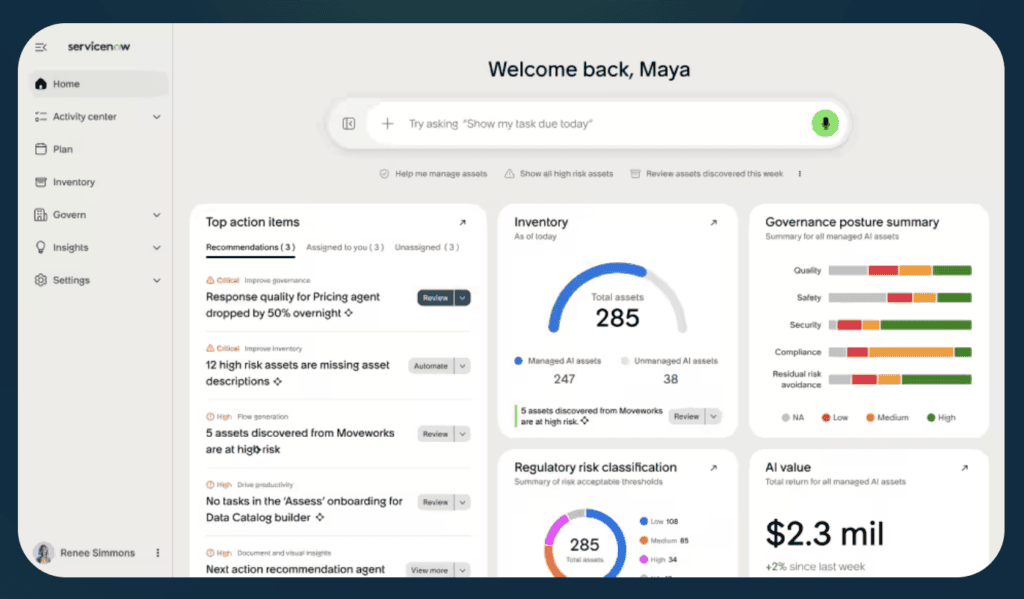
ServiceNow treats agents like any other IT asset. Its Knowledge 2026 expansion added 30 new connectors, including AWS, Azure, Google Cloud, SAP, Oracle and Workday, so Control Tower can discover, observe, govern, secure and measure agents it didn’t build. Cost and ROI dashboards handle the measuring. A kill switch can deactivate an agent on Bedrock, AgentCore, Foundry or Gemini Enterprise Agent Platform and later reinstate it. General availability was slated for August 2026.
- Good fit when change, risk and approvals already run through ServiceNow.
- Watch for: it governs what agents are and what they may do. It doesn’t ship them, so versions and rollouts still live in each builder’s pipeline.
7. CrewAI AMP
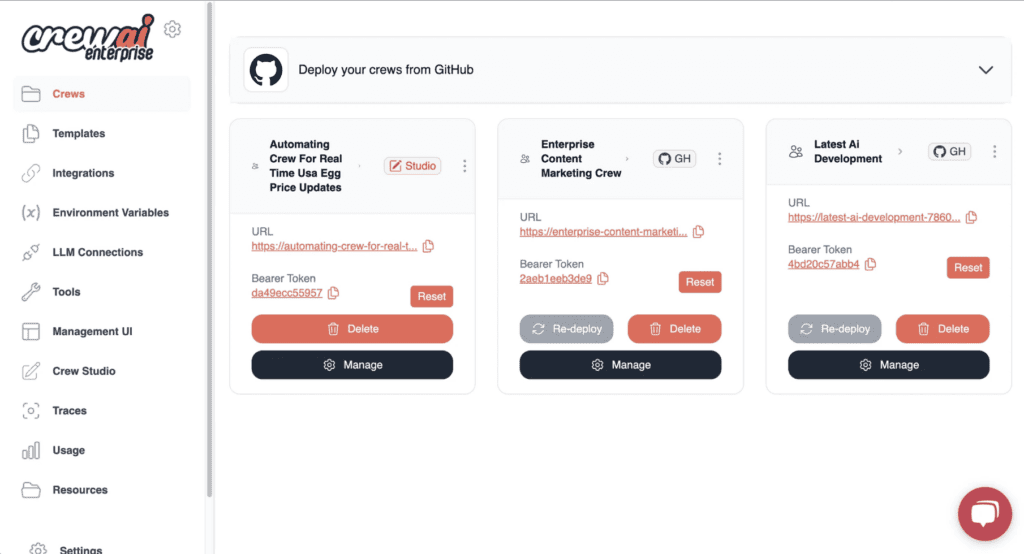
CrewAI’s Agent Management Platform handles production for its open-source framework: deploy crews from GitHub, the CLI or Crew Studio, call them by REST API, and trace each run with logs. Traces carry cost accounting, and the Enterprise plan adds role-based access control and deployment on CrewAI’s cloud, your VPC or your own infrastructure. CrewAI reports one Fortune 500 customer spun up nearly 500,000 agents and ran more than 100,000 executions in about 15 days.
- Good fit when your engineering teams have standardized on CrewAI.
- Watch for: it manages what’s built in CrewAI, not the rest of the fleet. The product was briefly called AOP (Agent Operations Platform) in late 2025, so check which name your contract uses. See Lyzr vs CrewAI.
Seven fleet platforms, five gauges
| Platform | Count: sees agents it didn’t build | Health: errors and drift across the fleet | Version: staged rollout and rollback | Spend: per agent, with caps | Reach: one change, every agent | Runs inside your network |
| Lyzr OpenController | ✓ | ✓ | ✓ | ✓ | ◐ gateway-routed agents | ✓ VPC, on-prem, air-gapped |
| Microsoft Agent 365 | ✓ | ◐ | ✗ | ✗ | ◐ | ✗ |
| Google Gemini Enterprise Agent Platform | ◐ | ✓ | ◐ | ✗ | ✓ | ◐ your Google Cloud project |
| Amazon Bedrock AgentCore + Agent Registry | ◐ | ◐ | ✓ | ◐ | ◐ | ◐ your AWS account |
| Salesforce Agentforce | ◐ | ✓ | ◐ | ◐ | ◐ | ✗ |
| ServiceNow AI Control Tower | ✓ | ◐ | ✗ | ◐ | ◐ | ✗ |
| CrewAI AMP | ✗ | ◐ | ◐ | ◐ | ◐ | ✓ Enterprise plan |
✓ built in and generally available · ◐ partial, in preview, announced, or limited to the vendor’s own agents · ✗ not in the public documentation we reviewed. Editorial assessment, October 2026. Confirm current features with each vendor.
Manage the road, not the garage
Our opinion: every native console above is a garage, excellent at maintaining the vehicles it built and getting better at spotting ones parked elsewhere. Microsoft’s cross-cloud sync and Salesforce’s Agent Scanners exist because even the suite vendors know your fleet doesn’t sleep in one place.
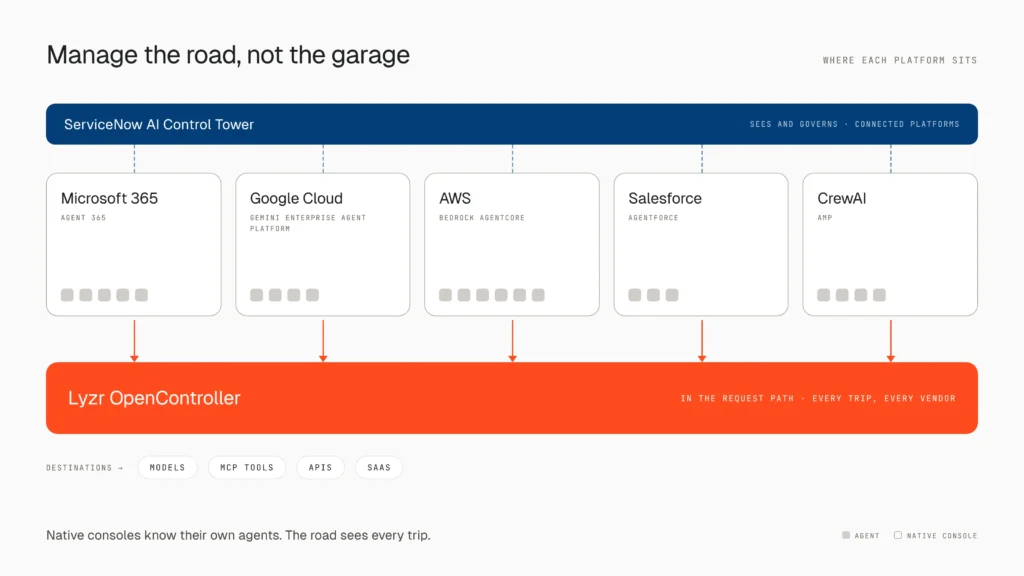
But fleets are managed on the road, where every trip passes the same checkpoints: a layer in the request path, owned by you, that doesn’t care who built the agent. Keep the native consoles for depth inside their own worlds. Put one neutral layer on the road for the fleet.
Run the model-swap drill before you sign
Demos run on tidy sample fleets. Test the day that hurts most instead: a model your agents depend on is being retired.
- Count: ask the platform how many agents call the retiring model. Time the answer.
- Canary: move 10% of them to the replacement.
- Compare: check errors, escalations and cost per run, old model versus new.
- Undo: roll one agent back in a single step.
- Finish: move the rest, and count how many needed a code change.
If step 1 needs a spreadsheet, you have your answer.
AI Agent Sprawl Audit: Find out how many agents you’re really running, how many lack an owner, and where your fleet’s blind spots are. Take the audit →
The number to track next quarter
Most AI scorecards count agents shipped. For a fleet, a better number is how long it takes to change every agent you have. When that figure drops from weeks to an afternoon, 150,000 agents stops sounding like a threat.
Book a demo and we’ll run the model-swap drill on your own agents in OpenController.
Book A Demo: Click Here
Join our Slack: Click Here
Link to our GitHub: Click Here
Got a use case in mind?
8 weeks from use case to agents running in production.
Platform, people and FDEs, all in. Bring your environment. We'll co-build and stay until it's live.
Talk to UsFree resource
101 AI Agents Use Cases
100+ production-ready AI agent use cases across Marketing, Sales, HR, Banking, Insurance, Operations and a lot more
Download now