

TL;DR
- Enterprise governance and control plane: OpenController, covering identity, policy, evaluation gates and lifecycle. It isn’t a prompt scanner or sandbox.
- Prompt and response inspection: Google Cloud Model Armor, for injection, jailbreaks, malicious URLs and sensitive data.
- Broad enterprise AI security: Prisma AIRS, spanning runtime, red teaming and agent security.
- Execution isolation: NVIDIA’s Open Agent Safety Platform with OpenShell, which enforces policy outside the agent.
- Open-source runtime governance: Microsoft’s Agent Governance Toolkit.
- Testing before release: Promptfoo, garak and PyRIT.
An agent in production receives a hidden instruction inside a retrieved document, calls a connected business tool and tries to send sensitive data somewhere it shouldn’t. The model’s text answer may look perfectly safe. The action isn’t.
That is why prompt-level safeguards alone fall short once an agent can use APIs, MCP servers and internal systems across multi-step workflows. The question is whether the agent stayed within its authorised boundaries through the whole execution. Protection has to be layered, and the tools below cover different parts of the problem. This guide compares the best tools for AI agent safety in production and explains where Opencontroller fits.
What is AI agent safety in production?
AI agent safety in production is keeping deployed agents within intended behavioural, access, data and operational boundaries while they complete useful work. Related terms overlap but differ:
- Safety: does the agent behave within acceptable boundaries?
- Security: does the system resist attacks, unauthorised access and data exposure?
- Governance: how are identity, policy, permissions, accountability and lifecycle decisions managed?
- Runtime protection: how is risky behaviour detected, constrained or blocked while the agent operates?
The five layers of AI agent safety
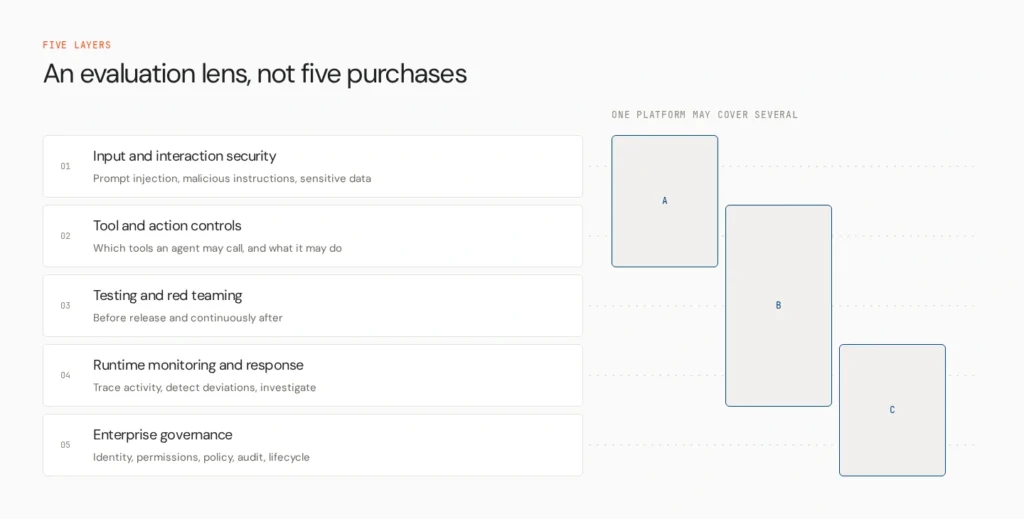
- Input and interaction security. Detect prompt injection, malicious instructions and sensitive data. A prompt-security gateway might catch a malicious instruction.
- Tool and action controls. Restrict which tools an agent can call and what it may do. A runtime policy layer can stop an unauthorised tool call.
- Testing and red teaming. Find vulnerabilities before release and during continuous testing.
- Runtime monitoring and response. Trace activity, detect deviations and investigate incidents. See AI agent observability.
- Enterprise governance. Apply identity, permissions, policy, audit trails and lifecycle control across the agent estate.
One platform may cover several layers, and no organisation needs five vendors. These layers are an evaluation lens, not rigid product categories.
How we compared them
We assessed coverage of agent-specific risks, ability to test, detect, constrain or block, visibility into execution, integration, deployment flexibility and auditability, using official documentation and credible technical sources. We treated announced features, open-source projects and generally available products differently, and note where capabilities are in preview.
The tools
1. Opencontroller by Lyzr

Opencontroller is an AI control plane for enterprises that need to discover, govern, monitor and control agents across frameworks and environments. It isn’t a prompt filter, scanner or standalone moderation API. Its value is the operational context around agents: which agents exist, who owns them, what they can access, which policies apply, which version is running and how activity can be investigated.
Lyzr positions it around an agent registry, identity, evaluation gates, staged promotion, runtime policy and observability, with immutable versions that make rollback a pointer change. That matters when agents are built on different frameworks and run in different environments, since specialised tools protect individual paths while governance applies consistent control across the estate.
- Strengths: a single view of agents, identity and policy, evaluation gates before promotion, audit trail
- Limits: it doesn’t replace prompt scanners, red-teaming tools or sandboxes, and a single-agent team may not need it
Best for: enterprises running many agents that need identity, policy and lifecycle control. See AI agent governance and the AI control plane.
2. Prisma AIRS

Palo Alto Networks describes Prisma AIRS as a platform protecting AI applications, models, data and agents, with an AI runtime firewall, an AI runtime API, model security, automated AI red teaming and posture management. Its agent security covers verifying agent identity and enforcing real-time controls against unauthorised actions, and red teaming extends to multi-turn and multi-agent testing.
- Strengths: broad coverage from testing to runtime, fits existing Palo Alto estates
- Limits: a large platform to adopt, and agent governance across non-Palo Alto tooling takes integration
Best for: security teams wanting AI protection inside an established security stack.
3. Google Cloud Model Armor
Model Armor screens prompts and responses for prompt injection, jailbreaks, malicious URLs, harmful content and sensitive data, and can sanitise MCP tool calls and responses through floor settings. When a violation is detected, it blocks the prompt or response and can send a finding to Security Command Center.
- Strengths: inline enforcement, configurable confidence levels, MCP coverage (in preview)
- Limits: inspects interactions, not an agent’s identity or lifecycle, and strongest on Google Cloud
Best for: teams on Google Cloud securing prompts, responses and MCP traffic.
4. NVIDIA Open Agent Safety Platform and OpenShell

Launched in September 2026, the platform pairs OpenShell, an Apache 2.0 runtime that runs agents in kernel-level sandboxes under declarative policy, with Sentry, a hardware-backed monitoring design on BlueField-4 DPUs. A supervisor outside each sandbox checks outbound requests against YAML policy compiled to OPA/Rego, and credentials never enter the sandbox. Sentry isn’t open source.
- Strengths: enforcement outside the agent’s reach, least-privilege sandboxes, audit trail
- Limits: infrastructure to run, a new project, and the hardware layer needs specific DPUs
Best for: teams that need strict containment of autonomous agents. This isolates execution and doesn’t inspect prompts.
5. Microsoft Agent Governance Toolkit
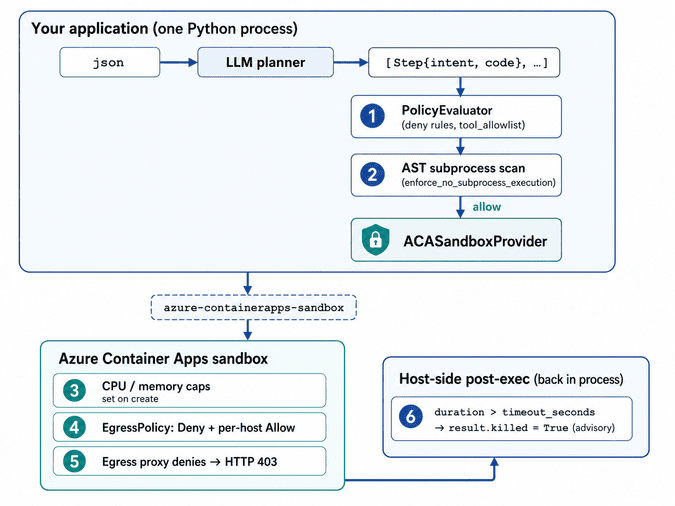
Released in April 2026 under the MIT licence and in public preview, the toolkit evaluates agent actions against policy before they execute. It supports YAML, OPA Rego and Cedar, adds privilege rings, circuit breakers and a kill switch, and integrates with frameworks such as LangGraph and the OpenAI Agents SDK. Its documentation recommends separate containers for OS-level isolation.
- Strengths: deterministic policy, open source, framework adapters
- Limits: a library you integrate and operate, and policy languages take learning
Best for: engineering teams building runtime policy into agents.
6. NVIDIA NeMo Guardrails

NeMo Guardrails provides programmable rails that constrain LLM and agent interactions inside the application. It is application-level control, unlike enforcement outside the agent process.
- Strengths: configurable conversational policy, open source
- Limits: lives within the agent’s own process, learning curve
Best for: developers shaping conversation and action flows.
7. Promptfoo, garak and PyRIT

These open-source tools test AI systems for vulnerabilities before release and in continuous workflows. Testing complements runtime enforcement and doesn’t replace it.
- Strengths: find weaknesses early, CI-friendly
- Limits: they don’t enforce anything in production
Best for: teams red teaming before deployment.
Also considered: Zenity, Prompt Security, NeuralTrust, Sweet Security and Rein Security cover agent discovery, interaction security or runtime monitoring. We didn’t include full entries because their current capabilities need confirmation.
Side-by-side comparison
| Tool | Primary safety focus | Main layer | Approach | Best for |
|---|---|---|---|---|
| OpenController | Identity, policy, lifecycle governance | Enterprise governance | Control plane across agents | Governing agent estates |
| Prisma AIRS | Runtime, red teaming, posture | Interaction, testing, runtime | Platform, firewall and API | Security teams on Palo Alto |
| Google Cloud Model Armor | Prompt and response screening | Interaction security | Cloud service, inline | Google Cloud users |
| NVIDIA Open Agent Safety Platform | Isolated execution, policy enforcement | Tool and action controls | Open runtime plus hardware design | Strict containment |
| Microsoft Agent Governance Toolkit | Runtime policy for agent actions | Tool and action controls | Open-source library | Developer-led enforcement |
| NeMo Guardrails | Programmable guardrails | Interaction security | Open-source framework | Conversational constraints |
| Promptfoo, garak, PyRIT | Vulnerability testing | Testing | Open-source tools | Pre-release red teaming |
What these tools protect against
| Risk | Control needed | Example tool type |
|---|---|---|
| Prompt injection | Input inspection | Model Armor, Prisma AIRS |
| Unauthorised tool calls | Action policy, sandbox | OpenShell, Agent Governance Toolkit |
| Excessive permissions | Identity and least privilege | Control plane, sandbox |
| Data exposure | Data screening, credential isolation | Model Armor, OpenShell |
| Unsafe multi-step behaviour | Testing and runtime limits | Promptfoo, circuit breakers |
| Missing audit and consistent policy | Registry, identity, audit | OpenController |
A support agent may retrieve an order but shouldn’t issue a refund above its approval limit. A document agent may read one repository without reaching unrelated confidential files. No single tool prevents every risk listed.
Safety, security and governance together
A prompt filter may flag a malicious instruction. A tool-level policy may block an unauthorised action. A control plane maintains visibility, identity and policy across the estate. They complement each other.
How to choose
Match tools to your main risk: malicious input, data exposure, unsafe tool use or excessive autonomy. Decide whether protection is needed in testing, in live execution or both, and whether you run one agent or a fleet. Check fit with IAM, cloud security, logging and incident response. Typical combinations include red teaming plus runtime guardrails, or execution isolation plus strict tool permissions, with centralised identity and lifecycle governance added at enterprise scale. The best choice follows your architecture and risk, not the longest feature list.
Where Opencontroller fits
A prompt-security tool inspects interactions. A red-teaming tool finds weaknesses. A runtime tool detects or constrains execution. An observability platform shows what happened.
Opencontroller connects agent identity, policy, runtime visibility and lifecycle governance across all of them.
Individual safeguards protect particular paths, while governance applies consistent control across the agents you operate. For rollout, see the Agents to Production playbook.
Layer your controls
Production safety needs complementary controls: test for vulnerabilities, constrain access and actions, monitor execution and govern the agents running across business systems. OpenController is the control-plane option for organisations needing broader visibility and governance. Read Lyzr’s guide to taking agents to production, or book a demo to see how the control plane could fit your architecture.
FAQs
It depends on the layer: Model Armor or Prisma AIRS for interaction security, OpenShell or the Agent Governance Toolkit for action control, Promptfoo for testing and OpenController for governance.
Limit its tools and permissions, enforce policy outside the model, inspect inputs and outputs, test before release, monitor execution and keep audit trails and rollback.
Screen inputs and retrieved content, keep untrusted data away from system instructions and limit what a hijacked agent can do through least-privilege tool access.
Enforce allow and deny policies on every action, outside the agent, with scoped credentials and approval for high-risk actions.
Security protects systems and data from threats. Governance manages identity, policy, approvals, audit and lifecycle.
Often, with ownership. OpenShell and the Agent Governance Toolkit are open source, though newer projects need evaluation and operational support.
No. They add agent-specific controls alongside IAM, cloud security, logging and incident response.
It provides identity, policy, evaluation gates, visibility and lifecycle control across agents, so specialised safeguards apply consistently.
Book A Demo: Click Here
Join our Slack: Click Here
Link to our GitHub: Click Here


